Colorado auditor finds serious issues with labor agency’s unemployment insurance accounting
Colorado’s state auditors found serious issues with the accounting practices of the unemployment insurance division of the Department of Labor and Employment, concluding the agency underestimated and overestimated figures to the tune of billions of dollars.
The auditors labeled the problems with its most serious concern — a “material weakness,” an indication of a significant flaw in financial reporting. That could create the possibility of a “material misstatement in the financial statements — one that auditors, regulators, and management can’t overlook.”
The auditors found errors that required accounting adjustments, such as an overestimate in payments owed to claimants to the tune of $1.5 billion, when it should have been only around $86 million.
The agency underestimated bad debt expenses by almost $800 million, understated its revenue by $1.6 billion, understated its expenses by $2.5 billion, and overstated deferred revenue by $75.5 million, the auditors found.
The bottom line, according to the audit, is that the net impact of the over- and understated areas amounted to $781.2 million.
The Colorado Department of Labor and Employment corrected the errors when notified by the auditors.
The auditors put the blame on the errors on the department’s failure to follow its own documented policies and procedures when it calculated and recorded its estimated payables and receivables for unemployment insurance.
Department staffers changed their methodology but didn’t update policies or evaluate whether those changes were appropriate, the audit said.
The auditors that matters because inaccurate information in the unemployment insurance financial statements could impact the ability of public officials, including state lawmakers, to make informed decisions about budgets and public services.
The state department agreed with the audit’s findings and said it would have fixes in place by June 2026.
The department also failed to implement prior audit recommendations on information technology, such as holding IT service organizations accountable for internal controls, which the auditors also labeled as a separate material weakness.
Another material weakness was tied to audit recommendations from 2023 and 2024 that have still not been implemented, according to the audit.
That included a failure to complete a review that would determine whether to write-off about $80 million in unemployment receivables, such as overpayments that were due to be paid back, from previous years. The audit said the department should determine if the amount represents what’s owed to the labor department and collect it — or write-it off and adjust it in the state’s accounting system.
The audit — part of its review of fiscal year 2025 — said that the department continues to lack sufficient internal controls over its financial accounting processes, including its year-end closing for fiscal year 2025.
The auditors recommended that accounting staff at the department follow current agency policies for its accounting processes.
While the department agreed with some of the recommendations, it said it will take until August 2027 to complete those changes.
The department disagreed with the recommendation on the write-off balance, stating it had identified the problem back in 2023 and that the absence of a write-off was to “ensure data integrity and respect the work of the previous administrations.”
Representatives from the labor department told the audit committee Wednesday that clearing those debts, which are old, would require a “six-year look-back” that would go from 2014 to 2020.
“We have a plan and we are on it,” the department’s staff said.
Unemployment Insurance wasn’t the only department program under the microscope.
The audit found more material weakness issues in the FAMLI leave program’s handling of information security, but the three specific problems were marked as confidential. The department agreed to have those problems resolved by July 2027.
Another FAMLI problem was in its internal controls, including a lack of a process on employer overpayments, and policies and procedures that would ensure FAMLI and department staff are communicating regularly on financial impacts to the program.
The audit, because it covered the state’s 2025 closing of the fiscal year books, also found material weaknesses in the Department of Health Care Policy and Financing; at Metropolitan State University of Denver; in the community block grant program at the Department of Local Affairs, tied to required reports the auditors indicated were not sent to the federal government; the Department of Public Safety’s disaster grant program; the Department of Public Health and Environment’s compliance with immunization agreements; and a lack of compliance by the Department of Transportation on reporting on a federal highway safety program.
Departments largely agreed with the audit recommendations and provided timelines for when those audit recommendations would be implemented.
Each fall, the auditor releases a report that summarizes the status of recommendations made during the previous five years.
That report, the auditor said, helps legislative oversight committees hold agencies accountable for their use of public resources.
Of the 1,385 recommendations made between July 2018 through June 2023, 110 have still not been implemented, according to the fall 2025 report. Of those 110 recommendations, 32 were considered higher priority because they were serious or not implemented in the previous three years.


Department of Agriculture warns of packages holding potentially invasive seeds
Michael Braithwaite
michael.braithwaite@gazette.com
Updated 5 hours ago
Spring planting is around the corner, and the Colorado Department of Agriculture wants residents to know where their seeds are coming from. Officials with the department warned Tuesday that they received reports of unsolicited packages containing plant seeds mailed internationally...

U.S. energy secretary warns Colorado’s energy policies could drive up prices, deter businesses
Scott Weiser
scott.weiser@gazette.com
Updated 3 hours ago
U.S. Energy Secretary Chris Wright on Monday warned that Colorado’s energy policies could lead to higher electricity prices and deter businesses, such as data centers, from locating in the state. Wright, a former executive of a Colorado-based energy company tapped...
Split vote by Colorado Title Board stops ballot push to privatize Pinnacol Assurance
Marianne Goodland
marianne.goodland@coloradopolitics.com
Updated 1 day ago
The Colorado Title Board, a three-member panel that sets the language for ballot measures, recently reversed a prior decision and blocked a proposal to privatize Pinnacol Assurance from moving forward. The main issue decided by the title board is whether...

Trump appoints Erika Kirk to Air Force Academy board
Mary Shinn
mary-shinn@coloradopolitics.com
Updated 2 hours ago
President Donald Trump has appointed Erika Kirk, the widow of conservative activist Charlie Kirk, to fill a seat on the Air Force Academy’s Board of Visitors. Charlie Kirk, the founder of conservative group Turning Point USA, was a member of...

Colorado Senate panel OKs bill named for Boulder teen cyclist killed in 2023 crash
Marissa Ventrelli
marissa.ventrelli@coloradopolitics.com
Updated 1 day ago
The Senate Judiciary Committee on Monday gave unanimous approval to a bill that would require law enforcement officers responding to crashes resulting in serious injury or death to offer drivers a voluntary breathalyzer test. Sponsors hope the measure would provide...

Fort Carson-based soldier killed in Iranian attack
Mary Shinn
mary-shinn@coloradopolitics.com
Updated 1 day ago
A Fort Carson-based soldier is among the U.S. service members killed in an attack by Iran during Operation Epic Fury, according to a Department of Defense news release. Sgt. Benjamin N. Pennington, 26, died Sunday of injuries sustained during an...
Colorado open records bill dies in Senate committee
Marianne Goodland
marianne.goodland@coloradopolitics.com
Updated 1 day ago
Efforts to overhaul Colorado’s open records law stalled anew. A proposal that would have extended response times for public records requests and added accountability measures for late responses failed to advance out of its first committee and will not move...
Colorado joins multi-state call to keep ICE away from polling locations
Jacob Mauk
jacob.mauk@denvergazette.com
Updated 2 days ago
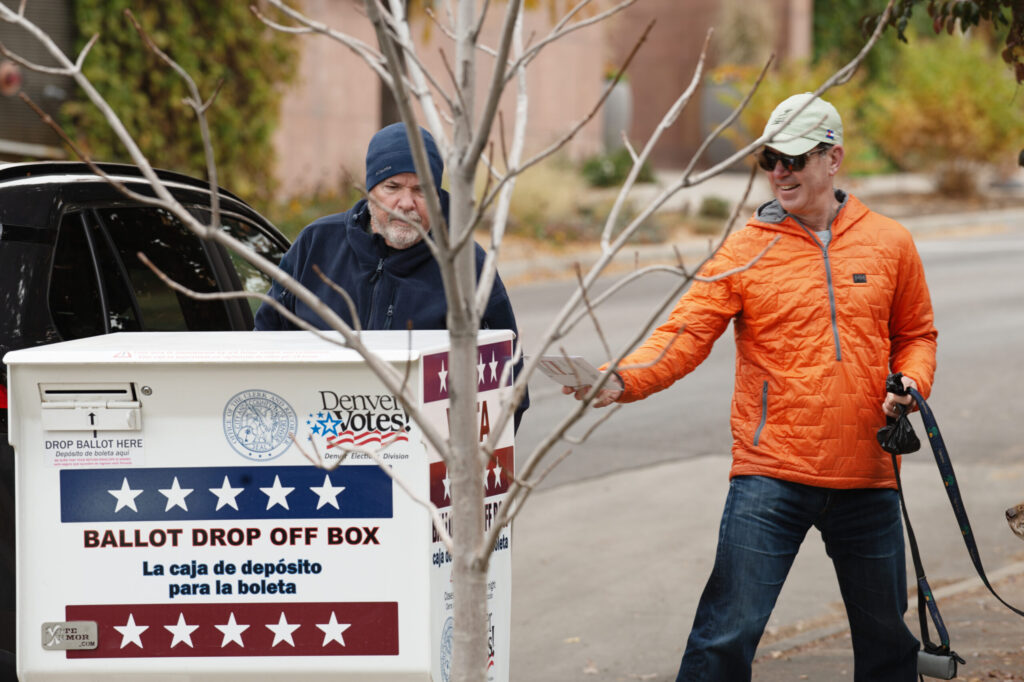
Colorado Secretary of State Jena Griswold announced Monday that the state has formally requested written confirmation from the Department of Homeland Security that ICE agents will not be stationed at polling locations during the 2026 election cycle, according to a...

Colorado prostitution decriminalization bill shelved after sponsor says it lacks votes
Marianne Goodland
marianne.goodland@coloradopolitics.com
Updated 2 days ago
A bill that would have decriminalized prostitution in Colorado will not move forward this year after its sponsor said it lacks the votes to pass its first committee. Sen. Nick Hinrichsen, a Pueblo Democrat, said he will ask to postpone...

Bill to roll back Colorado lottery credit card purchases clears Senate committee in tight vote
Marianne Goodland
marianne.goodland@coloradopolitics.com
Updated 1 day ago
A bill seeking to reverse the Colorado Lottery’s recent move to allow credit card purchases for tickets narrowly cleared its first legislative hurdle last week, advancing on a 5-4 vote after hours of debate over gambling addiction, consumer debt and...