Colorado justices, by 5-2, say Longmont detective did not violate suspect’s Miranda rights

The Colorado Supreme Court’s majority ruled on Monday that a Longmont detective did not coerce a suspect into talking by making references to how a judge would look at his character, and by suggesting he may get out of prison “in time to see your son’s prom.”
Under the landmark U.S. Supreme Court decision Miranda v. Arizona, law enforcement is required to inform suspects of their rights to remain silent and to consult with an attorney before interrogating them in custody. A failure to give a Miranda warning means the prosecution may not be able to use the defendant’s statements as evidence at trial.
On March 9, the state Supreme Court agreed that Angelo Joseph Torres never clearly invoked his Miranda rights and voluntarily spoke with Detective Daniel Kilian.
However, by 5-2, the justices also concluded that Kilian’s subsequent tactics were fair game and did not coerce Torres into making incriminating statements, including Kilian’s suggestion that Torres could be free by the time of his unborn son’s high school prom.
“Detective Kilian’s reference to the possibility that Torres might not be released from prison until his unborn son’s prom is evocative, to be sure, but it does not amount to psychological coercion,” wrote Justice Maria E. Berkenkotter for the majority.
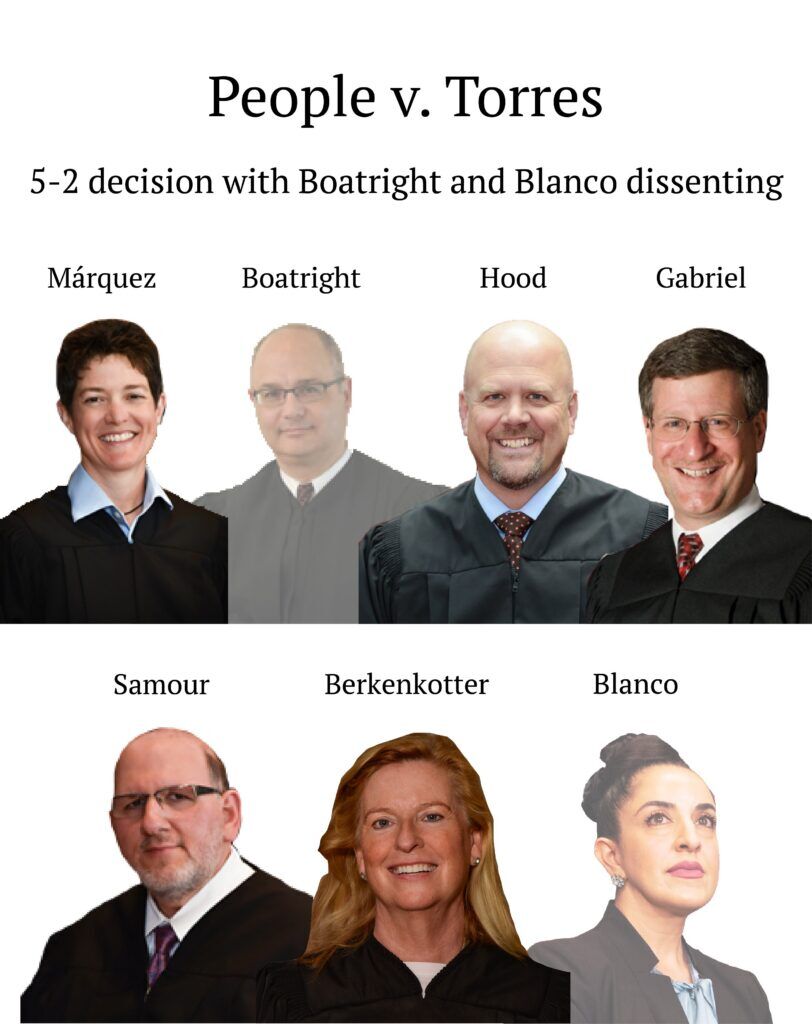
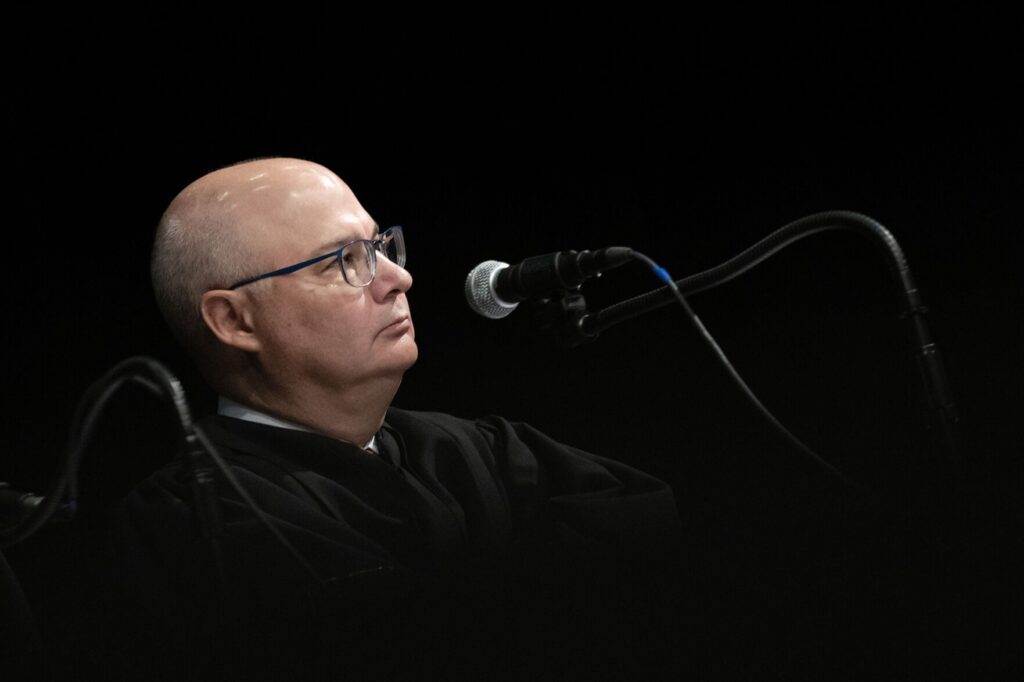
Justice Brian D. Boatright disagreed with that characterization of Kilian’s conduct.
“I am particularly concerned about the detective connecting Torres’s unborn son to the interrogation. It served no legal purpose. It certainly did not help make his statements voluntary,” wrote Boatright for himself and Justice Susan Blanco. “The only explanation for intimating that Torres would not get out of prison until his ‘son’s prom’ was to exploit Torres’s emotions. It was purely an emotional ploy. And it worked.”
Torres turned himself in to the Longmont Police Department on an active warrant. In an interrogation room, Kilian read Torres his Miranda rights and asked if he wanted to talk.
“Nah, I just don’t know why I am doing this,” said Torres. “I don’t even know what the warrant’s for.”
“You’re asking a bunch of questions that I really can’t talk about unless you waive your rights and want to talk,” responded Kilian, adding that Torres could choose to stop speaking at any point. “I think there’s some things that you’d probably like to hear that I had to say. I know you have a baby boy on the way.”
Torres asked what Kilian wanted to discuss. Kilian said that Torres had to relinquish his Miranda rights to find out. Torres continued to seek details about the warrant and mentioned he already knew about one felony charge.
“There’s some additional charges that are going to be put on you,” said Kilian. “Those are the ones I want to talk to you about.”
Torres agreed to sign a form and talk with Kilian. He told the detective he already knew he was going to jail, but “I just want to know what’s going on.”
Kilian responded that Torres faced charges related to an investigation into another suspect, who allegedly received a plea offer of 15-25 years in prison.
“We’re looking at charging you with conspiracy, which puts you maybe getting out in time to see your son’s prom,” said Kilian. “If you talk to me about everything, then I put it on the record that you (voluntarily) told me this.”
He continued, “The judge is going to look at you in one of two ways. Either there’s evidence you were truthful about it, or there’s evidence and you said, ‘No, no, no, no, no.’ And how does that look for your character?”
After Torres made incriminating statements to Kilian, a Boulder County grand jury indicted him for charges related to drugs, guns, and human trafficking. The defense sought to exclude Torres’ statements from the trial, arguing Kilian coerced him into speaking.
District Court Judge Dea M. Lindsey granted the motion. She believed Torres invoked his Miranda rights out the outset, and his statements to Kilian were involuntary. Specifically, Kilian’s references to Torres’ unborn son and his speculation about the leniency Torres might receive were coercive.
The district attorney’s office appealed to the Supreme Court. The justices disagreed with Lindsey and concluded, in context, that Torres had not invoked his right to silence during the interrogation.
“Torres did not simply say ‘(n)ah’ without more. He immediately continued, pressing for information and talking over Detective Kilian,” wrote Berkenkotter. “And, notably, here, it was Torres who sought information from Detective Kilian, not the other way around.”
The majority did not believe Kilian’s conduct was coercive, as he merely “encouraged Torres to be truthful.”
“Torres was familiar with the criminal justice system; he voluntarily turned himself into police custody, and he showed absolutely no signs of mental or emotional incapacity or distress at any point during the interrogation,” wrote Berkenkotter in finding Torres had voluntarily incriminated himself to Kilian.
Boatright, in dissent, argued that Kilian’s comments, after Torres signed the Miranda rights waiver, amounted to promises or “emotional exploitation” aimed at getting Torres to speak about his alleged criminal activity.
“Again, the detective attempted to leverage Torres’s emotions regarding his unborn child. The detective then threw Torres a lifeline when he promised to help Torres if he cooperated,” wrote Boatright. “It was then that Torres made inculpatory statements. In my opinion, he did not make them voluntarily.”
The case is People v. Torres.

Colorado justices find Fort Collins police lacked probable cause to arrest suspect in park
Michael Karlik
michael.karlik@coloradopolitics.com
Updated 3 hours ago
The Colorado Supreme Court agreed on Monday that Fort Collins police lacked probable cause to arrest a man for a child sex offense based on his presence in a public park around the time they intended to meet with their...

Supreme Court to hold oral arguments, discipline commission releases report | COURT CRAWL
Michael Karlik
michael.karlik@coloradopolitics.com
Updated 4 hours ago
Welcome to Court Crawl, Colorado Politics’ roundup of news from the third branch of government. The state Supreme Court is holding oral arguments this week, plus Colorado’s judicial discipline commission released its annual report. Colorado Supreme Court news • The Supreme...
Federal judge dismisses developer’s challenge to Denver affordable housing ordinances
Michael Karlik
michael.karlik@coloradopolitics.com
Updated 3 days ago
A federal judge dismissed a homebuilder’s constitutional challenge on Tuesday to a pair of Denver ordinances that impose obligations on developers related to the affordable housing demands created by new construction. Two related companies, redT Homes and redT Capital Partners,...
10th Circuit distances itself from prior decision making it easier to toss prisoner lawsuits
Michael Karlik
michael.karlik@coloradopolitics.com
Updated 3 days ago
The Denver-based federal appeals court distanced itself on Wednesday from its own recent decision that made it easier for prison officials to end civil lawsuits by transferring incarcerated plaintiffs between facilities. A three-judge panel of the U.S. Court of Appeals...

Appeals court overturns Douglas County vehicular homicide conviction due to faulty jury instructions
Michael Karlik
michael.karlik@coloradopolitics.com
Updated 1 day ago
Colorado’s second-highest court overturned a defendant’s vehicular homicide conviction and 12-year prison sentence on Thursday after determining a Douglas County judge omitted key language from the jury instructions that could have resulted in a different outcome. James Paul McDonald was...

Federal judge dismisses malicious prosecution claim against former Denver prosecutor
Michael Karlik
michael.karlik@coloradopolitics.com
Updated 3 days ago
A federal judge concluded on Monday that a former Denver prosecutor could not be sued for allegedly causing the arrests of two plaintiffs after they failed to appear for trial on the scheduled date, even though the trial had been...
Judicial discipline commission reports increased transparency, increased submissions
Michael Karlik
michael.karlik@coloradopolitics.com
Updated 2 days ago
The Colorado Commission on Judicial Discipline received 473 misconduct complaints about judges in 2025, which was nearly 29% higher than in 2024 and substantially greater than any time in the past decade. However, only 31 complaints were referred to the commission...
Colorado Gov. Jared Polis ignites fierce debate after raising clemency questions in Tina Peters case
Marianne Goodland
marianne.goodland@coloradopolitics.com
Updated 5 days ago
Gov. Jared Polis ignited a political firestorm Tuesday night after weighing in on the prison sentences of two former Colorado officials — a Democrat and a Republican — convicted of attempting to influence a public servant. The comments quickly fueled...

Colorado Supreme Court signals intervention in dispute over treatment for trans children
Michael Karlik
michael.karlik@coloradopolitics.com
Updated 6 days ago
The Colorado Supreme Court ordered Children’s Hospital Colorado on Tuesday to explain why it should not direct the organization to resume providing certain types of services to transgender children in compliance with the state’s non-discrimination law. Last month, a Denver...

Judge nixes latest policy requiring 7 days’ notice for Congress members to visit ICE facilities
Michael Kunzelman
michael.kunzelman@associatedpress.com
Updated 6 days ago
WASHINGTON (AP) — A federal judge agreed on Monday to temporarily suspend the latest version of a Trump administration policy that requires members of Congress to provide a week’s notice before they can visit immigration detention facilities. U.S. District Judge...