

Judicial fees, furniture under scrutiny as Colorado lawmakers consider budget request
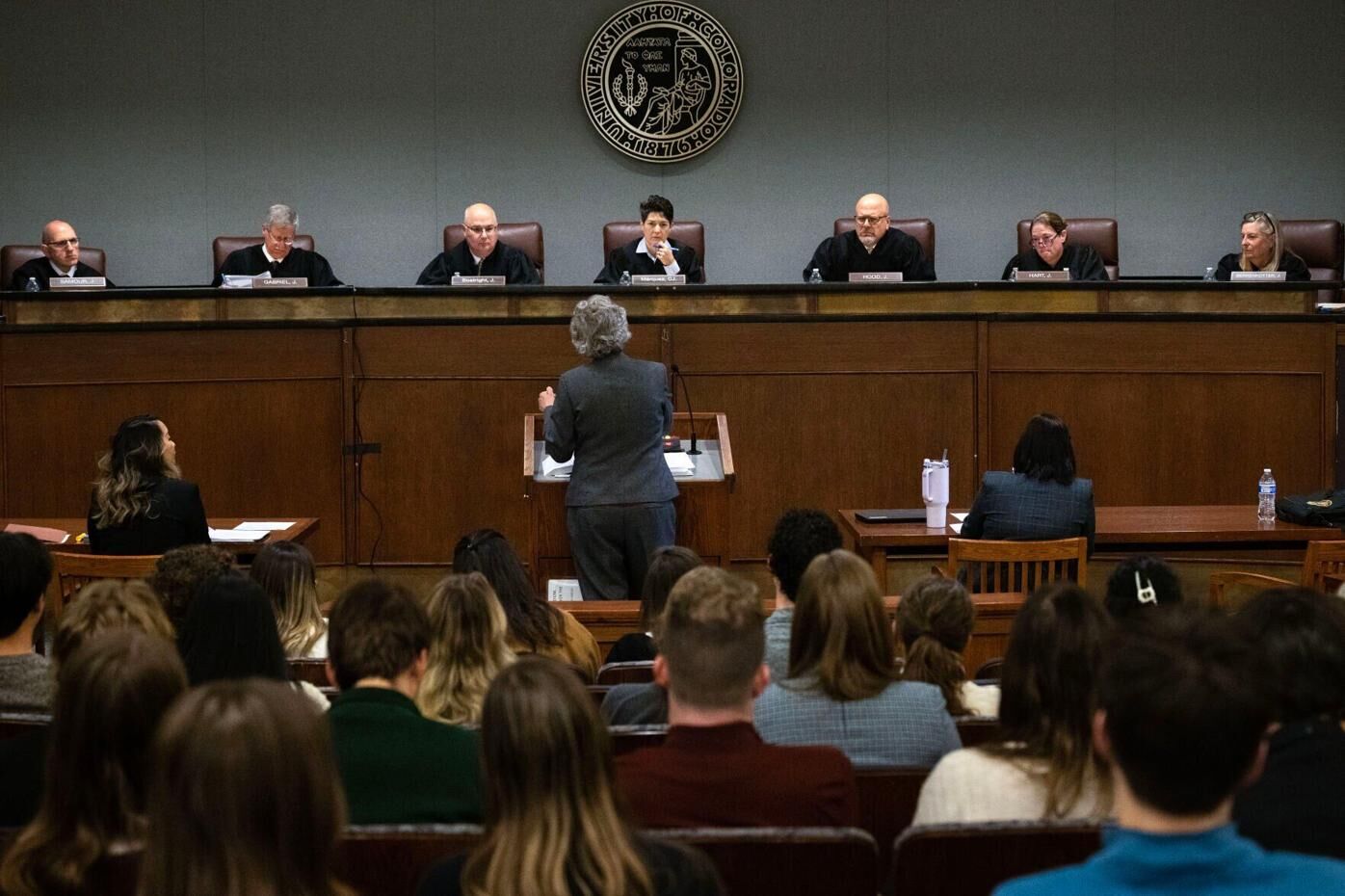
Members of the legislature’s Joint Budget Committee expressed concerns last week about aspects of the judiciary’s requested $845 million budget for courts and probation, while also hearing about the Judicial Department’s relatively restrained spending over time.
“If you adjust for inflation, spending has actually gone down” for the trial courts, said staff analyst Amanda Bickel.
The department has again emphasized the need to add judges, following the General Assembly’s addition of 15 trial court judgeships earlier this year. The implementation takes effect over two years, and the judiciary emphasized the need to maintain the second wave of judges.
Bickel told legislators they could save money by spreading the addition of judges over a longer period, but it would require separate legislation and a supermajority vote. Members of the JBC appeared reluctant to do so, considering the judiciary’s need for far more than 15 judges.
“I think we already dramatically cut what they asked for and it does seem like we’ve done enough damage already,” said Sen. Judy Amabile, D-Boulder.
In a written report, Bickel indicated caseloads have rebounded to nearly where they were 10 years ago, following a decrease in 2020. The report also noted that probation caseloads have declined since the outset of the COVID-19 pandemic, but “more complex and higher oversight probationers” are causing an increased workload.
“I would love to see the data that the department has put together that indicates the caseload they are handling is increasingly complex,” said Rep. Kyle Brown, D-Louisville.

The judiciary is also seeking a range of additional employees, from staff attorneys at the Court of Appeals to a risk management officer and an analyst to work on judicial security. Chief Justice Monica M. Márquez has indicated she plans to launch a judicial security task force, which the analyst would work with.
“We absolutely need security for judges and court employees,” said Amabile, but an analyst “doesn’t seem like the most direct way to address the situation.”
“That is actually a county responsibility as much as it is a state responsibility,” added Sen. Barbara Kirkmeyer, R-Brighton. “They need to start working within existing resources.”
JBC members also spent substantial time discussing the desire to reduce spending on courthouse furnishings. Although the law places responsibility on counties for courthouse costs, Bickel’s report indicated the practice has been for the state to shoulder the burden of furnishing. Ending all but the funding for audiovisual equipment would save the state roughly $3 million per year.
“The court system is definitely a state-local collaboration,” she said.
“There seems to be some fairness in bearing the cost of (courthouse) expansion, but that doesn’t mean we can afford it,” responded Sen. Jeff Bridges, D-Greenwood Village.
The JBC also gave a chilly reception to the idea that the Judicial Department should have greater authority to adjust certain fees set by law. Bickel indicated the judiciary’s “array of fees is phenomenally complex.” Unlike regulatory agencies that impose fees on regulated entities to cover the costs of regulation, there are more purposes behind judicial fees.
“And there’s been a fair amount of research that says a lot of times, fees are a real problem for people,” she said.
“I don’t feel comfortable with that,” said Rep. Emily Sirota, D-Denver, the committee chair, referring to blanket fee-adjustment authority.
Bickel added that statewide policy changes tend to drive requests for increased funding, and some potential opportunities for savings would be rooted in legislation, rather than budget decisions.
“The judiciary is not gonna take a position that any particular bill is a bad idea. That’s outside the box they consider appropriate,” she said. “On the other hand, because judges are actively involved in administering the law, they can see where things are not working well.”
Bickel conveyed a suggestion from multiple people of combining two separate sections of state law that govern evictions, but cautioned it would be “likely a complex and technical process.”
Rep. Rick Taggart, R-Grand Junction, said he was sympathetic to the judiciary’s spending priorities, even though the legislature has faced back-to-back deficits of around $1 billion.
“This department has been very frugal and it’s unfortunate they’ve had to bring so much to us in two very tight budget years, and probably another one after this one,” he said. “The timing for this department has not been great.”


At least 6 candidates vying to replace former Sen. Dafna Michaelson Jenet
Marianne Goodland
marianne.goodland@coloradopolitics.com
Updated 19 minutes ago
Sometime in the next 24 days, a vacancy committee for Senate District 21 will hold an election to choose a successor to former Sen. Dafna Michaelson Jenet, D-Commerce City. Michaelson Jenet resigned on Feb. 13 to take a job as...
Battle lines drawn as Colorado considers decriminalizing prostitution
Marissa Ventrelli
marissa.ventrelli@coloradopolitics.com
Updated 16 hours ago
Battle lines have begun to form at the Colorado state Capitol, where legislators are preparing to tackle a proposal to decriminalize prostitution statewide. Proponents said the proposal — which would eliminate the offense of soliciting for prostitution and the prohibition...
In a meeting Colorado GOP chair Brita Horn calls ‘illegal,’ Republicans vote to demand her resignation
Ernest Luning
ernest.luning@coloradopolitics.com
Updated 2 days ago
Roughly half the membership of the Colorado Republican Party’s state central committee on Saturday voted overwhelmingly to approve a resolution expressing “no confidence” in state GOP Chairman Brita Horn’s leadership and calling for her immediate resignation in an online meeting...

Democrats Michael Bennet, Phil Weiser make their cases to be Colorado’s next governor ahead of primary
Ernest Luning
ernest.luning@coloradopolitics.com
Updated 2 hours ago
Nearly eight months before ballots will be counted in Colorado’s race for the its open gubernatorial seat, voters are lining up behind two of the state’s leading Democrats, who are facing off in a primary that will likely determine which...
Colorado GOP officers set competing meetings to hold ‘no-confidence’ votes on state chair Brita Horn
Ernest Luning
ernest.luning@coloradopolitics.com
Updated 3 days ago
Once again, members of the Colorado Republican Party’s central committee have scheduled separate, competing meetings to consider whether the state GOP’s governing body supports its chair, but this time neither meeting will be held under a bridge. State GOP Chair...
Colorado Democratic candidate submitted 1,600 signatures — only 29 were valid
Marianne Goodland
marianne.goodland@coloradopolitics.com
Updated 2 days ago
When he turned in some 1,600 signatures last month, Eric Nelson said it demonstrated “strong grassroots support from voters” across the district and a “growing momentum” for his “inclusive, community-centered leadership.” On Thursday, the Secretary of State rejected Nelson’s petition...

Colorado bill disqualifies former ICE agents from getting job in local law enforcement | Bills in Brief
Marissa Ventrelli
marissa.ventrelli@coloradopolitics.com
Updated 3 hours ago
Colorado lawmakers introduce hundreds of bills each year. Bills in brief cuts through the noise by explaining which proposals matter, what’s at stake, and how decisions at the Capitol could affect everyday life across the state. Colorado legislators are pushing legislation to...

Colorado senators initially push for — then drop ‘identity’ factor in parenting time decisions
Marissa Ventrelli
marissa.ventrelli@coloradopolitics.com
Updated 3 days ago
The sponsors of a proposal that would require suppression of records in name-change petitions for minors removed a provision that would have mandated the courts to factor in the issue of “identity” when allocating parenting time. In its original form,...

Colorado legislators challenge lottery rules allowing credit card purchases
Marianne Goodland
marianne.goodland@coloradopolitics.com
Updated 3 hours ago
Back in November, legislators told the Colorado Lottery Commission to hold off on rules that would allow, for the first time, purchases of lottery products with credit cards. The commission went ahead anyway and approved those changes. And now lawmakers...

Hickenlooper endorsed by Planned Parenthood Action, environmental group in Colorado’s U.S. Senate race
Ernest Luning
ernest.luning@coloradopolitics.com
Updated 4 days ago
A pair of progressive national groups that advocate for abortion rights and fighting climate change have endorsed U.S. Sen. John Hickenlooper’s bid for reelection, with both calling the Colorado Democrat a proven fighter for their causes. Planned Parenthood Action Fund...
PREV
PREVIOUS

Colorado Supreme Court approves tenant-friendly rule change, broadens professional discipline for sexual misconduct
The Colorado Supreme Court approved a set of rule changes last week that will make it easier for tenants facing eviction to respond to and learn about their landlord’s initial court filing, and for lawyers to be held professionally accountable for unlawful sexual conduct. On Dec. 11, the justices enacted a change to the civil […]

Colorado officials react as Trump weighs reclassifying marijuana
Colorado policymakers and advocacy groups are responding to reports that the federal government could begin loosening restrictions on marijuana, according to insiders in Washington. According to the Washington Post, President Trump is expected to sign an executive order directing federal agencies to pursue reclassification of marijuana from a Schedule I controlled substance to Schedule III, […]