

New housing needs assessment for Colorado Springs and El Paso County: ‘No market segment is adequately served’
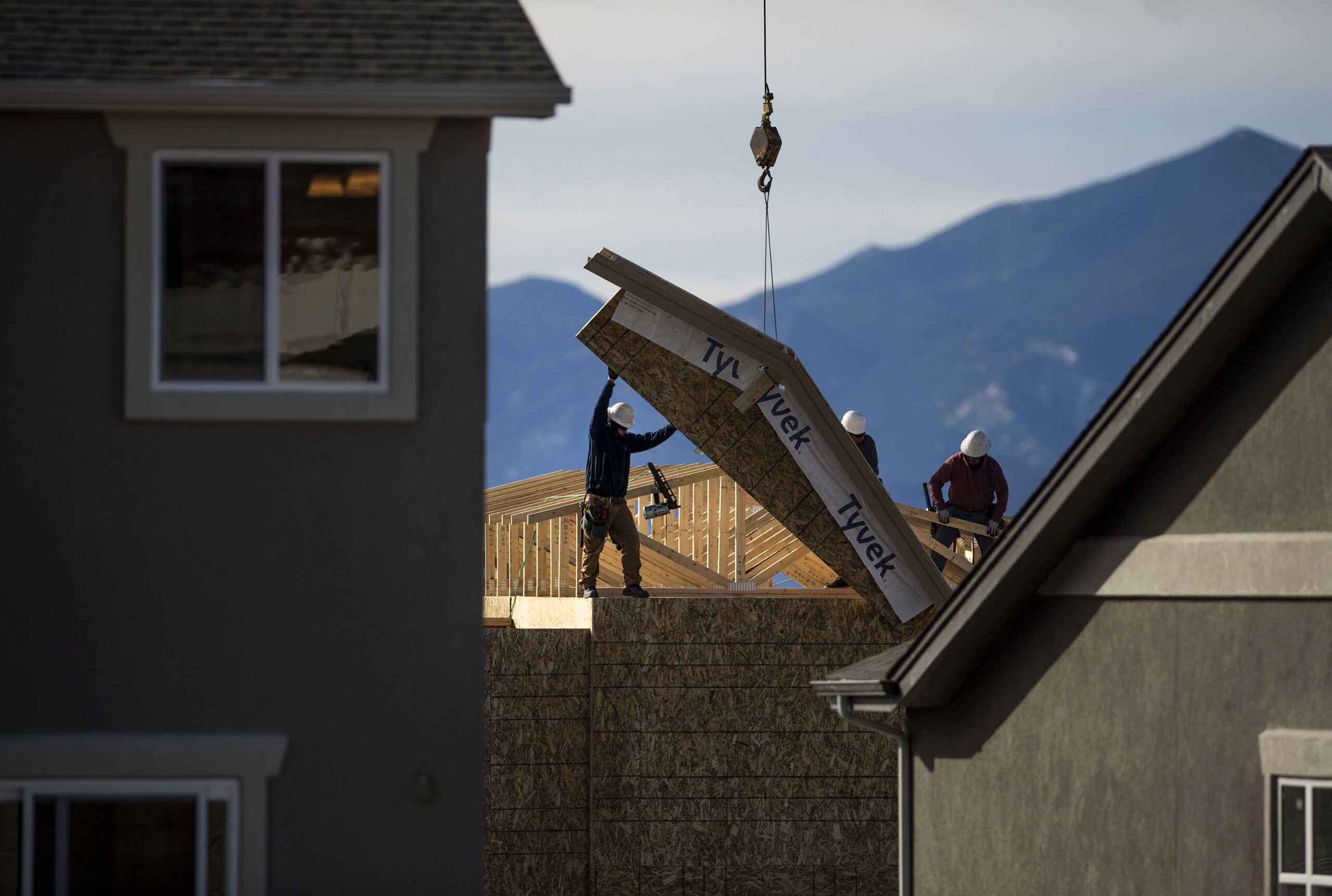
For decades, Colorado Springs and El Paso County leapt rooftops ahead of housing demand and now fall so short that it’s uncertain whether catching up to the growing need is feasible, a new Regional Housing Needs Assessment shows.
While the 314-page report concludes that “no market segment is adequately served,” sectors having the most problems with securing housing are low-income residents, people exiting homelessness, singles, seniors and active-duty military.
Colorado Springs City Council heard the data during a presentation at Monday’s work session, not in seeking approval for the document but as informational.
“The challenges are significant, but so are the benefits, if we can ensure all residents have the safe and secure homes they need to flourish in this society,” said Aimee Cox, the city’s chief housing and homelessness response officer.
The findings estimate that there’s a countywide shortfall of 27,000 units as of 2023 and a projected need of 60,034 units in total by 2035.
“Approximately two to two-and-a-half times the community’s average annual housing production is needed to catch up,” the study found.
Housing inventory and costs have become a top issue, Cox said, because the topic affects every employer and resident — from homeless people to wealthy people.
Obstacles mentioned include securing funding mechanisms, higher costs of building supplies, labor availability, public sentiment and the so-called “not in my backyard” syndrome and red-tape requirements for developing affordable housing.
Yet officials said after the presentation they’re optimistic that the community will rally together under a forthcoming action plan to make gains.
“In the past two months, we closed on 712 more affordable housing units,” Cox said. “We are making progress; we act and will continue to act on the needs identified in this report.”
The situation didn’t happen overnight — it’s been a long time in the making, said Tatiana Bailey, owner of Data-Driven Economic Strategies, which conducted some of the research.
Underbuilding of new homes, apartments, duplexes and condominiums started during the Great Recession, between December of 2007 to June of 2009, the report states. And it’s continued.
The study found that from 2006 to 2024, the region averaged 3,021 annual single-family housing permits, which is 5,479 less than what it should have been — at 8,500 per year.
One reason is population growth, said Bailey. Though population projections for the region have been downgraded, estimates remain on a slower but steady upward trajectory.
Last year, El Paso County’s population weighed in at 752,892, according to the American Community Survey, up from 397,289 in 1990.
The Colorado State Demography Office projects the county’s population will hit 965,622 by 2050 — a decrease from the more than 1 million that had been forecast.
Between 2010 and 2023, the city added 30,000 households and 36,000 new homes, reflecting an improvement in stock, said James McMurray, project manager with Matrix Design Group, the research consultant.
In general, the county’s population is a little older and smarter, with 42% of adults holding a bachelor’s degree, and more financially stable than 2018-2023, he said.
But wages have not kept pace with rising rents and mortgages, he said. Of the county’s 200,000 residential households, 61% own their homes and 39% lease units.
Residential rent prices averaged $1,784 in March, McMurray pointed out. Thus, a household in Colorado Springs would need to earn $78,693 to “comfortably afford this rent,” the study says. Just above one-third of renters meet that threshold.
“About 55% of our population earns under $75,000 a fairly significant income threshold as it relates to housing affordability,” McMurray said.
One-third of homeowners also are “cost-burdened” by housing expenses and do not meet the $150,000 annual income needed to afford an average valued house of $457,000 in Colorado Springs.
The 2023 median household income of $87,470 in Colorado Springs was below the statewide median of $92,470. El Paso County’s median income was $102,825.
“Market choice is limited, and homeownership is increasingly out of reach for many, as housing costs continue to outpace income growth,” McMurray said.
Median housing values in the unincorporated county and metro area increased by about 40% from 2018 to 2023, which was above Colorado’s median increase of 32%.
Of the total 27,000 units needed currently, 11,775 are rental units and nearly 16,000 are owned units.
Also included are about 2,000 supportive housing units for people leaving homelessness and requiring assistance with substance addiction or other mental health conditions.
The military’s basic allowance for housing falls below the monthly ownership or rental costs for most of the area’s military families and singles, particularly junior and mid-grade enlisted personnel, the report also determined.
“Continued attention to housing affordability, proximity and unit diversity is essential to sustain the region’s defense workforce and operational effectiveness,” the report says.
The Colorado Springs Housing Action Plan that will be released in the first quarter of the coming year will contain strategies to help identify funding to carry out the ideas; adjust policies around zoning, development and parking requirements; coordinate regionally; prevent foreclosures; and manage affordable housing, among others.
Public input will be sought at community meetings and presentations, officials said.
A Senate bill state lawmakers passed last year mandates that every Colorado community conduct such a study and a subsequent action plan.
The assessment for El Paso County, the state’s largest county and Colorado Springs, the state’s second-largest city, is among the first to be released under the new law, according to Katie Sunderlin, housing solutions manager for the city.
Numbers from the new housing assessment
El Paso County population as of 2024: 752,892
Of the county’s 200,000 households, 61% own their homes and 39% lease units
All types of housing units needed currently: 27,000
Housing units projected to be needed by 2035: 60,034
Average asking rent in Colorado Springs as of March: $1,784
A household would need to earn $78,693 in Colorado Springs market to comfortably afford the average rent; 36% of renters meet that threshold
Median renter income: $58,325
Average home value in Colorado Springs as of March: $457,000
A household would need to earn over $150,000 to afford average home in Colorado Springs market; 30% of home buyers meet this threshold
Median homeowner income: $106,625


Douglas County businesses to pay fines for unreported thefts under proposed ordinance
Noah Festenstein
noah.festenstein@denvergazette.com
Updated 1 hour ago
Douglas County commissioners on Tuesday advanced an ordinance aimed at curbing retail theft by penalizing businesses that refuse to report shoplifters to law enforcement. The proposal is notable in that it shifts the onus of responsibility to businesses. Officials said...

Humane Colorado bids fond farewell to its CEO at Celebration of Compassionate Leadership | NONPROFIT REGISTER
Joanne Davidson Special to Colorado Politics
joanne-davidson-special-to-colorado-politics@coloradopolitics.com
Updated 11 hours ago
HUMANE COLORADO Denver News: Veterinarian Apryl Steele is not one to toot her own horn, so the general public might have no idea of the depth and scope of the role she has played in elevating the standard of care for companion animals and for expanding the socially...

Trump administration announces $12 billion soybean aid package
RACHAEL WRIGHT Special to The Gazette
rachael-wright-special-to-the-gazette@coloradopolitics.com
Updated 1 day ago
President Donald Trump and Secretary of Agriculture Brooke Rollins announced Monday that the administration was planning to disburse a $12 billion dollar aid package as part of the Farmer Bridge Assistance (FBA) Program, to make targeted, one-time payments to crop...

Audit finds major gaps in Colorado’s oil and gas reporting, enforcement
Marissa Ventrelli
marissa.ventrelli@coloradopolitics.com
Updated 1 day ago
The agencies responsible for regulating Colorado’s oil and gas industry are underperforming when it comes to reporting and enforcement and they also failed to collect payments amounting to hundreds of thousands of dollars in lost revenue, according to a state...

Clash of the titans: Democratic race for governor pits two candidates similar in focus, but very different in style | Vince Bzdek
Vince Bzdek
vince.bzdek@gazette.com
Updated 2 days ago
By Vince Bzdek The race for governor is shaping up to be a clash of Democratic titans, U.S. Sen. Michael Bennet and Attorney General Phil Weiser. They are two of Colorado’s highest profile politicians with deep track records who...
Coal-fired generator at Pueblo’s Comanche Power Plant gets a one-year extension on life
Alexander Edwards
alexander-edwards@coloradopolitics.com
Updated 4 days ago
The Comanche Power Plant in Pueblo will continue to operate a coal-powered electrical generating unit that was slated for retirement this month for one more year. The move comes after Xcel Energy, the state’s largest utility company, petitioned in November...

Q&A: Denver Metro Chamber of Commerce VP says it’s ‘getting harder, more expensive to do business’ in Colorado | FISCAL ROCKIES
Thelma Grimes
thelma.grimes@coloradopolitics.com
Updated 24 hours ago
Editor’s Note: Once among the nation’s fastest-growing economies, Colorado today confronts mounting challenges that threaten its momentum. This series reveals how a state once defined by prosperity is navigating economic cliffs and ridges. We explore the impact that increased regulations, tariffs,...

Can you afford to live in Denver? | FISCAL ROCKIES
Michael Braithwaite
michael.braithwaite@gazette.com
Updated 24 hours ago
Editor’s Note: Once among the nation’s fastest-growing economies, Colorado today confronts mounting challenges that threaten its momentum. This series reveals how a state once defined by prosperity is navigating economic cliffs and ridges. We explore the impact that increased regulations, tariffs,...

After years of leading the nation, Colorado’s economy shows signs of cooling | FISCAL ROCKIES
Marissa Ventrelli
marissa.ventrelli@coloradopolitics.com
Updated 12 hours ago
Editor’s Note: Once among the nation’s fastest-growing economies, Colorado today confronts mounting challenges that threaten its momentum. This series reveals how a state once defined by prosperity is navigating economic cliffs and ridges. We explore the impact that increased regulations, tariffs,...

Q&A: Colorado Chamber of Commerce CEO sees warning signs for state economy, despite strengths | FISCAL ROCKIES
Thelma Grimes
thelma.grimes@coloradopolitics.com
Updated 24 hours ago
Editor’s Note: Once among the nation’s fastest-growing economies, Colorado today confronts mounting challenges that threaten its momentum. This series reveals how a state once defined by prosperity is navigating economic cliffs and ridges. We explore the impact that increased regulations, tariffs,...
PREV
PREVIOUS

Trump administration announces $12 billion soybean aid package
President Donald Trump and Secretary of Agriculture Brooke Rollins announced Monday that the administration was planning to disburse a $12 billion dollar aid package as part of the Farmer Bridge Assistance (FBA) Program, to make targeted, one-time payments to crop farmers. The FBA is designed to be an “economic bridge” to the next planting season. […]

Denver approves $30M shelter contract with Urban Alchemy
With a 9-4 vote, Denver City Council members approved a new $30 million, three-year contract with Urban Alchemy, a San Francisco-based nonprofit, to run The Aspen, a former DoubleTree Hotel that has been turned into a homeless shelter. More than two hours of discussion focused on the contract and the new service provider, selected by […]