

U.S. Senate passes bill to end shutdown

HOUSE VOTE EXPECTED AS SOON AS WEDNESDAY
WASHINGTON — The U.S. Senate passed a major funding package on Monday night that is likely to bring to an end the longest partial government shutdown in history.
On a 60-40 vote, the Senate sent to the U.S. House a measure that would fund the government through Jan. 30 and provide full-year appropriations for the Departments of Agriculture and Veterans Affairs, along with legislative operations.
Eight Democratic caucus members broke with the party to support the package, as they did Sunday night on a key procedural vote. Democrats had demanded an extension of enhanced health care subsidies that are set to expire at the end of the year, something they did not get.
The House is expected to reconvene on Wednesday to take up the bill, as Speaker Mike Johnson, R-La., said he would give his chamber 36 hours to travel back to Washington.
“I’d like for us to be voting on this as early as Wednesday, which is the quickest we could process it if the Senate does their work,” Johnson said Monday evening on Fox News.
President Donald Trump said he supports the deal, and that “we’ll be opening up our country, very quickly.” He said he would abide by the deal’s provisions relating to firing federal employees. The bill would require rehiring fired federal employees, while barring mass layoffs, as the administration has sought, through Jan. 30.
“The deal is very good,” Trump said.
Senate Minority Leader Charles E. Schumer, D-N.Y., and most Democrats opposed the bill, along with Republican Rand Paul of Kentucky. But enough moderate and retiring Democrats had grown weary of prolonging the shutdown. Republicans have refused to negotiate on health care, saying that subject should be tackled after – not before – the government reopens.
With Republicans in control of the White House and Congress, Sen. Jeanne Shaheen, D-N.H., said late Sunday night that Senate Majority Leader John Thune’s promise to hold a vote on extending the expiring Affordable Care Act tax credits by next month is enough to get her to support the bill.
“This was the only deal on the table,” Shaheen said. “It was our best chance to reopen the government and immediately begin negotiations to extend the ACA tax credits that tens of millions of Americans rely on to keep costs down.”
The bill also would provide final full-year funding for programs covered by the agriculture, legislative branch and military construction-VA bills, which were in the package the Senate passed earlier this year.
Before voting for passage, the Senate voted against an amendment proposed by Paul to strip out language he objected to in the agriculture funding bill regulating the hemp industry. The amendment was tabled on a 76-24 vote.
Paul has said the language, pushed by his Kentucky counterpart Mitch McConnell, would “destroy” the industry.
Democrats also made a last-ditch attempt to secure a one-year extension of the enhanced health insurance subsidies, as Schumer had proposed as a compromise last week.
“I just can’t stand by without a fight,” said Sen. Tammy Baldwin, D-Wis., who offered an amendment for a one-year extension. “Americans have said loudly and clearly that they are in a health care crisis.”
Republicans have said they will not support extending those subsidies without negotiating changes to make health care costs more sustainable. An effort to take up her amendment was defeated, 47-53, with every Republican opposing it.
Democrats also sought an amendment designed to prohibit the Trump administration’s use of a “pocket rescission,” a legally untested budget maneuver that allows the White House to cancel previously appropriated funds within 45 days of the end of a fiscal year without congressional approval. The administration relied on that procedure to claw back nearly $5 billion in foreign aid earlier this year.
An effort by Sen. Jeff Merkley, D-Ore., to take up an amendment to prohibit the practice was defeated on a 47-53 vote along party lines.
The House vote to end the shutdown will be one of the chamber’s first since Sept. 19, when it passed a continuing resolution that would have extended funding through Nov. 21. Johnson has kept his members home since that vote to increase pressure on the Senate. The new bill is expected to pass the House with support from nearly all Republicans and likely at least a few Democrats.
House Minority Leader Hakeem Jeffries, D-N.Y., is against the bill, and House Democrats are expected to widely oppose it. Many are angry that eight Senate Democratic caucus members had cut short a shutdown they had hoped to use as leverage to extend the expanded health insurance subsidies.
In response to the COVID-19 pandemic, Congress had adopted the American Rescue Plan Act of 2021, which, among other provisions, temporarily expanded eligibility for the premium tax credits for tax years 2021 and 2022. Notably, the law eliminated the income limit of 400% of the federal poverty level, thereby allowing more Americans to quality, and provided larger subsidies compared to the original Affordable Care Act. The Biden administration and Congress then extended these enhanced tax credits in the 2022 Budget Reconciliation Law for another three years and established the sunset date of Jan. 1, 2026.
This CQ-Roll Call article was syndicated via the Associated Press.


Bureau of Land Management revokes American Prairie’s bison leases | OUT WEST ROUNDUP
The Associated Press
the-associated-press@coloradopolitics.com
Updated 4 days ago
MONTANA BLM revokes bison grazing leases The U.S. Department of the Interior announced on Jan. 16 that it is revoking grazing permits in Phillips County that American Prairie had been using to sustain its herd of bison. The decision comes...

Colorado GOP Chair Brita Horn rebuffs critics as fellow party officer greenlights ‘no-confidence’ vote
Ernest Luning
ernest.luning@coloradopolitics.com
Updated 4 hours ago
A Colorado Republican Party officer said last week that a move by party officials to impose restrictions on state GOP chair Brita Horn and hold a “no-confidence” vote on her leadership can proceed. Horn, however, told Colorado Politics that the...

Evans challenger Evan Munsing qualifies by petition for Democratic primary ballot in Colorado’s 8th CD
Ernest Luning
ernest.luning@coloradopolitics.com
Updated 1 day ago
Thornton Democrat Evan Munsing, one of three major Democratic candidates challenging Republican U.S. Rep. Gabe Evans’ bid for a second term, became the first candidate to qualify for Colorado’s 8th Congressional District primary after submitting a sufficient number of valid...

Pueblo state representative defects from party, handgun carry permit bill receives first real scrutiny | A LOOK BACK
Rachael Wright, Special to Colorado Politics
rachael.wright@coloradopolitics.com
Updated 4 days ago
Forty-Five Years Ago This Week: After being labelled a turncoat by activist John Van Vranken in The Colorado Statesman, state Rep. Bob Kirscht, R-Pueblo, defended his defection from the Democratic Party on the grounds of “philosophical differences.” The Democratic Party,...
Capitol M: Olympic version | Week of Feb. 7, 2026
Marianne Goodland
marianne.goodland@coloradopolitics.com
Updated 3 days ago
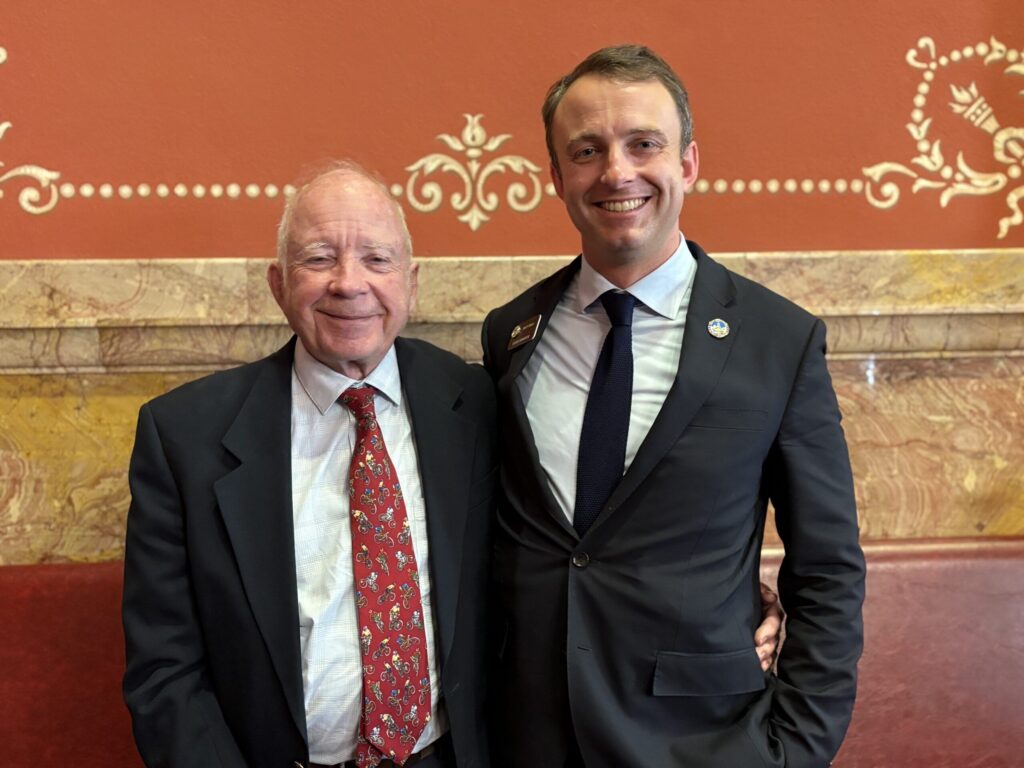
The lighter side of the state Capitol, usually. Sen. Byron Pelton, R-Sterling, who turns 50 this year, is sporting eyeglasses for the first time. He blames the lege. “With 700 bills to read a year, my eyes are failing me,”...

Colorado Politics Calendar Feb. 9-15
Rachael Wright, Special to Colorado Politics
rachael.wright@coloradopolitics.com
Updated 4 days ago
CoPo’s weekly political calendar will help you find political and public-policy events throughout Colorado. It includes candidate and issue campaign events, public policy meetings, court hearings, state and local party conventions, assemblies, debates, rallies, parades, speaking engagements, traveling dignitary appearances,...
Trump’s critics are not the ones suffering from “derangement” | SONDERMANN
By Eric Sondermann
by-eric-sondermann@coloradopolitics.com
Updated 4 days ago
It appears that 63% of Americans, plus or minus, are deranged. Per recent surveys, that is the percentage of fellow citizens who do not approve of President Trump’s performance a year into his second term. In Trump’s world, almost any...

Federal judge blasts government for violating court order, confiscating man’s property
Michael Karlik
michael.karlik@coloradopolitics.com
Updated 4 hours ago
A federal judge gave the government three hours on Friday to return the property of a man released from immigration detention, which it allegedly retained in violation of her previous order. “At its most benign, this failure is an unforced...

DA’s withdrawal from veterans treatment court not judge’s problem, ethics panel says
Michael Karlik
michael.karlik@coloradopolitics.com
Updated 2 days ago
There are no ethical concerns from a judge continuing to participate in a specialty veterans treatment court if the district attorney’s office has withdrawn from the program, the Colorado Supreme Court’s ethics committee advised on Wednesday. Colorado law permits chief...

As federal vaccine guidance shifts, Colorado Senate backs recommendations from pediatric groups
Marianne Goodland
marianne.goodland@coloradopolitics.com
Updated 2 days ago
At least 20 states have said they are using guidance from the American Academy of Pediatrics and other medical associations when setting vaccine policies and immunization schedules, in some cases supplementing or diverging from recommendations issued by the Trump administration...
PREV
PREVIOUS

Denver council rejects 2026 budget, but mayor's $1.66B spending plan will still govern operations
The Denver City Council rejected Mayor Mike Johnston’s $1.66 billion spending plan, but the proposal, as amended, will still govern operations, as the charter requires the city to have a budget in place by Nov. 12. In a split 6-6 vote on Monday, councilmembers expressed disappointment with various aspects of the budget process, citing its […]

Colorado's Democratic senators slam deal to end shutdown, vow to fight for health care tax credits
Colorado’s two Democratic U.S. senators voted against a bipartisan deal reached Sunday to end the longest federal government shutdown in history, blasting the package’s failure to extend some health insurance tax credits. The full Senate passed spending legislation late Monday that could pave the way to reopen the government before the end of the week […]