

Another translocated wolf dies in Colorado, bringing total to 12
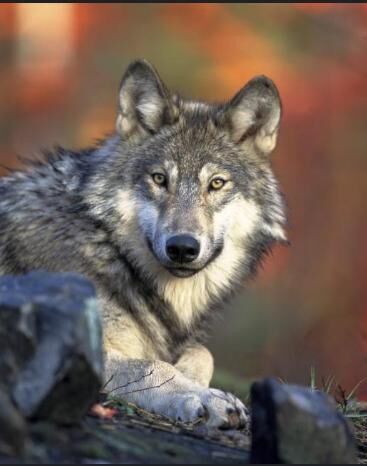
Wildlife officials on Friday morning announced that another British Columbia wolf, a female with the tag 2506, died in southwest Colorado.
Officials said necropsy will be performed by U.S. Fish & Wildlife.
The Colorado Parks and Wildlife did not identify the wolf’s exact location, but southwestern Colorado is home to both the Ute Mountain Ute and Southern Ute reservations.
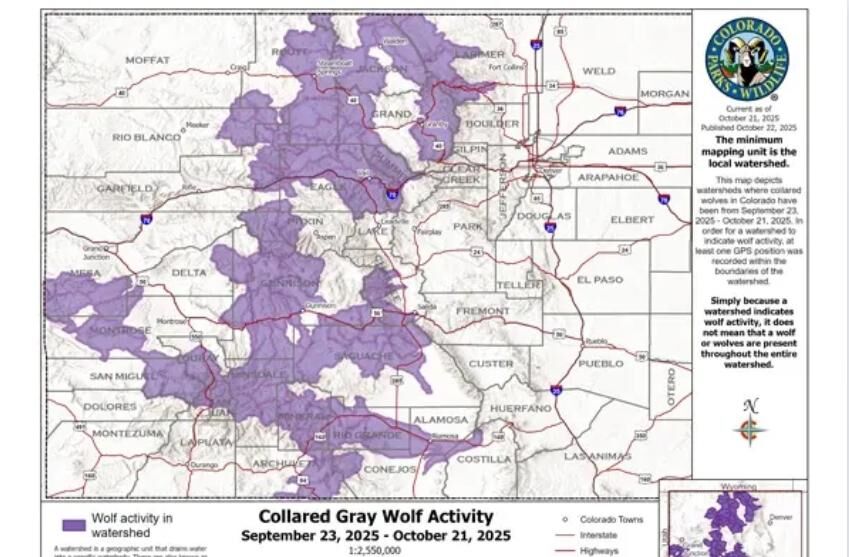
The October wolf map shows wolf activity in the watershed that includes Archuleta County, the eastern edge of the Southern Ute reservation.
This makes the sixth wolf to die from the 15 brought to Colorado from British Columbia in January, and the 12th overall.
The deaths have included two of the Copper Creek litter born in 2024, plus the male from the breeding pair, and three others from the original 10 wolves brought from Oregon.
At least four wolves died after being shot; three that were lethally removed either by Colorado Parks and Wildlife or U.S. Fish & Wildlife, and the male of the Copper Creek pack, which, when captured, was found with a gunshot wound that eventually caused its death.
The cause of death for two wolves, one from British Columbia and another from Oregon, is unknown, as they died in Wyoming.
The other five died from other causes, such as attacks from mountain lions or from another wolf; one was hit by a car in Northwest Colorado.
Colorado’s wolf reintroduction has been plagued by problems, largely related, ranchers said, to the state’s lack of preparation and communication with the ranching community.
Voters, primarily along the Front Range, narrowly approved the 2020 ballot measure that called for the reintroduction of wolves onto Western Slope counties, which strongly rejected the proposal.
The wolves have caused hundreds of thousands of dollars in damages to ranches, due to the deaths of dozens of cattle, sheep, llamas and dogs, and the state has so far spent more than four times what it initially estimated the program would cost.
In a story first reported by Colorado Politics last month, the head of U.S. Fish & Wildlife told Colorado Parks and Wildlife it may not bring in wolves from anywhere other than five western states: Idaho, Wyoming, Montana, Washington and Oregon.
That raises problems for Colorado – because Idaho, Wyoming, Montana and the Confederated Tribes of the Colville Nation in Washington State have refused to allow the state to obtain wolves from their territories.
The Colville tribes rescinded an agreement in 2024 to provide wolves due to Colorado Park and Wildlife’s lack of cooperation with the Colorado Southern Ute Tribe.
A Colville tribal official confirmed with Colorado Politics last week that it is not planning to share wolves with Colorado anytime soon.
However, the Washington Department of Fish and Wildlife Commission could be discussing a request from Colorado for wolves as soon as next week.
Colorado Public Radio reported on Thursday that Gov. Jared Polis spoke to Washington Gov. Bob Ferguson about obtaining Washington wolves.
A Polis spokesperson said the governor spoke with Ferguson and several other governors on the subject, and that he has regular interactions with governors on a number of topics.
“The Governor and his team have ongoing conversations with multiple potential sources of wolves to support reintroduction efforts that were approved by voters,” the spokesperson said.
Discussions at some level are occurring with all five states and potential sources “in order to maximize Colorado’s options,” the spokesperson added.
The Washington commission will meet Nov. 13 to 15.
Washington’s wolf population is about 230, according to the Washington Department of Fish & Wildlife. The population grew by 20% in 2023.
Wolves are listed as endangered in the western two-thirds of the state and delisted in the eastern third, both designations by the federal government.
Washington state law, meanwhile, considers all wolves endangered, regardless of location.
The Colville and Spokane tribes are in the eastern third of Washington. Tribal governments largely manage the wolf populations on their lands.
The state wildlife commission adopted its wolf conservation and management plan in 2011.
Washington is struggling with an increase in livestock depredations by wolves, with 56 livestock reportedly killed by wolves in 2024, more than double the number from the previous year and a record high since the state began tracking those conflicts.
Of the 43 wolf packs in Washington, 10 were cited as killing livestock in 2024.
The Dominion wolf pack, located in northeastern Washington, was believed responsible for 18 killed or injured livestock in 2024. The department authorized a lethal take and killed one of the pack members in August 2024.
The Leadpoint and Onion packs, also in northeastern Washington, were listed as responsible for eight livestock depredations in 2024. The department later killed a male wolf from the Onion pack, which had killed three cattle in a 30-day period and a fourth week later.
The Couse pack is located in southeast Washington. The Couse pack, new in 2023, killed or injured six cattle in 2024 and the department authorized a lethal take, though that never happened. The pack continued to kill or injure livestock through November 2024, according to the state’s wolf report.
The Columbia pack, also in southeastern Washington, was responsible for a dozen killed or injured livestock, including eight injured calves in 10 days. Two of its wolves were lethally removed earlier this year.
Other packs listed as depredating in 2024 include the Togo (northeast), Sullivan Creek (northern) and Grouse Flats (southeast) packs, and two packs still yet to be identified.
The department reported 37 wolf mortalities in 2024, including 18 “legally harvested” by Colville tribal hunters and another killed by Spokane tribal hunters. Seven died from “unlawful take,” the department reported.
The October 8, 2025, wolf report identified three other known packs – Reed, Sherman, and Touchet – and one new pack, as well as the Togo pack, as responsible for the deaths or injuries of 16 livestock this year.
Washington wildlife officials killed a wolf from the Togo pack in August.
One rancher said the wolves have killed 100 livestock on her ranch in the last decade.
“They’re eating us alive, literally,” Kathy McKay of K-Diamond-K Guest Ranch told Center Square in August.
Colorado Parks and Wildlife included several wolves from Oregon packs with histories of killing livestock in the first batch brought to Colorado in December 2023.
That decision contravened recommendations in the state’s wolf plan, which stated that, “if a wolf is depredating livestock, the pack it belongs to is likely to depredate as well; additionally, if a pack is depredating, it is difficult to exclude one individual as non-depredating … A known wolf or pack of wolves that have been identified as chronic depredators by the source location should not be used for translocation to Colorado.”
The Oregon wolves, released in Grand County, killed dozens of livestock in 2024. The Copper Creek pack – a mating pair and four pups – was captured by state wildlife officials in September 2024 after numerous livestock deaths and injuries were reported. The female and four pups were released in Pitkin and Eagle counties in January, where they began killing livestock last spring.

With the deadline missed, Bureau of Reclamation plans to move forward on Colorado River operations
Marianne Goodland
marianne.goodland@coloradopolitics.com
Updated 14 hours ago
Feb. 14 was no Valentine for the seven states of the Colorado River, which failed to come up with an agreement by that deadline on how to manage the dwindling water resource beginning Oct. 1. The U.S. Department of the...

Appeals court clarifies what materials judges may rely on for postconviction decisions
Michael Karlik
michael.karlik@coloradopolitics.com
Updated 12 hours ago
Colorado’s second-highest court clarified on Thursday that trial judges who are deciding whether to grant relief to convicted defendants may rely on the materials attached to, or referenced in, the parties’ arguments. In contrast to direct appeals of criminal convictions,...

Democrat Shannon Bird qualifies by petition for primary ballot in Colorado’s toss-up 8th CD
Ernest Luning
ernest.luning@coloradopolitics.com
Updated 12 hours ago
Former state Rep. Shannon Bird has qualified for the Democratic primary ballot in Colorado’s hotly contested 8th Congressional District by submitting a sufficient number of petition signatures, state election officials said this week. The winner of the Democrats’ June 30...

Colorado Supreme Court accepts cases about reliability of gun-to-bullet matching
Michael Karlik
michael.karlik@coloradopolitics.com
Updated 3 days ago
The Colorado Supreme Court announced on Monday that it will hear two cases questioning the reliability of expert testimony that purports to identify whether a specific bullet was fired from a specific gun. At least three of the court’s seven...

A day in the life of the Capitol: Capitol M | Week of Feb. 14, 2026
Marianne Goodland
marianne.goodland@coloradopolitics.com
Updated 4 days ago
The lighter side of the Capitol, usually. If you were walking around the Capitol on Feb. 12, there was plenty to see and to be amused (or delighted) by. Let’s start with the high school kids from Greeley’s District 6....

Colorado legislators, friends and family pay tribute to late Sen. Faith Winter
Marianne Goodland
marianne.goodland@coloradopolitics.com
Updated 3 days ago
Colorado legislators on Friday, joined by current and former lawmakers, memorialized the late Sen. Faith Winter, noting her contributions to public policy in transportation, family and medical leave, and climate legislation. Winter died in an auto accident on Nov. 26...
Deadlocked: Colorado basin states negotiations collapse
Marianne Goodland
marianne.goodland@coloradopolitics.com
Updated 2 days ago
With the Feb. 14 deadline looming, the seven states in the Colorado River Basin failed to reach an agreement on how to manage the river after the 2026 operating guidelines expire later this year. John Entsminger, Nevada’s chief negotiator, said...

Push to regulate high concession prices in Colorado could hurt vendors, critics warn
Bernadette Berdychowski
bernadette.berdychowski@denvergazette.com
Updated 2 days ago
High food and drink prices have long been a staple of going to a sports game, concert, festival or the airport. But as inflation has increasingly pinched people’s wallets, pushback against higher concession prices is growing. The issue has reached...
Colorado Democrats seek to legalize prostitution by July
The Denver Gazette
the-denver-gazette@coloradopolitics.com
Updated 3 days ago
A group of Democrats is seeking to legalize prostitution in Colorado, arguing that current penalties “endanger” consenting adults. The proposal, if enacted, would decriminalize prostitution statewide and preempt local ordinances that ban it. If signed into law, it will take...

Evergreen CommonSpirit gunman identified as previous patient
9News
9news@coloradopolitics.com
Updated 3 days ago
A gunman who shot into a primary care office in Evergreen Thursday afternoon was previously a patient at the facility, authorities said. Lance Black, 62, fired about 19 shotgun rounds into various pieces of equipment, computers and walls at a...
PREV
PREVIOUS

DIA to cut flights until government shutdown ends
Denver International Airport will reduce its flights by up to 10% while the government shutdown persists. The news comes after the Federal Aviation Administration announced Wednesday that it would be reducing air traffic across 40 “high-volume” markets, as air traffic controllers have become increasingly strained amid the shutdown. DIA is on that list. Reductions are […]
Trump administration seeks to block court order for full SNAP payments in November
BOSTON (AP) — President Donald Trump ’s administration asked a federal appeals court Friday to block a judge’s order that it distribute November’s full monthly SNAP food benefits amid a U.S. government shutdown, even as at least some states said they were moving quickly to get the money to people. The judge gave the Trump […]