

10th Circuit sides with Golden officers in constitutional lawsuit over arrest, cell phone search
Members of the Golden Police Department did not violate a man’s clearly established rights when they arrested him on suspicion of retaliating against a witness and used a defective warrant to search his phone, the federal appeals court based in Denver ruled last week.
Wayne Dean Wieber was involved in a long-running neighborhood dispute, to the point where the police department instituted a policy to manage complaints about people’s behavior. After Wieber told a sergeant in late 2016 that he spoke to a neighbor’s employer to “get back” at that family, the sergeant arrested Wieber. A detective applied for a warrant to search his phone, which a Jefferson County judge granted.
Prosecutors later dismissed the charges, prompting Wieber to sue the city and a handful of officers for violating his rights. A three-judge panel of the U.S. Court of Appeals for the 10th Circuit found the search warrant to be unconstitutional, but otherwise sided with the defendants.
Judge Carolyn B. McHugh, in the Feb. 27 order, noted no prior court decision had put the officers on notice that their conduct was clearly unreasonable. Problematically, Wieber’s lawyer had made underwhelming legal arguments throughout the case — for example, by comparing Wieber’s lawsuit to a 1969 U.S. Supreme Court decision about threats to the president.
“Mr. Wieber made no attempt to explain how that case adequately alerted any reasonable officer that the warrantless arrest here was unlawful,” McHugh wrote.
In the underlying case, Sgt. Matthew Porter emailed the police department and Wieber in October 2016 announcing a “zero tolerance for anything criminal taking place” in Wieber’s neighborhood. A follow-up letter to residents informed them that Porter and another officer would handle complaints arising from the approximately 12-year-old dispute, and explained how criminal charges would be filed.
Weeks later, Porter investigated a complaint that Wieber falsely told his neighbor’s employer that young children were playing on the neighbor’s work truck. In reality, the neighbor had allegedly parked the work truck to prevent Wieber and his wife from recording children playing outside.
According to Porter’s report, Wieber admitted to complaining to his neighbor’s employer, and said he wanted to “get back” at the family. The neighbor faced work consequences as a result of Wieber’s report, as well as a subsequent one in which Wieber alleged more troubling behavior. After consulting with prosecutors, Porter believed Wieber committed the crime of retaliation against a witness.

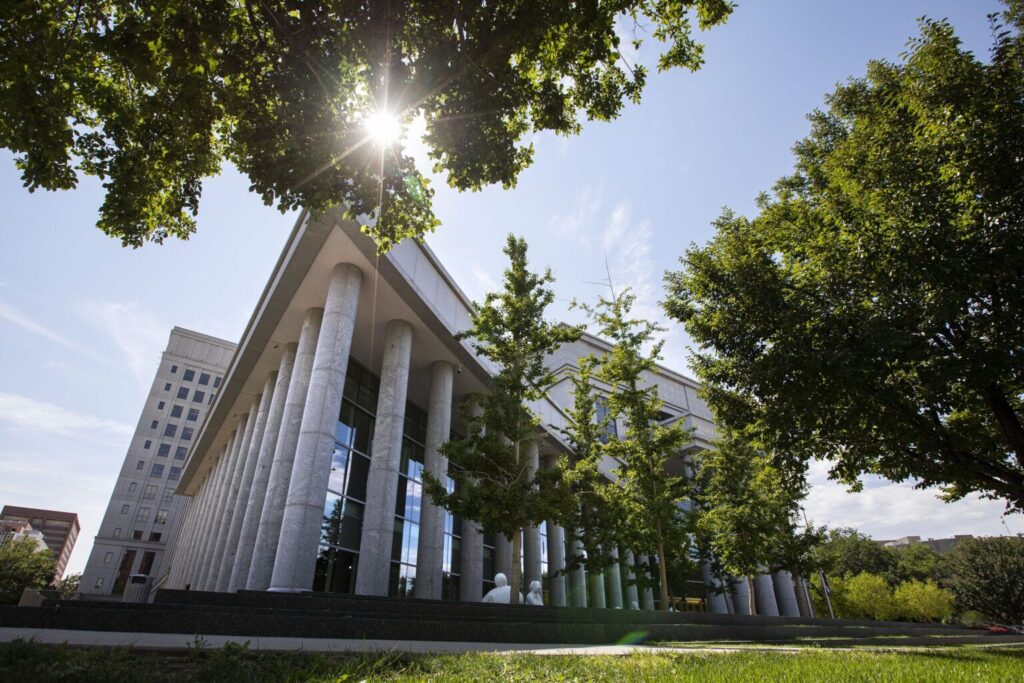
The Jefferson County Administration & Courts Facility in Golden, known as the “Taj Mahal.” (iStock)
Porter arrested Wieber and Detective James Barron applied for a warrant to search Wieber’s phone “in the furtherance of this investigation.” Barron noted in a separate statement that there were multiple active investigations, including one in which Wieber was the alleged victim. A judge signed off on the warrant.
Following the dismissal of charges, Wieber sued the city and the various officers involved in 2018. The defendants moved in September 2020 to end the case in their favor without a trial. After waiting for more than 2.5 years, U.S. District Court Judge Daniel D. Domenico finally ruled in their favor in early 2023.
“The undisputed evidence shows that the warrant application was not falsified, the warrant was properly issued, and the search was conducted consistent with the warrant,” Domenico wrote. As for Wieber’s arrest, “the officers had probable cause for the actions they took.”
Consequently, Domenico granted the officers qualified immunity, which bars civil lawsuits against government employees unless they violate a person’s clearly established legal rights.

Daniel Domenico.
On appeal to the 10th Circuit, the judges on the panel amplified a concern Domenico expressed in his order: Wieber’s attorney, Nancy C. Johnson, made confused or inadequate arguments about qualified immunity.
“The case law is very clear,” said McHugh during oral arguments in January. “For it to be clearly established, there has to be a U.S. Supreme Court case or 10th Circuit authority that made it clear to every reasonable officer that this warrantless arrest was a violation of your client’s Fourth Amendment rights.”
However, the panel also pressed the defendants’ attorney to justify the constitutionality of Barron’s application to search Wieber’s phone, which contained only a generic reference to “this investigation” on the document the judge signed.
Chief Judge Jerome A. Holmes noted there were multiple investigations in the neighborhood, including where Wieber was the alleged victim.
“You’re not helping me, man,” Holmes said. “Which of those three that I identified for you are we talking about?”
“I think what you’re picking up on is the fact that there’s a lot going on in this case,” responded attorney James T. Kadolph.
“You better believe it,” Holmes said.
Ultimately, the panel expressed no opinion on whether Porter’s arrest of Wieber was unconstitutional due the lack of arguments from his attorney. Instead, it only found there was no prior court case prohibiting the arrest, entitling Porter to immunity.
McHugh wrote that Barron’s search warrant application was unconstitutional because it referenced “this investigation” without pinpointing the witness retaliation case in particular.
And yet, she continued, the document “is a far cry” from prior examples of clearly unconstitutional warrants, such that Barron was entitled to immunity, as well.
The case is Wieber v. Porter et al.

Federal judge dismisses developer’s challenge to Denver affordable housing ordinances
Michael Karlik
michael.karlik@coloradopolitics.com
Updated 8 hours ago
A federal judge dismissed a homebuilder’s constitutional challenge on Tuesday to a pair of Denver ordinances that impose obligations on developers related to the affordable housing demands created by new construction. Two related companies, redT Homes and redT Capital Partners,...

10th Circuit distances itself from prior decision making it easier to toss prisoner lawsuits
Michael Karlik
michael.karlik@coloradopolitics.com
Updated 17 hours ago
The Denver-based federal appeals court distanced itself on Wednesday from its own recent decision that made it easier for prison officials to end civil lawsuits by transferring incarcerated plaintiffs between facilities. A three-judge panel of the U.S. Court of Appeals...

Appeals court overturns Douglas County vehicular homicide conviction due to faulty jury instructions
Michael Karlik
michael.karlik@coloradopolitics.com
Updated 2 days ago
Colorado’s second-highest court overturned a defendant’s vehicular homicide conviction and 12-year prison sentence on Thursday after determining a Douglas County judge omitted key language from the jury instructions that could have resulted in a different outcome. James Paul McDonald was...

Federal judge dismisses malicious prosecution claim against former Denver prosecutor
Michael Karlik
michael.karlik@coloradopolitics.com
Updated 12 hours ago
A federal judge concluded on Monday that a former Denver prosecutor could not be sued for allegedly causing the arrests of two plaintiffs after they failed to appear for trial on the scheduled date, even though the trial had been...
Judicial discipline commission reports increased transparency, increased submissions
Michael Karlik
michael.karlik@coloradopolitics.com
Updated 3 days ago
The Colorado Commission on Judicial Discipline received 473 misconduct complaints about judges in 2025, which was nearly 29% higher than in 2024 and substantially greater than any time in the past decade. However, only 31 complaints were referred to the commission...
Colorado Gov. Jared Polis ignites fierce debate after raising clemency questions in Tina Peters case
Marianne Goodland
marianne.goodland@coloradopolitics.com
Updated 2 days ago
Gov. Jared Polis ignited a political firestorm Tuesday night after weighing in on the prison sentences of two former Colorado officials — a Democrat and a Republican — convicted of attempting to influence a public servant. The comments quickly fueled...

Colorado Supreme Court signals intervention in dispute over treatment for trans children
Michael Karlik
michael.karlik@coloradopolitics.com
Updated 4 days ago
The Colorado Supreme Court ordered Children’s Hospital Colorado on Tuesday to explain why it should not direct the organization to resume providing certain types of services to transgender children in compliance with the state’s non-discrimination law. Last month, a Denver...

Judge nixes latest policy requiring 7 days’ notice for Congress members to visit ICE facilities
Michael Kunzelman
michael.kunzelman@associatedpress.com
Updated 4 days ago
WASHINGTON (AP) — A federal judge agreed on Monday to temporarily suspend the latest version of a Trump administration policy that requires members of Congress to provide a week’s notice before they can visit immigration detention facilities. U.S. District Judge...
Judge nixes latest policy requiring 7 days’ notice for Congress members to visit ICE facilities
Michael Kunzelman
michael.kunzelman@associatedpress.com
Updated 3 days ago
WASHINGTON • A federal judge agreed on Monday to temporarily suspend the latest version of a Trump administration policy that requires members of Congress to provide a week’s notice before they can visit immigration detention facilities. U.S. District Judge Jia...
Colorado Supreme Court clarifies restraining order violations can always support burglary charge
Michael Karlik
michael.karlik@coloradopolitics.com
Updated 2 days ago
The Colorado Supreme Court’s majority ruled on Monday that a violation of a restraining order can also serve as a basis for finding a defendant guilty of burglary. Under state law, a person commits second-degree burglary by unlawfully entering or...