

Colorado lawmakers advance bill eliminating election requirement to impose union dues on non-union members
A panel of Colorado legislators on Tuesday advanced a proposal to eliminate provisions of a law governing the process for imposing union fees on non-union members.
Under the 80-year-old law, the first election to form a union must receive a simple majority to pass. The second election, which allows the collection of dues on non-union members, requires 75% of the workers to say “yes.” Colorado is the only state in the country with the second election requirement, making it not quite a right-to-work state, in which employees do not have to pay union dues if they don’t belong to a union, but not quite a right-to-organize state, either, in which, depending on the outcome of negotiation, all workers could pay union dues, regardless of whether they’re members or not.
The Senate Business, Labor and Technology Committee advanced Senate Bill 005, which eliminates the second election, on a party-line vote of 4-3.
The bill’s supporters argued that the current law is antiquated and that unionization is ultimately good for workers and the state economy. Critics said the current law is working and upending it will undercut Colorado’s economic gains.
The bill’s fate, even if reached the governor’s desk, remains uncertain. In his annual State of the State address, Gov. Jared Polis said that he would only support changes to the law if it has the buy-in of both labor and business. Polis vetoed three labor bills last session.
Sens. Robert Rodriguez, D-Denver, and Jessie Danielson, D-Wheat Ridge, and Denver Democratic Reps. Jennifer Bacon and Javier Mabrey authored the bill.
Rodriguez called the current law antiquated, adding it was passed during a time when women could not serve on juries, Republicans controlled the state legislature, and a Japanese internment camp was operating in Colorado.
“The passage of the Colorado Labor Peace Act in 1943 was driven by way of anti-union sentiment from business leaders and conservative politicians as reaction to the increasing power workers have across the country,” he said.
The benefits of unionization are clear, Danielson added.
“Better pay, better healthcare, better retirement and safety in the workplace, a seat at the table. All of those things make life better for workers across the state,” Danielson said.
Large corporations oppose unions because the latter disrupt the power imbalance between employers and employees, Danielson added.
“Why don’t we trust workers to make their own decisions in negotiations?” she asked. “Why is the state of Colorado holding up this additional barrier for workers who have already decided that they want this?”
Opponents: Proposal won’t help workers
Several workers from the restaurant industry testified that the proposal would negatively effect their sector.
Kenny Minton, a chef at Denver’s Coperta restaurant, said the proposal could negatively impact the restaurant industry because workers who aren’t able to attend elections due to their schedules wouldn’t have a say in the unionization process.
“I question who this bill helps, apart from the executives,” he said. “It doesn’t seem to help workers at all. We’re already protected and able to form unions under the Labor Peace Act as it stands.”
Toni Orozco Joyce, general manager at Twenty One Steakhouse in Pueblo, argued that unions often disrupt camaraderie between coworkers and can lead to higher turnover rates. She echoed Minton’s sentiments, saying the bill isn’t a good fit for restaurants because it “lumps the industry into a framework that would ultimately harm employees and business.”
Sonia Riggs of the Colorado Restaurant Association said the industry is being “targeted” by unions, adding that restaurants are still recovering from the COVID-19 pandemic and Denver lost more restaurants than it gained last year.
“This bill does not protect Colorado restaurant workers,” she said. “Instead, it directly harms them by eliminating the right to a second union vote.”
“Being able to switch shifts or add or reduce hours is what makes restaurants professional havens for people who need non-traditional schedules. That’s why this bill is so burdensome for Colorado workers,” Riggs said. “Any employee who isn’t able to be there for the proposed one and only union vote is denied a voice in an important decision that impacts how much of their hard-earned wages they get to take home.”
Supporters: Law creates unnecessary barriers to unionization
AFL-CIO secretary-treasurer Fred Redmond, who represents labor organizations nationwide, said Colorado has some of the most anti-union statutes in the country. He said the Labor Peace Act is a significant reason behind the state’s low union membership rate, which is among the lowest in the nation.
“(The Labor Peace Act) is not just outdated, it is fundamentally unfair. Colorado workers should not be held to a higher standard than their politicians. If a simple majority is enough to elect Colorado leaders and decide critical statewide policy, it should be good enough for workers who are simply trying to negotiate for better pay, benefits, and safe workplaces,” he said.
Larson Ross, a former warehouse worker for Hello Fresh in Aurora, said unionization efforts began at his workplace after a pallet fell on one of his coworkers, breaking the latter’s back.
Over the next two and a half months, Ross says anti-union consultants consistently interrogated workers and held “captive” audience meetings, during which they shared the names, photos and personal information of pro-union workers and told employees not to trust them.
The “intimidation tactics” worked, Ross said, adding they lost the first election, despite having more than two-thirds of their coworkers’ support before the consultants arrived.
“Workers go through all of this just to be able to achieve fair conditions,” he said. “Not only do they have to do it once, but in Colorado, they have to do it twice. This puts workers in a position of being bullied all over again.”

Colorado Politics Calendar May 4-10
Rachael Wright, Special to Colorado Politics
rachael.wright@coloradopolitics.com
Updated 3 days ago
CoPo’s weekly political calendar will help you find political and public-policy events throughout Colorado. It includes candidate and issue campaign events, public policy meetings, court hearings, state and local party conventions, assemblies, debates, rallies, parades, speaking engagements, traveling dignitary appearances,...
Gov. Lamm scolds own party over losing modernization battle against GOP | A LOOK BACK
Rachael Wright, Special to Colorado Politics
rachael.wright@coloradopolitics.com
Updated 3 days ago
Forty-Five Years Ago This Week: “The Democratic Party lost the battles of ideas and political technology last November,” Gov. Dick Lamm told the Boulder County Democratic Party at the annual Harry S. Truman Memorial Dinner. Lamm argued that the Democratic...

The need for a governor to say “no” to his friends | SONDERMANN
By Eric Sondermann
by-eric-sondermann@coloradopolitics.com
Updated 2 days ago
A wise man once remarked that the real test of a governor is his willingness to turn down and reject the pleadings of political friends and allies. That gentleman knew something of what he spoke. He occupied the corner-office executive...

Colorado to get $75 million from opioid settlement with Purdue Pharma
Marissa Ventrelli
marissa.ventrelli@coloradopolitics.com
Updated 11 hours ago
A $7.4 billion settlement reached with the pharmaceutical company Purdue Pharma and the Sackler family — its owners — is now legally effective a decade after attorneys general from multiple states launched an investigation and seven years after Colorado filed...

Committee approves reworked version of previously vetoed rideshare bill
Marissa Ventrelli
marissa.ventrelli@coloradopolitics.com
Updated 15 hours ago
Members of the Colorado House Business Affairs and Labor Committee voted across party lines to pass a modified version of a bill establishing regulations on rideshare companies. Last year, Reps. Jenny Willford, D-Northglenn, and Meg Froelich, D-Englewood, introduced House Bill...
Fight over credit card ‘swipe fees’ attracts nearly 200 lobbyists in Colorado
Marianne Goodland
marianne.goodland@coloradopolitics.com
Updated 12 hours ago
One of the most expensive fights of the 2026 session got a little closer to being over on Friday, when the Colorado Senate took a second final vote on the proposal to eliminate “swipe fees” on sales taxes. It’s not...
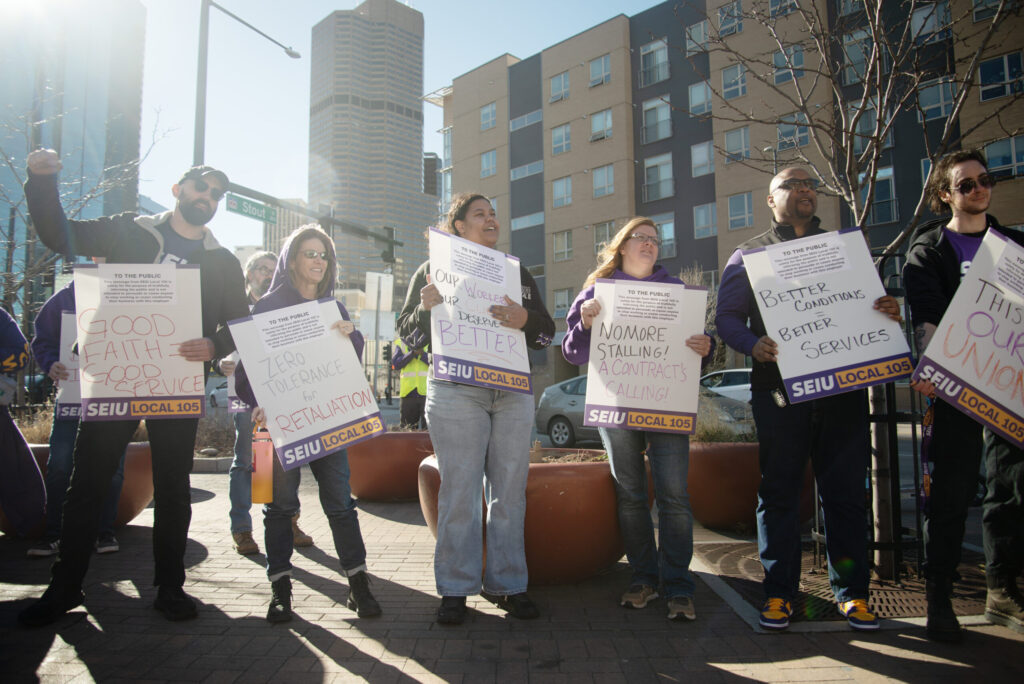
Veto likely as union-backed bill heads to Colorado governor’s desk — again
Marissa Ventrelli
marissa.ventrelli@coloradopolitics.com
Updated 12 hours ago
For the second year in a row, a bill that would make it easier for labor organizations to impose fees on all workers, regardless of union membership, is headed for Gov. Jared Polis’ desk. The governor, who vetoed the legislation...

Aurora mental health nonprofit cuts 100-plus jobs after Colorado agency reduces reimbursement rate
Marianne Goodland
marianne.goodland@coloradopolitics.com
Updated 19 hours ago
A nonprofit that provides services through 11 mental health centers in Aurora announced Thursday that it is eliminating 111 jobs effective June 30, the result of federal and state budget reductions. Aurora Mental Health & Recovery said the positions being...
Denver law students create AI-powered tools in federal judge’s ‘design sprint’
Michael Karlik
michael.karlik@coloradopolitics.com
Updated 9 hours ago
A tenant discovered a handwritten note on his door stating he had 48 hours to move out. The landlord changed the locks without notice or court proceedings. The tenant paid rent on time and had never received any complaints about...

Colorado space startup secures $650 million for expansion
alex-edwards
alex.edwards@gazette.com
Updated 2 days ago
The window to deliver space superiority for the U.S. is open but shrinking rapidly, according to defense startup True Anomaly. The Centennial-based company hit a milestone in its pursuit to help deliver that, announcing Tuesday that it raised $650 million...