

Matthew Ball chosen to represent Colorado’s Senate District 31 after five rounds of voting
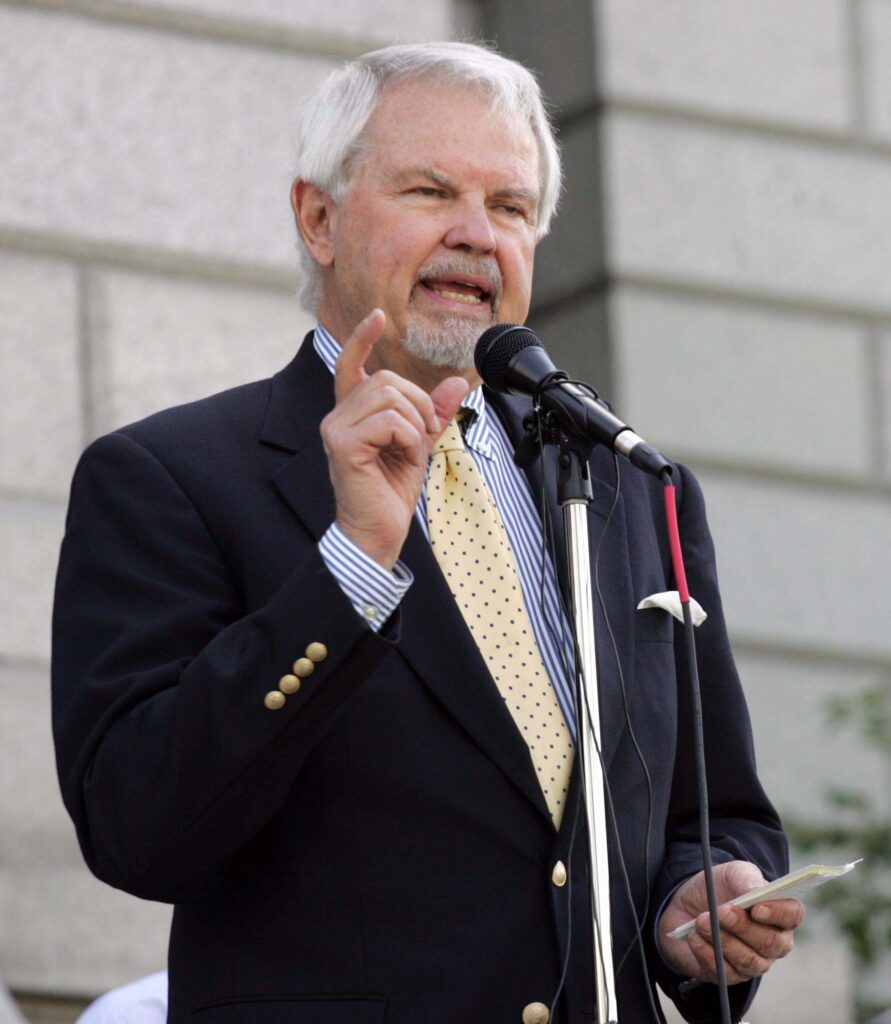
A Democratic vacancy committee for Senate District 31 chose Matthew Ball to represent the central Denver district after five rounds of voting Tuesday night.
Ball won with 61 votes over Rep. Steven Woodrow of House District 2, who finished with 37.
Seven candidates squared off in an hour-long candidates forum before the vacancy committee got down to the business of voting. The committee had 107 members present out of 109 total members. To win with the required 50% plus one of the vote, candidates had to get 54 votes as long as all 107 voted.
The seven candidates:
- Ball, policy director for the city of Denver
- Rep.-elect Sean Camacho of House District 6
- Woodrow
- Chris Chiari, a filmmaker and owner of The 420 Hotel
- Iris Halpern, an attorney and partner at Rathod Mohamedbhai LLC
- Shaneis Malouff, chief of staff at the Auraria Higher Education Center
- Monica Van Buskirk, a small business owner, formerly with Connect for Health Colorado.
After the first round of balloting Ball received 32 votes, Woodrow got 25 votes, Camacho received 18 votes, Van Buskirk won 15 votes, Malouff got eight votes, Halperin took six votes, and Chiari got one vote. Chiari was dropped from the list for the second round of balloting.
On round two, Ball got 32 votes, Woodrow received 30 votes, Van Buskirk took 15 votes, Camacho received 14 votes, Halpern won 7 votes and Malouff took four votes. Malouff dropped off for round three.
Round three resulted in two fewer candidates: Halpern got seven votes and was dropped for round four; Camacho announced he was withdrawing.* Ball got 35 votes, Woodrow took 30 votes, Van Buskirk won 16 votes, and Camacho got 12 votes.
In round four, Ball got 49 votes, Woodrow 36 votes and Van Buskirk got 20 votes and dropped off for the fifth and final round.
The candidates faced questions on issues such as the budget deficit, how they would work across the aisle with Republican colleagues, climate change, their experience in working with blue-collar and Hispanic voters, how to address childcare and transportation/commuting issues and what each candidate felt was the most pressing issue in the district.
Camacho outlined what he wouldn’t cut with regard to the state’s $1 billion shortfall: education and higher education, which he called critical functions to protect. Halpern called for putting off spending on Proposition 130, which voters approved in November and which would put $350 million into public safety, although the measure didn’t identify a timeline for when that would start, although she said she was okay with spending $10 million to $15 million to support fallen police officers.
Malouff spoke of protecting K-12 and higher education, as well as not cutting Medicaid provider rates, which has been proposed by the governor. Van Buskirk noted Medicaid is 40% of the state budget, and lawmakers should look for ways to make it more efficient.
Woodrow noted that in his five years in the legislature, in only one year did lawmakers have money to spend. The others have included drastic cuts or sweeping cash funds. TABOR is the real issue, Woodrow said. He called for a focus on tax credits for the wealthy and large corporations, and to look at the funding for the Department of Corrections.
Ball said he’s just finished his second budget cycle with the city of Denver, which had lower than expected tax revenues. He advocated for protecting education and the state pension plan, but to also have a “strategic conversation” around TABOR. That could include going to the ballot with a “progressive income tax” that doesn’t raise everyone’s taxes, just on the top one percent or five percent.
Where would the candidates compromise to get to broader consensus? “Ideological purity cannot be the only place where we build rapport,” said Chiari.
Halpern responded that she’s worked on legislation that had support from both sides of the aisle, and that Republicans must be involved in the discussion on affordable housing because it’s not just an issue in Denver. But it’s important not to cave on priorities, she added.
Van Buskirk grew up with a conservative father, but said it taught her how to find that common ground, and she pointed to her work to pass the 2021 Colorado Option bill, which was bipartisan.
Woodrow, who has taken heat, including from House Speaker Julie McCluskie, for divisive rhetoric against Republicans on Twitter, said “governing is compromise” and that they can compromise on the details of policy without sacrificing values. But there are areas where there is real, genuine deep disagreement with Republicans, such as on abortion or climate change. “Do we do it in a way that’s disparaging and cutting and indulges our basic instincts on social media? Or is it a way that brings out the best of our ideals and what we wanna accomplish? And that’s what I hope to do going forward.”
Woodrow deleted his Twitter account after calling then-presidential candidate Trump “the devil” following the July assassination attempt.
Ball pointed to his experience on the city’s Roads to Recovery initiative, inviting in police, sheriffs, social workers and members of city council to deal with the thousands of people who cycle in and out of jail and psychiatric facilities.
Denver is closing schools, including three in the district, and the state is in the bottom five in providing talent to meet workforce needs. Camacho was at the Metro Denver Chamber of Commerce legislative preview Tuesday morning and heard Republicans talking about that issue. He said he has bills with Republican prepared for the 2025 session where he found common ground to delivery for youth.
On the issue of climate change, several candidates pointed to Hansen’s leadership.
How would the candidates reach out to blue collar and Hispanic voters, who turned to the Republican Party in the November election? It’s about economics, said Malouff, advocating for a progressive income tax and levying higher taxes on the top 1%, which she said would bring in almost $1 billion. Van Buskirk said she was running to bring in someone who represents “a broader part of our district,” is engaged with sports teams and with small businesses along Colfax. “We need to go where the people are,” she added.
“We need to follow the lead of the Black and Latino caucuses,” said Woodrow. “They understand their communities and the disconnect between the things that we are all fighting so hard for and what they see on the ground in their communities and neighborhoods day to day.”
Ball said he grimaced during the last election when the party told people the economy was fine “because it didn’t match peoples’ lived experience. When you don’t talk to people in a way that reflects what they know, then you lose trust. And so that’s what I think we need to talk about as a party, is that we are not talking about the kitchen table issues.”
Camacho, the only person of color among the seven, said the Senate needs more Latino representation, given that it has just three Latino/a senators, a point also made by Servicios Segue in their endorsement. The Democratic Party needs to recenter on the people they work for, working people. “We cannot be a party of the elites.”
The candidates were also asked which three Coloradans, living or dead, they would dine with to pick their brains about the state and how to succeed as a state senator.
Among the names: Barney Ford, former U.S. Rep. Ed Perlmutter, current House Speaker Julie McCluskie, Senate President-elect James Coleman, former U.S. Rep. Pat Schroeder, Mayors Wellington Webb and Federico Pena, Justice Monica Marquez, former Gov. Roy Romer and Karl Frithjof Hovelsen, the founder of Steamboat Springs, all came up. And so did Doug Bruce, “just so I can harangue the hell out of him,” said Woodrow.
The 2025 General Assembly starts at 10 a.m. Wednesday morning.
With Ball’s election, the only vacancy left to be resolved is in House District 41, after Rep. Iman Jodeh was picked by a vacancy committee Monday to succeed Sen. Janet Buckner, both Aurora Democrats.
Correction: a previous version incorrectly said Camacho threw his support to Woodrow after the fourth round. Colorado Politics regrets the error.


Trump order aims to help more people get retirement savings plans in time for new federal match
Collin Binkley
collin.binkley@associatedpress.com
Updated 2 hours ago
WASHINGTON • President Donald Trump signed an executive order on Thursday calling for a new government website where people in the United States can find and compare private-sector retirement savings accounts, aiming to help millions of workers whose employers do not offer such...

Colorado Politics Calendar May 4-10
Rachael Wright, Special to Colorado Politics
rachael.wright@coloradopolitics.com
Updated 3 days ago
CoPo’s weekly political calendar will help you find political and public-policy events throughout Colorado. It includes candidate and issue campaign events, public policy meetings, court hearings, state and local party conventions, assemblies, debates, rallies, parades, speaking engagements, traveling dignitary appearances,...
Gov. Lamm scolds own party over losing modernization battle against GOP | A LOOK BACK
Rachael Wright, Special to Colorado Politics
rachael.wright@coloradopolitics.com
Updated 3 days ago
Forty-Five Years Ago This Week: “The Democratic Party lost the battles of ideas and political technology last November,” Gov. Dick Lamm told the Boulder County Democratic Party at the annual Harry S. Truman Memorial Dinner. Lamm argued that the Democratic...

The need for a governor to say “no” to his friends | SONDERMANN
By Eric Sondermann
by-eric-sondermann@coloradopolitics.com
Updated 2 days ago
A wise man once remarked that the real test of a governor is his willingness to turn down and reject the pleadings of political friends and allies. That gentleman knew something of what he spoke. He occupied the corner-office executive...

Dismissal sought in Michael Clark’s second trial
Jenny Deam
jenny-deam@coloradopolitics.com
Updated 10 hours ago
The murder conviction of Michael Clark should be dismissed due to a 32-year delay that led to crucial evidence being lost or destroyed, a bungled police investigation and “outrageous conduct” at the state crime lab, according to defense motion filed...

Colorado to get $75 million from opioid settlement with Purdue Pharma
Marissa Ventrelli
marissa.ventrelli@coloradopolitics.com
Updated 1 hour ago
A $7.4 billion settlement reached with the pharmaceutical company Purdue Pharma and the Sackler family — its owners — is now legally effective a decade after attorneys general from multiple states launched an investigation and seven years after Colorado filed...

Committee approves reworked version of previously vetoed rideshare bill
Marissa Ventrelli
marissa.ventrelli@coloradopolitics.com
Updated 1 day ago
Members of the Colorado House Business Affairs and Labor Committee voted across party lines to pass a modified version of a bill establishing regulations on rideshare companies. Last year, Reps. Jenny Willford, D-Northglenn, and Meg Froelich, D-Englewood, introduced House Bill...
Fight over credit card ‘swipe fees’ attracts nearly 200 lobbyists in Colorado
Marianne Goodland
marianne.goodland@coloradopolitics.com
Updated 1 day ago
One of the most expensive fights of the 2026 session got a little closer to being over on Friday, when the Colorado Senate took a second final vote on the proposal to eliminate “swipe fees” on sales taxes. It’s not...

Veto likely as union-backed bill heads to Colorado governor’s desk — again
Marissa Ventrelli
marissa.ventrelli@coloradopolitics.com
Updated 1 day ago
For the second year in a row, a bill that would make it easier for labor organizations to impose fees on all workers, regardless of union membership, is headed for Gov. Jared Polis’ desk. The governor, who vetoed the legislation...

Aurora mental health nonprofit cuts 100-plus jobs after Colorado agency reduces reimbursement rate
Marianne Goodland
marianne.goodland@coloradopolitics.com
Updated 1 day ago
A nonprofit that provides services through 11 mental health centers in Aurora announced Thursday that it is eliminating 111 jobs effective June 30, the result of federal and state budget reductions. Aurora Mental Health & Recovery said the positions being...