

Utah project marks big boost for electricity made from the heat of the Earth | OUT WEST ROUNDUP
UTAH
Geothermal power development hits milestone
One method of making electricity cleanly to address climate change has been quietly advancing and on June 25 it hit a milestone.
A California utility is backing the largest new geothermal power development in the U.S. — 400 megawatts of clean electricity from the Earth’s heat — enough for some 400,000 homes. Southern California Edison will purchase the electricity from Fervo Energy, a Houston-based geothermal company, Fervo announced.
The company is drilling up to 125 wells in southwest Utah.
The boost could go a long way toward bringing down the cost of a new generation of geothermal energy, said Wilson Ricks, an energy systems researcher at Princeton University.
The first generation of geothermal plants — The Geysers in California, tapped into superheated reservoirs of steam or very hot water close to the Earth’s surface. Such reservoirs are relatively rare.
Colorado kicks off $12M grant program for geothermal energy
New geothermal companies are adapting drilling technology and practices taken from the oil and gas industry to create reservoirs from hot rock, unlocking the potential for geothermal energy in many more places.
Fervo is pioneering horizontal drilling in geothermal reservoirs. It signed the world’s first corporate agreement with Google in 2021 to develop new geothermal power and drilled three wells in Nevada. That project began sending carbon-free electricity onto the Nevada grid in November to power data centers there.
The Cape Station project, about 200 miles south of Salt Lake City, is expected to start delivering electricity to California as early as 2026.
ARIZONA
Metro Phoenix reports at least 6 heat-related deaths
PHOENIX — At least six people have died from heat-related causes this year so far in sizzling metro Phoenix, where the temperatures in late June hit 115 degrees Fahrenheit, the Maricopa County Department of Public Health reported.
Another 87 deaths are under investigation for possible heat-related causes through June 15, public health officials said in the weekly update to its online heat surveillance information.
Phoenix hit 115 degrees F on June 20 and 21, making them the hottest days of 2024 up to that point.
Meteorologist Ryan Worley of the National Weather Service said rain could cool the area to “around 110 degrees,” but added that temperatures would likely increase the following week.
Arizona county confirms 645 heat-associated deaths in metro Phoenix last year | OUT WEST ROUNDUP
Situated in the Sonoran desert, Maricopa County saw a stunning 645 heat-related deaths last year, about 50% more than the 425 confirmed for 2022.
Arizona Gov. Katie Hobbs declared a state of emergency in 2023 after metro Phoenix experienced a 31-day streak of temperatures reaching at least 110 degrees F.
Maricopa County, the hottest big metro area in the U.S., is among few jurisdictions that provide regularly updated data on heat-related deaths that can be easily accessed by the public.
Last year in Pima County, home to Arizona’s second most populous city of Tucson, there were 176 heat-related deaths and another 51 such deaths in the five additional rural counties that the medical examiner handles.
OKLAHOMA
State superintendent orders grade 5-12 to teach the Bible
OKLAHOMA CITY — Oklahoma’s top education official ordered public schools on June 27 to incorporate the Bible into lessons for grades 5 through 12, the latest effort by conservatives to incorporate religion into classrooms.
The directive drew immediate condemnation from civil rights groups and supporters of the separation of church and state, with some calling it an abuse of power and a violation of the U.S. Constitution.
The order sent to districts across the state by Republican State Superintendent Ryan Walters says adherence to the mandate is compulsory and “immediate and strict compliance is expected.”
Oklahoma law already explicitly allows Bibles in the classroom and lets teachers use them in instruction, said Phil Bacharach, a spokesman for state Attorney General Gentner Drummond.
Faith and power: Review finds religion overrepresented in Colorado's legislature | COVER STORY
But it’s not clear if Walters has the authority to mandate that schools teach it. State law says individual school districts have the exclusive authority to decide on instruction, curriculum, reading lists, instructional materials and textbooks.
“Public schools are not Sunday schools,” said Rachel Laser, president and CEO of Americans United for Separation of Church and State, in a statement. “This is textbook Christian Nationalism: Walters is abusing the power of his public office to impose his religious beliefs on everyone else’s children. Not on our watch.”
A former public school teacher who was elected to his post in 2022, Walters ran on a platform of fighting “woke ideology,” banning books from school libraries and getting rid of “radical leftists” who he claims are indoctrinating children in classrooms.
High court nixes public funds for religious charter school
OKLAHOMA CITY — The Oklahoma Supreme Court on June 25 stopped what would have been the first publicly funded religious charter school in the U.S., turning back conservatives and the state’s GOP governor who have welcomed religious groups into public education.
The high court ruled 7-1 that the Statewide Virtual Charter School Board’s 3-2 vote last year to approve an application by the Catholic Archdiocese of Oklahoma for the St. Isidore of Seville Virtual Charter School violates the Establishment Clause, which prohibits government from making any law “respecting an establishment of religion.” The ruling also says both the Oklahoma and U.S. constitutions, as well as state law, were violated.
“Under Oklahoma law, a charter school is a public school,” Justice James Winchester, an appointee of former Republican Gov. Frank Keating, wrote in the court’s majority opinion. “As such, a charter school must be nonsectarian.”
The Archdiocese of Oklahoma City and Diocese of Tulsa said in a statement they will “consider all legal options” in response to the court’s ruling.
Across the nation and in Colorado, partisan cultural battles create blizzard of school-related lawsuits
The lone dissenter, Justice Dana Kuehn, wrote that excluding St. Isidore from operating a charter school based solely on its religious affiliation would violate the Free Exercise Clause of the First Amendment to the U.S. Constitution.
A group of Oklahoma parents, faith leaders and a public education nonprofit sued to stop the establishment of the school.
Oklahoma Gov. Kevin Stitt, who supported the board’s decision, said he was disappointed by the challenge and remained hopeful the U.S. Supreme Court would consider the case.
KANSAS
Governor OKs bills to entice Chiefs, Royals with new stadiums
TOPEKA — Kansas’ governor signed legislation on June 21 enabling the state to lure the Super Bowl champion Kansas City Chiefs and Major League Baseball’s Royals away from neighboring Missouri by helping the teams pay for new stadiums.
Gov. Laura Kelly’s action came three days after the Republican-led Legislature approved the measure with bipartisan supermajorities — an unusually quick turnaround that signals how urgently Kansas officials consider making the offers.
Missouri officials have argued that discussions about building new stadiums are still in the early stages. They said construction of a new one typically takes about three years, and pointed out that the lease on the existing complex that includes the teams’ side-by-side stadiums doesn’t end until January 2031.
The measure Kelly signed will allow bonds to cover 70% of a new stadium’s cost. The state would have 30 years to pay them off with revenues from sports betting, state lottery ticket sales, and new sales and alcohol taxes generated in the area around each proposed stadium.
The height of controversy: Proposed 36-story high-rise in downtown Colorado Springs spurs views vs. vibrancy debate
The Kansas-Missouri border splits the 2.3 million-resident Kansas City area, with about 60% of the people living on the Missouri side.
Kansas officials began working on the legislation after voters on the Missouri side of the metropolitan area refused in April to continue a sales tax used to keep up the existing stadium complex.
Kansas lawmakers approved the stadium financing plan during a single-day special session Tuesday. Kelly, a Democrat, called the session for the legislature to consider tax cuts after she vetoed three previous tax plans and legislators adjourned their regular annual session May 1.
Although the financing law doesn’t specifically name the Chiefs or Royals, it is limited to stadiums for National Football League and Major League Baseball teams “in any state adjacent to Kansas.”
Rare white buffalo calf in Yellowstone park fulfills Lakota prophecy | OUT WEST ROUNDUP
Wyoming pass landslide brings mountain-sized headache to commuting workers | OUT WEST ROUNDUP
Rare lizard's endangered listing could slow oil and gas drilling in Permian Basin | OUT WEST ROUNDUP


Colorado halts wolf releases for 2026 as federal pressure mounts
Marianne Goodland
marianne.goodland@coloradopolitics.com
Updated 45 minutes ago
Colorado Parks and Wildlife, facing mounting criticism from the Trump administration over its management of the wolf reintroduction program, announced Wednesday they will not bring in any new wolves to the state for the 2026 winter season. CPW was turned...

Colorado wildlife officials report first wolf death of 2026 as mortality count reaches 13
Marianne Goodland
marianne.goodland@coloradopolitics.com
Updated 16 minutes ago
Colorado Parks and Wildlife announced late Monday that another British Columbia female gray wolf, known as 2504-BC, was found dead in northwest Colorado on Friday, Jan. 16. No cause of death nor an exact location of where the wolf was...

Trump’s threats challenge Europe’s security and prosperity, EU chief says ahead of summit
Lorne Cook
lorne.cook@associatedpress.com
Updated 3 hours ago
BRUSSELS (AP) — U.S. President Donald Trump’s threats to annex Greenland and impose tariffs on its backers pose a challenge to Europe’s security, principles and prosperity, European Council President António Costa said on Wednesday. “All these three dimensions are being...
Federal judge says prisoner cannot sue for dog-bite injury
Michael Karlik
michael.karlik@coloradopolitics.com
Updated 4 hours ago
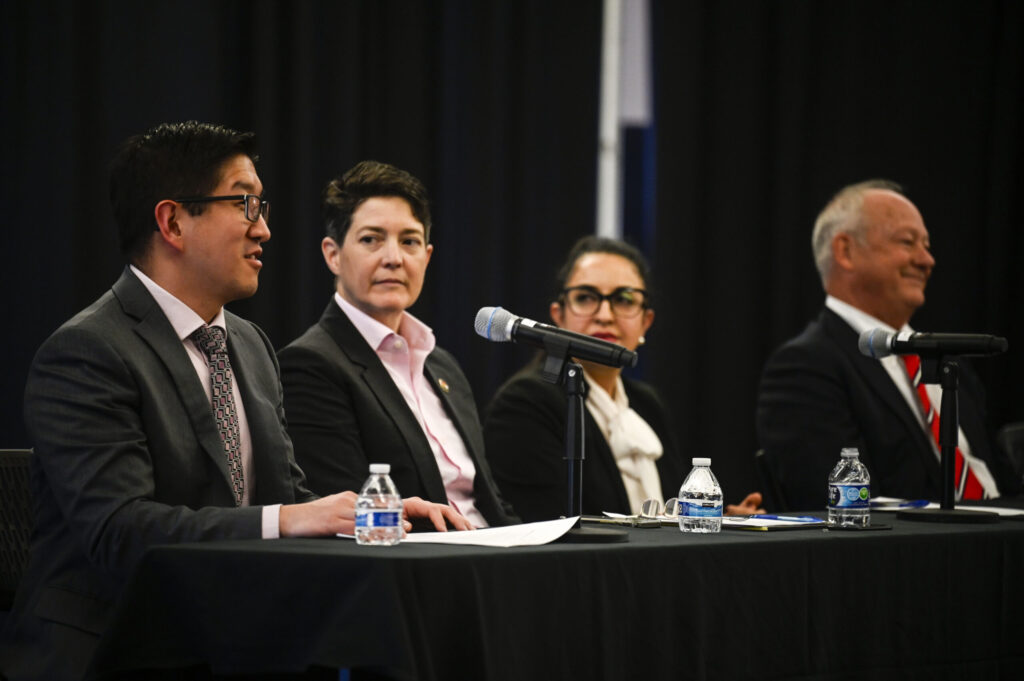
A federal judge concluded last week that a man cannot sue the government for injuries he sustained when a dog allegedly attacked him while he participated in a prison program. Kenneth M. Chandler, representing himself, was participating in the “FIDOS”...

Agencies investigate suspicious object at Lake Pueblo State Park
James Gavato
james-gavato@gazette.com
Updated 2 hours ago
PUEBLO — Agencies were investigating a suspicious object Tuesday night at Lake Pueblo State Park, according to Colorado Parks and Wildlife. Parks and Wildlife states that officials discovered a “suspicious munitions-like object” that was partially buried near the dam, Gazette...

Colorado Springs officials oppose Space Command lawsuit; AG won’t back down
Mary Shinn
mary-shinn@coloradopolitics.com
Updated 3 hours ago
As Colorado Springs and El Paso County officials oppose a lawsuit against the Trump administration over relocating Space Command to Alabama, the state Attorney General’s Office says it won’t back down. “Some elected officials may choose to accommodate the Trump...

Fort Carson soldier’s wife could be deported
Carol McKinley
carol-mckinley@coloradopolitics.com
Updated 2 hours ago
As the country’s largest immigration enforcement crackdown continues in Minnesota’s Twin Cities, a Fort Carson sergeant is fighting a personal immigration crisis — one that may implode his family. Sgt. Tyler Garza’s wife, Jennifer Maradiaga Baca, is not a legal...
4 arrested after $900K in damages to former Pueblo County middle school
Cleo Westin
cleo-westin@coloradopolitics.com
Updated 2 hours ago
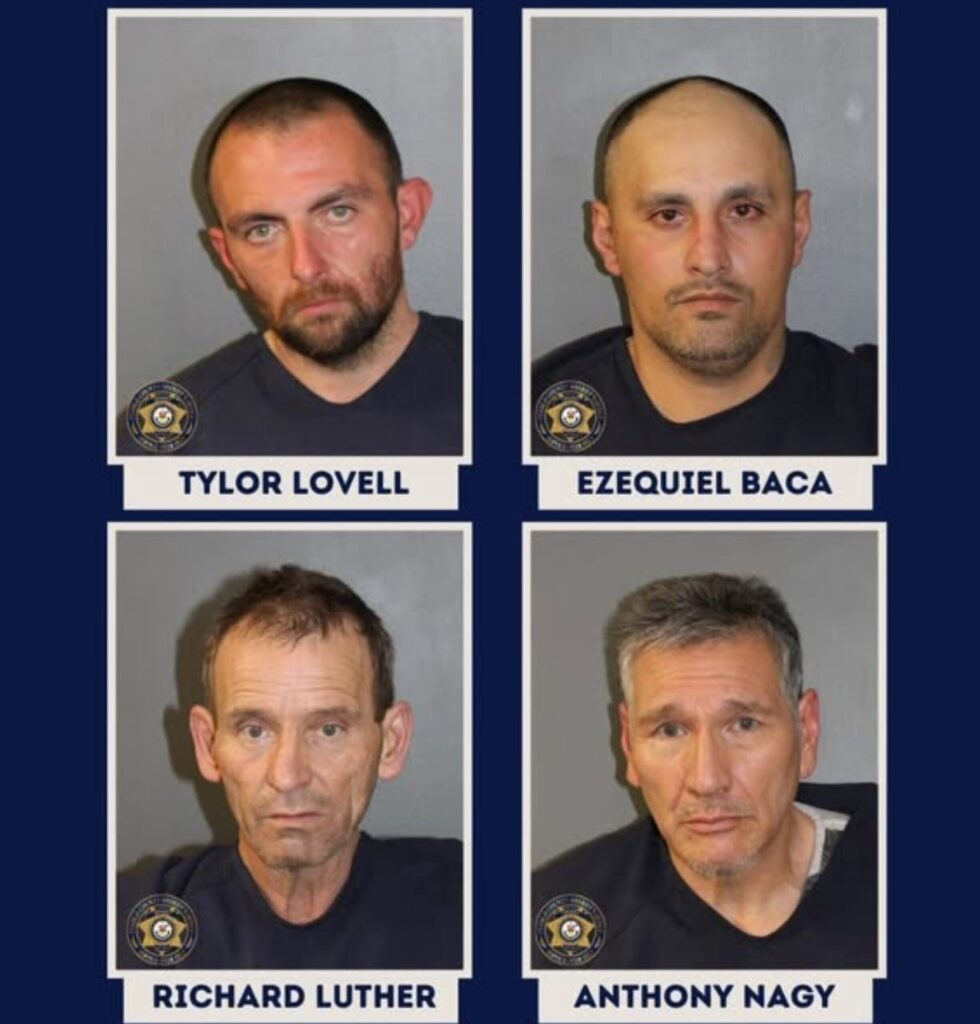
Pueblo County sheriff’s deputies arrested four men after interrupting a burglary in progress at the former Excelsior Middle School on Thursday, according to a news release by the Sheriff’s Office. Richard Luther, 60, Tylor Lovell, 31, Ezequiel Baca, 35, and...

Federal judge recommends dismissing trans athletics lawsuit by area school districts
Eric Young
eric.young@gazette.com
Updated 2 hours ago
A judge has recommended dismissing a federal lawsuit filed by multiple school districts against the Colorado Attorney General’s and Civil Rights Offices over their policies dictating students’ participation in athletics and activities based on their biological sex rather than gender...
DOJ subpoenas Minnesota officials in ICE probe
The Associated Press
the-associated-press@coloradopolitics.com
Updated 20 hours ago
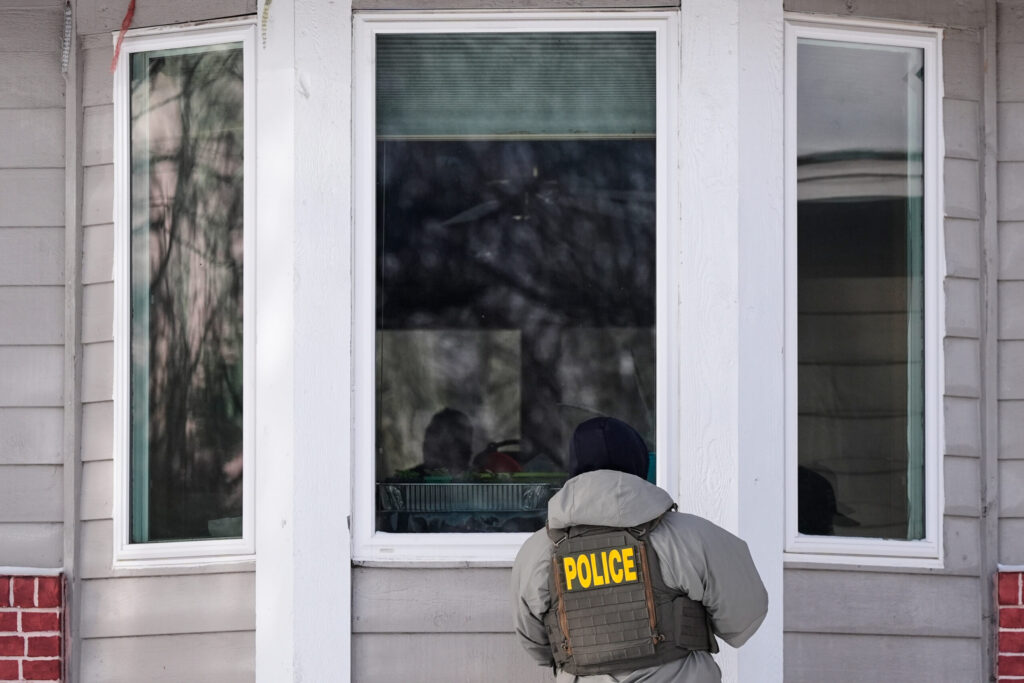
MINNEAPOLIS — Federal prosecutors served grand jury subpoenas Tuesday to Minnesota officials as part of an investigation into whether they obstructed or impeded law enforcement during a sweeping immigration operation in the Minneapolis-St. Paul area, a person familiar with the...