

Colorado lawmakers target social media platforms used by kids, justices grapple with questions of race in jury selection | WHAT YOU NEED TO KNOW

Today is Feb. 15, 2024, and here’s what you need to know:
A measure in the Colorado state Senate aims to impose a host of requirements on social media companies, including age verification, tools and settings for parents and a prohibition against practices that are “not in the best interest of juveniles.”
Notably, the proposal mandates social media companies to respond to inquiries from law enforcement agency within three days – and to fulfill such requests within 30 days.
The new guardrails would help create a safer and healthier online environment for children, the bill’s sponsors said, adding that “unregulated” social media platforms have wreaked havoc on kids’ mental health and made it dangerously easy for sexual predators to target them.
For two hours on Tuesday, the Colorado Supreme Court grappled with a question that could significantly affect the composition of juries going forward: If a juror of color, based on her experiences, says that bias in policing exists, would removing that person from the jury pool be tantamount to dismissing her because of her race?
Previously, in a pair of cases out of Arapahoe County, the state’s second-highest court overturned the defendants’ convictions because prosecutors dismissed, or “struck,” two women of color from the jury pool. Although the prosecutors explicitly justified the strikes with concerns about the women’s attitudes toward police, the Court of Appeals concluded those views were linked to race.
During oral arguments, Justice Richard L. Gabriel warned that if prosecutors could strike jurors of color whose negative experiences with police were informed by their race – or the race of their friends and family – anyone who speaks about a “driving while Black” encounter could effectively be barred from serving on criminal juries.
When Friday Health Plans went belly up in August last year, it didn’t just leave 30,000 Coloradans without health insurance.
Most of those former clients, largely in the individual market, found themselves facing the prospect that they’d have to start over with a new health insurance company mid-year and pay a new round of deductibles in the months to come.
Officials urged health insurers to honor those out-of-pocket and deductibles and not require their new clients to pay them twice in a calendar year.
A bipartisan group of Colorado officials and lawmakers on Wednesday unveiled legislation that allocates millions of dollars in tax credits, which they say would help position Colorado as one of the nation’s top quantum tech hubs.
Gov. Jared Polis and state legislators on Wednesday announced legislation that creates an income tax credit and a “loan loss” reserve.
The Biden administration named Colorado a federally-designated quantum tech hub in October, citing the industry’s technological uses for medicine, computing, logistics, networks and military operations.
Aurora Mayor Mike Coffman met with three homeless men over the weekend and said on social media that the conversation reaffirmed his belief in a “work first” approach to homelessness.
The three men Coffman met with were living in a hotel used by Denver, he said. The four met for breakfast at a truck stop near the hotel.
On Dec. 31, Coffman wrote, the three men were told they’d be arrested if they stayed at the encampment they lived in. They were told to pack their things into two large yellow trash bags and prepare to move into a hotel, Coffman wrote.


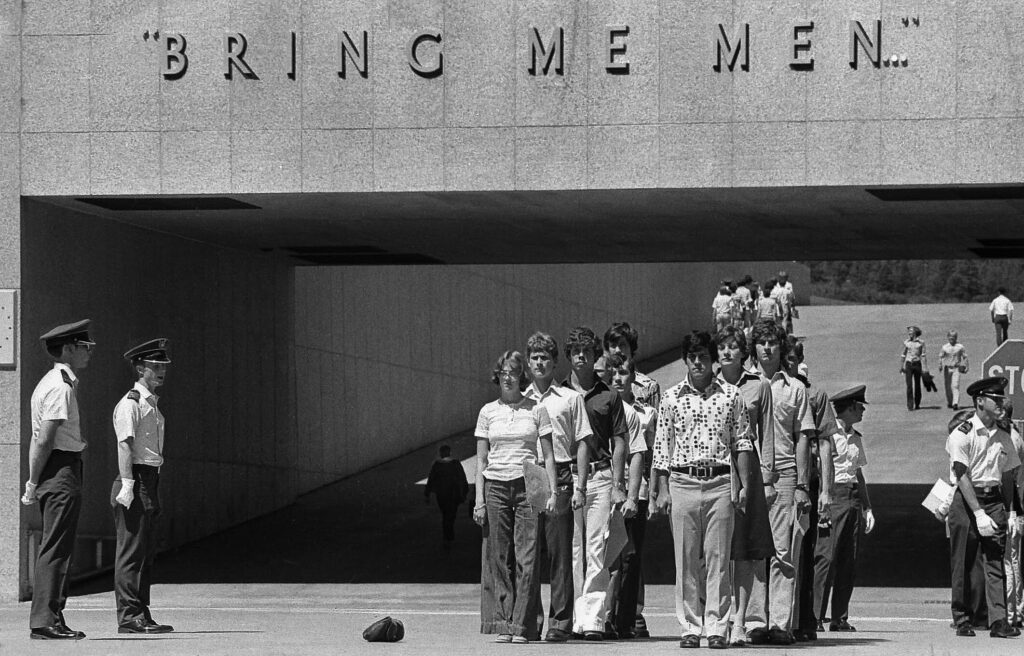
Fifty years later, women reflect on first coed class at the Air Force Academy, struggle for equality
Mary Shinn
mary-shinn@coloradopolitics.com
Updated 2 days ago
When the first female Air Force Academy cadets arrived 50 years ago this summer, they stood in front of an enormous sign on campus that read “Bring me men.” In the shadow of that sign, Kathleen Utley Kornahrens, one of...

As Lake Powell shrinks, marinas are having to adapt to dwindling water levels | OUT WEST ROUNDUP
The Associated Press
the-associated-press@coloradopolitics.com
Updated 5 days ago
ARIZONA Reservoirs near record lows PAGE — The Colorado River’s Lake Powell, the second largest reservoir in the U.S., is shrinking. A record-dry winter and extreme heat — as well as decades of overuse, chronic drought and climate change —...

A new day? Colorado’s troubled guardianship office pursues ‘cultural reset’
Marianne Goodland
marianne.goodland@coloradopolitics.com
Updated 4 days ago
Colorado’s guardianship program, long criticized for mismanagement and high staff attrition, is undergoing a “cultural reset,” as its new director works to repair partnerships and prepare for a major expansion under recent legislation. Created by lawmakers in 2017, the Office...

U.S. Senate OKs funding bill to avoid government shutdown
Wire Services
wire-services@coloradopolitics.com
Updated 2 days ago
Hemp provision became point of contention WASHINGTON • The U.S. Senate in an overnight vote Saturday approved a short-term measure to fund federal agencies into early December and avoid a government shutdown during the middle of campaign season. The late-summer...

The relevance of Watergate more than a half-century later | SONDERMANN
By Eric Sondermann
by-eric-sondermann@coloradopolitics.com
Updated 5 days ago
It was the scandal for which all other scandals are now named. In June 1972, a small group of Cuban burglars with high-level connections broke into the headquarters of the Democratic National Committee. Those headquarters were located in the Watergate...

Wirth downplays Social Security disaster talk | A LOOK BACK
Rachael Wright, Special to Colorado Politics
rachael.wright@coloradopolitics.com
Updated 4 days ago
Forty-five years ago this week: “As time goes on,” said Democratic U.S. Rep. Tim Wirth, of the 2nd Congressional District, “we are finding that the safety net, which was proposed earlier this year, has some very large holes in it,”...

Colorado Politics Calendar Aug. 10-16
Rachael Wright, Special to Colorado Politics
rachael.wright@coloradopolitics.com
Updated 4 days ago
CoPo’s weekly political calendar will help you find political and public-policy events throughout Colorado. It includes candidate and issue campaign events, public policy meetings, court hearings, state and local party conventions, assemblies, debates, rallies, parades, speaking engagements, traveling dignitary appearances,...

Democratic group aims Spanish-language TV ad at Gabe Evans in Colorado’s battleground 8th CD
Ernest Luning
ernest.luning@coloradopolitics.com
Updated 2 days ago
A national group tied to House Democratic leadership launched a six-figure Spanish-language TV ad in Colorado this week targeting Republican U.S. Rep. Gabe Evans and the GOP’s signature budget legislation. The 30-second spot is part of $15 million in new...

Colorado School of Mines lands major share in Trump’s $100M mining-education plan
Thelma Grimes
thelma.grimes@coloradopolitics.com
Updated 3 days ago
President Donald Trump on Friday named the Colorado School of Mines among roughly a dozen institutions that will share in a $100 million commitment “to train the next generation of American miners.” Paul Johnson, the university’s president, said he is...

Local party leaders, incoming judge among members of judicial performance commission that violated law
Michael Karlik
michael.karlik@coloradopolitics.com
Updated 2 days ago
A local Democratic leader and 2024 presidential elector. A legislative aide and leader in the Young Republicans. An incoming county court judge freshly appointed by the governor. They are among the eight members of the northeastern Colorado judicial performance commission...
PREV
PREVIOUS

Longtime Colorado Springs businessmen purchase right to publish the defunct Independent and Business Journal
A financially strapped alternative weekly in Colorado Springs that shut down in December and whose nonprofit publishing company since has folded will relaunch in a few months, according to two local investors behind the reboot. Business partners J.W. Roth and Kevin O’Neil said Wednesday that they have acquired the rights to publish the Colorado Springs […]

Denver magistrate may resolve dispute between parents over whether to vaccinate child against COVID-19, appeals court says
Colorado’s second-highest court last week clarified that trial judges need not find a child is endangered before they break an impasse between two parents who cannot agree about which course of action is best. A three-judge panel for the Court of Appeals agreed a Denver magistrate appropriately sided with a father who wanted his child […]