

Estes Park dam disaster kills three, sparks legislative action | A LOOK BACK

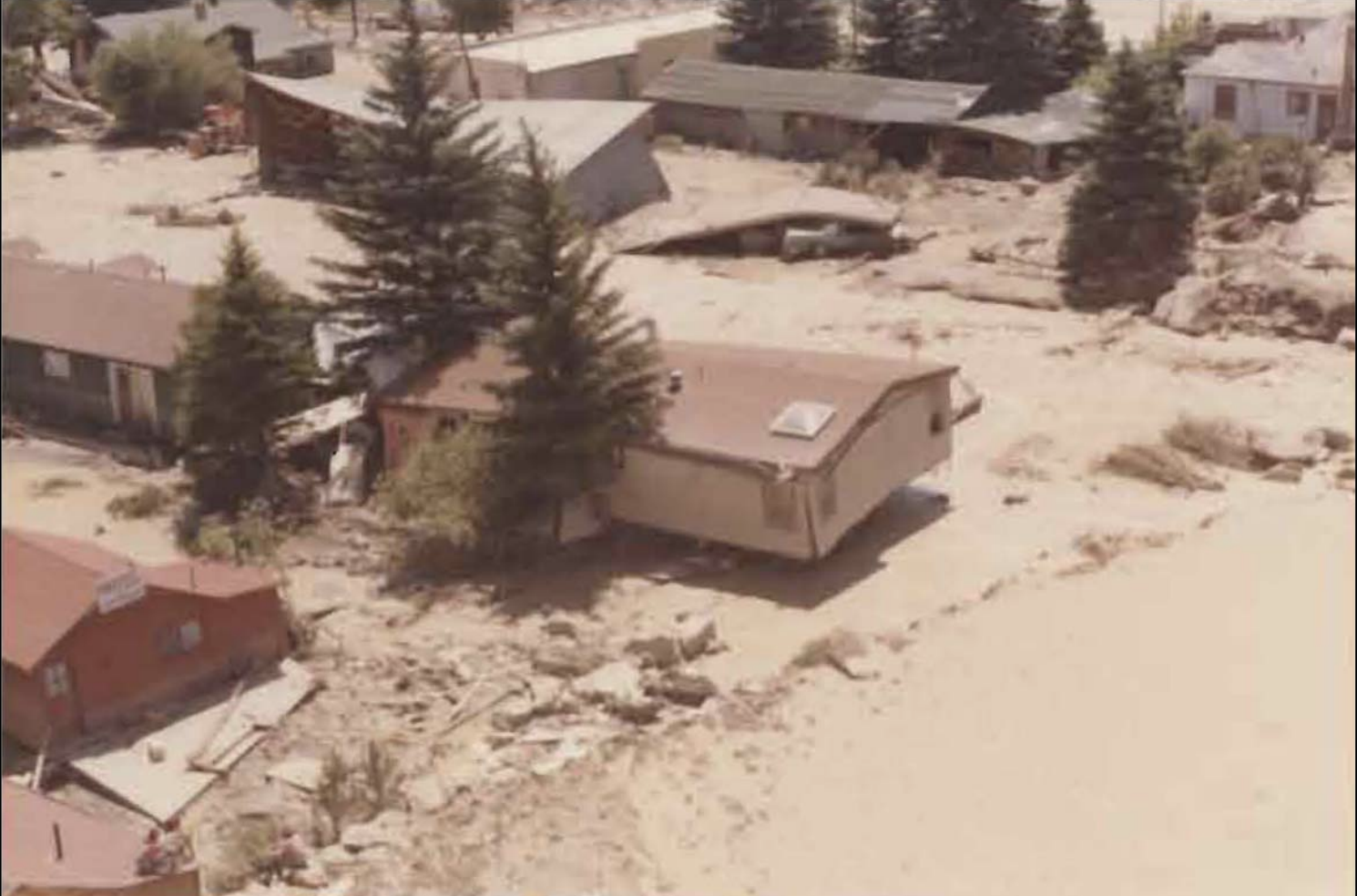
Forty Years Ago This Week: Just after 6 a.m. on July 15, 1982, the Lawn Lake Dam above Estes Park experienced a “catastrophic failure,” causing 30 million cubic feet of water to tear through the landscape, headed directly toward the town of Estes Park. After merging with the Cascade Dam and Fall River, five to six feet of mud and water poured into the town, damaging 177 Estes Park businesses – over 90% of the commercial structures – and causing more than $31 million in damages and the deaths of three people.
The National Park Service had no warning or evacuation plan in place for a potential dam failure near Horseshoe Park, and was later sued by family members of the three people who lost their lives in the tragedy.
President Ronald Reagan declared the flood a national disaster. Nine months later, Colorado State Engineer Jeris A. Danielson issued a report pointing to the source of the failure, “leakage under high pressure … from the outlet pipe and valve.”
Mesa State College Dean of Students Sen. Tilman Bishop, R-Grand Junction, had spent his interim months studying Colorado’s 27,000 dams, reservoirs and stock ponds. Following his research, state Sens. Wayne Allard, R-Loveland, Joel Hefley, R-Colorado Springs, Richard Soash, D-Steamboat Springs, Don Sandoval, D-Denver, and Rep. Walt Younglund, R-New Raymer, joined Bishop in announcing the introduction of Senate Bill 84-28 and House Bill 84-1052 to help clarify responsible parties for water storage and related problems in Colorado.
“The Lawn Lake tragedy and the interim study,” Bishop said, “raise questions of reservoir safety, and there are numerous questions currently without answers.”
Bishop outlined some of those questions: “Who in a dam tragedy is responsible? Who inspects which dams and for what purpose? What is the reservoir’s obligation to recreational user safety What do we do about concurrent state/federal jurisdiction?”
In an aim to address the implications of a “high hazard dam,” which refers not to the structure but the potential loss of life and threat to property, SB 28 would make it illegal to build any new facilities below the high water mark of a reservoir.
Meanwhile, under the language in HB 1052, absent negligence, owners of dams and reservoirs would be exempt from liability for floods that exceeded the one hundred year flood mark.
“We have tried to identify the high-water level so that changes can be made for safety and for adequate liability coverage, and so that the state engineer can do his job in an orderly way without becoming a czar,” Bishop said.
Bishop said he foresaw opposition from developers and controversy over the proposed minimum liability limit of $1 million, but, “we’re solving some problems here – and the interim committee, in my judgement, did a damn fine job.”
Thirty Years Ago: The failure of a bill supporting the hemp industry to come to fruition in the state Senate angered activists so much that they quickly accused Senate Minority Leader Sam Cassidy, D-Pagosa Springs, of killing it before it could even be introduced in the legislature.
Calling out a member of his own party, the bill’s prospective sponsor then publicly confirmed the claim. “Cassidy told me not to sponsor that bill because this is an election year,” explained Sen. Lloyd Casey, D-Northglenn. “I agreed to go along with him for this year.”
Colorado Hemp Initiative’s Tom Barrus called the maneuver “disgusting.”
“So much for the GAVEL amendment,” Barrus said. “Here we have Sam Cassidy squashing a bill, not even allowing it to be introduced so it could be killed in committee.”
Cassidy told The Colorado Statesman that there had been no impropriety and that all of his colleagues were independent and made their own decisions, “from the bottom up, not the top down.”
But before the start of session, Cassidy said a number of senators had expressed their concerns about Casey’s hemp bill.
“They said it was the wrong time to do it, that it would harm Democrats,” Cassidy continued. “I passed on their concerns. Casey made his own decision.”
Meanwhile, CEI was finalizing plans with the secretary of state’s office for a petition drive to attempt to put their initiative on the November ballot.
Rachael Wright is the author of the Captain Savva Mystery series. She has degrees in Political Science and History from Colorado Mesa University and is a contributing writer to Colorado Politics and The Gazette.

Colorado justices confirm leaving-the-scene prosecutions require no proof of driver’s knowledge
Michael Karlik
michael.karlik@coloradopolitics.com
Updated 29 minutes ago
The Colorado Supreme Court confirmed on Tuesday that its 20-year-old decision involving drivers who leave the scene of an accident remains good law and prosecutors do not have to prove that such defendants knew they were involved in an accident....
Road-funding initiative in Colorado qualifies for November ballot
Marissa Ventrelli
marissa.ventrelli@coloradopolitics.com
Updated 4 hours ago
A measure that would dedicate all transportation-related revenue to Colorado’s roads and bridges has officially qualified for the November ballot after it cleared the state’s signature threshold, according to election officials. Backed by the coalition Restore Our Roads, Initiative No....

Judge blocks Colorado’s proposed ban on using SNAP benefits for soda
Marissa Ventrelli
marissa.ventrelli@coloradopolitics.com
Updated 4 hours ago
A federal judge has temporarily blocked Colorado and several other states from enforcing a proposed “Healthy Choice Waiver” that would have barred Supplemental Nutrition Assistance Program (SNAP) recipients from using their benefits to buy soda and other sugary drinks. Under...
Medicaid suspends agency behind ‘The Program,’ citing ‘credible’ fraud allegations
David Migoya
david.migoya@gazette.com
Updated 2 hours ago
The agency overseeing Colorado’s federal Medicaid program has suspended an Aurora home-health agency that is the focus of an investigation into an enterprise that lured dozens of homeless people with promises of free housing and cash and reaped tens of...
Boulder police overreached in interrogating suspect, Colorado Supreme Court finds
Michael Karlik
michael.karlik@coloradopolitics.com
Updated 4 hours ago
Two Boulder detectives violated a man’s constitutional rights by interrogating him at his home using a court order that solely authorized the collection of his DNA evidence, the Colorado Supreme Court concluded on Tuesday. The ruling curtailed the ability of...
Property owners may access evidence before eminent domain decisions, Colorado justices conclude
Michael Karlik
michael.karlik@coloradopolitics.com
Updated 4 hours ago
The Colorado Supreme Court ruled on Tuesday that a Douglas County judge incorrectly believed he lacked the authority to allow a property owner to pursue evidence challenging a government entity’s legal right to take its property through eminent domain. In...
Missy Woods accepts plea deal, avoids trial on 102 felony counts
Jenny Deam
jenny.deam@gazette.com
Updated 5 hours ago
The former top Colorado Bureau of Investigation forensic scientist accused of altering and deleting DNA evidence in scores of criminal cases across the state for years pleaded guilty to four criminal counts Tuesday in Jefferson County. Yvonne “Missy” Woods, 65,...
ICE may deport illegal immigrants without judge approval, appeals court rules
Anna Giaritelli Washington Examiner
anna-giaritelli-washington-examiner@coloradopolitics.com
Updated 7 hours ago
A federal appeals court has ruled in favor of expanding a fast-track deportation process to let the Trump administration expeditiously remove illegal immigrants who are living inside the United States, not just at the southern border. On Tuesday, the U.S....

Dispute over nuclear inspections clouds US-Iran teams’ work to finalize a war-ending deal
Jon Gambrell
jon.gambrell@associatedpress.com
Updated 12 hours ago
ISLAMABAD (AP) — The U.S. and Iran were in dispute Tuesday over whether Tehran had agreed to allow U.N. inspectors to view bombed Iranian nuclear sites, as officials mediated talks on a permanent end to their war and violence broke...
Aurora creates police oversight office in final vote
Kyla Pearce
kyla.pearce@gazette.com
Updated 12 hours ago
The Aurora City Council voted unanimously Monday to create a police oversight office as the city’s consent decree comes to an end. Without discussion, council members approved a final ordinance creating the Office of Public Safety Accountability, prompting city officials...
PREV
PREVIOUS

Lauren Boebert finishes in middle of the pack in straw poll at inaugural GOP primary debate
U.S. Rep. Lauren Boebert’s middling finish in a straw poll Thursday night drew gasps from the crowd that had just witnessed the Colorado lawmaker face off against eight other Republicans in a congressional primary debate at a rec center in Fort Lupton. The headline-grabbing incumbent’s performance in the decidedly non-scientific survey – Boebert landed in […]

Backlash greets New Mexico governor's $500M proposal to treat fracking wastewater | OUT WEST ROUNDUP
NEW MEXICO Governor proposes $500M to treat fracking wastewater SANTA FE – Environmental activists pushed back on Jan. 22 against an initiative from the governor of New Mexico that would finance the treatment and recycling of oil-industry wastewater, warning that the plan relies on unproven technologies and might propel more water-intensive fracking for oil and […]