

States’ competing opinions on Trump’s ballot eligibility compounds pressure on U.S. Supreme Court
In his dissenting opinion this month, Colorado Justice Carlos Samour worried about what his colleagues’ decision to disqualify Donald Trump from the presidential ballot means for the country’s grand experiment in democracy.
In particular, Samour raised the prospect of the states, given the nuances of their own election laws, ruling disparately on the question of Trump’s eligibility.
“Because most other states don’t have the Election Code provisions we do, they won’t be able to enforce Section Three,” Samour wrote, referring to Section 3 of the 14th Amendment, which was added after the Civil War to prevent former Confederates from holding elected offices and which states that anyone who swore an oath to “support” the constitution and then “engaged in insurrection” against it cannot hold government office.
“That, in turn, will inevitably lead to the disqualification of President Trump from the presidential primary ballot in less than all fifty states, thereby risking chaos in our country,” Samour wrote. “This can’t possibly be the outcome the framers intended.”
Samour’s fear is taking shape in real time.
Two states – Colorado and Maine – have removed Trump from their primary ballots, and several others are considering whether he engaged in insurrection during or leading up to the Jan. 6 attack on the nation’s Capitol and is, thereby, barred from running for the presidency in 2024.
Indeed, the states’ competing actions have raised the stakes, particularly because their election officials face swiftly approaching deadlines to decide which candidates will appear on their ballots.
The prevailing sentiment in Colorado and elsewhere is these developments compound the pressure on the U.S. Supreme Court to act – and to do so swiftly – in order to offer clarity Trump and the country.
“(We) are urging the Supreme Court to swiftly grant and resolve this case as we are just weeks from the first ballots being cast in the 2024 presidential election,” the lawyers for the Colorado Republican Party said in appealing the state supreme court’s decision.
The six Coloradans who sued to disqualify Trump also agree on the need for a swift resolution.
“This case involves issues of exceptional national importance,” they wrote to the U.S. Supreme Court, asking the country’s justices to expedite their review of the Colorado case.
That expedited decision is warranted, they said, so “that the important question of Trump’s eligibility can be resolved by this Court before most primary voters cast their ballots.”
Colorado’s justices became the first by any state supreme court to address head-on the substantive arguments of Trump’s – or any presidential candidate’s – eligibility, given the allegations that Trump engaged in an insurrection on Jan. 6, 2021.
More than 30 states have seen similar lawsuits – which have either been dismissed or are still pending – to keep Trump off the ballot. The most formidable challenges, thus far, have been filed by such as the Citizens for Responsibility and Ethics in Washington and Free Speech for People.
Michigan and Minnesota have rejected the lawsuits. Meanwhile, Maine’s Secretary of State Shenna Bellows removed Trump from the ballot on Wednesday.
Both Colorado and Maine’s actions came with an automatic hold that will likely remain in place until the U.S. Supreme Court decides whether to take up the appeal from Colorado. Their decision to keep or kick Trump from a state primary ballot would effectively end the ongoing or pending challenges against the former president across the country.
In the meantime, some legal experts now suspect that the next state Supreme Court to weigh on a 14th Amendment lawsuit could be in Oregon. Free Speech for People sued the Democratic secretary of state earlier this month for deciding to keep Trump on Oregon’s upcoming primary ballot.
“The next place to watch for action in addition to appealing out from Colorado and in Maine: the Oregon Supreme Court,” Anthony Michael Kreis posted on X, the social media formerly known as Twitter.
Free Speech for People’s legal director Ron Fein has said that, while the highest court “may have the final word,” his group intends to challenge Democratic Oregon Secretary of State LaVonne Griffin-Valade’s decision to keep Trump on the primary ballot there.
In a Dec. 8 petition, Fein’s group asked the state Supreme Court to weigh the matter before the primary ballots there are finalized. It is not immediately clear when the Oregon Supreme Court will act on this petition.
Meanwhile, Trump survived another effort to remove him from the primary ballot in Wisconsin on Thursday after officials there declined to review a complaint attempting to remove him under the 14th Amendment.
The Associated Press and Michael Karlik contributed to this article.


Republican Jeff Crank, Democrat Jessica Killin qualify by petition for Colorado’s 5th CD primary
Ernest Luning
ernest.luning@coloradopolitics.com
Updated 3 hours ago
Republican U.S. Rep. Jeff Crank and Jessica Killin, one of the Democrats challenging the first-term incumbent, have both qualified for the primary ballot in Colorado’s 5th Congressional District after turning in a sufficient number of petition signatures, state election officials...
Split vote by Colorado Title Board stops ballot push to privatize Pinnacol Assurance
Marianne Goodland
marianne.goodland@coloradopolitics.com
Updated 2 days ago
The Colorado Title Board, a three-member panel that sets the language for ballot measures, recently reversed a prior decision and blocked a proposal to privatize Pinnacol Assurance from moving forward. The main issue decided by the title board is whether...
Colorado joins multi-state call to keep ICE away from polling locations
Jacob Mauk
jacob.mauk@denvergazette.com
Updated 3 days ago
Colorado Secretary of State Jena Griswold announced Monday that the state has formally requested written confirmation from the Department of Homeland Security that ICE agents will not be stationed at polling locations during the 2026 election cycle, according to a...
Can deliberation save democracy? | Vince Bzdek
Vince Bzdek
vince.bzdek@gazette.com
Updated 3 days ago
In September 2019, 523 Americans traveled to Dallas for an experiment called “America in One Room.” The gathering was designed to test a theory: Could representative citizens deliberate productively even in an era of intense polarization? The event focused on...
Redistricting scheme would give Colorado Democrats seven House members, split El Paso County | Bob Loevy
Bob Loevy
bob-loevy@coloradopolitics.com
Updated 4 days ago
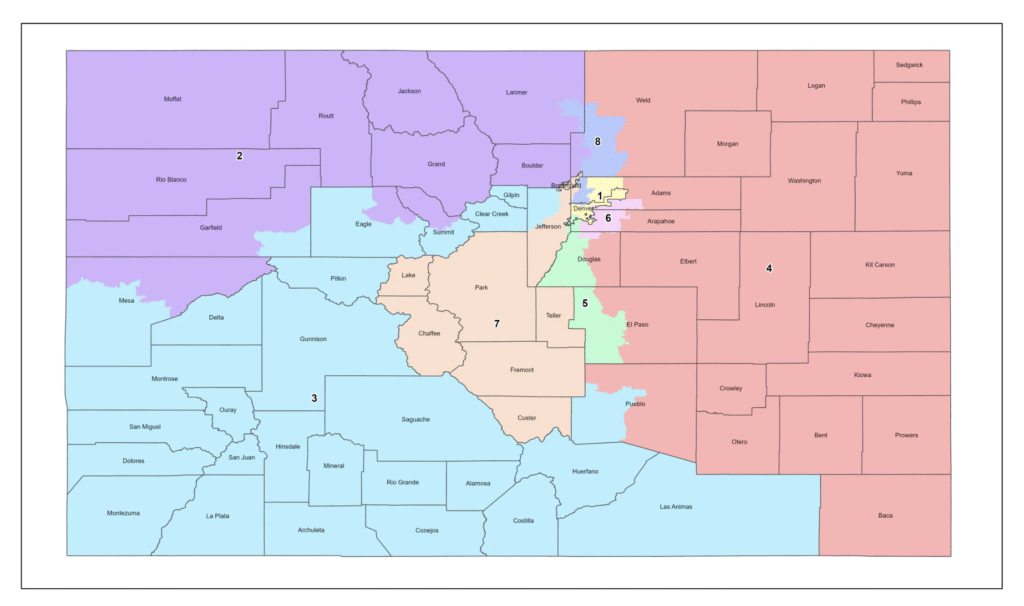
A proposed redistricting plan, which could give Colorado seven Democratic members of the U.S. House of Representatives and only one Republican, would split El Paso County into two parts and thereby weaken the county’s influence in Congress. El Paso County,...
Colorado Democrats, Republicans fight over ballot fiscal information
Marissa Ventrelli
marissa.ventrelli@coloradopolitics.com
Updated 6 days ago
Republicans and Democrats clashed anew over legislation that would require identifying which programs would see a funding reduction if a ballot measure passed, with the former saying it’s yet another way for the government to control the campaign narrative and...

Democrat Dwayne Romero jumps in primary to challenge Republican Jeff Hurd in Colorado’s 3rd CD
Ernest Luning
ernest.luning@coloradopolitics.com
Updated 6 days ago
The Democrat who has been running for nearly a year to unseat Republican U.S. Rep. Jeff Hurd in Colorado’s 3rd Congressional District got some company in the primary this week. Dwayne Romero, a Snowmass Village business owner and decorated Army...

Colorado’s congressional redistricting proposal could flip three Republican House seats | ANALYSIS
Michael Braithwaite
michael.braithwaite@gazette.com
Updated 4 days ago
A Democrat-backed proposal to redraw Colorado’s congressional map for the 2028 election could flip three Republican districts. The proposal, introduced by a group called Coloradans for a Level Playing Field, is yet another development in a national redistricting debate after...
Judge declines to block potential Boebert challenger from going through assembly process in Colorado’s 4th CD
Ernest Luning
ernest.luning@coloradopolitics.com
Updated 1 week ago
Congressional candidate Eileen Laubacher, one of the Democrats seeking to challenge Republican U.S. Rep. Lauren Boebert, can participate in the party’s caucuses and assemblies pending a court hearing later this month, a Denver judge ruled Tuesday in response to a...
Colorado Gov. Jared Polis ignites fierce debate after raising clemency questions in Tina Peters case
Marianne Goodland
marianne.goodland@coloradopolitics.com
Updated 1 week ago
Gov. Jared Polis ignited a political firestorm Tuesday night after weighing in on the prison sentences of two former Colorado officials — a Democrat and a Republican — convicted of attempting to influence a public servant. The comments quickly fueled...
PREV
PREVIOUS

GOP groups set debates for Republican primaries in Colorado's 4th and 8th congressional districts
Nearly a dozen Republicans running in two of Colorado’s most hotly contested GOP primaries are scheduled to appear at a pair of candidate debates in Fort Lupton next month, the Republican Women of Weld announced on Friday. The evening of debates is expected to feature every GOP candidate running to replace retiring Republican U.S. Rep. […]

GOP promotes Denver voter effort to woo Dems | A LOOK BACK
Forty Years Ago This Week: The newly formed Pro-Denver initiative was being touted as “the most ambitious effort made by Republicans to win the hearts and minds of Denverites in many years,” according to one of its founders, Sue McGinley. Since its founding early in the year, Pro-Denver had grown to 150 paid members and […]