

Floodgates could open as Republicans bid to replace Ken Buck in Colorado’s coveted 4th CD | TRAIL MIX
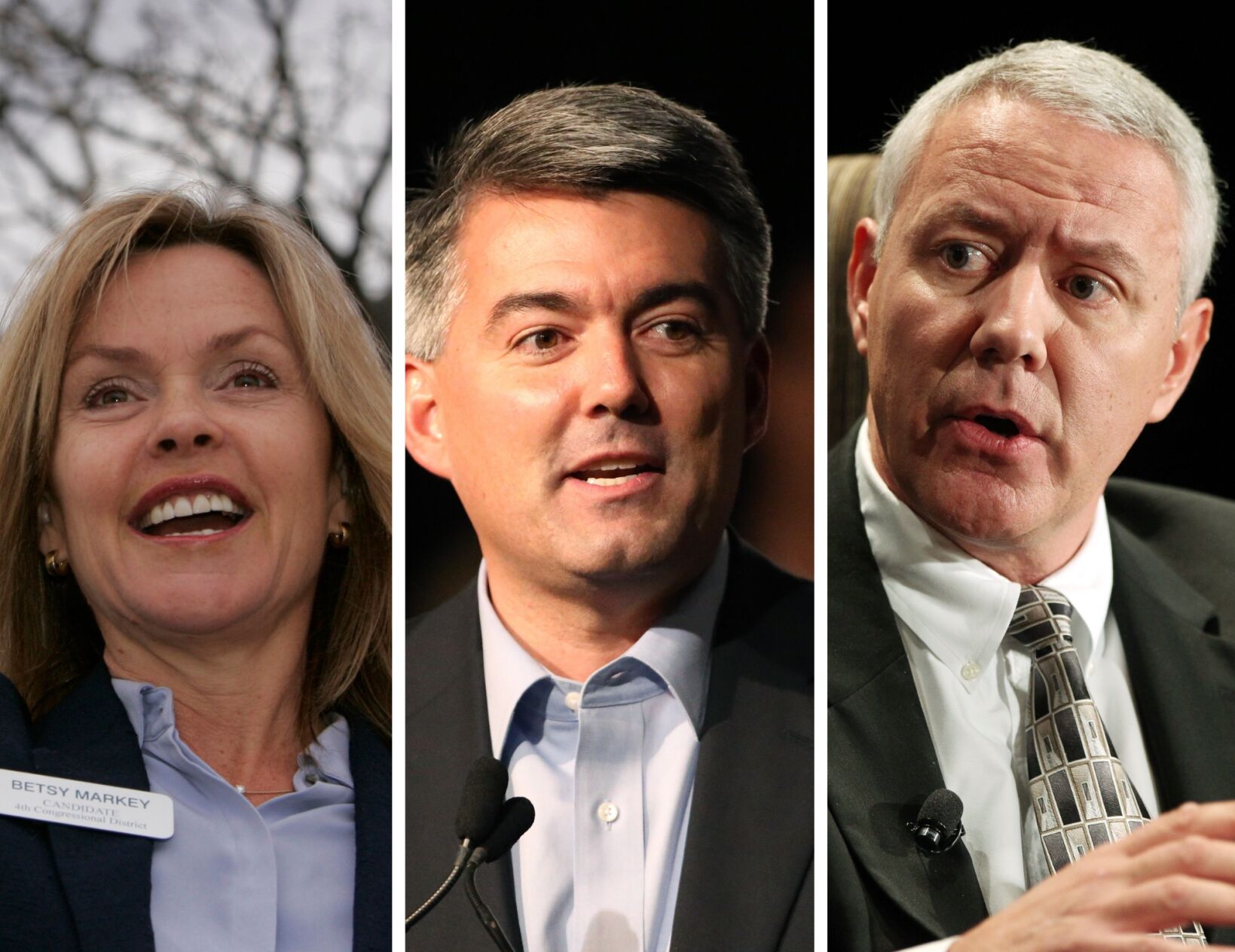
The scramble to take over for U.S. Rep. Ken Buck is on in Colorado’s 4th Congressional District.
The Windsor Republican lasts week laid to rest months of widespread speculation with his announcement that he won’t seek a sixth term representing the reliably Republican seat, which covers roughly the eastern half of the state.
Although Buck’s move was considered likely enough that a handful of GOP politicians had already been sounding out supporters about a potential run, the incumbent’s declaration set off a frenzy and reshuffled Colorado’s 2024 political calendar.
Before Buck made it official, the looming election cycle looked like it would be dominated by Republican U.S. Rep. Lauren Boebert’s battle to survive an energized primary opponent and a well-funded Democratic challenger, with Democratic U.S. Rep. Yadira Caraveo’s bid for a second term in the toss-up 8th Congressional District taking up any slack.
But in a state whose electorate has shifted solidly into Democratic territory over the last decade, the sudden opening in a safe Republican House district creates a rare opportunity for Republicans who’d put their ambitions for higher office on hold.
Expect the floodgates to open wide.
Already, four Republicans are campaigning to replace Buck, with the field potentially set to swell into double digits by the end of the year.
The two primary challengers Buck had drawn before his retirement announcement – Weld County Council member Trent Leisy and first-time candidate Justin Schrieber – were joined within days by state Rep. Richard Holtorf, R-Akron, and nonprofit head Deborah Flora, a former talk radio host who ran last year for the U.S. Senate.
Other Republicans considering runs include Logan County Commissioner Jerry Sonnenberg, a former state lawmaker; House Minority Leader Mike Lynch of Wellington; former state Sen. Tom Wiens of Castle Rock; former House Minority Leader Patrick Neville of Castle Rock; Douglas County commissioners Abe Laydon and Lora Thomas; former University of Colorado Regent Heidi Ganahl; former 18th Judicial District Attorney George Brauchler; and former Fort Collins City Councilman Gino Campana.
And while the Democrats don’t have a realistic chance of flipping the seat, the party’s strategists have been licking their chops at the prospect of watching a crowded primary contest in a divided GOP that’s searching for an identity and prone to infighting.
If nothing else, the GOP’s pending 4th CD primary might occasionally take the spotlight off the Democrats’ own internal tensions and stumbles. It could also give Democratic candidates and operatives the chance to portray their rivals as “too extreme” for Colorado – a time-worn but effective attack – as Buck’s potential replacements race to the right in an attempt to secure the nomination.
It’s been 10 years since there’s been an opening in one of Colorado’s few Republican-leaning House seats, though the last time it happened there wasn’t much warning.
This cycle’s crop of candidates have four months to go until precinct caucuses in the first week of March – and nearly eight months to campaign before next year’s June 25 primary. That compares to the short notice their counterparts got in 2014, when Republican Cory Gardner, the two-term incumbent, ended his bid for reelection and switched to the U.S. Senate race just days before caucuses, throwing the state’s political chessboard into the air.
Within hours of Gardner’s surprise announcement, the leading Republican in a crowded field hoping to challenge Democratic U.S. Sen. Mark Udall dropped out of the Senate race and declared he would instead run for Gardner’s 4th CD seat.
That candidate was Buck, then the Weld County district attorney, who had narrowly lost a bid for Colorado’s other U.S. Senate seat four years earlier.
With little time to make the ballot, just three Republicans joined Buck in the primary for the seat Gardner was vacating – state Sen. Scott Renfroe, R-Greeley, Weld County Commissioner Barb Kirkmeyer and wealthy Larimer County author Steve Laffey, a former mayor of Cranston, Rhode Island.
Endorsed by Gardner, Buck won the four-way primary with 44% of the vote, about twice the share received by Renfroe, with Kirkmeyer and Laffey trailing. Buck went on to defeat Democratic nominee Vic Meyers with 65% of the vote and won reelection four times, never dipping below 60% in November.
While Renfroe faded from public view after his primary loss, Kirkmeyer later won a state Senate seat and lost a close race last year to Caraveo in the 8th CD. Laffey mounted a longshot bid for the 2024 GOP presidential nomination but ended his campaign last month and left the Republican Party.
The solid red 4th CD turned even more favorable for GOP candidates following last year’s redistricting, which moved its center of gravity south along Colorado’s Front Range from Weld County, along the Wyoming border, to suburban Douglas County, south of the Denver metro area.
Douglas County – including Castle Rock, Parker, Highlands Ranch and Lone Tree – accounts for almost exactly half of the district’s population. A slice of Larimer County – primarily Loveland – makes up about 15% of its residents, followed by Weld County’s roughly 8% share, with all or portions of another 18 counties spreading east across the plains to the Kansas border making up the balance.
The district is the most Republican-leaning House seat in the state, surpassing both U.S. Rep. Doug Lamborn’s El Paso County-based 5th Congressional District and Boebert’s Western Slope-based 3rd Congressional District.
According to an analysis prepared by Colorado’s Independent Redistricting Commission, the 4th CD’s voters have favored Republican candidates in recent statewide elections by 26.6 percentage points, beating the 5th CD’s 20.2-point margin and the 3rd CD’s 9.3-point GOP edge. The state’s other five congressional districts have leaned toward Democrats in statewide elections, ranging from a narrow 1.3-point margin in the 8th CD to an overwhelming 57.1-point advantage in Denver’s 1st Congressional District.
Even though he lost Colorado to Democrat Joe Biden by 13.5 percentage points, Republican Donald Trump carried the 4th CD’s electorate – under its current boundaries – by the widest margin in the state, by an 18.6-point margin. Trump prevailed in the 5th CD by 10.1 points and in the 3rd CD by 8.3 points, while Biden won in the other districts.
The Cook Political Report’s Partisan Voting Index – based on a formula that measures every congressional district’s competitiveness, based on results in the two previous presidential elections – ranks the 4th CD as Colorado’s most Republican district, with a PVI of R+13. The 5th CD, by comparison, scores R+9, and the 3rd CD is at R+7.
That could change before the end of the decade, as Douglas County’s heavily Republican electorate shifts toward voting more like their neighbors in Jefferson and Arapahoe counties – two former GOP strongholds that moved firmly into the Democratic column a decade ago and haven’t looked back since.
Republicans continue to outnumber Democrats in Douglas County by nearly two-to-one, but Ganahl, last year’s GOP gubernatorial nominee – who lives in the county – came within just over 1,000 votes of losing the county to Democratic Gov. Jared Polis, and a progressive slate of school board candidates defeated their conservative opponents there in this week’s off-year election.
Still, the 4th CD is considered a plum prize for Colorado Republicans, who have lost every statewide race since 2016 and hold record low numbers in the legislature.
The House district has routinely been a springboard to the Capitol’s upper chamber, produced more of the state’s U.S. senators in the last 50 years than any other congressional seat. Significantly, every senator initially elected as a Republican in Colorado since 1990 moved up from the 4th CD – from Hank Brown and Wayne Allard to Gardner. (The state’s other GOP senator during that span, Ben Nighthorse Campbell, represented the 3rd CD and won his first Senate term as a Democrat, but switched parties before winning reelection as a Republican.)
By comparison, the state’s 2nd Congressional District has generated two senators since 1972 – Udall and Tim Wirth, both Democrats – and the 5th CD has yielded one, Republican Bill Armstrong.
The seat has also seen the most turnover this century, boasting five occupants since 2000: Republicans Bob Schaffer, Marilyn Musgrave, Gardner and Buck, and Democrat Betsy Markey, who served a single term after defeating Musgrave in 2008 before losing to Gardner in 2010. Over the same period, the 1st and 8th CDs have each had a single representative, the 5th CD has had two, the 2nd, 6th and 7th CDs have each had three, and the 3rd CD has had four.

USPS ballot rule faces lawsuit from Colorado, other states
Thelma Grimes
thelma.grimes@coloradopolitics.com
Updated 7 hours ago
Colorado, along with 25 other states, filed a lawsuit against the U.S. Postal Service to challenge a new rule that seeks to restrict the mailing of ballots to American citizens in an eligible voters list. Colorado relies heavily on the...
Colorado lawmaker, House leaders named in workplace-retaliation lawsuit
Marianne Goodland
marianne.goodland@coloradopolitics.com
Updated 1 day ago
A former legislative aide has filed a lawsuit alleging she was mistreated, illegally directed to perform campaign work and harmed by a House leadership structure she charged was fragmented, politicized and ineffective at protecting employees. The lawsuit, filed by Jennifer...
Democratic candidate in Colorado’s 4th CD urges long-term water planning
Marianne Goodland
marianne.goodland@coloradopolitics.com
Updated 4 days ago
The Democrat hoping to become the next representative of Colorado’s 4th Congressional District on Thursday made her case on the final day of Colorado Water Congress in Steamboat Springs. Eileen Laubacher, who spent 34 years in the U.S. Navy and...
Democratic gubernatorial candidate Phil Weiser promises to appoint rural outreach director, water adviser
Marianne Goodland
marianne.goodland@coloradopolitics.com
Updated 6 days ago
Democratic gubernatorial candidate and current Attorney General Phil Weiser told the Colorado Water Congress Thursday he intends to appoint a rural outreach director and a water policy adviser should he win the election in November. Weiser’s speech at the Steamboat...
Attorney general candidates present priorities at Colorado Water Congress
Marianne Goodland
marianne.goodland@coloradopolitics.com
Updated 5 days ago
The two major-party candidates for attorney general — Republican Michael Allen, the district attorney for Teller and El Paso counties, and Democratic Secretary of State Jena Griswold — on Thursday outlined their priorities at the Colorado Water Congress. Griswold attended...
Denver named finalist for 2028 Democratic Convention site
Thelma Grimes
thelma.grimes@coloradopolitics.com
Updated 6 days ago
The Mile High City competes with Boston and Philadelphia The list of cities being considered to host the 2028 Democratic National Convention has narrowed even further, with Denver making the cut as one of the final three, along with Boston...
GOP gubernatorial candidate Victor Marx pushes aggressive water-storage expansion at Colorado Water Congress
Marianne Goodland
marianne.goodland@coloradopolitics.com
Updated 7 days ago
Victor Marx, the Republican nominee for governor, took the spotlight Wednesday during the opening day of the Colorado Water Congress, laying out how he says the state should approach its water future. Marx told the standing-room-only audience in Steamboat Springs...
U.S. Rep. Lauren Boebert stresses storage, forest health and Upper Basin rights at Colorado Water Congress
Marianne Goodland
marianne.goodland@coloradopolitics.com
Updated 6 days ago
Republican U.S. Rep. Lauren Boebert used her brief Wednesday appearance at Colorado Water Congress to tout her record on delivering water projects for the state and her district. Boebert, who is running for her second term representing the 4th Congressional...
Colorado House Democrats’ caucus finances under scrutiny as ethics case against leader advances
Marianne Goodland
marianne.goodland@coloradopolitics.com
Updated 4 days ago
Democratic lawmakers told a legislative ethics panel that a leader’s management of caucus finances left them with unanswered questions, disputed reimbursements and a breakdown in communication that ultimately triggered a formal complaint. The House Ethics Committee is examining a complaint...

Colorado lieutenant governor candidate Markert says early discipline and key mentors set his course
Marianne Goodland
marianne.goodland@coloradopolitics.com
Updated 1 week ago
Editor’s note: This is the first installment in a three-part series examining Colorado’s candidates for lieutenant governor. In this piece, Colorado Politics speaks with George Markert, the Republican running mate to gubernatorial candidate Victor Marx. Marx is competing against Democrat...
PREV
PREVIOUS
Aurora's proposed 2024 budget allocates more funds to public safety
Aurora’s councilmembers seek to spend about $150 million more next year, which includes additional money for public safety. The council plans to adopt the city’s 2024 proposed budget – which sits at $1.3 billion, $152 million more than this year’s spending plan – later this month. The largest share of the general fund dollars is earmarked for […]

Colorado Supreme Court to scrutinize parole requirements for juvenile sex offenders
The Colorado Supreme Court has agreed to answer whether the state law authorizing indefinite, potentially lifetime sentences for sex offenses makes room for the special considerations that must be given to juveniles who are tried as adults. In a rare move, the court accepted the question not through the usual appeals process, but following a […]