

Prop HH: 3 takeaways from the defeat of Colorado Democrats’ property tax proposal

Gov. Jared Polis and his Democratic allies at the state Capitol tasted defeat on Tuesday, following the landslide loss of a measure that sought to offer property tax relief by using Taxpayer’s of Bill of Rights refund dollars.
Unofficial results showed the property tax measure losing by 61% to 39% as of 10 p.m. Tuesday night.
Here are a few takeaways:
Voters don’t like complicated ballot measures
One of the biggest knocks against Proposition HH was how hard it was to understand. It didn’t help that both sides engaged in less-than-factual advertising on the measure, according to observers. Even the General Assembly’s Blue Book, which is supposed to make the measure understandable, ran to 12 pages in discussing the proposal.
Ballotpedia rated the measure, using the Flesch-Kincaid Grade Level test, at 26, one level below the highest available – meaning it was very difficult to read and “best understood by university graduates.”
Jon Caldara of the Independence Institute, one of the measure’s opponents, submitted a ballot measure to the state’s title board that was nearly identically to Proposition HH – to prove, according to him, that HH was deceptively worded. The title board called his ballot measure’s language misleading and inappropriate. Submitted to the voters by Democrats in the Colorado General Assembly, Proposition HH did not have to go through the title board.
Voters don’t like Democrats messing with TABOR refunds
While voters put Democrats in charge of statewide public policy, they’ve taken a dim view of their efforts to cut TABOR refunds.
Indeed, voters don’t have a problem with increasing marijuana or tobacco taxes, or even sports betting – the so-called “sin” taxes. But mess with TABOR refunds, no matter how noble the claimed rationale is, and voters say “no.”
Take Proposition CC in 2019, for example. That measure, also referred to voters largely by Democrats, asked for permission to keep TABOR revenue above the TABOR cap. The ballot groups’ spending overwhelmingly favored Proposition CC. It didn’t matter. Voters rejected the measure by 7 percentage points.
Ballotpedia noted that since the passage of TABOR in 1992, Colorado voters have rejected 25 out of 36 statewide ballot measures designed to increase state revenues, which would have implicated TABOR.
So, what now?
Perhaps the biggest question of all is what Polis and his allies do next about property taxes.
The governor said he is considering “next steps.”
The options are to wait until January, which raises worries that property tax increases will hit Coloradans’ wallets before the legislature would have time to act. The alternative is to convene a special session.
A special session is allowed under state law to deal with specific issues. The governor usually calls for it, although the laws allow lawmakers to do so themselves. Special sessions usually last no more than three days, the minimum time it takes for a bill to get through both chambers of the legislature.
Polis has said he had no alternative to Proposition HH, although Republican lawmakers have twice asked him to call a special session, most recently a week ago, when they predicted the measure would go down in flames.
Polis has called for a special session just once since taking office. That session in December 2020 dealt with the COVID crisis.



Surprise candidate Shimon Blau cleared to face off against Melat Kiros in November
Ernest Luning
ernest.luning@coloradopolitics.com
Updated 4 days ago
Unaffiliated congressional candidate Shimon Blau, a Denver doctor, has qualified by petition for the general election in Colorado’s 1st District, where Democrat Melat Kiros defeated 15-term U.S. Rep. Diana DeGette in last month’s primary, the Colorado Secretary of State’s Office...
Victor Marx, GOP candidate for governor, faces 100-plus campaign finance complaints
Marianne Goodland
marianne.goodland@coloradopolitics.com
Updated 15 hours ago
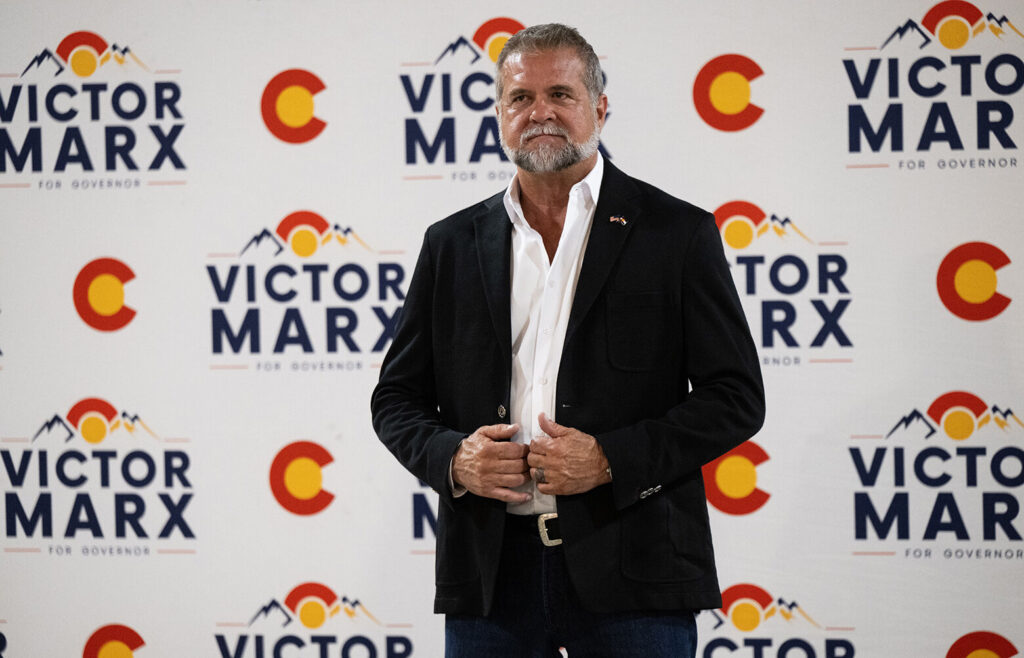
Victor Marx’s gubernatorial campaign has been hit with more than 140 campaign finance complaints, although most have been consolidated by the state’s election office because they follow similar alleged violations. Marx faces Attorney General Phil Weiser, who won the Democratic...

Jefferson County to fill commissioner vacancy after Dahlkemper tapped for lieutenant governor
Matt Kyle
matt.kyle@denvergazette.com
Updated 5 days ago
Democratic gubernatorial nominee Phil Weiser on Wednesday announced that Jefferson County Commissioner Lesley Dahlkemper would be his lieutenant governor, meaning she would be leaving her commissioner seat open should he win the race in November. However, Dahlkemper’s term was already...
Democrat Phil Weiser names Jeffco Commissioner Lesley Dahlkemper as his gubernatorial running mate
Ernest Luning
ernest.luning@coloradopolitics.com
Updated 6 days ago
Colorado Attorney General Phil Weiser, the Democratic nominee for governor, on Wednesday named Jefferson County Commissioner Lesley Dahlkemper to be his lieutenant governor running mate in the general election. Calling her “someone who can be a governing partner,” Weiser said...

Democrat John Hickenlooper hauls in $1.3 million in 2nd quarter in Colorado’s U.S. Senate race
Ernest Luning
ernest.luning@coloradopolitics.com
Updated 1 week ago
U.S. Sen. John Hickenlooper’s reelection campaign raised just over $1.3 million in the year’s second quarter and finished the period with $2 million in the bank, leaving the first-term Democrat with nearly 80 times as much cash on hand as...

Campaign launched to redirect $1 billion in TABOR refunds to education
Marissa Ventrelli
marissa.ventrelli@coloradopolitics.com
Updated 1 week ago
A coalition that includes the state teachers’ union on Tuesday launched a campaign for a ballot proposal that would reduce more than $1 billion in taxpayer refunds and spend the money on education. The measure is among several campaigns taking...

WATCH: Trump speaks on elections in primetime address
The Associated Press
the-associated-press@coloradopolitics.com
Updated 2 weeks ago
WASHINGTON (AP) — President Donald Trump will deliver a primetime address Thursday that he says will include a focus on elections. The speech comes as he’s escalated calls for Republicans to pass tighter federal voting rules for November’s midterm elections....

Signatures submitted to cap Colorado’s income tax rate
Marissa Ventrelli
marissa.ventrelli@coloradopolitics.com
Updated 1 week ago
The group behind a ballot measure aiming to cap the state’s income tax at the current rate has submitted signatures from voters to election officials for review, part of the tug and pull in Colorado between opposing political forces fighting...

Republican candidates pass on signing Colorado gubernatorial nominee Victor Marx’s ‘unity compact’
Ernest Luning
ernest.luning@coloradopolitics.com
Updated 2 weeks ago
A spokesperson for Republican gubernatorial nominee Victor Marx said his campaign is “extremely encouraged” by responses to a document the campaign circulated late last week, asking fellow GOP nominees how they want to collaborate in the months ahead before Colorado’s...

Forward Party nominee for Colorado’s U.S. Senate seat puts $1.1 million into his campaign
Ernest Luning
ernest.luning@coloradopolitics.com
Updated 2 weeks ago
Bob Chew, the Colorado Forward Party nominee for the seat held by Democratic U.S. Sen. John Hickenlooper, plans to report donating $1.1 million to his campaign and raising an additional $20,000 in the most recent quarter, his campaign told Colorado...
PREV
PREVIOUS

Proposition HH results: Voters reject Democrat-backed measure diverting TABOR refunds to property tax relief
While Colorado shifted to solidly blue in all but a few statewide offices, voters took a dim view of the property tax measure the Democrats asked them to pass on Tuesday night. Proposition HH, which Gov. Jared Polis championed, failed to garner support, the unofficial results showed. The measure trailed throughout the night, securing only […]

Takeaways from the Denver school board election
The unofficial vote tallies – if the results hold – suggests that none of the candidates backed by the local teachers union will ascend to office. Here are three takeaways from the Denver Public Schools’ board of education races on Tuesday: Teachers union loses sway Typically, teachers unions enjoy an outsized influence on voters. Not […]