

Denver mayor needs to house 100 homeless a week to deliver on promise by year’s end

After 112 days in office, Denver’s new mayor now needs to house 100 homeless people on average each week to deliver his promise of getting a thousand of them off the city’s streets by the end of the year.
So far, Mike Johnston’s administration has housed 208 homeless people, according to a city-made homeless housing dashboard at the start of November.
He’ll need to house 792 more by Dec. 31.
Johnston, who was sworn in as Denver mayor on July 17, immediately took aim at the city’s homelessness crisis. He declared a state of emergency, launched an operations center to coordinate responses, hired a homelessness adviser, and spent millions of dollars to buy “tiny homes” – his foremost transition strategy – under the umbrella of a “housing first” approach to the challenge.
Observers gave Johnston solid marks for his first 100 days in office. Others have long criticized the mayor for failing to tackle what they believe lies at the root of homelessness: mental health and drug addiction.
“Mayor Johnston certainly deserves an ‘A’ for his extensive engagement with the community in addressing Denver’s No. 1 challenge, which is homelessness,” Mike Dino, a political expert who served as campaign manager for former Mayor Wellington Webb, told The Denver Gazette. “He has been attentive, considerate, and positive in his approach to the various facets of his plan to address homelessness.”
In August, Citizens for a Safe and Clean Denver – which describes itself as a non-partisan group that seeks to offer “alternate narrative, and data-based, common-sense solutions” – urged Johnston anew to focus on mental health, saying even if the mayor successfully gets 1,000 homeless people into shelters, “we cannot house our way out of this crisis because, well-intentioned as he may be, he’s fighting the wrong battle.”
“The mayor has not yet meaningfully acknowledged the primary role that addiction and mental health play in creating unsheltered homelessness. Until these facts are recognized and addressed, Denver’s crisis will only grow,” the group said. “We are tolerating and destigmatizing public drug consumption while enabling lives to be lost to addiction.”
Johnston’s ‘housing first’ sprint
Johnston’s administration hunkered down on his first full day of office. The new mayor activated an emergency operations center, which draws scores of staffers from the city’s pool of employees, the first time in history that Denver launched one to tackle homelessness.
Of Colorado’s major cities, Denver saw the biggest increase in the number of homeless people – 5,818 as of January, up from 4,794 last year, according to a point-in-time count that offers a single night’s snapshot of the crisis back in January.
And, between 2022 and 2023, the number of “unsheltered” people – those who sleep in public places, such as in tents, cars or the streets – grew by 33 percent, from 2,078 to 2,763, according to the survey.
In contrast, Aurora’s homeless population stood at 572 in the same survey, down from 612 the year before. Meanwhile, El Paso County saw a 17 percent drop in its homeless population – from a high of 1,562 in 2019 to 1,302 in January.
Against this backdrop, Johnston’s administration embraced the “housing first” approach. The idea is to respond to an individual’s most acute need first, which proponents of the strategy say is housing, and then offer other services later.
So far, the Johnston administration has provided shelter to just under two homeless people a day on average. He now needs at least 14 a day to achieve his goal by Dec. 31.
The plan – Johnston and his homelessness adviser, Cole Chandler, articulated – is to sweep homeless encampments, put people in transitional housing with services offered, and eventually give them permanent housing opportunities.
Already, the city has cleared four encampments.
Also crucial to the strategy is building “micro-communities,” where the “tiny homes” would be erected. Chandler told The Denver Gazette to expect a busy December. Up to 500 such units are in the pipeline for the “micro-communities,” four of which have already broken ground.
“We wanted to take a huge and measurable chunk out of that right off the bat,” Chandler said. “And, so you know, the goal is really within the first term to end unsheltered homelessness. But we wanted to start by taking up a significant chunk, and so that’s where we got to the 1,000 number.”
Some claimed that previous administrations didn’t show the same dedication that Johnston has when it comes to homelessness.
“Mayor Johnston has really embraced the sense of urgency that we’ve been feeling about homelessness for years,” said Cathy Alderman, who speaks for the Colorado Coalition for the Homeless.
Denver contracts with the Colorado Coalition for the Homeless for services. Denver’s councilmembers last month rejected a $6.4 million, three-year contract with the group following a request by Johnston to do so, saying his administration needs more time to develop a “strong and fair” agreement. The group hinted of differences in approaches.
“I think he is setting a tone of optimism and confidence and he is spending a lot of time listening to people, which is so important,” Alderman said.
Denver, a dozen years ago
Former Mayor Michael Hancock’s first 100 days looked much different 12 years ago.
At the time, the country was recovering from the Great Recession and the National Western Stock Show and United Airlines were on the verge of leaving Denver.
Tim Tebow became the Denver Broncos’ starting quarterback, and the Broncos held a 2-5 record to start its 2011 season in the last mayoral transition. The team ended up going on a six-game winning streak after Hancock’s first 100 days.
“Mayor Hancock had a mostly robust economy and the city was in an upswing,” Dino said. “Mayor Johnston is dealing with the post pandemic malaise and the need to rejuvenate our center city and restore hope that city government is a viable partner in moving forward for our success.”
Homelessness has been imprinted on Denver’s consciousness as a crisis going back to the 1980s. A Washington Post article noted how the country’s leading mayors, including Denver’s Federico Peña, told a congressional subcommittee that hunger and homelessness increased, even as the unemployment rate declined. The Post cited Peña as saying that, despite low unemployment, Denver had been unable to cope with the mentally ill and thousands of homeless job-seekers, which he said were from other regions.
Subsequent mayors, too, tackled homelessness, including Wellington Webb and John Hickenlooper, who famously launched Denver’s “Ten Year Plan to End Homelessness.”
By the time Hancock took office in 2011, the city was spending $8 million on the crisis. When Hancock left office this year, Denver’s homelessness budget stood at $254 million. Johnston’s administration wants to spend roughly the same amount – $242 million – next year. Using the latest homeless count, that translates to roughly $85,000 per homeless person total for two years.
Alderman said Johnston is on the right track.
“I don’t think the city of Denver was able to scale up the necessary resources and response to make significant headway in addressing the problem,” Alderman said of Hancock’s homelessness response.
Johnston and Hancock’s cabinets, snowstorms and direct DIA flights
Like Hancock, Johnston spent his first 100 days building his team.
“I remember Mayor Hancock kind of did that pretty methodically,” said Jim Carpenter, who served as chief of staff to Gov. Bill Ritter and state director for U.S. Sen. Ken Salazar. “I think that Mayor Johnston has made some really strong hires. But I think he’s doing this, you know, at kind of his own pace. I think some people will say filling these positions has been a little slower, but he’s made some really great hires.”
By this time, Hancock needed only three more positions to fill. Johnston is still looking for department heads for Community Planning & Development, Denver Department of Public Health & Environment and Department of Public Safety. In addition, he has yet to appoint chiefs for the police and fire departments and the sheriff’s office.
Both Hancock and Johnston celebrated 100 days right before the season’s first major snowfall.
And both proudly announced direct, international flights out of Denver International Airport. In August, Johnston announced partnering with Aer Lingus for direct flights to Ireland. Hancock, too, announced direct flights, from Denver to Iceland with Icelandair.
Downtown Denver Partnership CEO Kourtny Garrett, who worked with Johnston closely in his first 100 days, said she sees progress.
“Being able to rally every single city department around this issue, from where it has gotten in just 100 days in terms of beginning to build that housing pipeline, beginning to address encampments, and offering housing and services to each individual is tremendous,” she said. “Look at just 100 days, versus a lot of these plans that are six months, eight months, six years, eight years in the making.”
What if Johnston fails to get 1,000 homeless people off the streets by Dec. 31?
“To steal his words, ‘Even if we fail, we will fail fast and start again,'” Garrett said. “Because right now we need to see action. We need to be moving forward.”





Democrat Dwayne Romero jumps in primary to challenge Republican Jeff Hurd in Colorado’s 3rd CD
Ernest Luning
ernest.luning@coloradopolitics.com
Updated 17 minutes ago
The Democrat who has been running for nearly a year to unseat Republican U.S. Rep. Jeff Hurd in Colorado’s 3rd Congressional District got some company in the primary this week. Dwayne Romero, a Snowmass Village business owner and decorated Army...

Colorado’s congressional redistricting proposal could flip three Republican House seats | ANALYSIS
Michael Braithwaite
michael.braithwaite@gazette.com
Updated 16 hours ago
A Democrat-backed proposal to redraw Colorado’s congressional map for the 2028 election could flip three Republican districts. The proposal, introduced by a group called Coloradans for a Level Playing Field, is yet another development in a national redistricting debate after...

Judge declines to block potential Boebert challenger from going through assembly process in Colorado’s 4th CD
Ernest Luning
ernest.luning@coloradopolitics.com
Updated 2 days ago
Congressional candidate Eileen Laubacher, one of the Democrats seeking to challenge Republican U.S. Rep. Lauren Boebert, can participate in the party’s caucuses and assemblies pending a court hearing later this month, a Denver judge ruled Tuesday in response to a...
Colorado Gov. Jared Polis ignites fierce debate after raising clemency questions in Tina Peters case
Marianne Goodland
marianne.goodland@coloradopolitics.com
Updated 2 days ago
Gov. Jared Polis ignited a political firestorm Tuesday night after weighing in on the prison sentences of two former Colorado officials — a Democrat and a Republican — convicted of attempting to influence a public servant. The comments quickly fueled...

Bills on ballot access, dual office ban move swiftly through Colorado legislature
Marianne Goodland
marianne.goodland@coloradopolitics.com
Updated 2 days ago
With an eye on the 2026 election cycle and mounting tensions with the Trump administration, Colorado lawmakers are fast-tracking a pair of election bills they say will protect the state’s mail ballot system and tighten rules for elected officials. The...

Colorado GOP chair Brita Horn loses ‘no-confidence’ vote, vows to refocus on ‘mending that divide’
Ernest Luning
ernest.luning@coloradopolitics.com
Updated 2 days ago
The Colorado Republican Party’s state central committee approved a resolution expressing “no confidence” in state chair Brita Horn in a landslide late Monday night near the end of an online meeting marked by rancor and confusion. Almost 80% of the...
Primary rival sues to prevent Democrat Eileen Laubacher from going through assembly in Colorado’s 4th CD
Ernest Luning
ernest.luning@coloradopolitics.com
Updated 3 days ago
Democratic congressional candidate Trish Calvarese on Monday asked a judge to prevent one of her primary rivals, Eileen Laubacher, from participating in the caucus and assembly process to seek the nomination to challenge Republican U.S. Rep. Lauren Boebert in Colorado’s...
Colorado Senate swears in Adrienne Benavidez after district vacancy win
Marianne Goodland
marianne.goodland@coloradopolitics.com
Updated 4 days ago
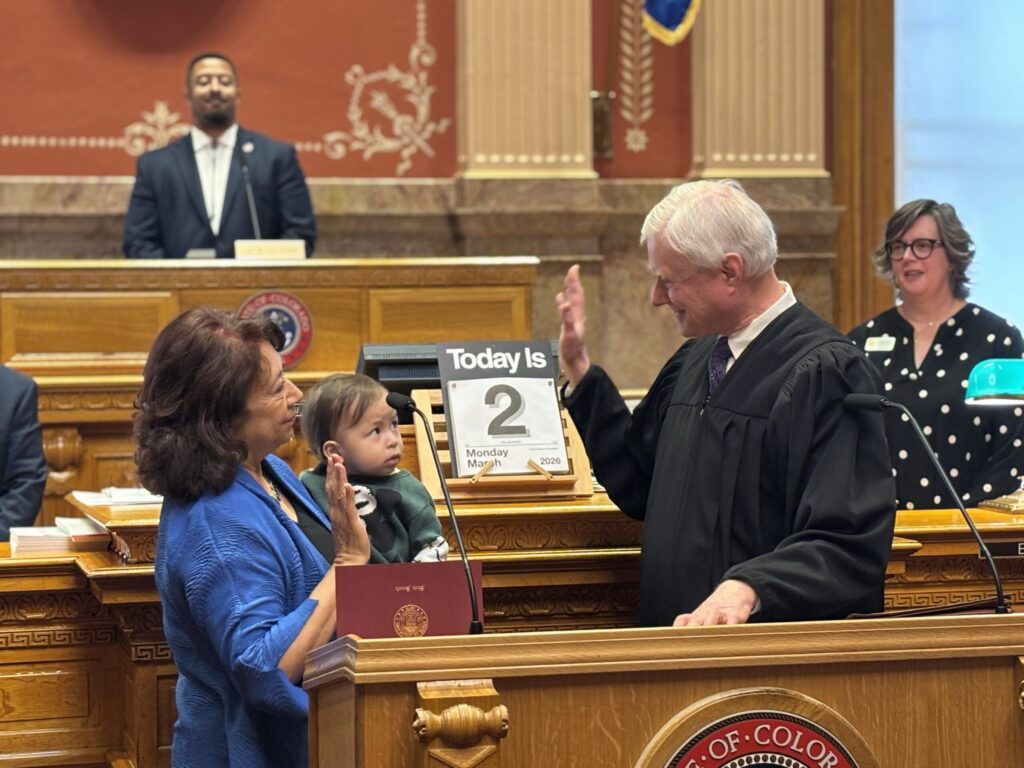
Sen. Adrienne Benavidez, a Democrat from Adams County, was sworn in Monday to the Colorado Senate, just four days after winning a vacancy election in District 21. She was sworn in by Colorado Court of Appeals Justice Lino S. Lipinsky...

Democrat Michael Bennet turns in petitions for Colorado’s gubernatorial primary, plans to skip caucuses
Ernest Luning
ernest.luning@coloradopolitics.com
Updated 5 days ago
U.S. Sen. Michael Bennet, a Democratic candidate for governor, submitted nominating petitions for Colorado’s June primary ballot on Friday, his campaign and the Colorado Secretary of State’s Office said. Bennet plans to rely on his petitions to get on the...

Former House member picked to fill Senate vacancy in Colorado
Marianne Goodland
marianne.goodland@coloradopolitics.com
Updated 5 days ago
A vacancy committee on Thursday night chose a former House legislator to replace former Sen. Dafna Michaelson Jenet, who resigned on Feb. 13 to become the director of the David and Laura Merage Foundation for Combating Antisemitism. Adrienne Benavidez —...
PREV
PREVIOUS

Appeals court rebuffs Alamosa County judge for flippant denial of sentence reduction
An Alamosa County judge’s single-sentence explanation denying a defendant’s request for a sentence reduction – that it was “not well taken” – was itself not well taken by Colorado’s second-highest court. Prosecutors originally charged Desiree Lee Espinoza with multiple serious offenses, including attempted murder and assault. She pleaded guilty to kidnaping and received a 16-year prison sentence […]

Maria de Cambra to become next head of Colorado's Local Affairs department
Maria De Cambra, Gov. Jared Polis’ communications and community outreach director, will leave that post to join the Department of Local Affairs as its next executive director, effective Dec. 4. De Cambra succeeds Rick Garcia, who had been at the helm since 2019 and whose final day is Dec. 15. The department figured prominently in the […]