

Homelessness in Colorado: Aurora experiments with ‘treatment first’

Editor’s note: This three-part series explores the unique complexities and similarities of the homeless challenge in Denver, Aurora and Colorado Springs. Today’s Part 2 focuses on Aurora.
For 12 years, Jodi Froemming owned a house in Aurora, a sprawling municipality and one of Colorado’s fastest-growing cities on the Front Range.
“I had the perfect life,” Froemming told The Denver Gazette. “Then, everything I worked for got taken.”
Froemming’s path into homelessness began when her mother was diagnosed with cancer. She was the only person who could provide her mother with intensive care and she lost her job.
Without that income, Froemming and her husband were forced to sell their Aurora house. They lived in an apartment, but rent quickly became too expensive. They next moved into a hotel, where they turned to alcohol to cope with the stress.
Froemming’s mother died, and her husband, she said, became violent and went to jail. Their dog also died.
Today, Froemming is among hundreds of homeless people in Colorado’s third largest city. Aurora officials are closely watching the experiments in Denver and Colorado Springs – as well as in other parts of the country – in the hopes of figuring out the best strategy or combination of approaches to confront the crisis and ultimately help people like Froemming.
For now, Aurora’s leaders have decided against following Denver’s approach.
In Denver, undergirding Mayor Mike Johnston’s promise to end homelessness, is a strategy popular among the city’s homeless advocacy groups: “housing first.” The idea is to respond to an individual’s most acute need first, which is housing, and then offer other services later. That is, housing is offered without preconditions, such as mental health treatment or work.
Meanwhile, in Colorado Springs, Mayor Yemi Mobolade calls his city’s strategy an “all-hands-on-deck,” multi-faceted approach, using the industry’s best practices across multiple service providers and agencies.
Aurora, which has been taking notes – notably from strategies used in Houston, Texas – is borrowing from “work-first” and “treatment-first” models by providing anyone in need with emergency services but offering more robust services to people who are participating in the workforce and receiving any behavioral health treatment they may need.
Without saying it out loud, Aurora’s leaders see Denver’s homeless situation as a cautionary tale. Indeed, of Colorado’s major cities, Denver faces the most acute challenge. The city saw the biggest increase in the number of homeless people – 5,818 as of January, up from 4,794 last year, according to a point-in-time count that offers a single night’s snapshot of the crisis back in January.
By comparison, El Paso County saw a 17% drop in its homeless population – from a high of 1,562 in 2019 to 1,302 in January.
Aurora’s homeless population stood at 572 in the same survey, down from 612 the year before.
‘Work first’
Aurora Mayor Mike Coffman supports a “work-first” strategy, noting the city is hewing closer to Colorado Springs’ approach. Coffman disagrees with “housing-first” models – the preferred strategy in Denver – because, he argues, they measure success by how many people are taken off the streets, while he looks at employment and self-sufficiency as more meaningful yardsticks.
Under its “work-first” strategy, Aurora supports and provides jobs through Ready to Work, a program started by Bridge House, a nonprofit that provides homeless people with dormitory housing and services to help them stay sober, receive counseling and upgrade their job skills, while requiring them to work a minimum of 20 hours a week.
Coffman maintained that his approach does not criminalize urban camping and it gives homeless people a 72-hour notice before the city sweeps an encampment.
“Unfortunately, they rarely take advantage of our services and chose to remain on the streets and simply move to another area and then return later on to the same location despite the fact that we offer them a safe place to stay with lots of resources to help them,” Coffman said.
The number of homeless people in Aurora has fluctuated over the years. The lowest was 357 in 2018; the highest was 612 in 2022, according to a point-in-time count taken each year by the Metro Denver Homeless Initiative.
In the latest snapshot of Colorado’s homeless population, the city saw a decrease – to 572 this year.
Over that timeframe, Aurora gained more people. In 2018, the city had 374,154 residents. By 2022, that number had jumped to 398,018. In 2023, the city’s population stood at 399,913.
The challenge for Aurora, like many other urban centers, is how to successfully confront the crisis without having to break the bank. The city spent about $5.6 million on homelessness last year, which translates to roughly $10,000 per homeless person, based on the most recent count.
That spending, in fact, increased from $4.1 million in 2018. Still, it’s nowhere near the allocation in Denver, which is poised to spend half a billion dollars on the crisis over two years. Aurora’s spending more closely mirrors that of Colorado Springs, which earmarked about $6.2 million for homelessness this year.
‘Treatment with workforce’
Bob Dorshimer, CEO of Mile High Behavioral Healthcare, is keenly aware of the debate over which philosophical approach is best in tackling homelessness. Regardless, Colorado is not doing well, he concluded, pointing to its major cities seeing an increase in the number of homeless people.
While Aurora prefers “work-first” and Denver embraces “housing-first,” Dorshimer said the nonprofit he runs espouses an alternative: “Housing first, but not housing only.”
More specifically, Dorshimer believes in an approach that puts emphasis on treatment and in getting people work. The Comitis Crisis Center, for example, which the nonprofit runs, offers a detoxification program that has 10 beds dedicated to homeless people who undergo treatment every day and start learning employment skills.
“If I could direct the approach, what I believe in is treatment with workforce,” Dorshimer said. “Everybody enjoys the dignity of work and determining their own future with their money. Many of the people experiencing homelessness want job training and re-education. They want low barrier jobs where they can work in an industry, receive a paycheck and live in a supportive environment.”
Mile High Behavioral Healthcare is Aurora’s oldest nonprofit that provides “wraparound” care for families, veterans and single people through medical assistance, case management and other services.
“We really believe in wraparound care,” Dorshimer said. “You can’t just give someone a house without care.”
Denver’s approach isn’t working, he said, because housing people without giving them care just creates “frat houses.”
But Aurora also needs to take steps toward solving the root problem of lack of affordable housing, Dorshimer said.
“If we can move more toward affordable housing, I think that will help decrease homelessness,” Dorshimer said. “Second, skill-based training, and then third, permanent supportive homeless programs for those living with long-term mental health and substance use disorders is key.”
A navigation center
As Aurora studies other cities’ homeless strategies, one idea appears to be taking hold.
Coffman is working with Councilmember Dustin Zvonek to pursue a navigation center similar to the Colorado Springs Rescue Mission, which the mayor said he has been “very impressed” with.
The mayor envisions a structure with three tiers. The first part is a “low-barrier” shelter with minimal services for those not participating in case management. The second offers better conditions for those participating in addiction recovery, mental health counseling and job training. The third is transitional housing for people working full-time but who are still in need of some services.
“The idea is to encourage those in the low-barrier shelter to want to participate in an activity to affirmatively do something to move out of homelessness and achieve better living circumstances and for those in that category to want to move to the third area, where there are even better living conditions for those who are working fulltime,” Coffman said.
Coffman is also working with Councilmember Steve Sundberg to ticket people violating the camping ban and create a specialized court to handle low-level offenses.
That approach would emphasize getting people off the street with a commitment to participating in addiction recovery, mental health counseling and job training in exchange for dropping the charges. Participants would be provided with a safe place to stay, the mayor said.
“I visited Colorado Springs and I was impressed with their more aggressive approach in not tolerating encampments,” Coffman said. “But I wanted to have more options available for treatment and job training before we move forward with a more aggressive approach.”
Coffman and Sundberg plan to bring the idea to the City Council before the end of the year. The mayor said he thinks the city’s approach is working, but it can do better.
In the next five years, he said, the number of “unsheltered” homeless people – individuals who sleep in public spaces, such as in cars and on streets – will likely decrease, but the number of “sheltered” homeless people will likely stay “relatively flat.”
Aurora or Denver?
Jodi Froemming described Aurora’s camping bans and the city’s relationship with its homeless residents as a “cat and mouse game,” where every week they’re told to leave, so they move somewhere else.
Froemming said homeless people would prefer a “housing-first” approach – but only if the housing lasts long enough for people to get back on their feet. Thirty days in a shelter is simply not enough time to find stable employment and start one’s life over, she said.
An example, she said, is that it takes a while to get an ID, a simple process that can get convoluted by the fact a person is homeless, she said. And nobody will hire someone without a valid identification, she noted.
If offered stable housing, “you’ll see people be successful,” she said.
Froemming said she and the people she lives with have often talked about moving to Denver, where they believe they could get housing. But the process isn’t easy, she said.
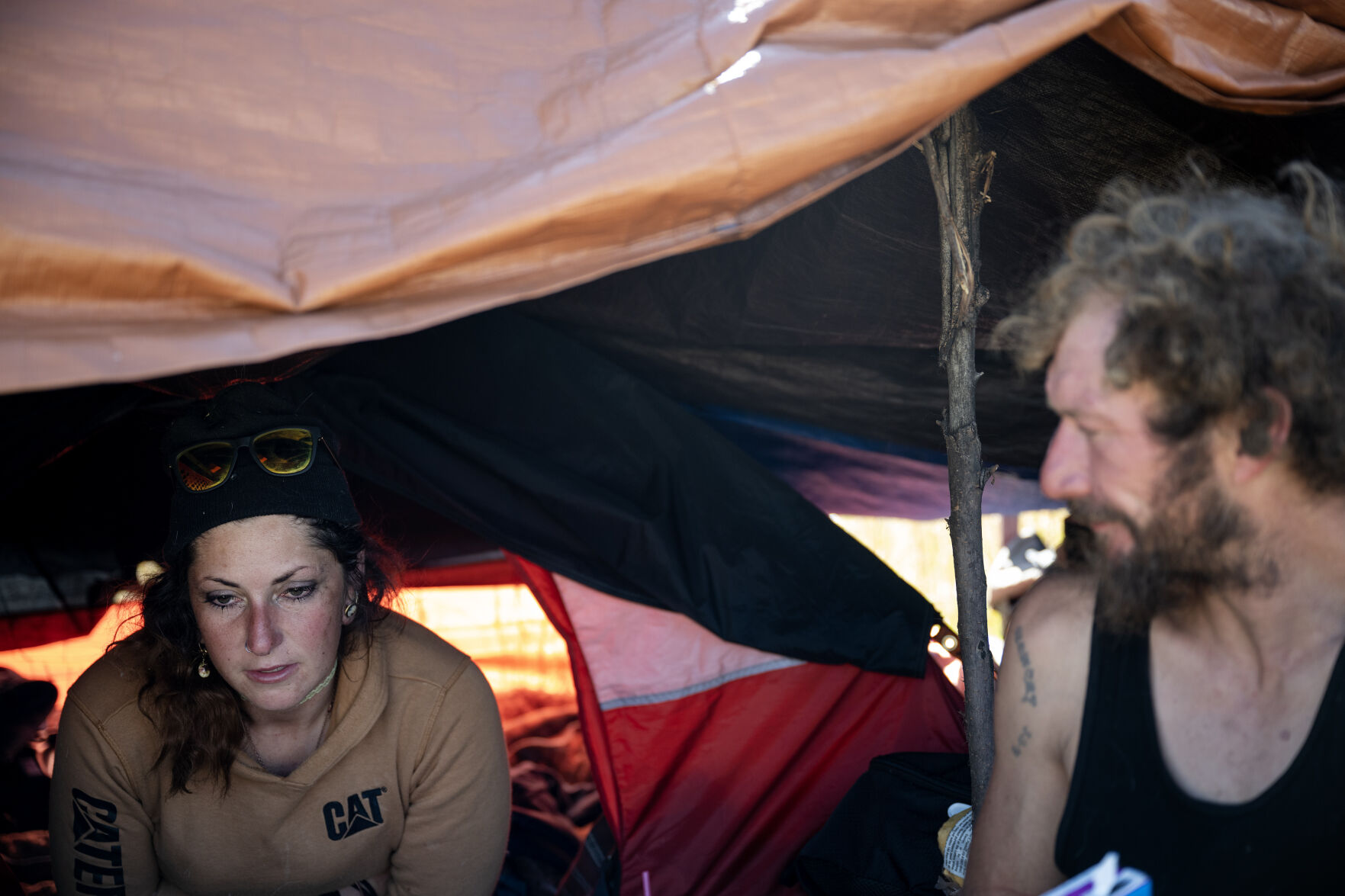
Emily Razavi and Billy Roark, who said Aurora doesn’t provide them with the resources they need to get back on their feet, echoed Froemming – that getting out of the cycle of homelessness isn’t as straightforward as getting a job.
Roark said he gets up every day, and he wants to go to work. But having served time in prison and lacking the resources to clean up or access transportation, the only employment available is under-the-table jobs that don’t pay enough, he said.
“Every time I try to get up on my feet,” Razavi said, “they take them out from under me.”
The two have also discussed moving to Denver.
But they said there is a tradeoff, and they have to pick their poison: In Denver, they would have a better shot at getting housing; in Aurora, they can set their tent up with a view – rather than in a concrete jungle.
“Don’t you think I’d love to go home?” Razavi said. “For me, this is a temporary blip. For others who have mental health issues or other factors, the only way out is death or prison.”

A snapshot of Aurora’s homeless situation
Currently, between 130 and 150 shelter beds are available on any given night in Aurora. The city is also about 7,500 to 8,500 affordable housing units short.
According to statistics the city provided to The Denver Gazette, just over 2,000 homeless people reported being served in Aurora as of June this year. (The figure is based on the number of hygiene kits issued at various locations, so if the same client gets multiple kits, they are counted multiple times.)
Through September of this year, the city has moved 57 people out of “pallet shelter” sites into permanent housing.
By the same date, 46 homeless people had been helped through Aurora’s Flexible Housing Fund, a program that combines efforts of the city and organizations in Aurora to administer one-time assistance for move-in, prevention and landlord mitigation costs.
The city also housed 40 homeless veterans through Built for Zero, a group of service providers that collaborate to connect veterans to services and ultimately house them.
The city has also housed 303 people into pallet shelters and abatement pallets. This number may have duplicates, since people who left and came back would be counted twice.



Colorado ski resorts announce early closures amid historic snowpack lows, high temperatures
Kyla Pearce
kyla.pearce@gazette.com
Updated 3 days ago
As Colorado’s historically low snowpack year comes to a close and spring conditions take over the mountains, the state’s major ski resorts are announcing closing dates — some of which are weeks before historic closing dates. Most of Colorado’s ski...

Longtime community leader Arlene Hirschfeld to be honored | NONPROFIT REGISTER
Joanne Davidson Special to Colorado Politics
joanne-davidson-special-to-colorado-politics@coloradopolitics.com
Updated 2 days ago
WOMEN UNITED, MILE HIGH UNITED WAY Denver News: Arlene Hirschfeld, a Denver native who has devoted her adult life to serving others, will receive the 2026 Frances Wisebart Jacobs Award when Mile High United Way hosts its Women United Luncheon on April 17. The award is named...

Major downtown Denver office conversion gets $63M from DDDA
Bernadette Berdychowski
bernadette.berdychowski@denvergazette.com
Updated 3 days ago
The Denver Downtown Development Authority approved $63 million on Wednesday for the ambitious plan from a developer to convert two office towers into what it calls a “vertical village.” The project, dubbed High Fidelity Plaza from The Luzzatto Co., would...

Pinnacol separation bill delayed as Colorado budget remains in flux due to $1.5B deficit
Marianne Goodland
marianne.goodland@coloradopolitics.com
Updated 3 days ago
A bill that would allow Pinnacol Assurance to formally sever its remaining ties with the state appears unlikely to emerge anytime soon, as House leaders juggle a massive budget shortfall, unresolved negotiations with key stakeholders, and growing doubts about whether...

Comedy showcase to feature new and established talent | NONPROFIT REGISTER
Joanne Davidson Special to Colorado Politics
joanne-davidson-special-to-colorado-politics@coloradopolitics.com
Updated 2 days ago
MIZEL ARTS AND CULTURE CENTER Denver News: A host of emerging comedians will perform along with Denver native and nationally recognized comic Noah Gardenswartz when the Mizel Arts and Culture Center hosts The Tight Five: Standup Comedy Showcase. The up-and-comers take the stage...

Gov. Jared Polis signs housing bills amid push for ‘affordability’
Marissa Ventrelli
marissa.ventrelli@coloradopolitics.com
Updated 2 days ago
Gov. Jared Polis held the first public bill signing of the 2026 legislative session on Wednesday on a pair of housing measures that, sponsors said, are aimed at affordability. Part of Democrats’ “affordable” housing package this year, the bills —...

Colorado farmers begin spring planting season with soaring fertilizer costs and price-gouging fears
Marianne Goodland
marianne.goodland@coloradopolitics.com
Updated 2 days ago
As Colorado farmers prepare their fields for spring planting, many are sounding the alarm over fertilizer prices that have surged far beyond what they say global supply disruptions can explain. With nitrogen costs up 30% in a matter of days,...

Colorado Democrats want large corporations to pay fee if employees are on Medicaid
Marianne Goodland
marianne.goodland@coloradopolitics.com
Updated 5 days ago
Democrats are seeking to require Colorado’s largest corporations to pay thousands of dollars for each employee that relies on the Medicaid program for health insurance. They don’t have to pay the fee if they can demonstrate offering an “affordable health...

CDOT pivots from snowplowing to wildfire mitigation along highways
Scott Weiser
scott.weiser@gazette.com
Updated 3 days ago
Colorado Department of Transportation maintenance crews have launched an early push to clear dry vegetation along highways to reduce the chance that sparks or cigarette butts from passing vehicles might ignite fast-moving fires this summer. With CDOT meteorologists forecasting above-normal...

Farmworker overtime bill advances after lengthy debate in Colorado Senate
Marianne Goodland
marianne.goodland@coloradopolitics.com
Updated 6 days ago
The Colorado Senate on Tuesday narrowly advanced a bill to raise the overtime threshold for agricultural workers, defeating more than a dozen amendments from its leading opponent aimed at rewriting the measure. As introduced, Senate Bill 121 would raise the threshold for...
PREV
PREVIOUS

Colorado Supreme Court reins in Arapahoe County judge who set early deadline for DUI test results
An Arapahoe County judge had no authority to penalize the prosecution when the state lab did not provide blood test results in a drunk driving case as soon as he wanted it to, the Colorado Supreme Court ruled on Monday. The 18th Judicial District Attorney’s Office petitioned the justices directly after County Court Judge J. […]

Lisa Calderón endorses Denver school board candidate
Denver Public Schools Board of Education candidate Kwame Spearman has secured the endorsement of one of Denver’s most well-known progressives. Former mayoral candidate Lisa Calderón, who came in third in the April 4 Denver mayoral election, offered her support to Spearman’s campaign for the at-large seat. Calderón appreciated Kwame’s dedication to replacing police in schools, […]