

Colorado Supreme Court wary of letting Adams County sue Denver over airport noise monitoring

Three years after a trial judge concluded Denver breached its agreement with Adams County to use a monitoring system for reporting excessive noise levels at Denver International Airport, the Colorado Supreme Court is weighing whether Adams County actually missed its opportunity to sue – by 20 years.
The airport opened in 1995 after Denver annexed 55 square miles of land in Adams County. The intergovernmental agreement between the two entities stipulated that Denver would be responsible for paying Adams County for noise violations, which have amounted to tens of millions of dollars over the years.
In 2018, Adams County sued for breach of contract after it discovered the modeling system Denver had long used to report violations was undercounting the number of excess noise incidents. It sought to force Denver to rely on a noise monitoring system instead. A judge agreed with Adams County and the state’s Court of Appeals upheld her decision.
During oral arguments before the Supreme Court on Wednesday, however, Denver insisted that Adams County knew since the mid-1990s that Denver was using a noise modeling system. The city maintained that if Denver breached its contract, it happened more than two decades ago – meaning the statute of limitations has long expired for Adams County to do anything about it.
“Is it your position, then,” asked Justice Monica M. Márquez, “Denver’s off the hook for ever installing an actual, true noise monitoring system going forward?”
“Yes, it’s off the hook,” responded Denver’s attorney, Frederick R. Yarger.
“Even though we know now that the modeling system underreports the values?” said Márquez.
While some members of the Supreme Court appeared hesitant to endorse the notion that Adams County forfeited the ability to enforce a key term of its 50-to-100-year agreement, both parties distanced themselves from the legal principle the Court of Appeals employed to side with Adams County.
The dispute centers on Denver’s obligation to report airport noise levels annually. If plane noise exceeds two decibels above the maximum threshold, Denver is allowed to ask the Federal Aviation Administration for changes to airport operations, or to adjust operations itself. If not, Denver is liable for $500,000 for each noise infraction.
Since opening, the airport has used a system that models noise levels, called ARTSMAP. In 1992, Adams County sued Denver, arguing a noise monitoring system, rather than a modeling system, was required.
At the time, the ability of microphone-based monitoring systems to distinguish airplane noise from other ambient sound was rudimentary. However, a consultant believed technology had improved enough to set up such a noise monitor, called ANOMS. Based on the promise of installation, the lawsuit was dismissed.
After the airport opened, both types of systems were operational. Still, Denver relied on the modeling system for its reports. Adams County sued Denver in 1998 for noise violations, but did not seek to force Denver to use the monitoring system.
More than a decade later, in 2014, Denver provided its annual noise report that included data from both ARTSMAP and ANOMS. Adams County processed the noise monitoring data and found that instead of the minor variation in decibel levels between the two systems that existed in the late 1990s, ARTSMAP was modeling vastly fewer noise violations than the monitoring system was catching.
Once again, Adams County sued, along with three municipalities, this time seeking a declaration that Denver had breached its contract by continuing to use the outdated and inaccurate noise modeling system to report violations.
Denver argued the three-year statute of limitations began – at the latest – in 1995, when the airport opened and Adams County knew Denver was using noise modeling instead of noise monitoring. But then-Jefferson County District Court Judge Christie A. Bachmeyer disagreed, noting Denver’s annual obligation to report noise levels meant Adams County had a new claim every year that Denver did not use ANOMS.
A three-judge panel for the Court of Appeals declined to endorse Bachmeyer’s conclusion about the annual opportunity Adams County had to sue, but agreed Adams County could not have taken action until after it realized the drastic underreporting of noise violations from the modeling system.
“Not only was Adams unable to prove that any damages flowed from Denver’s use of ARTSMAP rather than ANOMS” before 2014, wrote Judge Rebecca R. Freyre, “but it also had no incentive to sue.”
Denver appealed, arguing the Court of Appeals’ standard did not correctly apply the law. The attorney for Adams County also declined to defend the “incentive to sue” principle, instead believing that Bachmeyer’s initial reasoning was correct.
However, the county came under fire at oral arguments, as Justice Richard L. Gabriel pressed attorney Mark R. Davis to concede the absence of noise monitoring data was not news to Adams County.
“You knew they didn’t do that in 1996,” Gabriel said.
“Yes, we knew that. But we also knew they installed ANOMS,” Davis replied.
“But they didn’t use ANOMS to report (noise) values,” Gabriel responded.
“We knew. Yeah, we knew,” admitted Davis.
Justice Carlos A. Samour Jr. observed Adams County “sort of took its chances” in the ’90s.
“I understand now you realize, apparently, the values are different between the monitoring system and the modeling system,” he said. “Why shouldn’t we look at this as: Adams took its chances and decided, ‘Well, let it go?'”
“There’s only a breach when you feel like there’s one?” Justice Melissa Hart asked, doubling down on the county. “I guess that feels like not what a statute of limitations is.”
Márquez threw a lifeline to Adams County, suggesting that, even if the justices believed the Court of Appeals was wrong, it could still find the facts supported Bachmeyer’s original ruling.
“Your theory all along has been: this has been a recurring breach of a reporting duty – the duty to report the (noise) values based on a noise monitoring system. That that’s an annual obligation,” she said.
Correct, Davis responded.
The attorney for Denver clarified that even if the court decides Adams County cannot challenge the use of ARTSMAP, the county can continue to sue for noise violations.
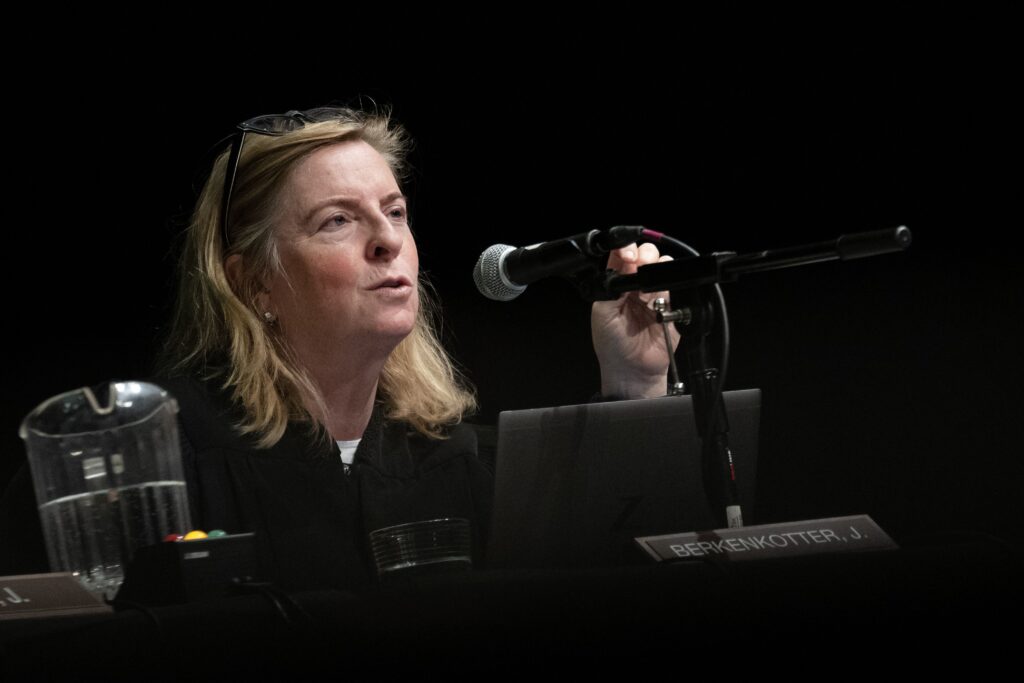
Justice Maria E. Berkenkotter did not participate in the appeal.
The case is City and County of Denver v. Board of County Commissioners et al.


Colorado Supreme Court blocks ballot initiative defining ‘fees’
Michael Karlik
michael.karlik@coloradopolitics.com
Updated 11 hours ago
The Colorado Supreme Court blocked a proposed ballot initiative on Monday that would have required voter approval for new fees above a certain threshold, while also enshrining a definition of “fee” into the state constitution for the first time. Chief...
Colorado justices, by 5-2, say Longmont detective did not violate suspect’s Miranda rights
Michael Karlik
michael.karlik@coloradopolitics.com
Updated 12 hours ago
The Colorado Supreme Court’s majority ruled on Monday that a Longmont detective did not coerce a suspect into talking by making references to how a judge would look at his character, and by suggesting he may get out of prison...
Colorado justices find Fort Collins police lacked probable cause to arrest suspect in park
Michael Karlik
michael.karlik@coloradopolitics.com
Updated 15 hours ago
The Colorado Supreme Court agreed on Monday that Fort Collins police lacked probable cause to arrest a man for a child sex offense based on his presence in a public park around the time they intended to meet with their...

Supreme Court to hold oral arguments, discipline commission releases report | COURT CRAWL
Michael Karlik
michael.karlik@coloradopolitics.com
Updated 16 hours ago
Welcome to Court Crawl, Colorado Politics’ roundup of news from the third branch of government. The state Supreme Court is holding oral arguments this week, plus Colorado’s judicial discipline commission released its annual report. Colorado Supreme Court news • The Supreme...

Federal judge dismisses developer’s challenge to Denver affordable housing ordinances
Michael Karlik
michael.karlik@coloradopolitics.com
Updated 3 days ago
A federal judge dismissed a homebuilder’s constitutional challenge on Tuesday to a pair of Denver ordinances that impose obligations on developers related to the affordable housing demands created by new construction. Two related companies, redT Homes and redT Capital Partners,...

10th Circuit distances itself from prior decision making it easier to toss prisoner lawsuits
Michael Karlik
michael.karlik@coloradopolitics.com
Updated 4 days ago
The Denver-based federal appeals court distanced itself on Wednesday from its own recent decision that made it easier for prison officials to end civil lawsuits by transferring incarcerated plaintiffs between facilities. A three-judge panel of the U.S. Court of Appeals...

Appeals court overturns Douglas County vehicular homicide conviction due to faulty jury instructions
Michael Karlik
michael.karlik@coloradopolitics.com
Updated 1 day ago
Colorado’s second-highest court overturned a defendant’s vehicular homicide conviction and 12-year prison sentence on Thursday after determining a Douglas County judge omitted key language from the jury instructions that could have resulted in a different outcome. James Paul McDonald was...
Federal judge dismisses malicious prosecution claim against former Denver prosecutor
Michael Karlik
michael.karlik@coloradopolitics.com
Updated 3 days ago
A federal judge concluded on Monday that a former Denver prosecutor could not be sued for allegedly causing the arrests of two plaintiffs after they failed to appear for trial on the scheduled date, even though the trial had been...
Judicial discipline commission reports increased transparency, increased submissions
Michael Karlik
michael.karlik@coloradopolitics.com
Updated 3 days ago
The Colorado Commission on Judicial Discipline received 473 misconduct complaints about judges in 2025, which was nearly 29% higher than in 2024 and substantially greater than any time in the past decade. However, only 31 complaints were referred to the commission...
Colorado Gov. Jared Polis ignites fierce debate after raising clemency questions in Tina Peters case
Marianne Goodland
marianne.goodland@coloradopolitics.com
Updated 5 days ago
Gov. Jared Polis ignited a political firestorm Tuesday night after weighing in on the prison sentences of two former Colorado officials — a Democrat and a Republican — convicted of attempting to influence a public servant. The comments quickly fueled...
PREV
PREVIOUS

Doug Lamborn appointed to conference committee tasked with reconciling defense policy bill
U.S. Rep. Doug Lamborn has again been named to sit on the conference committee that will work out differences between the House and Senate versions of the 2024 National Defense Authorization Act. A 16-year member of the House Armed Services Committee, the Colorado Springs Republican was appointed on Tuesday by House Speaker Kevin McCarthy to […]

Divided appeals court finds no misconduct from Denver prosecutor's inflammatory argument
While the Colorado Supreme Court has established that prosecutors may not characterize a witness’s testimony as a “lie,” the state’s second-highest court has decided, by 2-1, a Denver prosecutor did not cross the line by repeatedly using a synonym for “lie.” Jurors convicted Rigoberto E. Fernandez in 2015 for stabbing a man at Montbello Recreation […]