

Denver Mayor Mike Johnston details $52 million in homeless initiatives

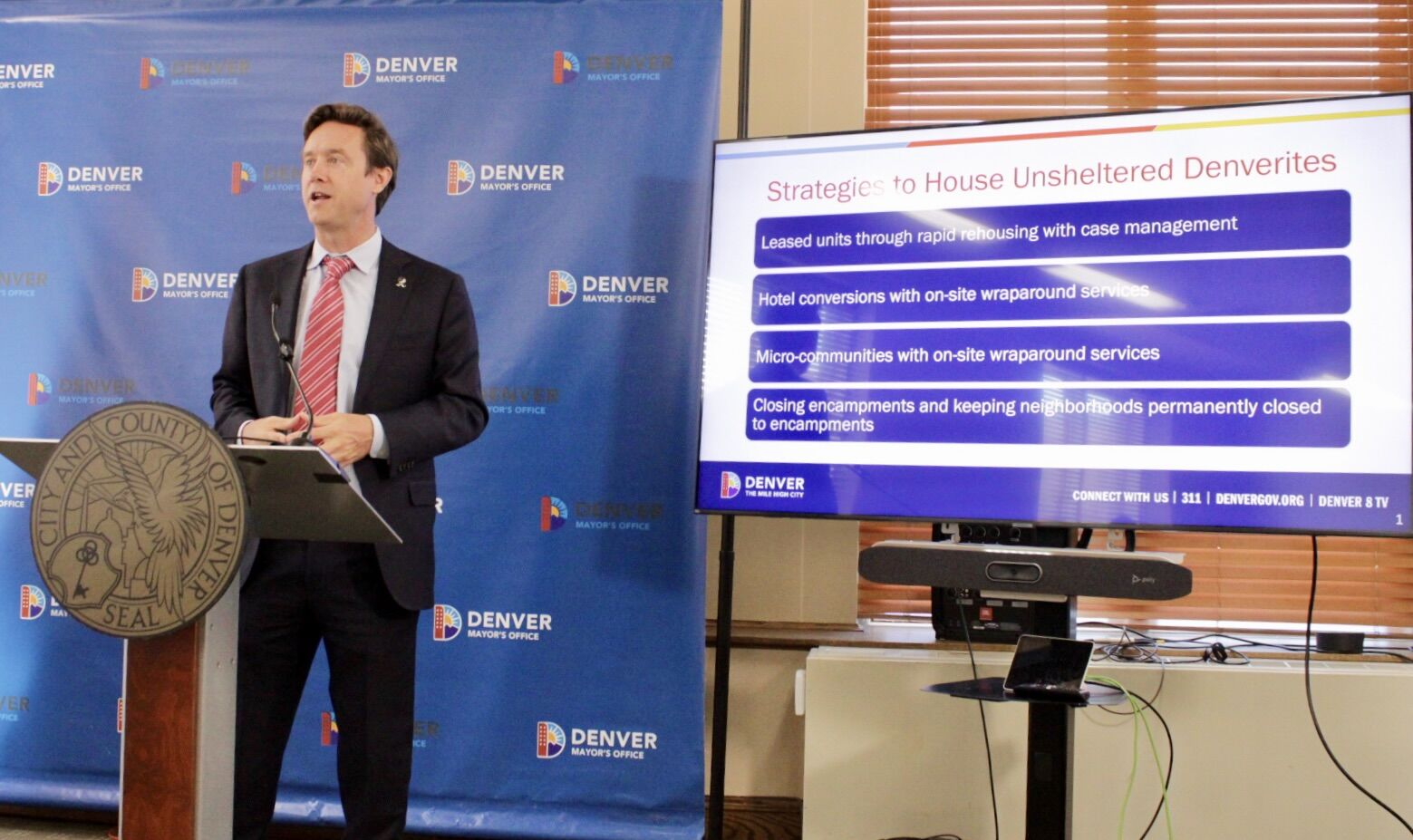
Denver Mayor Mike Johnston on Tuesday revealed the city intends to spend roughly $50 million on his homeless initiatives through the rest of the year, the majority of which is earmarked for building “micro-communities.”
Micro-communities consist of a supervised set of tiny homes or “pallet” shelters with access to bathrooms, kitchens, showers and other services. The idea is to offer homeless people a place to live that can be built faster and cheaper.
The city expects to spend about $48.6 million on his initiatives, said Johnston, who was sworn into office in July and who vowed to get 1,000 homeless people off of the city’s streets.
An additional $3 million is being set aside to create a budget cushion for four different strategies the city is deploying to combat homelessness, Johnston added.
The building of micro-communities sits atop the list of strategies the Johnston administration is deploying in a campaign to curb the city’s soaring homelessness crisis, with a price tag of $19.6 million this year alone, according to the mayor’s office.
The mayor’s office released earlier potential sites for micro-communities, and the city council last month approved a contract to purchase 200 pallets. Johnston said the pallets have been ordered.
Denver, like other major cities in America – notably metro centers in the West – is grappling with homelessness that some believe are fueled by substance abuse and the lack of access to affordable housing.
The seven-county metro Denver region saw a 32% jump in homelessness this year, based on the Metro Denver Homeless Initiative count. Point-in-time counts are estimates taken on a single night, which many say undercount the true scale of the crisis.
As of Jan. 30, the region had 9,065 homeless people, compared to 6,884 the year before. Between 2022 and 2023, the number of “unsheltered” people – those who specifically sleep in public places, such as on the street, in tents or in cars – grew by 33%, from 2,078 to 2,763.
In raw count, Denver saw the biggest increase with 5,818 homeless people, up from 4,794 last year. The city has poured significant resources into reducing homelessness, spending $152 million in 2022 and authorizing $254 million to address the problem in 2023. When then-Mayor Michael Hancock took office a dozen years ago, that spending stood at $8 million.
When pressed about residents’ concerns surrounding micro-communities and the potential of increased crime and drug use, Johnston replied, “The long term goal is to move people out of homelessness and into housing, and we can then close these encampments, and keep those encampments closed permanently.”
He added: “The single most dangerous strategy is keeping folks living in encampments that are unsupervised, unstructured and unsafe. We know when we get people out of these settings into settings that do have wraparound services, that do have staff around the clock … That these are the safest, most stable structures.”
Johnston maintained that the micro-community structure is “proven to be safer for unhoused residents and safer for neighbors.”
A resident near a new homeless pop-up or refugee shelter in the 300 block of Zuni Street said violence, drug-use, loitering and jaywalking have become problems.
“Our tax dollars are going toward this. The city is creating a homeless problem in our neighborhood that wasn’t there before,” the resident told The Denver Gazette.
During his first full day in office, Johnston declared a homelessness emergency, which the city council has twice extended.
“We are confident we’re going to be able to deliver on that,” Johnston said, referring to his vow to get 1,000 homeless people off of the streets.
Sources for Johnston’s initiatives include the city’s Department of Housing Stability, which is funding $37 million for homeless efforts. Other funding sources are the American Rescue Plan Act ($4.7 million), savings from under-budgeted real estate acquisitions ($2 million) and general fund transfers from COVID-19 pandemic response efforts ($8 million), according to the mayor’s office.
“I think the long-term zoning capacity is up to four years,” Johnston said on micro-community timelines. “But I think we’ve looked at a two-to-four year timeline. As people know, this goes to our longer need around affordable housing.”
The Johnston administration is implementing other strategies to tackle homelessness, notably the following:
-
Converting hotels into shelters: The city spent a tentative $18.9 million to purchase and operate the 194-unit Best Western Central Park hotel on Quebec Street. The original price tag was $26 million, according to 9News. An additional $5.4 million is earmarked for leasing and operating additional hotels. The housing agency funded $16.1 million of the purchase, the mayor’s office reported.
-
Spending $4 million for rapid re-housing contracts on leased units.
-
The city’s homeless encampment response for outreach, transportation, resources and related service is costing $750,000 in 2023.
Amongst the homeless population, 40% are employed, Johnston told The Denver Gazette.
“They just can’t make enough money to pay the first and last month’s rent,” he said. “So, what we’re really working on is getting folks into these transitional supportive housing units so we can then work on expanding the number of affordable units that are available across the city.”



Colorado bill aims to regulate AI chatbots to protect minors from self-harm, sexually explicit content
Marissa Ventrelli
marissa.ventrelli@coloradopolitics.com
Updated 3 hours ago
Juliana Peralta of Thornton was a vibrant, happy kid, said her mom, Cynthia Montoya. However, in the final months of 2023, Cynthia began to notice a change in her 13-year-old daughter. Juliana had become more withdrawn and was on her...

More than 20 Colorado counties receive grants to improve land record-keeping systems
Maren Prince
maren.prince@denvergazette.com
Updated 21 hours ago
More than 20 Colorado counties received a total of $2.5 million to improve their land record-keeping systems, according to a Monday news release. The State’s Electronic Recording Technology Board awarded 22 counties with grants ranging from $5,000 to $350,000, according...

Colorado House passes ‘kidfluencer’ bill requiring trusts, removal rights for children
Marissa Ventrelli
marissa.ventrelli@coloradopolitics.com
Updated 7 hours ago
A bill that seeks to provide “kidfluencers” compensation for their work on their parents’ social media accounts passed the Colorado House on Monday, with both Democrats and Republicans voting in favor of the legislation. House Bill 1058, sponsored by Reps....

Applications open for Social Impact Artist Award | NONPROFIT REGISTER
Joanne Davidson Special to Colorado Politics
joanne-davidson-special-to-colorado-politics@coloradopolitics.com
Updated 5 days ago
BONFILS-STANTON FOUNDATION Denver News: Applications are now being accepted for the Bonfils-Stanton Foundation’s 2026 Social Impact Artist Award. Now in its second year, the award will go to two Denver-based artists or artist collectives, each of whom will receive $50,000 — a $35,000...

Greeley voters halt landmark development project
Hap Fry, Special to The Gazette
hap-fry@gazette.com
Updated 5 days ago
GREELEY – The landscape-altering Cascadia development project has been put on ice, according to unofficial results of a city referendum on the project Tuesday. The proposed development would have included an 8,600-seat multiuse arena and ice center that would be home to the Colorado Eagles,...

Protecting satellites in space, on the ground a priority for Colorado companies
Alexander Edwards
alexander-edwards@coloradopolitics.com
Updated 6 days ago
As the Department of Defense moves toward utilizing more commercial partnerships, building a resilient space-based commercial field is contingent on several factors, according to industry leaders at the annual Warfare Symposium in Aurora. The symposium features businesses of all sizes...
Bipartisan opposition sinks eviction bill in Colorado
Marissa Ventrelli
marissa.ventrelli@coloradopolitics.com
Updated 7 days ago
Two Democrats sided with Republicans on a legislative panel to reject a proposal that would have made several changes to eviction filings and proceedings, including requiring judges to suppress court records. Sponsored by Rep. Junie Joseph, D-Boulder, House Bill 1047...

Gala-goers usher in the lunar Year of the Fire Horse in grand style | NONPROFIT REGISTER
Joanne Davidson Special to Colorado Politics
joanne-davidson-special-to-colorado-politics@coloradopolitics.com
Updated 5 days ago
NATHAN YIP FOUNDATION Greenwood Village News: If predictions for the lunar Year of the Fire Horse hold true, 2026 will be a time of intense energy filled with big changes, fresh starts, and new opportunities, so long as one maintains a steady hand and a sense of clear direction to avoid whatever chaos may result. At...
Democratic lawmakers propose changes to landlord-tenant laws in Colorado | Bills in Brief
Marissa Ventrelli
marissa.ventrelli@coloradopolitics.com
Updated 1 week ago
Colorado lawmakers introduce hundreds of bills each year. Bills in brief cuts through the noise by explaining which proposals matter, what’s at stake, and how decisions at the Capitol could affect everyday life across the state. House Bill 1013, sponsored by Reps....
Colorado lawmakers mull competing bills on data centers
Scott Weiser
scott.weiser@gazette.com
Updated 1 week ago
A Colorado coalition of data center developers and operators is urging lawmakers to pass a proposal that offers tax breaks to attract large facilities, while calling a competing bill a major obstacle to new investment. Meanwhile, proponents of the latter...
PREV
PREVIOUS

WATCH: Lauren Boebert ejected from 'Beetlejuice' performance in Denver after complaints
U.S. Rep. Lauren Boebert was escorted by security from a performance of “Beetlejuice” on Sunday night in Denver after audience members complained the Garfield County Republican was talking loudly, singing and using her cellphone camera during the musical, a spokesman for the city-owned Buell Theatre said. Two patrons were asked to leave the auditorium during […]
Young and left-leaning: Poll hints at how Denver's newest residents could shape city politics for years to come | ANALYSIS
A recent poll highlighted the ideological underpinnings at work in the city of Denver, most notably how a group of young residents with socialist views stridently oppose some strategies that the overwhelming majority of voters support. In particular, the poll – conducted by Republican and Democrat pollsters – strongly hints of the philosophical push and pull that […]