

Who can Coloradans trust? | HUDSON
It’s been 40 years since a therapist and close friend, advised me, “You know, Miller, you seem to have an anti-authoritarian mindset. Why is that?” Her observation came without knowing I had reported my commanding officer to the Judge Advocate General’s staff for diverting funds. I still recall the precise words included in JAG’s response: “We are responsible for enforcing Naval Regulations and the chain of command in place to implement them,” which I accurately interpreted as a warning that “you better be right about this, Lieutenant.” A subsequent investigation confirmed the allegation, and my C.O. was officially reprimanded, bringing a swift close to his Naval career. A few months later, I was quietly “RIFed” as part of a “reduction in force” that dispatched me home a year early but, oddly enough, with a promotion.
As a freshman legislator in the Colorado House, I resigned from the Democratic caucus in 1979 declaring I would not return until we elected new leadership. This is the kind of political move that fails to endear you with partisan comrades, whatever the justification. During the following year I recruited veteran legislators Wayne Knox and Jerry Kopel to engineer a revolt that removed Bob Kirscht of Pueblo as minority leader and replaced him with Federico Peña. The morning following his defenestration, Kirscht parties and was rewarded with a seat on the Joint Budget Committee. Suddenly, Democrats who had been avoiding me approached to mumble, “I had no idea Bob was a problem for House Democrats. I guess a change was needed.”
Stay up to speed: Sign-up for daily opinion in your inbox Monday-Friday
So, why have I opted to be a boat-rocker for much of my adult life? As Chief Quinn counseled us at Officer Candidate School, “Don’t rock the boat just to watch the waves – tip the damned thing over.” This is advice that matched my inclinations. There are two ways those in positions of authority can and often abuse their power. Each is infuriating. First is to exceed their legal or allotted authority in order to bully subordinates. Second is to fail to fulfill their assigned obligation to remedy corruption and organizational failures for which they are responsible. The latter is often more damaging than the former.
David Brooks recently wrote an essay for Atlantic magazine inquiring, “How America Became Mean?” Well, there are many explanations available. Pankaj Mishra wrote a bestseller in 2017 with “Age of Anger: A History of the Present,” perfectly timed following the 2016 Presidential election. Recently, Rob Schneider offered up “The Return of Resentment” while Pippa Norris and Rob Inglehart suggest “Cultural Backlash” as an answer. Liberal Ezra Klein recently featured conservative writer Mary Katherine Ham who argues America’s institutions have “earned” Republican mistrust on his podcast. Where can we search these days for leaders focused on improving our quality of life and the equitable sharing of the benefits of the commonwealth?
There’s no ready answer. Permit me to recount a recent disappointment. Having been involved with efforts to provide high-speed transit serving Colorado’s mountain resorts along Interstate 70 for a quarter century, I became aware of the Uinta Rail Spur proposal in Utah more than a year ago. Alarm at oil trains running beside the Colorado River and then across the state was first raised in Western Slope communities. Eagle County Commissioners searched for allies to support their objections to federal approval of the Uinta Basin rail project. I took it upon myself to alert several Front Range elected officials as well as environmental organizations that they should probably pay attention to this dispute. I even penned a column suggesting the possibility of oil trains running through downtown Denver should re-open the longstanding discussion of an “Eastern Freight Bypass” skirting the Front Range.
When I spoke with Alan Salazar, then chief-of-staff to Denver Mayor Michael Hancock, pointing out that Mayor Hancock should be prepared to reply to questions about the Uintah shipments, he assured me he would pass the information along to the city’s transportation office staff. Alan is a smooth, smart political operator I’ve known for many years and he knew – and knew that I knew – this was a polite brush-off. The controversy would drop into a black hole and, sure enough, Mayor Hancock made it to the exit without being confronted. Nor did he offer a helping hand. DRCOG and several local governments straddling the rail line also blew off any concern.
Response from Front Range environmental groups was little better, also promising to refer the matter to transportation staff. This, of course, didn’t prevent them from soliciting me for financial contributions – Conservation Colorado being the most active on the fundraising front. Most elected officials finally expressed their concerns recently, but they are arriving late to the party. The Willow oil field development in Alaska was approved last year with vigorous support from Native tribes.
The Utes just slapped Gov. Jared Polis around for attempting to derail their economic development plans. The majority of the Uinta crude lies are on the Ute reservation. Asleep at the switch when they might have strangled this baby in the cradle, it’s now time to negotiate safety protocols. Only Denver Councilwoman Debbie Ortega and U.S. Rep. Joe Neguse were paying attention when it still mattered. The sudden virtue signaling from others makes an anti-authoritarian like myself order another beer.
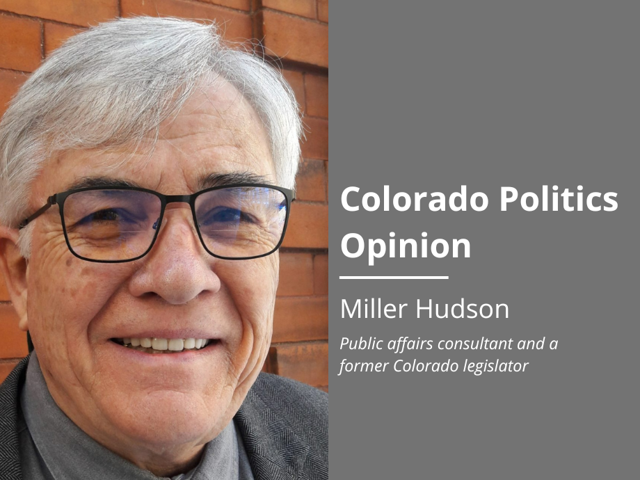
Miller Hudson is a public affairs consultant and a former Colorado legislator.

It’s time to let unaffiliated voters caucus | Vince Bzdek
Vince Bzdek
vince.bzdek@gazette.com
Updated 4 hours ago
There’s no getting around it: Colorado’s 3,000 county caucuses, which just wrapped up recently, left half the electorate out in the cold. Since unaffiliated voters now make up 51% of all Colorado voters, a majority of Colorado electors are barred...
A Mile High, again: Capitol M | Week of March 21, 2026
Marianne Goodland
marianne.goodland@coloradopolitics.com
Updated 3 days ago
The lighter side of the Capitol, usually…. Local Journalism Day, except they forgot their very own local journalists. The state Senate on Thursday, March 19, passed a resolution recognizing Local Journalism Day. Everyone voted for it, which is good, because...

The insular bubble of caucuses and assemblies | SONDERMANN
Eric Sondermann
eric-sondermann@coloradopolitics.com
Updated 2 days ago
Nearly 30 years ago, then-Federal Reserve Chairman Alan Greenspan coined the term “irrational exuberance” to describe the overheated stock market. That descriptive phrase could also apply to much of the political realm. The hype in politics often grossly exceeds the...
Set appropriate state guidelines for critical surveillance technology | OPINION
Colorado Politics
colorado-politics@coloradopolitics.com
Updated 2 days ago
I admit it: I’m worried. I’m hearing a lot about surveillance in the public arena. I hear cameras are capturing my car’s license plate wherever I drive, my face as I go in and out of stores and health facilities,...
Puppy trafficking bill promotes inhumane breeding | OPINION
Colorado Politics
colorado-politics@coloradopolitics.com
Updated 2 days ago
By Patti Strand When Justice Thurgood Marshall wrote “The Constitution does not prohibit legislatures from enacting stupid laws,” he wasn’t wrong. He was referring to a political process sometimes ill-equipped to deal with complex issues that require subject-matter knowledge and a...
Penny wise but foolish by pounds | Paula Noonan
Paula Noonan
paula-noonan@coloradopolitics.com
Updated 2 days ago
Leadership of Colorado’s General Assembly introduced the Fiscal Year 2026-2027 Legislative Appropriation bill, HB26-1333, at $75.72 million. That will be the budget to run the state legislature next year. About $74 million comes out of the general fund and the...
Proposed evictions bill fails to improve housing stability while threatening higher rents | OPINION
Colorado Politics
colorado-politics@coloradopolitics.com
Updated 3 days ago
No landlord wants to evict a tenant for non-payment of rent. That is true for large housing providers, small “mom-and-pop” owners and nonprofit housing rental providers alike. Evictions are financially and emotionally costly for everyone involved. But when rent goes unpaid, eviction...

Prevention works — invest in conflict prevention with wolves | FEEDBACK
Colorado Politics
colorado-politics@coloradopolitics.com
Updated 2 days ago
The recent reporting on Colorado’s wolf depredation payouts exceeding $700,000 highlights a critical problem with the current approach to wolf recovery: current mainstream systems focus on compensation and ineffective reactive non-lethals. These systems are not designed to prevent conflict but attempts...
Colorado’s clean-energy future must be affordable for older adults | PODIUM
Colorado Politics
colorado-politics@coloradopolitics.com
Updated 2 days ago
By Jason DeaBueno Last winter, one of the older adults we serve at Silver Key shared something that has stayed with me. She begun turning her heat down at night — not because she wanted to, but because she was...
Why Denver should care about conservation easements — even if you’ve never set foot on a ranch | OPINION
Colorado Politics
colorado-politics@coloradopolitics.com
Updated 3 days ago
By Jason Swann I live in Denver. I drink tap water from my kitchen sink, hike close to home when I can, worry about wildfire smoke every summer, and try, like many families, to keep up with the rising cost...
PREV
PREVIOUS

Roosevelt rolling over in grave over Antiquities Act abuse | GABEL
Rachel Gabel The Antiquities Act of 1906 authorizes the president of the United States to proclaim national monuments of federal lands that contain historic landmarks, historic and prehistoric structures, or other objects of historic or scientific interest. According to the Congressional Research Service, the president is to reserve “the smallest area compatible with the proper […]

‘Housing first’ is a dead end for Denver’s homeless | Denver Gazette
Tom Wolf was a homeless drug addict roaming the streets of San Francisco five years ago. Today, he’s an outspoken advocate for an approach to homelessness that is strikingly different from the “housing first” policies now in place in a lot of U.S. cities, including Denver. Last week, as reported by The Gazette, he stopped […]