

Coloradans pay when government grapples itself | HUDSON
It wasn’t my intention to pen another screed grumbling about the American proclivity for resorting to governance by lawsuit. Alas, last week’s newsfeeds report a pair of jurisdictional disputes which have sent Colorado governments trotting off to court. Before attending to the specifics of these conflicts, I should confess to having had a burr under my saddle for more than 40 years whenever I discover one unit of my governments is in the process of suing another. I know I’ll wind up paying for both platoons of attorneys.
These scraps are a sufficiently lucrative market. Entire law firms specialize in pursuing them. These clients (indirectly, Colorado taxpayers) can be expected to pay promptly and, win or lose, the judgments will usually be appealed – assuring continuing business. While I served in the Legislature, several decades ago, I introduced a bill that would have required quasi-governmental agencies and other units of government to participate in 120 days of mandatory negotiations using a professional arbitrator before proceeding to court.
This legislation arrived long before the GAVEL amendment was approved by voters, guaranteeing every bill a public hearing. Mine was “pocket vetoed” by the chair of the Local Government Committee who apologized to me, agreeing it really wasn’t such a bad idea, but all the major political players were virulently opposed – the Municipal League, Colorado Counties, Inc., as well as Colorado trial attorneys. This legislation was doomed, as was another proposal that any buildings financed with public funds incorporate passive solar features in their design, provided this didn’t increase costs by more than 1%. I recognized mandating inclusion of renewable technologies would be futile. This proposition attracted assaults from realtors, construction companies and even architects. It was also pocket vetoed without a hearing.
Stay up to speed: Sign-up for daily opinion in your inbox Monday-Friday
At the end of four years serving in the Legislature more than half my bills failed to receive a hearing. With a few exceptions, my only net positive contribution during two terms had been joining with moderate Republicans (a breed nearing extinction) in killing several of the most dreadful legislative proposals. I decided it was time to throw in the towel and walk away, if not from politics. You don’t mind losing but not being heard is humiliating.
So, why is the town of Idaho Springs headed to court seeking an injunction against its local school district? This pair is squabbling over construction of a new maintenance barn for the district’s school buses. If it strikes you this should be a resolvable conflict, you’re not alone. The school board is telling the town it can’t mess with their plans, hiding behind state approvals. The town is asserting its right to permit the bus barn through its planning process.
Whether the town is concerned about congestion, runoff pollution or esthetics is unclear. It’s entirely possible members of the city council simply dislike the school board. I’m reminded of Henry Kissinger’s observation that the reason academic politics get so nasty is because the stakes are so small. Have you noticed how frequently Colorado recall elections occur in small towns? Idaho Springs attempted to dump its mayor a few years ago.
More intriguing is the recent filing of an objection by Denver International Airport against the Colorado Department of Health and the Environment regarding its draft rewrite of the state’s General Industrial Stormwater Permit requirements. The full title of this regulation is twice as long as this abbreviated identifier, which tells us we are wandering well into the weeds of public policy. We expect our Departments of Health to keep our water clean and DIA to ensure air travel remains safe, yet these equally admirable goals have collided as one arm of the “administrative state” collides with another – each honorably attempting to protect us.
At the root of the current quarrel is a growing concern with the public health implications of PFAS chemical pollution. These forever chemicals have been used for years in everything from non-stick frypans to baby bottles and, here’s the key, in firefighting foams and airport de-icing fluids. At the Colorado Springs Airport, which shares runways with Peterson Air Force Base, PFAS contamination has found its way into local municipal water systems. A pending clean-up will prove lengthy and expensive. With micro-plastics routinely discovered in brain samples, PFAS agents may be the least of our challenges.
The Federal Aviation Administration is engaged in a break-neck effort to replace existing aviation fluids with PFAS free replacements expected to become available in 2024. Meanwhile, civilian airports are required to use Department of Defense approved agents which still contain trace PFAS contaminants. The Colorado Department of Health plans to prohibit further use and demand any equipment that may retain even microscopic traces of previous use be junked. This would slap a $20 million dollar cost on an airport which provides a major economic driver for the entire Front Range.
This well-intentioned rulemaking is attempting to comply with recent EPA/PFAS regulations that conflict with existing FAA rules. DIA is trapped in the middle. The good news is both CDPHE and DIA are still talking. These discussions may lead to a reasonable compromise.
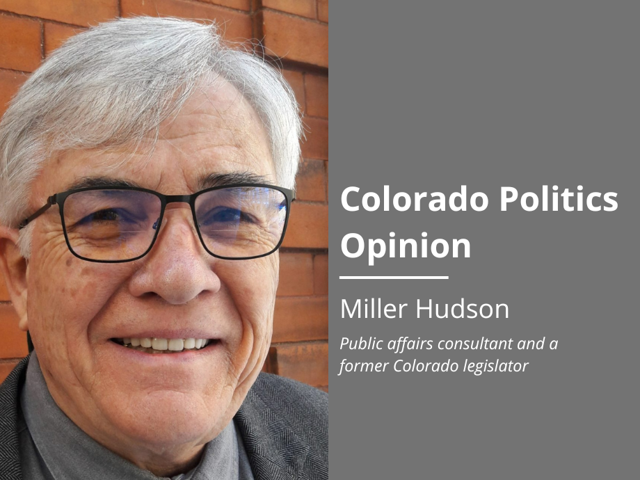
Miller Hudson is a public affairs consultant and a former Colorado legislator.

An April Fool’s Day to remember | Capitol M | Week of April 4, 2026
Marianne Goodland
marianne.goodland@coloradopolitics.com
Updated 2 days ago
The lighter side of the Capitol, and if light were weight, the Capitol would have lifted off better than the Artemis II rocket on April Fool’s Day. There was a plethora of Fools at the Capitol for April Fool’s Day...

Democrats rebounding without learning necessary lessons | SONDERMANN
Eric Sondermann
eric-sondermann@coloradopolitics.com
Updated 14 hours ago
“When we fight, we win!” That, reportedly, was the chant heard over and over again at the Colorado Democratic Assembly a week ago. It suggests that pugilism has been the piece missing from the Democratic toolkit. Perhaps it was just...

The Centennial State’s nuclear energy opportunity | OPINION
Michael Hancock
michael-hancock@coloradopolitics.com
Updated 2 days ago
Colorado was given a clear opportunity earlier this year. On Jan. 28, the U.S. Department of Energy issued a Request for Information (RFI) seeking potential hosts for Nuclear Energy Innovation Campuses — an early-stage process designed to identify states serious...

More pain than gain in upending Colorado’s water-access laws | OPINION
Colorado Politics
colorado-politics@coloradopolitics.com
Updated 2 days ago
By Greg Walcher and Mike King Colorado’s long-standing balance between public recreation and private property along rivers is now under renewed pressure. But changing stream access law would impose significant fiscal and legal costs for relatively limited new recreational benefit....

Guardianship is not a homelessness policy | OPINION
Colorado Politics
colorado-politics@coloradopolitics.com
Updated 2 days ago
By Amelia McKeon The federal government’s proposal to expand guardianship for homeless veterans is being framed as compassionate. It is anything but. It is a dangerous shift toward using one of the most restrictive legal tools we have as a...

Ready to build next-gen clean-energy infrastructure — data centers included | OPINION
Colorado Politics
colorado-politics@coloradopolitics.com
Updated 2 days ago
By Nate Bernstein and Jason Wardrip Colorado has long taken pride in doing things a little differently. We are a state of innovators, entrepreneurs and adventurers, and often lead the nation in new policies and new ideas. For generations, our...
Untraditional education platform makes fool out of state ed department | Paula Noonan
Paula Noonan
paula-noonan@coloradopolitics.com
Updated 3 days ago
It’s April Fool’s week and ERBOCES, Education Re-envisioned BOCES, is one of the state’s biggest jokers. This untraditional education platform authorized through five founding school districts including Falcon School District 49 in El Paso County has played the Colorado Department...

‘Steel for fuel’ — but bill consumers for both | PODIUM
Colorado Politics
colorado-politics@coloradopolitics.com
Updated 2 days ago
By Sarah Montalbano In 2018, Xcel Energy, an investor-owned utility serving millions of customers across eight states, was the first U.S. utility to pledge to deliver 100% carbon-free electricity by 2050. Eight years later, Xcel is pleading with Colorado...

Mental health education for coaches can help young athletes on and off the field | OPINION
Colorado Politics
colorado-politics@coloradopolitics.com
Updated 4 days ago
By Erin Harrop Youth athletics have become significantly more intense and competitive. The physical effects of training or injury can be grueling — but so are the mental health effects, particularly as performance pressure increases. As leaders and mentors, coaches...
Legislature busy sending lots of minor bills for governor’s signature | Hal Bidlack
Hal Bidlack
hal-bidlack@coloradopolitics.com
Updated 5 days ago
One of the benefits of being, well, I guess technically, some type of journalist writing here on Colorado Politics, isI get on interesting mailing lists. A while back, some kind soul in the governor’s office added me to the daily...
PREV
PREVIOUS

County fairs are where Colorado kids learn to love agriculture | GABEL
072423-cp-web-oped-gabel-1 County fair season has arrived in Colorado and supporting the youngsters showcasing their projects at the fair is a fine way to support agriculture. A fair can evoke memories of Ferris wheels and greased pig contests and fried foods. These are accurate, but the 4-H and FFA projects that don’t draw the crowds outside […]
‘Comrade Dave’ Williams aims to purge state GOP | WADHAMS
Dick Wadhams One can envision a grandstand full of Democrats laughing and munching on popcorn while watching the Great Purge of the Colorado Republican Party led by “Comrade Dave” Williams and his merry gang of Soviet-style purists. Deep anti-Trump sentiment drove hundreds of thousands of new, younger, unaffiliated voters to annihilate Colorado Republican candidates during […]