

Slow burn for Colorado Supreme Court scandal | MAES
In early 2021 the Colorado Supreme Court was confronted with a “pay for silence” scandal that continues to breathe life and seriously questions the integrity, impartiality and transparency of Colorado’s highest court. The scandal, though reported in 2021, actually had its origin in 2019 when it was discovered that the Supreme Court under the leadership of then-Chief Justice Ben Coats offered a high-ranking administrator with the office of the State Court Administrator a $2.5 million contract over the term of five years. The allegation was that the contract was offered in exchange for not filing a tell-all discrimination lawsuit by the administrator. This despite the fact the administrator was facing dismissal over financial irregularities. Once the story broke the offer was rescinded.
The bombshell disclosure shook the Supreme Court at its core values and prompted numerous inquiries at the highest levels including the convening of a legislative investigation by the Interim Committee on Judicial Discipline. The committee was comprised of members from both the Senate and House of Representatives. The committee was charged with suggesting reform as deemed appropriate, including removing the Supreme Court from being judge and jury over judicial misconduct matters.
Subsequent to the disclosure of the contract and other damning information, the Supreme Court, under the direction of Chief Justice Brian Boatright, commissioned two reports at the cost of roughly $300,000 to investigate numerous allegations of misconduct by the court, favoritism, sexual harassment and a general discontent within the judicial department. The costs of the investigations were borne by the taxpayers and conducted by Investigations Law Group (ILG) and the team of Robert C. Troyer and Nicholas E. Mitchell.
The major transgression committed by the Supreme Court was its unwillingness to permit the Colorado Commission on Judicial Discipline to conduct its own independent investigation of judicial misconduct as required by law. Instead, The Supreme Court circled the wagons in order to protect its own and drove the narrative it wanted the public to hear.
Along the way, the commission was threatened with eviction from their office which was under the supervision of the Office of Attorney Regulation Counsel (OARC) which answers directly to the Supreme Court and has the authority to initiate disciplinary proceedings against attorneys. The executive director of OARC subsequently felt it necessary to warn the attorney members on the Commission of the consequences of their public comments should they be deemed violations of professional misconduct. The attorney members rejected any insinuation that their comments were subject to disciplinary action. An attorney representing the commission felt compelled to advise OARC the veiled threats had a chilling effect on lawyer members and were inappropriate.
OARC also refused to provide funding for the commission to address the allegations which required the commission to seek and receive funding from the general fund. It is safe to say OARC was helping the Supreme Court impede the work of the commission.
Stay up to speed: Sign-up for daily opinion in your inbox Monday-Friday
Boatright and the Supreme Court have not been willing partners to reform. The Supreme Court stonewalled the gathering of information to the extent criminal charges could not be filed by the Denver District Attorney due to insufficient evidence. Additionally, the Denver DA, Colorado Supreme Court and State Attorney General allowed the statute of limitations to expire preventing the filing of criminal charges for potential criminal activity.
Coats, now retired, by action of the commission is facing public censure for his role in the pay for silence contract and, perhaps, violations of the state’s judicial code of conduct. It is the first time in state history that a member of the high court faced investigation and sanction by the commission.
What is clear to this day is the commission acted courageously and chose to speak truth to power in light of the overwhelming opposition by the immense power wielded by the Supreme Court. To some it came with a price.
Liz Krupa, a non-lawyer, served as chair of the commission with Judge David Prince from El Paso County serving as vice-chair. Both were extremely vocal in their criticism of certain practices engaged in by the Supreme Court.
Boatright and the Supreme Court appoint the judge members of the commission. Judge Prince was eligible for reappointment by Boatright upon the completion of his term on June 30, 2023. Although it was made clear at a public hearing held by the Interim Committee on Judicial Discipline that a failure by Boatright to reappoint Judge Prince would not only be viewed by many to be retaliation for his opinions which differed in many respects from Boatright’s but would also deprive the commission of valuable institutional history as it moved forward to implement the recommended changes to the judicial discipline process.
Consistent with thumbing his nose at the commission, Boatright chose to bypass Judge Prince for another term and instead appointed El Paso County District Judge Jill Brady to fill the vacant Prince seat. The decision smacks of retaliation for Prince’s refusal to walk in lockstep with the boss.
Let’s weigh Boatright’s retaliatory behavior in light of the following statements he made to the state Legislature in his State of the Judiciary speech on Feb. 18, 2021. He said the following, “Where there is wrongdoing, we will address it. Where there was an abuse of power, we will stop it. Where our policies are deficient, we will change them. We want to know the truth. We recognize the branch faces a crisis of confidence in the leadership.”
His appointment of Judge Brady followed her criticism concerning the Commission’s investigation methods The statements were made at a statewide meeting of judges with Boatright in attendance. While Judge Brady is certainly free to exercise her first amendment right, she should disclose whether her opinions have been shaped by her own experiences and/or prior conversations with Boatright.
In the interest of transparency, Chief Justice Boatright should disclose the process he followed in selecting Judge Brady including whether others were offered the opportunity to apply. Transparency in the process will support the recommendation at page 128 of the ILG report which provides, “To provide confidence that appointed officials and leadership at the Branch are held to the highest ethical and behavioral standards, an appropriate degree of transparency and accountability is imperative.”
Incidentally, Boatright made the appointment at the expense of appointing a judge from a rural county. The other Supreme Court appointees are from Arapahoe, Jefferson, El Paso and Adams counties. So much for diversity.
Others have questioned whether Boatright’s snub is an indication of a sea change on the commission which could affect the work done over the last year and further stifle reform. It must be remembered that Gov. Jared Polis is responsible for appointing the non-lawyers to the commission of which there are three to be appointed. The exiting non-layers are all term-limited and Polis has a tradition of allowing appointees to serve only two terms despite no prohibition on serving longer.
It appears the Supreme Court is willing to let the scandal suffer a slow burn. Stay tuned.
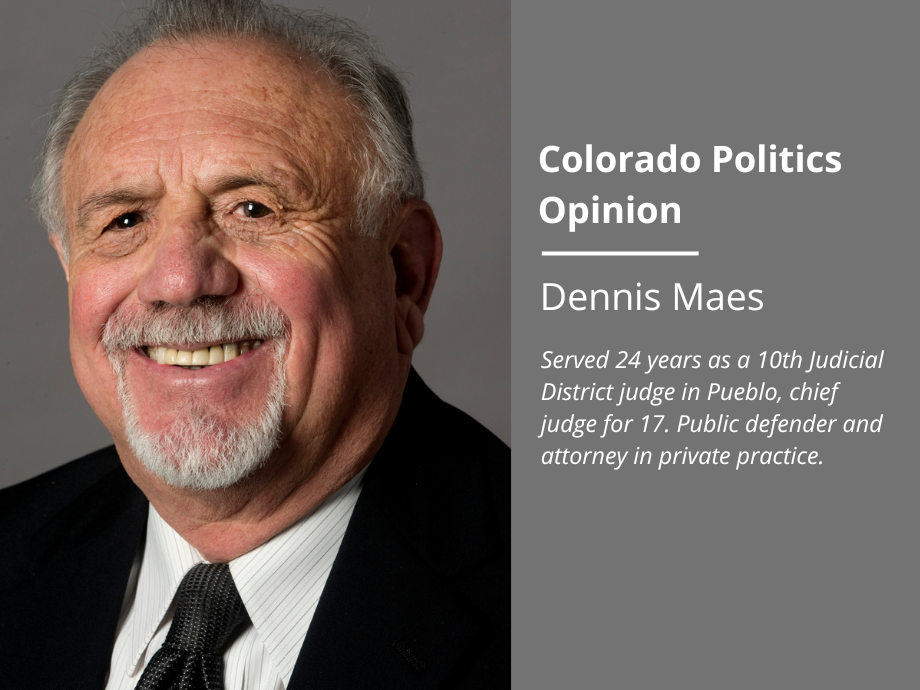
Dennis Maes served 24 years as a 10th Judicial District judge in Pueblo and was chief judge for 17 of those years. He previously served as director of Pueblo County Legal Services, Inc.; as a public defender and as an attorney in private practice.


Dan Haley on the role of oil and gas in Colorado’s energy future | The OpEdge Podcast
Tony Olivero
tony.olivero@gazette.com
Updated 5 hours ago
Dan Haley, executive director of Coloradans for Responsible Energy Development, joins The OpEdge to discuss the role of oil and natural gas in Colorado’s energy future amid the state’s aggressive push toward “net zero.” Haley tells host and investigative columnist...
Rural hospitals don’t want special treatment, just a chance to care for locals | PODIUM
Colorado Politics
colorado-politics@coloradopolitics.com
Updated 1 day ago
By Kevin Stansbury As chief executive of Lincoln Health, my responsibility is simple: ensure the people of eastern Colorado have access to high-quality healthcare close to home when they need it most. That mission has never been easy. Rural hospitals...
Blue states should avoid disasters | Hal Bidlack
Hal Bidlack
hal-bidlack@coloradopolitics.com
Updated 1 day ago
Back when I was teaching political science at the U.S. Air Force Academy (and amazingly to me, a week from this column’s publication will mark 20 years since my retirement from active duty. Where the heck did that time go?)...
Right-to-hunt ballot measure’s a cruel, anti-wildlife solution to a nonexistent problem | GUEST COLUMN
Colorado Politics
colorado-politics@coloradopolitics.com
Updated 2 days ago
By Eric Washburn I love to hunt. Every year I try to hunt big game in Colorado and waterfowl in Louisiana. This year, I applied for five Colorado big game licenses — elk, deer, pronghorn, moose and bighorn sheep. I...
Jena Griswold’s record: corruption, incompetence | Dick Wadhams
Dick Wadhams
dick-wadhams@coloradopolitics.com
Updated 5 days ago
There is no statewide elected official going back decades who is as breathtakingly corrupt and incompetent as Secretary of State Jena Griswold, who is now running for attorney general of all things. And compliant ruling Democrats know it. Their silence...

Kiros exudes why Colorado’s political times are a-changin’ at annual Denver Dems gala | Miller Hudson
Miller Hudson
miller-hudson@coloradopolitics.com
Updated 5 days ago
Among Colorado’s few remaining bipartisan rituals are county and state party dinners. I was particularly intrigued by last week’s Denver Democratic Party’s 2026 Annual Gala, a “New Deal for a New Era.” Their glossy program featured an artist’s Technicolor rendering...

Livestock grazing regulations need flexible updates | Rachel Gabel
Rachel Gabel
rachel-gabel@coloradopolitics.com
Updated 5 days ago
The Bureau of Land Management last updated their livestock grazing regulations the year I graduated from high school. I am 49. Assessing rangeland health can’t be done once and not revisited. This year is a prime example that managers must...

Taxpayers donate to tax increase campaign | Jon Caldara
Jon Caldara
jon-caldara@coloradopolitics.com
Updated 6 days ago
Give the man his due. President Donald Trump has undeniable talents. Colorado politicians are learning. Chief among The Don’s skills is taking the self-serving, ethically dubious behavior of previous politicians and putting it on steroids. Or, to borrow from the...
A summertime all-you-can-eat political buffet | SONDERMANN
Eric Sondermann
eric-sondermann@coloradopolitics.com
Updated 1 week ago
We find ourselves in the doldrums of August with a complete dearth of political news. Yeah, right. These days, that train never stops moving. It is a 24/7/365 express amplified by 24/7/365 media. Let me respond with one of my...

State money diversion scheme the unsurprising downfall of ERBOCES scam | Paula Noonan
Paula Noonan
paula-noonan@coloradopolitics.com
Updated 6 days ago
Falcon School District 49, aka El Paso County School District 49, has finally cut bait, thrown the fishing pole into the lake and sunk the canoe. The longtime enabler of the Education Reenvisioned BOCES’ (ERBOCES) schemes to fund private Christian...
PREV
PREVIOUS

‘Electrification’ fizzles in Colorado’s cold | Denver Gazette
Colorado’s policymaking brain trust aims to take away our natural gas-fired furnaces, sooner or later, to make way for an all-electric future. For now, that agenda is taking shape in narrower restrictions, like Denver’s new building code adopted earlier this year, which bans gas furnaces and water heaters in new commercial and multifamily construction starting […]

Building lives in Aurora, building houses in Denver | DUFFY
Sean Duffy Tackling the tragedy of homelessness in the Denver metro area and helping these men and women at the margins of society get on a path to healthy self-sufficiency is again the focus of big promises and plans. Denver Mayor Mike Johnston has embraced an idealistic, historically flawed, strategy popular with bureaucrats and “homeless […]