

Gov. Jared Polis seeks to cut red tape, ban growth caps in affordable housing plan

Gov. Jared Polis on Wednesday rolled out long-awaited legislation intended to address Colorado’s dire shortage of affordable housing, which, if enacted, would include the first legislative change to land use planning in 50 years.
Accompanied by a bevy of local government, environmental and legislative leaders, the governor introduced the main proposal in the two-bill package, which relies on a five-point plan that includes both short- and long-term goals.
Supporters said the bill is the result of 125 meetings among municipal and county elected leaders from both parties, housing advocates, environmentalists, developers, labor and business leaders, and representatives of workers who need housing, which Polis called “an unprecedented coalition.”
Already, the bill has attracted supporters, who argue it chips away at a regulatory structure that’s choking growth, and critics, who describe it as a blatant power grab by the state.
The plan focuses primarily on urban and resort community housing, and leaves out any efforts to override local control for counties.
Municipalities, however, have the option of either adopting “flexible minimum standards” or being mandated to use a state-developed model, which would include zoning changes.
The Colorado Department of Local Affairs, which for years has had a collaborative relationship with local governments, will be put in the position of enforcing those mandates for municipalities that don’t go along with the flexible option.
The flexible standards include ADUs – accessory dwelling units, also known as in-law apartments or granny flats – and so-called “middle housing”, such as duplexes, triplexes, fourplexes and townhomes. Under those standards, the municipality can’t require parking but the developer can add it. Resort communities have additional flexibility to work regionally on housing strategies that would allow them to find the best places for more dense housing.
For renters, municipalities can regulate short-term rentals for the housing listed above, with “affordability strategies.”
The standards are different for non-urban municipalities of more than 5,000 residents, with only ADUs required under the bill to deal with affordable housing issues.
Should a municipality – whether urban or resort – decide to forego the “flexible” option, they would be required to use the statewide standard model, which would impose zoning requirements.
Colorado Department of Local Affairs chief Rick Garcia told Colorado Politics his agency will still be in the collaboration business. The legislation is very specific about the enforcement process, Garcia said, but he thinks that, as the process moves forward, “we can find successes and more effectively cooperate and collaborate with local governments so that ‘hammer’ is not the only tool we have.”
Fixed rail, rural resorts, dense housing
The second facet of the plan focuses on transit-oriented communities, also primarily targeting urban communities along the Front Range, including those with fixed rail, and rural resorts.
It could also include more dense housing near bus rapid transit or walkable commercial districts.
The bill outlines a series of either flexible minimum standards or state-mandated standards that apply to transit-oriented communities.
The intention is to reduce housing and transportation costs.
Under the flexible standards, municipalities can create different levels of multi-family zoning and choose from a menu of “affordability strategies,” presumably provided by the state.
The state model would also impose more detailed zoning standards, with a “density bonus” for affordable projects.
The third facet deals with cutting red tape, which could allow for faster deployment of manufactured homes that can be built in just a few days but often have to wait a year or more to be placed on site. It would remove limitations for minimum unit sizes in urban communities, so long as those units comply with fire and building code standards. It would not, however, include units such as tiny homes.
The bill would lift occupancy standards based on familial relationships. In some communities, most recently Denver, there have been city code limits on the number of unrelated people who can live together.
Homeowners’ associations would also be prohibited from blocking development such as ADUs, under the bill.
One issue around red tape is the legislative addition of requirements in building codes, such as a mandate that new multi-family developments include electric vehicle charging stations.
In 2022, Gov. Jared Polis vetoed a bill requiring those stations on new multi-family units. In his 2022 veto letter, the governor said the bill did not have enough flexibility “to adapt to changing infrastructure” and would add too much to housing costs. He also said charging stations ought to be where there would be the most use, not just in new buildings.
The 2022 bill’s sponsor, Rep. Alex Valdez, D-Denver, introduced the 2023 version last week, but that measure is far less prescriptive than its 2022 predecessor.
The fourth and fifth points focus on longer term issues, such as creating a statewide strategic growth plan, and requiring municipalities to conduct regular housing needs assessments and housing plans aimed at dealing with gentrification, for example. The state has never had a strategic growth plan.
The bill would come with $15 million to provide technical assistance to local governments. That’s in addition to money that came from the American Rescue Plan Act, Proposition 123 and other housing measures adopted by the General Assembly in the past two years.
The bill doesn’t define just what is affordable, leaving that to each community to decide, based on the cost of living in those communities.
The second bill, however, is likely to be the most controversial: It would ban all growth caps, whether county or municipal. That would lift limits imposed in Lakewood, Golden and Boulder, for example.
Rep. William Lindstedt, D-Broomfield, points to his own community as a response to growth limits imposed in Boulder decades ago.
Growth caps – which typically translate to limiting growth in residential communities – interfere with affordable housing, Lindstedt told Colorado Politics.
‘Breathtaking power grab’
While the mayor of Boulder, Aaron Brockett, told Colorado Politics he had no problem with seeing Boulder’s growth cap fade into history, the restrictions on municipal local control is already raising fire from other municipalities.
The main bill, at more than 100 pages, is “not the Colorado Way,” said Kevin Bommer, executive director of the Colorado Municipal League, speaking on behalf of more than 1,800 elected city officials who he said will oppose the bill’s “breathtaking power grab.”
“Although the bill is being sold as a ‘menu of options’ with ‘flexibility’ to create affordability, it mainly benefits developer interests to the detriment to the quality of life and access to local elected officials expected by Coloradans and with no guarantees that anything built will be ‘affordable,'” Bommer said. “The League could support the bill if folks are willing to step away from a California-style, top-down approach, and support local government efforts to address density while guaranteeing affordable housing. Unfortunately, powerful special interests are more interested in preemptions than solutions.”
A statement from Colorado Counties’ John Swartout warned state preemption of local decision-making “could hinder local governments’ ability to incentivize affordability and private investment in our communities.” The statement also noted there are constraints beyond beyond the control of local governments, including state regulation and permitting and access to adequate water, sanitation and other utilities. We believe that local planning is key and that everyone can promote more responsible growth management practices.”
“We appreciate the considerable work that has been done to-date and we look forward to continued engagement with the sponsors and other stakeholders as the bill moves forward.”
J.J. Ament, president of the Metro Denver Chamber of Commerce, said at the press conference that, as Colorado tries to recruit and retain businesses, having affordable places to work within reasonable commutes is essential.
“It’s the economic competitiveness issue of the day,” he said.
While the bill isn’t perfect, the efforts to get input from people shows commitment to the cause by governor and legislature, he said, adding the message is “that we can collaborate on the issue of the day.”
After the press conference, however, Ament raised some concerns about the regulatory structure that the bill doesn’t address, as well as over other legislation moving through the Capitol that he said will interfere with the goals of the affordable housing bill.
The chamber’s members – whether builders, developers or the small business owner who is trying to find a place for an employee to live – are aligned on this issue, Ament told Colorado Politics.
It’s not a lack of capital or demand, he said.
“It’s that the regulatory environment in Colorado is so cumbersome and burdensome that you cannot get it done,” he said. “That’s what’s adding to prices.”
The constraint is not whether builders will build, he said, adding, “It’s the regulatory environment that won’t let them build.”
The bill isn’t perfect but it’s a huge step in the right direction, he said, with a message that says, “We will be able to now, as a matter of regional and statewide concern, eliminate some of the barriers around middle housing.”
Middle housing typically refers to townhomes, duplexes and similar dwellings.
Housing conflict at the Colorado state Capitol
Trying to streamline some of these approval process at the local level will deliver housing more quickly, he said. But Ament also said other proposals at the state Capitol could conflict with the housing proposal.
“We need to remove regulatory barriers in local communities; what one community does impacts neighboring communities,” he said, adding no community will do it on its own.
Ament said bills currently moving through the legislature – notably the right of first refusal, rent control, interference in the landlord and tenant relationship – need to die.
“You cannot on one hand support (the governor’s proposal) that says we need attainable housing now and at the same time be supporting these other bills that are in direct competition,” he said.
The bill doesn’t address what might be the elephant in the room for affordable housing – litigation reform.
While the bill advocates for modular or manufactured housing, townhomes, duplexes, triplexes and other multifamily housing, it leaves out the one type of housing that is often the entryway for young families getting into their first home or seniors planning to downsize: condos.
Ament said there are few for-sale condos in Colorado, with litigation as the reason.
“It might be a bridge too far for this bill but it’s something that must be addressed by future legislatures,” he said.
When asked what statewide regulations he would be willing to address, Polis indicated the regulatory changes needed are primarily at the local level, and that he would be open to discussing statewide regulations that affect Colorado’s housing stock.



Bennet, Hickenlooper to vote against Trump’s 10th Circuit nominee from Colorado
Michael Karlik
michael.karlik@coloradopolitics.com
Updated 1 hour ago
Colorado’s two Democratic senators will not vote to confirm President Donald Trump’s nominee to a vacancy on the Denver-based federal appeals court. Trump has selected U.S. District Court Chief Judge Daniel D. Domenico, who he appointed as a federal trial...

Who’s spending in Colorado to get your vote?
Marianne Goodland
marianne.goodland@coloradopolitics.com
Updated 2 hours ago
Groups that raise unlimited amounts of money have spent about $20 million in May and June to try and influence Colorado voters’ choices in the upcoming June 30 primaries. By law, these groups cannot coordinate with the candidates they support....

U.S. government declines to oppose multiple challenges to immigration detention in Colorado
Michael Karlik
michael.karlik@coloradopolitics.com
Updated 59 minutes ago
Multiple federal judges in Colorado granted petitions from people challenging the lawfulness of their immigration detention this week after the government took the unusual step of declining to submit arguments in opposition. Colorado’s federal trial court is facing a flood of...

Tina Peters tells supporters to ‘stand up and fight back’ at Castle Rock event
Marissa Ventrelli
marissa.ventrelli@coloradopolitics.com
Updated 15 minutes ago
Tina Peters, the former Mesa County clerk recently released from prison, warned supporters that what happened to her could happen to them, too, if they did not “stand up and fight back” at an event at the Douglas County Fairgrounds....

Iran strikes cargo ship in Strait of Hormuz, endangering Trump’s peace
Christian Datoc
christian-datoc@coloradopolitics.com
Updated 7 hours ago
Iran attacked a cargo ship traveling through the Strait of Hormuz on Thursday, possibly upending President Donald Trump‘s diplomatic end to the war with Iran. A U.S. official confirmed to the Washington Examiner that the Islamic Revolutionary Guard Corps “struck...

Senate GOP tries to mend fences with Trump after heated lunch
David Sivak
david-sivak@coloradopolitics.com
Updated 5 hours ago
Senate Republicans are trying to turn the page on a heated lunch with President Donald Trump that brought weeks of tensions to a new high-water mark. In a symbolic gesture, Senate Republicans took another vote on the Iran war Wednesday...
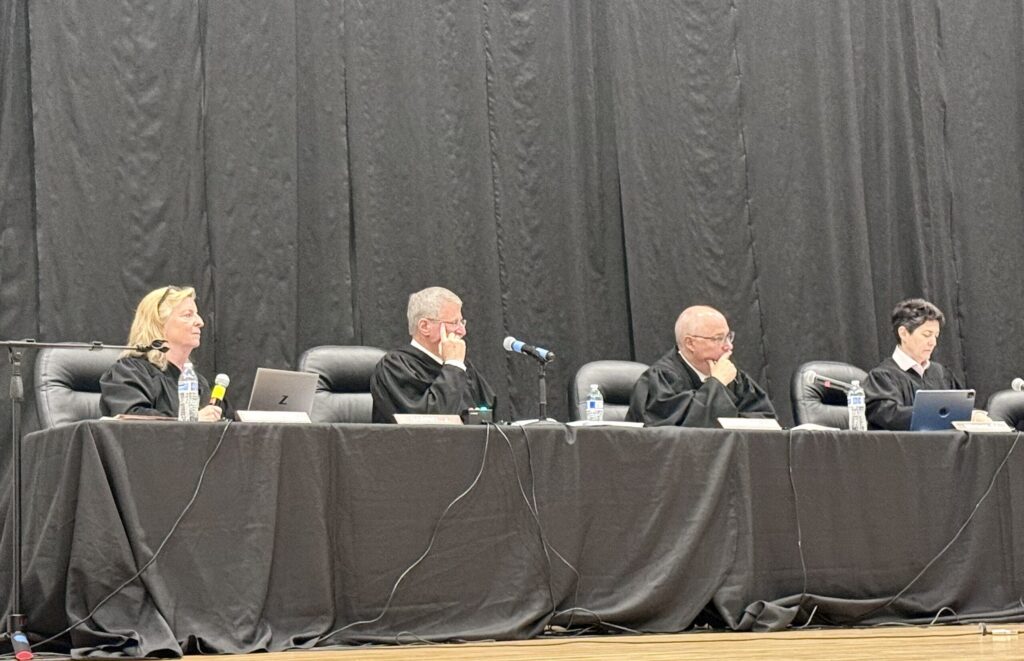
Colorado justices discuss solution to confusion from prior criminal ruling
Michael Karlik
michael.karlik@coloradopolitics.com
Updated 7 hours ago
The Colorado Supreme Court pondered the fallout on Tuesday from its nearly six-year-old decision interpreting the state’s impaired driving laws, with the justices now addressing how defendants affected by the legal change must seek postconviction relief. In contrast to other...

Colorado to participate in Great American State Fair in Washington
Marissa Ventrelli
marissa.ventrelli@coloradopolitics.com
Updated 5 hours ago
Visitors to Washington, D.C. for the country’s 250th anniversary will have the opportunity to learn about Colorado’s natural beauty and culture during the Great American State Fair, a World’s Fair-style event that opened Thursday at the National Mall. While all...

RTD to reconsider service priorities as cuts, budget deficit loom
Michael Braithwaite
michael.braithwaite@gazette.com
Updated 9 hours ago
Should the Regional Transportation District aim to maximize ridership or system coverage? That question sat at the heart of the RTD Board of Directors’ first Comprehensive Operations Analysis briefing on Thursday afternoon. With the Denver transit agency facing a budget...

Mobolade, Colorado Springs leaders say election date lawsuit is attack on local voters
Brennen Kauffman
brennen.kauffman@gazette.com
Updated 7 hours ago
Mayor Yemi Mobolade and other city leaders will fight to keep Colorado Springs elections in April in the face of a new lawsuit. Mobolade, the mayor’s Chief of Staff Wayne Williams and City Councilmember Roland Rainey addressed the lawsuit in...
PREV
PREVIOUS

Western Slope's Gordon Gallagher confirmed as federal judge
Gordon P. Gallagher is Colorado’s newest federal trial judge after the U.S. Senate voted 53-43 to confirm him to the state’s seven-member U.S. District Court on Wednesday. Gallagher is the first appointee to the district court since 1989 to live on the Western Slope. The court has not announced whether Gallagher will remain in Grand […]

Kroger-Albertsons merger raises fears of lack of competition in Colorado
A proposed Kroger-Albertsons merger, first announced in October last year, is raising worries about a lack of competition in Colorado, among other issues. Kroger, which operates King Soopers in Colorado, said that its proposed merger with Albertsons, which operates Safeway, will lead to lower prices, no layoffs for frontline workers and $1 billion to keep […]