

Drip, drop, dry | BIDLACK
Back when I was teaching political science at the Air Force Academy, I’d ask my students how many of them were rich? No one ever raised his or her hands. Then I’d ask different questions: how many of them ate today; how many of them expect to eat tomorrow; and how many of them can get a drink of clean and safe drinking water whenever they like? Then I asked who was “rich” again, but this time on a global scale? With this bit of enlightenment, most of the hands raised.
I bring this up because a recent Colorado Politics article has, yet again, raised the challenge of water management here in the western United States. Regular readers (hi Jeff!) will recall my earlier posts that deal with the five-or-so previous columns that discussed the need for us out here in the West to take water issues far more seriously. You may also recall the existence of the Colorado River Compact of 1922, where in an organization was established among the states that rely on the Colorado River for drinking and other urban uses but, most especially, for agricultural needs. The seven states that are members are divided into the upper basin (Colorado, New Mexico, Utah and Wyoming) and the lower basin, (Arizona, California and Nevada).
And as the current CoPo article points out, the water issues that seem to be most challenging tend to involve the upper basin states against the lower basin states, especially California. The interstate group that represents the upper basin states is asking the federal government to postpone the schedule release of 500,000 acre-feet of water from Flaming Gorge Reservoir in Utah that would help prop up Lake Powell. They argue we’ve had better than average snowfall (finally!) and that, coupled with other factors, makes the need to release that massive amount of water less pressing. One of the attorney’s stated it rather directly, saying it is time to send a message that “the Upper Basin states refuse to continue supplying (the) Lower Basin’s limitless demands for water.”
Even with the extra snow, there won’t be enough water for everyone, as reservoir levels have continued to drop across the west. Heck, the Glen Canyon Dam, which creates Lake Powell behind it, has already seen a drop of 47% in electrical production due to low water levels.
So, once again, we have a water battle between, well, mostly the upper states against California (and to a lesser extent, Arizona). Until we start seriously thinking about an interstate water grid, along the lines of the interstate power grid, we need to even more seriously think about how to reduce water usage in places where the rain doesn’t seem to fall as often as it used to (cough… climate change… cough).
Now, we as regular folks can certainly do our parts. Last summer, my next-door neighbor and I removed big sections of grass from our yards and replaced with xeriscaping. The rocks look nice, and I was able to permanently shut down about eight sprinkler heads on my watering system. It would be a good idea for our legislature to pass new laws greatly limiting how much thirsty grass can be planted with new construction, but until we look at the real consumer of massive amounts of water – agriculture – we won’t really approach any real and meaningful solutions.
I’m talking to you, California and Arizona.
But, of course, I’m also talking to us. We like going to the grocery store, regardless of time of year, to pick up fresh fruits and vegetables. We import lots of fruits and veggies in the winter from nations to our south, but we also grow vast amounts of food in places that, before modern irrigation systems were installed, were dry and dusty. California has roughly one-third of its agricultural land dedicated to fruits and veggies, roughly 7.5 million acres, leading the nation in the production of broccoli, artichokes, kiwis, plums, celery, garlic, cauliflower, spinach, carrots, lettuce, raspberries and strawberries.
Arizona also grows lots of things you wouldn’t expect to find in a desert. When I visited my daughter and son-in-law in Yuma, Arizona, where he was a fighter pilot for the Marines, I was amazed to see huge trucks with massive loads of broccoli and lettuce being harvested, even though the none-irrigated areas located next to the irrigated fields were dry and barren.
Look, it’s not unreasonable for people to want fresh produce year-round. But it is not reasonable to treat water as an unlimited resource at almost no cost. I’m a believer in market forces, and maybe it is time to rethink our expectations. You want fresh American-grown lettuce in winter? Well, maybe you should expect to pay a water fee on top of the regular cost. Or, more radically, perhaps we rethink out agricultural relationships as a nation.
I don’t want to hurt California’s farmers, but I also think we need to be realistic about what gets grown, where and when. With California agriculture consuming roughly 80% of the Colorado River water that arrives at its border, perhaps we need to say that certain thirsty crops just can’t be grown in certain places or, perhaps, certain times of year. A less thirsting form of, say, wheat might be planted. Vegetables such as corn, pole beans, and okra are drought tolerant, and might be an alternative consumers would need to get used to. Oh, lima beans are also drought resistant, but they are evil and vile beans, and should be extinguished from the face of the Earth, but I digress…
Absent a national water grid, which I think would be a great idea, we must adjust our expectations about what agricultural products and, frankly, front lawns, are OK in an arid area. Living in the American west is just terrific, but that doesn’t mean we can expect the same crops to grow here as in, say, Michigan. Water use must be a central focus of the U.S. and the various state legislatures. There are paths forward that will mitigate a potential crisis, but the time is running increasingly short.
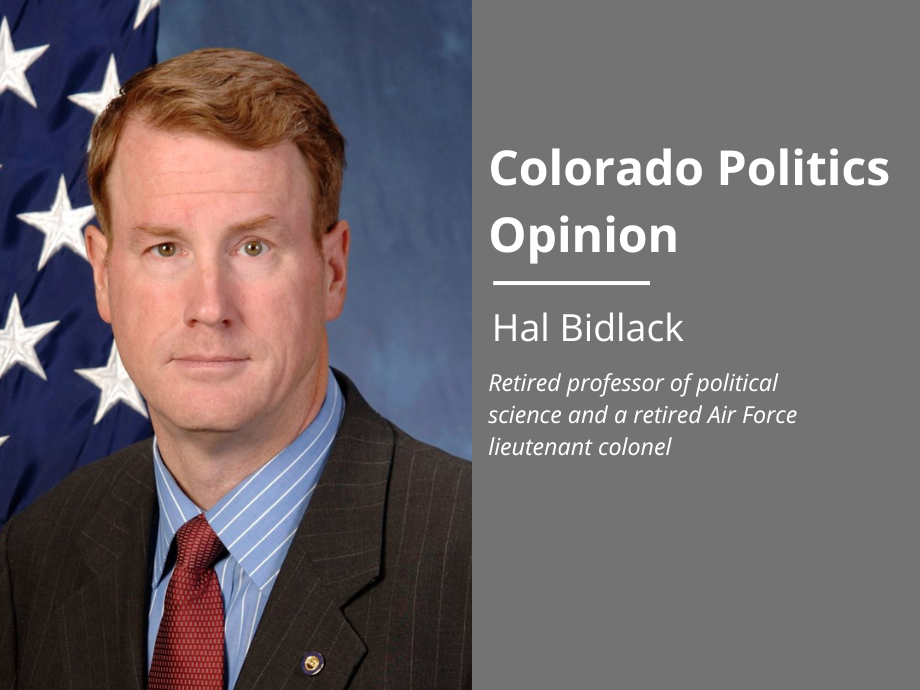
Hal Bidlack is a retired professor of political science and a retired Air Force lieutenant colonel who taught more than 17 years at the U.S. Air Force Academy in Colorado Springs.


Add Lynn Bartels to Colorado’s roll call of legends | Dick Wadhams
Dick Wadhams
dick-wadhams@coloradopolitics.com
Updated 19 hours ago
A few weeks after the Rocky Mountain News shut its doors forever in 2009, more than 600 Republicans gathered for the state party’s annual Centennial Dinner. Lamenting the historic significance of the loss of one of Colorado’s great daily newspapers,...

Conservation efforts emphasize the lesser prairie chicken | Rachel Gabel
Rachel Gabel
rachel-gabel@coloradopolitics.com
Updated 19 hours ago
Reid DeWalt, deputy director of Colorado Parks and Wildlife, spoke to the Water Resources and Agriculture Review Committee about the Lesser Prairie Chicken and moving conservation forward. He said in 2026, CPW staff counted 77 males on 13 leks, a...

Colorado’s regulations should address policy challenges only as truly needed | Miller Hudson
Miller Hudson
miller-hudson@coloradopolitics.com
Updated 16 hours ago
As Colorado approaches its 150th birthday, we should remember its first 100 years were characterized by repeated boom-and-bust economic cycles. Dependence on mineral extraction and agricultural commodity prices was subject to the volatility of these markets. In 1972, as I...
The last, best hope for the Colorado GOP | Kelly Sloan
Kelly Sloan
kelly-sloan@coloradopolitics.com
Updated 16 hours ago
If the Colorado Republican Party desires to retain any relevancy, let alone wrest back any of the levers of political control in the state, it needs to elect Barb Kirkmeyer in the June 30 primary. To be sure, Kirkmeyer would...

Understanding Trump’s remarkable political comeback in 2024 | Cronin and Loevy
Tom Cronin Bob Loevy
tom-cronin-bob-loevy@coloradopolitics.com
Updated 19 hours ago
President Donald Trump lost the 2020 presidential election. He inspired a riot at the U.S. Capitol to try to overthrow the results of that election. He was impeached by the U.S. House of Representatives and later was indicted for several...

Read Michener’s ‘Centennial’ | Jon Caldara
Jon Caldara
jon-caldara@coloradopolitics.com
Updated 4 days ago
If you’ve been reading my columns, you’ve noticed I’m basically illiterate. I blame my dyslexia and public education, but my Olympic-level laziness could be the driving factor. Anyway, I basically can’t read (and, still, I graduated from CU Boulder, so...
Giving credit to Polis where credit is due | SONDERMANN
Eric Sondermann
eric-sondermann@coloradopolitics.com
Updated 5 days ago
It is an understatement to suggest that Gov. Jared Polis has had a tough couple of months. The bloom was already off the rose and Coloradans were paying far more attention to the choice of his replacement than they were...
Will one unqualified AG replace another? | George Brauchler
George Brauchler
george-brauchler@gazette.com
Updated 4 days ago
Colorado Democrats are poised to nominate another attorney general candidate with de minimis relevant credentials or experience. Far from disqualifying, Colorado’s recent voting history mirrors that of America in favoring biography over experience, partisanship over policy, and emphasizing what divides...
Pueblo’s mayor keeps stirring the pot | Dennis Maes
Dennis Maes
dennis-maes@coloradopolitics.com
Updated 4 days ago
Pueblo Mayor, Heather Graham, has clearly proven to be a disciple of the Donald Trump school of governance. And, like her mentor, she is experiencing the same catastrophic results. The format is to ignore what the electorate approved and expects...
The perils of Colorado’s unregulated abortions | GUEST COLUMN
Colorado Politics
colorado-politics@coloradopolitics.com
Updated 4 days ago
By Tom Perille How did the movement which grew out of a genuine concern for the health and safety of women become the same movement that undermines women’s health and safety today? Despite good intentions, it was a long route...
PREV
PREVIOUS

Allowing Aurora PD to hire cheaters, liars undermines goals | Sentinel Colorado
A police department decimated by seemingly endless stories of drunken, lying, physically abusive, racist, discredited cops wants to make it easier to hire people to be cops who have been caught or convicted of some of those behaviors. What could go wrong? While the notion on some levels doesn’t ring the alarm bells as one […]

Biden, SCOTUS, student loans and the separation of powers | SLOAN
Kelly Sloan By all accounts, the Biden Administration’s arguments defending President Joe Biden’s student loan forgiveness edict before the Supreme Court are not going very well. The Court heard arguments this week challenging the president’s unilateral decision to dismiss, with the flick of his presidential wrist, nearly half-a-trillion dollars in student loan debt, absent any […]