

How the price of energy went nuts | Grand Junction Daily Sentinel
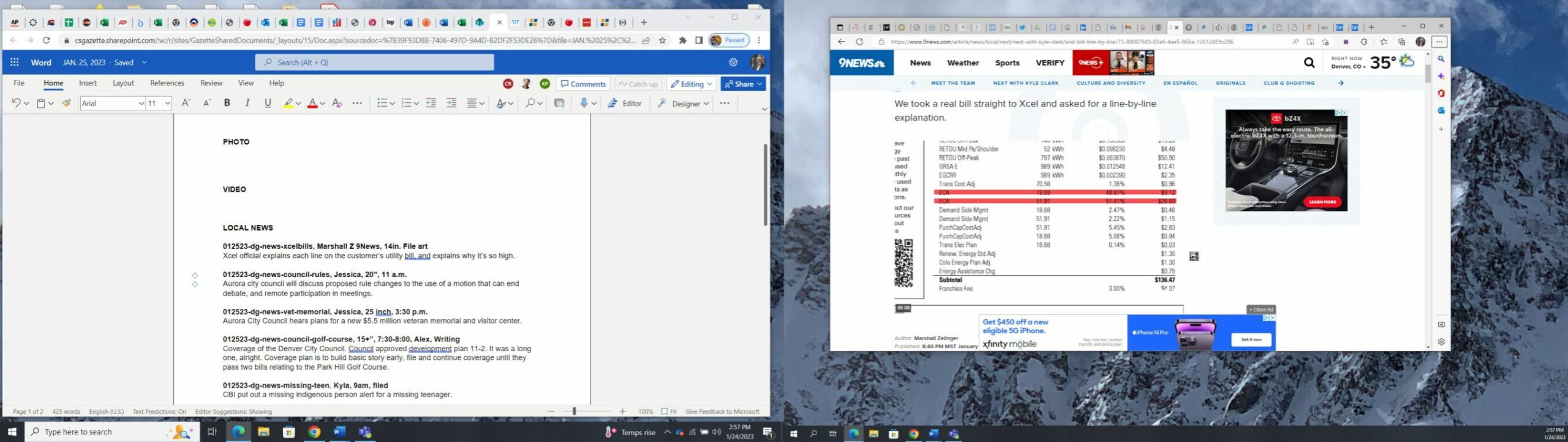
With energy bills where they are right now, it’s starting to feel like burning dollar bills for heat might be the cheaper option. But why are prices so high? There’s a short-term answer and a long-term one.
The short answer is the price of natural gas. Natural gas prices jumped to their highest point in 14 years last fall due to global supply disruptions brought on by the war in Ukraine, according to reporting by Colorado Public Radio. By law companies like Xcel can pass those cost increases directly through to consumers without generating additional profit.
The good news is those prices are coming down, as the U.S. increased its production and demand hasn’t been as high as feared, thanks to a warmer than expected winter in Europe. That will lead to as much as a 15% drop in energy bills in the next few months.
“Colorado customers will see lower natural gas bills than previously expected as a result of a recent decrease in wholesale natural gas prices,” Xcel Energy said in a statement.
So, the short-term spike is mostly due to a volatile market. According to a Public Utilities Commission (PUC) study, of the increase we are seeing, 70% is due to the price of natural gas and increased usage.
In response to this, Gov. Jared Polis directed the three-member PUC to reduce customer costs by exploring an expansion in natural gas storage and by making utilities pre-purchase gas ahead of anticipated price hikes, according to reporting by The Colorado Sun.
Having the ability to buy natural gas when the price is low and store it to use when the price is high makes a lot of sense. We urge the PUC to adopt those policies.
Critics of Xcel are decrying it taking record profits while so many Coloradans are struggling to pay their bills. This gets to the long-term issue.
It’s true that Xcel made a lot of money last year. The company reported it had earned $1.74 billion in profit last year – an 8.7% increase over the previous year. The problem is that Xcel doesn’t make more profit when gas prices go up.
The state grants the company a competition-free monopoly, which comes with strings attached. It isn’t allowed to turn a profit on any of its day-to-day operations. So, how does a for-profit business make a profit if it isn’t allowed to make one through operations?
By law it is allowed to collect extra revenue on infrastructure investments, like new transmission lines, power plants or wind farms. The Colorado Public Utilities Commission sets the rate of return through a process called “base rate increases,” which are extra fees baked into monthly energy bills.
“Xcel Energy’s base rates have doubled in the last 15 years,” Cindy Schonhaut, the director of the Colorado Office of the Utility Consumer Advocate, told CPR. “That’s astounding, and it doesn’t have to do anything with inflation. It has everything to do with greed and profit.”
That’s on the PUC, which can tell the energy companies it won’t approve a base rate increase for an unnecessary project, or not approve the full amount requested. The PUC has done this on occasion, but it’s also gone along with a number of increases.
We want our energy companies to invest in infrastructure. That’s good for Colorado, but the PUC needs to really scrutinize each project. The PUC can also tell these companies that the days of 10% profit are over. Maybe 3% profit is more appropriate. Customers are hurting, it’s time energy providers tighten their belts.
Grand Junction Daily Sentinel Editorial Board
Read the original article here.


Threats inside and out loom for Colorado’s Republicans | Dick Wadhams
Dick Wadhams
dick-wadhams@coloradopolitics.com
Updated 1 day ago
Colorado Republicans made strides in 2024 despite an insidious state chairman who tried to defeat successful Republican candidates. Newly elected U.S. Reps. Gabe Evans, Jeff Hurd and Jeff Crank fought off unethical opposition from their own state party chairman, making...

Is it time for both parties to bail on Colorado’s political nominating system? | Miller Hudson
Miller Hudson
miller-hudson@coloradopolitics.com
Updated 1 day ago
Cracks are beginning to appear in Colorado’s political nominating system. Recently, Mario Nicolais, a formerly Republican-leaning pundit, and Doug Friednash, former Democratic legislator, have opined regarding the imminent demise of the caucus/assembly framework which controls partisan candidate selection. There has...

Recognizing the value of generational work | Rachel Gabel
Rachel Gabel
rachel-gabel@coloradopolitics.com
Updated 1 day ago
The Lesser Prairie Chicken habitat in southeastern Colorado is a swath of prairie that begins in Cheyenne and far-southeastern Lincoln counties and moves south and east into Kiowa, Prowers and Baca counties. This is cattle country where the short grass...

Why the controversy with mail-in ballots? | Cronin & Loevy
Tom Cronin Bob Loevy
tom-cronin-bob-loevy@coloradopolitics.com
Updated 1 day ago
Most Coloradans enjoy the right to vote “by mail” at election time. Most Americans favor this process. But U.S. President Donald Trump is trying to federalize (nationalize) this practice and shift the supervision of voting from county clerks to the...

Who are the kings being crowned here in Colorado? | Jon Caldara
Jon Caldara
jon-caldara@coloradopolitics.com
Updated 4 days ago
Though most of us celebrate “No Kings Day” on July 4, the Trump-deranged got a head start last weekend with rallies around the state. Attendees bravely fought oppression by blocking traffic for people with jobs. Rally-goers demanded freedom from tyranny,...
An April Fool’s Day to remember | Capitol M | Week of April 4, 2026
Marianne Goodland
marianne.goodland@coloradopolitics.com
Updated 4 days ago
The lighter side of the Capitol, and if light were weight, the Capitol would have lifted off better than the Artemis II rocket on April Fool’s Day. There was a plethora of Fools at the Capitol for April Fool’s Day...

Democrats rebounding without learning necessary lessons | SONDERMANN
Eric Sondermann
eric-sondermann@coloradopolitics.com
Updated 2 days ago
“When we fight, we win!” That, reportedly, was the chant heard over and over again at the Colorado Democratic Assembly a week ago. It suggests that pugilism has been the piece missing from the Democratic toolkit. Perhaps it was just...

The Centennial State’s nuclear energy opportunity | OPINION
Michael Hancock
michael-hancock@coloradopolitics.com
Updated 4 days ago
Colorado was given a clear opportunity earlier this year. On Jan. 28, the U.S. Department of Energy issued a Request for Information (RFI) seeking potential hosts for Nuclear Energy Innovation Campuses — an early-stage process designed to identify states serious...

More pain than gain in upending Colorado’s water-access laws | OPINION
Colorado Politics
colorado-politics@coloradopolitics.com
Updated 4 days ago
By Greg Walcher and Mike King Colorado’s long-standing balance between public recreation and private property along rivers is now under renewed pressure. But changing stream access law would impose significant fiscal and legal costs for relatively limited new recreational benefit....

Guardianship is not a homelessness policy | OPINION
Colorado Politics
colorado-politics@coloradopolitics.com
Updated 4 days ago
By Amelia McKeon The federal government’s proposal to expand guardianship for homeless veterans is being framed as compassionate. It is anything but. It is a dangerous shift toward using one of the most restrictive legal tools we have as a...
PREV
PREVIOUS
Gov. Polis keeps calling COVID a crisis | Colorado Springs Gazette
Mayday. We have a crisis, right here in Colorado. It is not the matter of young adults and children dying from fentanyl poisoning. It is not Colorado’s soaring murder rate or the flood of illegal immigrants overwhelming social services. The “disaster emergency,” as Gov. Jared Polis declares it, is not the ever-growing dilemma of tents, […]

Three simple letters will cut energy costs | OPINION
Chris Hansen Cleave Simpson The pandemic and rising inflation created enough economic hardship in 2022, and now Coloradans’ electricity rates could pile on, climbing even higher in 2023. Check your latest energy bill – chances are it’s about 54% higher than it was this time last year. Coloradans deserve energy savings, now more than ever. Fortunately, there’s a way […]