

DA balks at effort to dismiss voting complaint against state senator
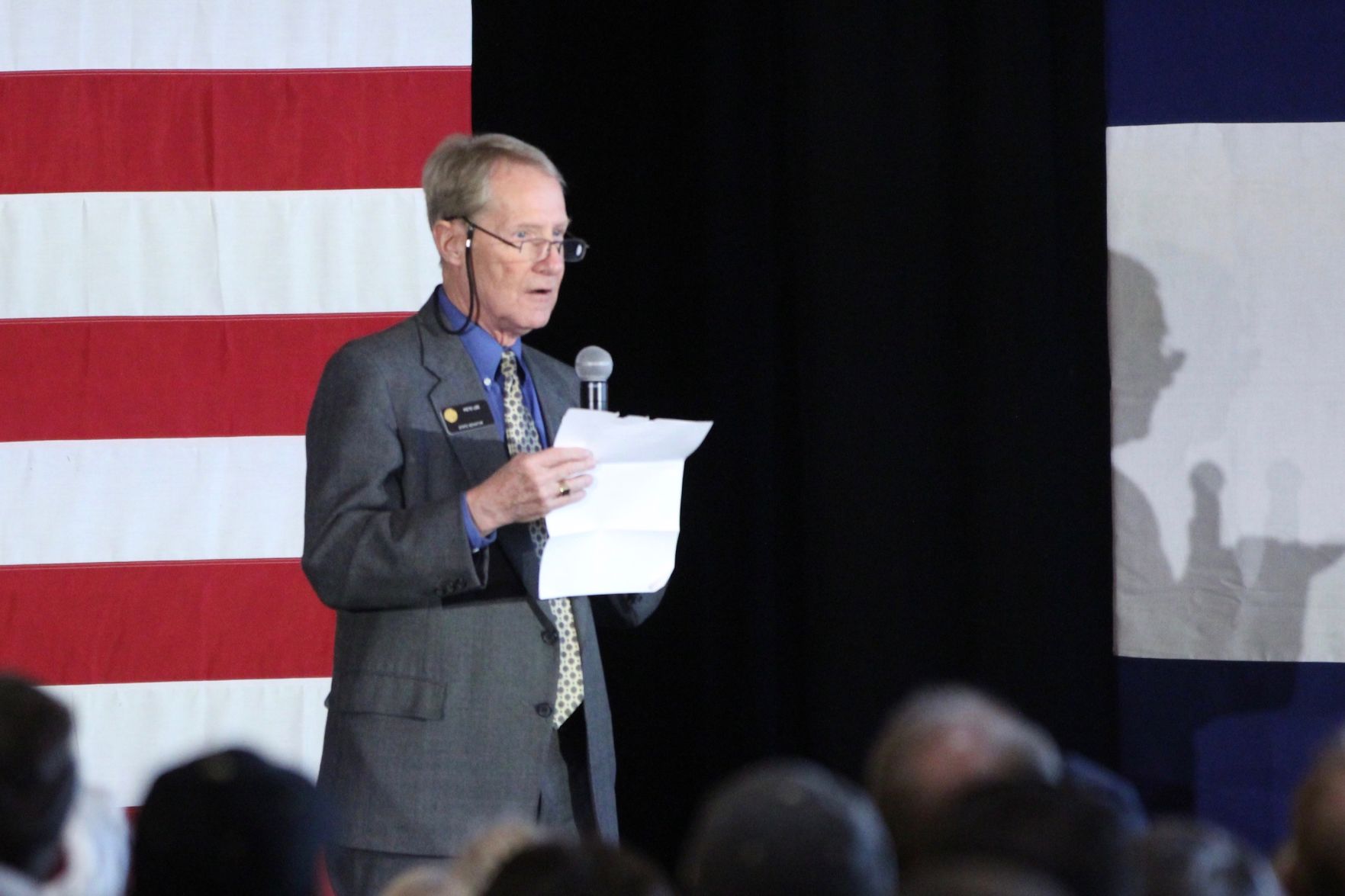
The district attorney who obtained a grand jury indictment against state Sen. Pete Lee is continuing to fight for the complaint to go forward to trial.
Lee, D-Colorado Springs, was indicted in August on one class 5 felony charge of falsifying his residency information for voting purposes.
Last month, Lee’s attorney filed a motion to dismiss the charge, based on inaccurate information submitted by the Colorado Supreme Court’s Attorney Registration office. That information was presented to the grand jury and according to Lee’s motion formed a significant part of the evidence against the lawmaker.
The felony charge alleges that Lee, under his legal name, Sanford Edmund Lee, voted in the March, 2020 presidential primary from a rental home he owns on N. Sheridan Ave., in Senate District 11, which he represents in the General Assembly. However, the indictment alleged, Lee’s permanent home is on W. Cheyenne Rd., a home he shares with his wife, and has owned since 1991. That home is in Senate District 12, represented by Republican state Sen. Bob Gardner.
The Sheridan address is occupied by Lee’s stepdaughter, according to grand jury testimony revealed in the district attorney’s motion Thursday. That motion was submitted by Assistant District Attorney Andrew Vaughan.
Lee’s attorney, David Kaplan, said in last month’s motion the the grand jury was repeatedly told “and with great emphasis, that Mr. Lee had changed his home residence” with the attorney registration office on Dec. 15, 2019.
The testimony given to the grand jury by District Attorney investigator David Guest “was unknowingly inaccurate,” the motion said. “The government went to great pains to establish a critical piece of evidence – Mr. Lee’s registration documents as an attorney in the state of Colorado,” the motion said.
The original affidavit submitted by the attorney registration office incorrectly said Lee had changed his registration address to the W. Cheyenne Road address in December, 2019. The office later submitted an amended affidavit that corrected the record, and said his registration used the N. Sheridan Ave. address.
“These misstatements and erroneous facts … are not peripheral to the charges sought,” Kaplan said in the motion. “They are a material misrepresentation of the facts used to obtain an indictment.”
“It irreversibly taints their deliberations and creates a fatal flaw in the indictment,” the lawyer added.
Vaughan’s motion said the defendant “cites no Colorado precedent that would directly support his request” and that he is asking the Court create a new standard to review a grand jury’s indictment for sufficiency of the evidence.
Kaplan’s motion cited a 1991 case from the Washington, D.C. Court of Appeals, Hunter v. United States. In their ruling, the appeals court said “where false material testimony is presented to the grand jury, the court may review the evidence presented…to determine whether the defendant suffered any prejudice…”
Vaughan’s motion claimed the the defendant would have to demonstrate prejudice, and the only way to do that would be to show the remaining evidence no longer supports probable cause.
Vaughan’s motion also claimed that when the court reviews a grand jury indictment, the evidence must be viewed in a light “most favorable to the prosecution.”
Even when the amended affidavit from the attorney registration office is take into account, the rest of the evidence “is more than sufficient to support a finding of probably cause, Vaughan’s motion said.
That evidence includes, and citing the grand jury transcript:
- That Lee’s claim that he lives at the N. Sheridan address “is logically inconsistent” with the physical structure and layout of both properties. The W. Cheyenne Rd. property is 2,700 square feet with five bedrooms and four baths; the N. Sheridan home is 936 square feet with two bedrooms and one bath.
- An article in the Colorado Springs Independent, dated June 9, 2020, in which Lee “seemingly admits” the N. Sheridan property is only his on paper for voting and tax purposes.
- Lee’s decision to change his voter registration back to the W. Cheyenne Rd. property after the article was published, despite his attempt to convince the Independent that he lived on N. Sheridan
- A claim by Lee that he paid taxes from the N. Sheridan address in 2020, but on April 22, 2020, he filed his 2019 tax return using the W. Cheyenne Rd. address
- The “hot mic” clip from YouTube, in which Lee admitted he only paid taxes from the N. Sheridan property but spends his nights at W. Cheyenne.
- Testimony from several neighbors on N. Sheridan that Lee had not lived in the property since the 1970s or 1980s, and that he stops by only to do maintenance on the property.
- Testimony from several W. Cheyenne Rd. neighbors that Lee lives at that address, and
- Testimony from Lee’s stepdaughter that he has lived with her and “her various friends” at the N. Sheridan address, which “is incredible” and at times “inconsistent,” according to the grand jury transcript.
Vaughan’s motion also states that to constitute a place, “such residence requires its adoption as a fixed and permanent habitation, and not only a personal presence for the requisite time, but an intention to make such place the true home.” And when a person acquires a new domicile, he must abandon the previous one before he can gain another, the motion states.
The motion states that Lee has a strong motive for misrepresenting his address: he would be unlikely to win a state senate seat in the district where the Cheyenne Rd. house is located. The record supports a “reasonable conclusion” that Lee lived on W. Cheyenne, not on N. Sheridan, when he voted in the 2020 presidential primary.
The next hearing on the case is set for Oct. 18.

Federal judge dismisses developer’s challenge to Denver affordable housing ordinances
Michael Karlik
michael.karlik@coloradopolitics.com
Updated 23 minutes ago
A federal judge dismissed a homebuilder’s constitutional challenge on Tuesday to a pair of Denver ordinances that impose obligations on developers related to the affordable housing demands created by new construction. Two related companies, redT Homes and redT Capital Partners,...

10th Circuit distances itself from prior decision making it easier to toss prisoner lawsuits
Michael Karlik
michael.karlik@coloradopolitics.com
Updated 3 hours ago
The Denver-based federal appeals court distanced itself on Wednesday from its own recent decision that made it easier for prison officials to end civil lawsuits by transferring incarcerated plaintiffs between facilities. A three-judge panel of the U.S. Court of Appeals...

Appeals court overturns Douglas County vehicular homicide conviction due to faulty jury instructions
Michael Karlik
michael.karlik@coloradopolitics.com
Updated 1 day ago
Colorado’s second-highest court overturned a defendant’s vehicular homicide conviction and 12-year prison sentence on Thursday after determining a Douglas County judge omitted key language from the jury instructions that could have resulted in a different outcome. James Paul McDonald was...
Federal judge dismisses malicious prosecution claim against former Denver prosecutor
Michael Karlik
michael.karlik@coloradopolitics.com
Updated 2 days ago
A federal judge concluded on Monday that a former Denver prosecutor could not be sued for allegedly causing the arrests of two plaintiffs after they failed to appear for trial on the scheduled date, even though the trial had been...
Judicial discipline commission reports increased transparency, increased submissions
Michael Karlik
michael.karlik@coloradopolitics.com
Updated 2 days ago
The Colorado Commission on Judicial Discipline received 473 misconduct complaints about judges in 2025, which was nearly 29% higher than in 2024 and substantially greater than any time in the past decade. However, only 31 complaints were referred to the commission...
Colorado Gov. Jared Polis ignites fierce debate after raising clemency questions in Tina Peters case
Marianne Goodland
marianne.goodland@coloradopolitics.com
Updated 2 days ago
Gov. Jared Polis ignited a political firestorm Tuesday night after weighing in on the prison sentences of two former Colorado officials — a Democrat and a Republican — convicted of attempting to influence a public servant. The comments quickly fueled...

Colorado Supreme Court signals intervention in dispute over treatment for trans children
Michael Karlik
michael.karlik@coloradopolitics.com
Updated 3 days ago
The Colorado Supreme Court ordered Children’s Hospital Colorado on Tuesday to explain why it should not direct the organization to resume providing certain types of services to transgender children in compliance with the state’s non-discrimination law. Last month, a Denver...

Judge nixes latest policy requiring 7 days’ notice for Congress members to visit ICE facilities
Michael Kunzelman
michael.kunzelman@associatedpress.com
Updated 3 days ago
WASHINGTON (AP) — A federal judge agreed on Monday to temporarily suspend the latest version of a Trump administration policy that requires members of Congress to provide a week’s notice before they can visit immigration detention facilities. U.S. District Judge...
Judge nixes latest policy requiring 7 days’ notice for Congress members to visit ICE facilities
Michael Kunzelman
michael.kunzelman@associatedpress.com
Updated 3 days ago
WASHINGTON • A federal judge agreed on Monday to temporarily suspend the latest version of a Trump administration policy that requires members of Congress to provide a week’s notice before they can visit immigration detention facilities. U.S. District Judge Jia...

Colorado Supreme Court clarifies restraining order violations can always support burglary charge
Michael Karlik
michael.karlik@coloradopolitics.com
Updated 2 days ago
The Colorado Supreme Court’s majority ruled on Monday that a violation of a restraining order can also serve as a basis for finding a defendant guilty of burglary. Under state law, a person commits second-degree burglary by unlawfully entering or...
PREV
PREVIOUS

Inmate's challenge to mail, privileges policies at 'supermax' prison rejected by federal court
The federal appeals court based in Denver has rejected an inmate’s challenges to a pair of mail policies at the “supermax” prison in Colorado, noting the legitimate safety concerns underlying the restrictions. The U.S. Court of Appeals for the 10th Circuit also appeared to suggest inmates at the United States Penitentiary, Administrative Maximum Facility in Florence […]

Colorado Coalition for the Homeless opens $46.5 million building in Denver
A team of investors, lenders and housing advocates has leveraged tax credits and other investments, resulting in a $46.5 million project to provide a new facility for the homeless. The Colorado Coalition for the Homeless (CCH), Denver Mayor Michael Hancock and U.S. Rep. Diana DeGette celebrated the grand opening of the Renaissance Legacy Lofts, a […]