

NOONAN | Where 3 tight state races seem to stand
There’s an order to calculating which state House and Senate races are competitive. The first scan is voter registration. The second scan is money. Political principles and voter turnout come in at the next levels if registration and money are competitive.
Based on voter registration, six state Senate races and 21 House races may be competitive using a registration spread differential of no more than 8 points, or, as an example, 28% registration to one party and 20% to the other party with the remainder as mostly Unaffiliated.
By registration, the Tom Sullivan-D vs. Tom Kim-R state Senate race is tightest, with 27.21% to the Dems, 25.34% to Republicans and 45.95% to Unaffiliated. That’s a small plus-1.97 for the Democrats.
Money tells another story. Sullivan, currently a House member from Aurora, has $66,970 on hand while Kim has $9,833. The district has 112,973 active voters to reach with mail, yard signs, etc. At this point, Sullivan has a strong advantage through name recognition and funds available. He’ll attract more money because of these advantages. So unless the GOP hops in to help Kim financially, his ability to get his message to voters will be limited by his funding. The current advantage goes to Sullivan.
The Colorado Springs race between Rep. Tony Exum, Sr.-D and state Sen. Dennis Hisey-R pits two incumbents against each other. Democrats lead by two percentage points in voter registration, but more than 50% of voters are Unaffiliated. That’s the largest Unaffiliated number in all Senate races. Hisey has a significant money advantage at $65,498 on hand to Exum’s $12,647.
To demonstrate Exum’s money weakness, in 2020 the four women in tight registration districts who carried the Democrats to control of the state Senate each raised about $500,000. Granted, that’s an outrageous number for state legislature races, but their fundraising secured two years for the agenda of Gov. Jared Polis.
Exum is better situated than Kim (see above) in that he has name recognition, but he’s not as well positioned as Hisey for getting his message out. And what are their messages? Exum voted with Democrats consistently. Of bills that reached a third and final reading, he voted YES 507 times and NO 3 times. Hisey, though not nearly as conservative as Ron Hanks or minority leader Chris Holbert, voted YES 394 times and NO 125 times.
Hisey says that his main concern is crime, public safety and support for first responders. He will put more money into police because “crime rates are spiking.” The first responder issue may be difficult to pin on Exum because he worked as a first responder, but Hisey’s money advantage may be able to make it stick. Exum’s emphasis is jobs and the economy. He’s also a strong supporter of protecting air and water quality. Hisey doesn’t mention the environment or climate change in his list of issues.
The competition between state Rep. Dylan Roberts-D and Eagle City Council member Matt Solomon-R presents a different angle on races. Democrats are down 2.5 percentage points in voter registrations for the district, so this will be a turn-out election for the blue party.
Roberts is up on money by a lot. The state representative has $137,938 on hand while Solomon has $26,984. The district has 110,741 voters stretching from the Interstate-70 resort corridor along with Steamboat Springs to Craig, Rangely, and Meeker in northwest Colorado. Both men come from the I-70 area so they will have to introduce themselves to ranchers and energy workers in the outer areas of the state.
Roberts has sponsored bills in support of the mountain economy, particularly on affordable healthcare, affordable housing and worker transitions and employment in energy industries. He also has worked on climate change, clean water and expanding in-stream water-flow programs. Solomon, as an owner of a gun store, strongly supports second amendment rights. He’s also committed to correcting public education funding.
Solomon may win if he keeps his fingers crossed that Republican voters will show up in high numbers and vote the party candidate. Roberts will win if he can use his funding to turn out women concerned about reproductive rights and health care in general. He must also turn out people focused on climate change.
The three races illustrate the array of challenges candidates face in tight matches. The contenders who put together the best strategies that use money to promote issues and turnout will probably go to the State House in January.
Paula Noonan owns Colorado Capitol Watch, the state’s premier legislature tracking platform.

Colorado must continue finding common ground on wildfire policy | GUEST COLUMN
Colorado Politics
colorado-politics@coloradopolitics.com
Updated 1 day ago
By John Herrick Colorado has never lacked for opinions about wildfire policy. We debate forest management, climate change, prescribed burns, land use, air quality and budgets. Those debates are familiar territory, but a new discussion is beginning to happen around...

Proposition NN is the best investment for Colorado’s students and schools | GUEST COLUMN
Colorado Politics
colorado-politics@coloradopolitics.com
Updated 1 day ago
By Justin Ogden Colorado families know what it means to make difficult budget decisions. Inflation has driven up the cost of groceries, housing, utilities and just about everything else. Families like mine work hard to stretch every dollar while still...
Were the primaries a preview for consequential general election? | Paula Noonan
Paula Noonan
paula-noonan@coloradopolitics.com
Updated 2 days ago
Colorado’s political future will go the way of this election. Historically, the state has not had both chambers controlled by a supermajority. This election may change that. The primaries suggest how the general election may play out. Democrats had solid...

Disagreement doesn’t have to mean disrespect | GUEST COLUMN
Colorado Politics
colorado-politics@coloradopolitics.com
Updated 2 days ago
By Vincent Atchity These days, it doesn’t take long to feel overwhelmed by politics. Turn on the news, scroll through social media or read the comments on almost any political post and you’ll find anger, outrage and personal attacks. For...
Keeping Colorado’s kids’ trust online | PODIUM
Colorado Politics
colorado-politics@coloradopolitics.com
Updated 3 days ago
By Stuart Jenkins Almost every day, the kids and teens we serve across Colorado are introduced to new generative artificial intelligence and other emerging technology, including conversational AI systems designed to simulate human conversation. These tools are no longer a...
Marx’s ‘through line’ predates Trump, connects to Maes | FEEDBACK
Colorado Politics
colorado-politics@coloradopolitics.com
Updated 3 days ago
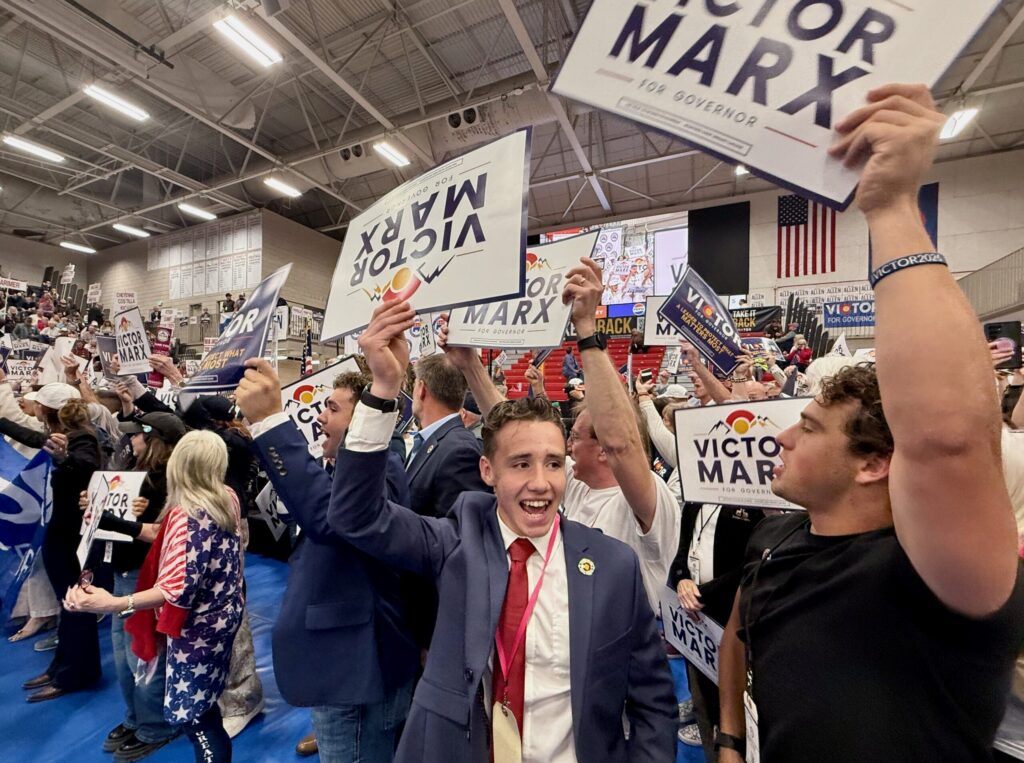
Eric Sondermann is of course correct Victor Marx is an unserious, unelectable, embarrassing Republican nominee for governor of Colorado. But I respectfully submit that the “through line,” as Mr. Sondermann describes it, is not from Trump to Marx, despite their...

Cedric Pride’s blueprint for opportunity through the trades | The OpEdge Podcast
Tony Olivero
tony.olivero@gazette.com
Updated 3 days ago
Cedric Pride, CEO of the nonprofit Pride Initiative in Denver, joins The OpEdge with a blueprint for workforce development, skilled trades, and economic opportunity. Pride tells host and investigative columnist Jimmy Sengenberger why he believes the trades offer a path...
Colorado’s No. 1 education ranking should raise our ambition | GUEST COLUMN
Colorado Politics
colorado-politics@coloradopolitics.com
Updated 3 days ago
By Scott Laband Colorado has earned the right to celebrate its new No. 1 ranking in education from U.S. News & World Report. Gov. Jared Polis called it “one of the proudest moments” of his time in office and shared the...

Colorado’s No. 1 education ranking reflects the power of school choice | GUEST COLUMN
Colorado Politics
colorado-politics@coloradopolitics.com
Updated 4 days ago
By Peter Mason Colorado is now the No. 1 state in the nation for education, according to the 2026 U.S. News & World Report Best States rankings. That is a distinction worth celebrating. It is also a distinction worth understanding....

Courageous Colorado bucks Trump’s federal stupidity | Miller Hudson
Miller Hudson
miller-hudson@coloradopolitics.com
Updated 4 days ago
There are several theories regarding the rhythm of American politics. The most frequently cited is the pendulum hypothesis — positing that episodes of liberal dominance are then interrupted by spans of conservative control. Since Ronald Reagan’s presidential election in 1980,...
PREV
PREVIOUS

SLOAN | Bennet, this isn't how to reduce inflation
Kelly Sloan Back when he was running for President in 2020, Joe Biden declared that “Milton Friedman isn’t running the show anymore.” With inflation currently around the 9% mark, I’d say that was a fairly accurate statement. Friedman, you will recall, instructed us that, “inflation is always and everywhere a monetary phenomenon, in the sense […]
Colorado Springs Gazette: Polis should fight the EPA’s gas tax
As if the price at the pump weren’t high enough, Colorado motorists could wind up paying another half a buck per gallon thanks to a pending federal action. As The Gazette reported Wednesday, it was our own Gov. Jared Polis who actually had egged on the feds a couple of years ago. He wrote the […]