

OUT WEST ROUNDUP | Yellowstone accelerates reopening plans after flooding
WYOMING?
Yellowstone accelerates reopening plans
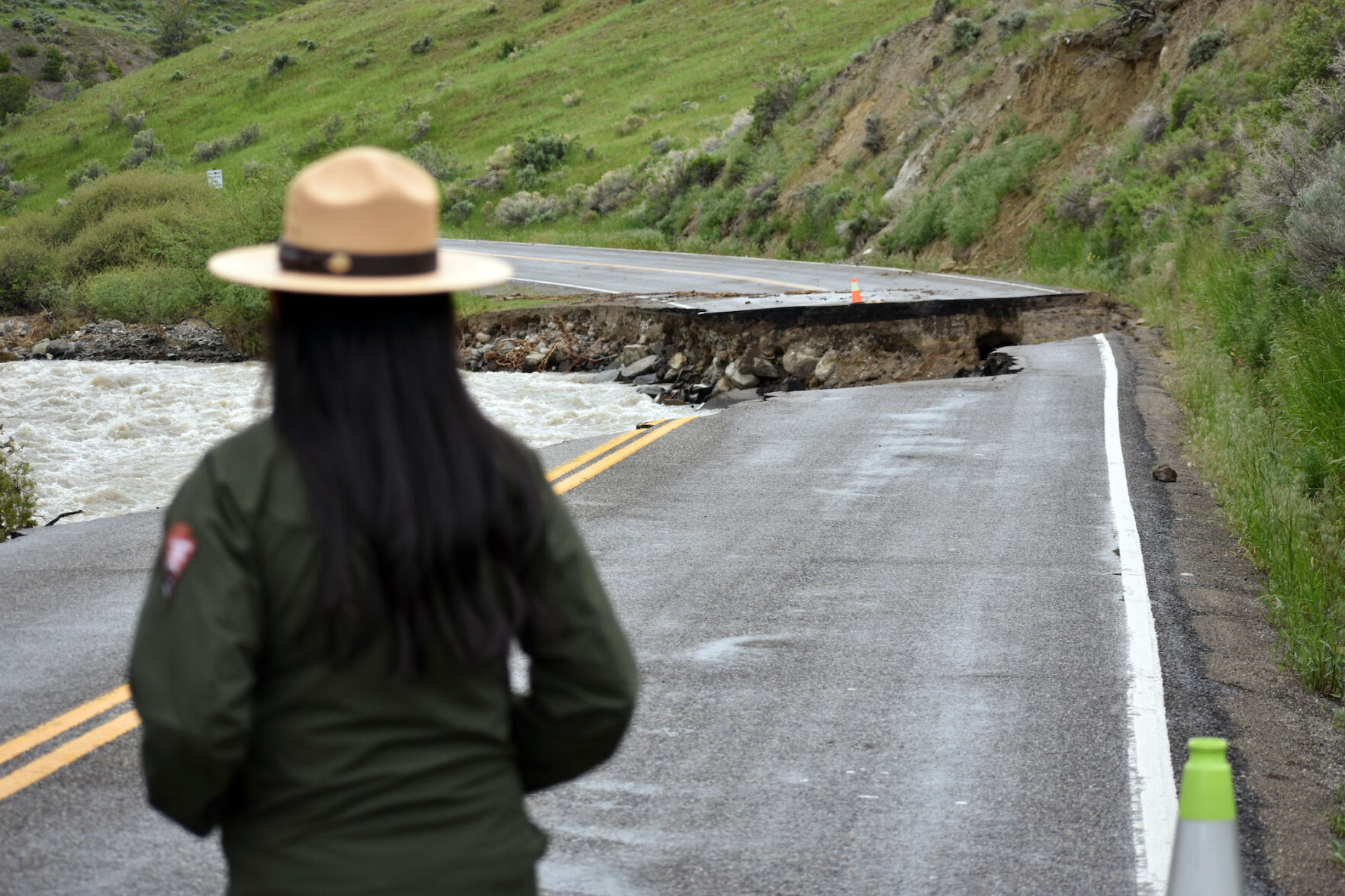
YELLOWSTONE NATIONAL PARK – The nation’s oldest national park, hit hard by flooding, has accelerated its reopening plans.
Days after flooding forced the park’s closure, Yellowstone said its less-damaged south loop would again allow vehicular entry starting on June 22, albeit at reduced capacity based on the license plate numbers of entering automobiles. On June 20, the park disclosed the heavily damaged northern loop could open in coming weeks, rather than staying closed until potentially spring.
National Park Service Director Chuck Sams with Yellowstone Superintendent Cam Sholly announced $50 million to “kick-start recovery efforts from record-breaking floods” during a visit on June 19 to the park and a town on its border, according to a release.
Approximately 80% of the park will be open once the northern loop restarts, the officials said, allowing access to Dunraven Pass, Tower and Mammoth Hot Springs.
The $50 million will help restore temporary access to Gardiner and Cooke City, Montana, the park noted.
The parks service said Old Gardiner Road is slated for substantial improvements in coming coming months, “ensuring that essential emergency services, food, supplies and other administrative needs will be available throughout the winter months.”
As work continues, the parks service plans to restore limited access to the north entrance, officials said.
Governor appeals massive federal land acquisition
Wyoming is appealing the largest-ever Wyoming land acquisition by the Bureau of Land Management due to concerns about the “transparency” of the process, Gov. Mark Gordon said on June 17.
The BLM announced several weeks earlier that it had purchased a 35,670-acre ranch southwest of Casper, located in Natrona and Carbon counties, and the property was now publicly accessible.
Federal ownership of the property allows anglers to reach another 8.8 miles of the North Platte River and creates a 118-square-mile block of contiguous public land that connects 40,000 acres of formerly unreachable state and federal lands.
But Wyoming “has concerns that BLM did not involve the public in the acquisition process and that the environmental assessment did not adequately consider impacts on tax revenues, school funding, grazing, mineral development and other natural resources,” Gordon’s office said in a statement.
Gordon emphasized that he supports increasing access to public land and the right of private landowners to determine how it is sold. The appeal, he said, was over lack of transparency in the acquisition.
IDAHO
US commits to bolster sagebrush ecosystems
OROFINO – Interior Secretary Deb Haaland on June 16 announced $9 million for 40 projects in Idaho and seven other Western states for sagebrush ecosystems to combat invasive species and wildfire, reduce the spread of juniper trees and promote community and economic stability.
The money announced will be used in Idaho, Oregon, Washington, Colorado, Montana, Utah, Wyoming and Nevada. Haaland said while visiting northern Idaho that the money will advance efforts to promote healthy sagebrush landscapes and communities threatened by climate change.
The U.S. Fish and Wildlife Service through the Bipartisan Infrastructure Law is receiving $10 million per year for five years to expand work to conserve sagebrush ecosystems. The ecosystem faces a variety of threats, notably from cheatgrass, which is prone to wildfire and wipes out native plants that sage grouse need to survive.
Sage grouse are chicken-sized, ground-dwelling birds considered an indicator species for the health of vast sagebrush landscapes in the West that support some 350 species of wildlife. Sage grouse populations have been declining.
Giant rangeland wildfires in recent decades have destroyed vast areas of sagebrush steppe. Experts say the wildfires have mainly been driven by warming temperatures and cheatgrass. Once cheatgrass takes over, the land is of little value.
A federal report in 2018 concluded efforts to save sagebrush habitat were failing, with invasive plants such as cheatgrass and medusahead on nearly 160,000 square miles of public and private lands.
NEW MEXICO
Recent rain allows some forests in Southwest to reopen
ALAMOGORDO – Some national forests in Arizona and New Mexico are relaxing fire restrictions and reopening, thanks to a strong start to the annual rainy season in the southwest U.S., officials said on June 23.
The monsoon has delivered much-needed moisture to the parched region and relief from scorching temperatures. Forecasters say Arizona has a good chance of getting above-average rain through the season that runs through September. New Mexico has equal chances of above, below and normal rainfall.
Two national forests that border New Mexico’s most populated areas – the Santa Fe and the Cibola forests – along with the Lincoln and Carson forests largely reopened on June 24 after being closed because of wildfire danger.
Some pockets will remain closed because of active wildfires, or the threat of flash flooding or trees falling.
Restrictions across the forests and other public land vary on whether campfires are allowed without limits or only in developed areas. Bandelier National Monument also will ease fire restrictions on June 24.
Lightning from monsoon storms also can ignite new blazes. Eight small fires were reported in Arizona and New Mexico on June 22, two of which were caused by lightning.
A dozen large wildfires were burning in the two states in what has so far been a historic start to the fire season due to hot, dry and windy conditions brought on by drought and climate change.
ARIZONA
State Supreme Court says anonymous juries constitutional
PHOENIX – The Arizona Supreme Court ruled on June 14 that state courts can keep juror identities secret, rejecting a challenge from a southern Arizona journalist who argued that the right to observe trials included access to the names of jurors who decide the fate of people charged with crimes.
The unanimous ruling written by Vice Chief Justice Ann Scott Timmer turned away arguments made by attorneys for the publisher of the Cochise County Record that withholding identities during the jury selection process without a compelling reason violated the First Amendment.
The decision continues an ongoing movement in some American courts toward allowing the identities of jurors who have traditionally been named to be kept secret. A media group that filed a friend of the court brief said that routinely keeping juror identities secret would undermine the media’s ability to play its watchdog role.
But Timmer wrote that while the First Amendment implicitly guarantees the right of the public and press to view criminal trials, it does not extend to all “confidential” information.
Timmer concluded that while juror names have generally been public across the nation, providing them would not create a more fair process, and might even imperil jury integrity.
The Reporters Committee for Freedom of the Press had urged the high court to require juror names be made available except in unusual cases, saying that doing otherwise would limit the ability of the public and press to scrutinize the judicial process.
Attorneys with the Arizona Attorney General’s office argued that revealing juror names would not help the selection process and that disclosing them would expose jurors to the risk of danger and embarrassment.
Morgan said he expected the loss, given questions from the seven justices during argument in April. But he noted that the court did not say juror names could never be released and that jurors themselves can identify themselves.
Cochise County courts use secret juries in all criminal trials, and Arizona law says that lists of juror names or other juror information shall not be released unless specifically required by law or ordered by the court.


Colorado Supreme Court signals intervention in dispute over treatment for trans children
Michael Karlik
michael.karlik@coloradopolitics.com
Updated 2 hours ago
The Colorado Supreme Court ordered Children’s Hospital Colorado on Tuesday to explain why it should not direct the organization to resume providing certain types of services to transgender children in compliance with the state’s non-discrimination law. Last month, a Denver...

Trump faces first domestic test on Iran conflict with Senate war powers vote
Ramsey Touchberry, Washington Examiner
ramsey.touchberry.washington.examiner@gazetteedit.wpenginepowered.com
Updated 3 hours ago
Administration officials are scrambling to sell members of Congress on President Donald Trump’s military operations in Iran ahead of bipartisan attempts to limit his war powers in the Middle East without approval from lawmakers. The Senate and House are set...
Supreme Court hands California parents win over secret gender transition policy
Jack Birle, Washington Examiner
jack.birle.washington.examiner@gazetteedit.wpenginepowered.com
Updated 3 hours ago
The Supreme Court gave California parents a significant victory late Monday when it kept in place a lower court’s block of the Golden State’s public school policy hiding students’ gender identity and preferred pronouns from parents. A 6-3 majority on...

Judge nixes latest policy requiring 7 days’ notice for Congress members to visit ICE facilities
Michael Kunzelman
michael.kunzelman@associatedpress.com
Updated 3 hours ago
WASHINGTON (AP) — A federal judge agreed on Monday to temporarily suspend the latest version of a Trump administration policy that requires members of Congress to provide a week’s notice before they can visit immigration detention facilities. U.S. District Judge...
Judge nixes latest policy requiring 7 days’ notice for Congress members to visit ICE facilities
Michael Kunzelman
michael.kunzelman@associatedpress.com
Updated 1 hour ago
WASHINGTON • A federal judge agreed on Monday to temporarily suspend the latest version of a Trump administration policy that requires members of Congress to provide a week’s notice before they can visit immigration detention facilities. U.S. District Judge Jia...
Gov. Polis, Upper Basin states criticize federal draft plan for managing the Colorado River
Marianne Goodland
marianne.goodland@coloradopolitics.com
Updated 4 hours ago
With no agreement among the seven Colorado River states and federal deadlines now passed, the Upper Colorado River Commission on Monday sharply criticized the U.S. Department of the Interior’s draft plan for managing the river after current guidelines expire this...

Ballot access, dual-office ban bills move swiftly through Colorado legislature
Marianne Goodland
marianne.goodland@coloradopolitics.com
Updated 5 hours ago
With an eye on the 2026 election cycle and mounting tensions with the Trump administration, Colorado lawmakers are fast-tracking a pair of election bills they say will protect the state’s mail ballot system and tighten rules for elected officials. The...

Colorado GOP chair Brita Horn loses ‘no-confidence’ vote, vows to refocus on ‘mending that divide’
Ernest Luning
ernest.luning@coloradopolitics.com
Updated 5 hours ago
The Colorado Republican Party’s state central committee approved a resolution expressing “no confidence” in state chair Brita Horn in a landslide late Monday night near the end of an online meeting marked by rancor and confusion. Almost 80% of the...

Trump to attend White House Correspondents’ Dinner for first time as president
Washington Examiner Staff, Washington Examiner
washington.examiner.staff.washington.examiner@gazetteedit.wpenginepowered.com
Updated 8 hours ago
President Donald Trump announced on Monday that he accepted an invitation to this year’s White House Correspondents’ Dinner. It would mark the first time Trump has attended the dinner, in either term, since he’s been president. Trump announced the decision...
Primary rival sues to prevent Democrat Eileen Laubacher from going through assembly in Colorado’s 4th CD
Ernest Luning
ernest.luning@coloradopolitics.com
Updated 10 hours ago
Democratic congressional candidate Trish Calvarese on Monday asked a judge to prevent one of her primary rivals, Eileen Laubacher, from participating in the caucus and assembly process to seek the nomination to challenge Republican U.S. Rep. Lauren Boebert in Colorado’s...
PREV
PREVIOUS

A LOOK BACK | Truman U.S. attorney talks party politics
Fifty Years Ago This Week: At an informal talk in Denver, former U.S. District Attorney Charles Vigil, who served as Colorado’s U.S. attorney during the Truman administration (1949-1953), expatiated on the state of party politics in Colorado. “You’d better not say ‘Democrat’ too loudly in Colorado,” Vigil said, “or ‘Republican’ either for all that.” Vigil […]

Q&A with John Parvensky | Colorado Coalition for the Homeless leader announces retirement
John Parvensky recently announced that he will retire from the Colorado Coalition for the Homeless, an organization he has led for 36 years. He will continue to serve as the coalition’s president and CEO until the organization’s board picks a successor. The Denver Gazette sat down with Parvensky to reflect on his time with the organization, […]