

State Commission on Indian Affairs keeps Lamar on banned mascot list — for now
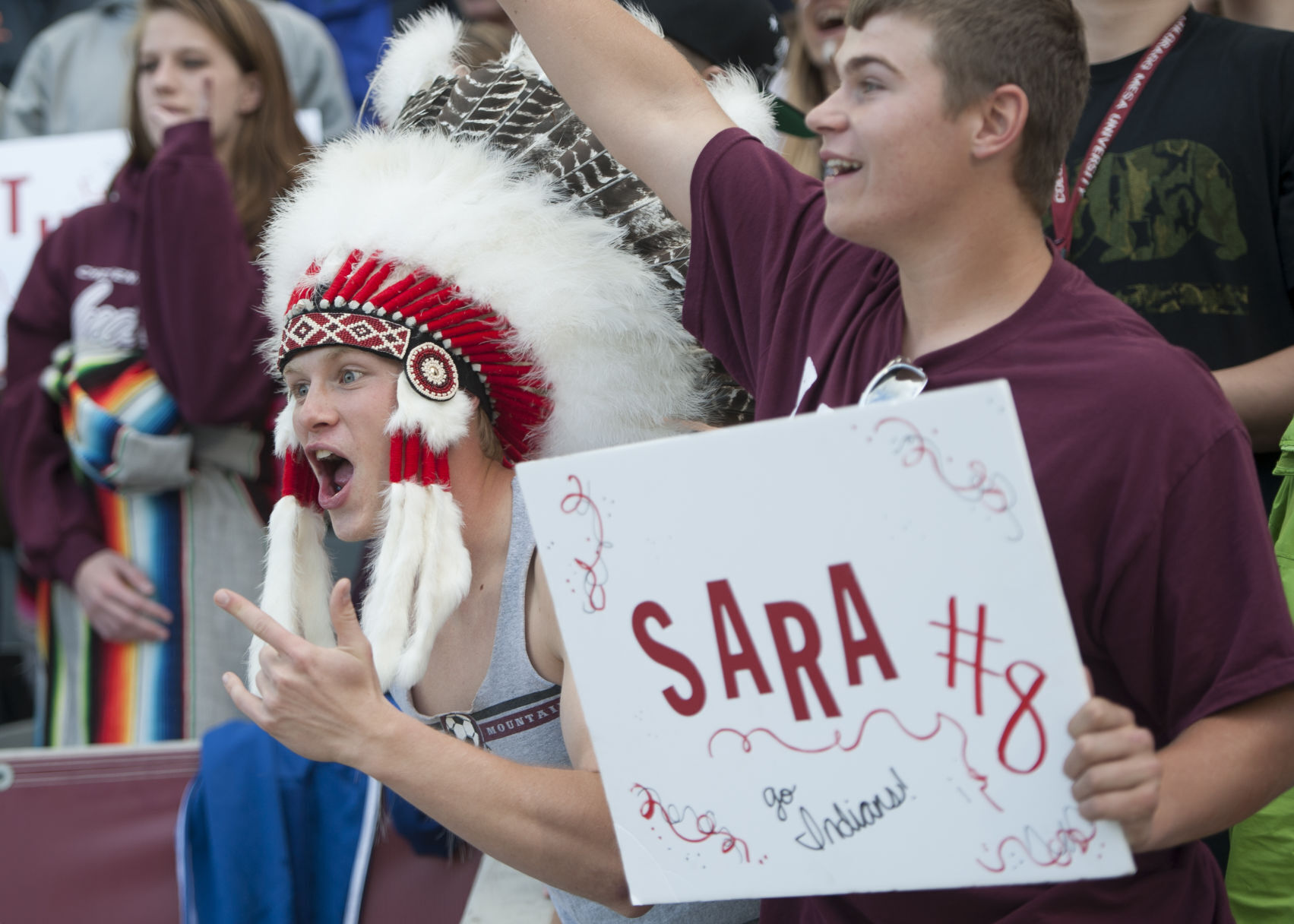
The Colorado Commission on Indian Affairs on Thursday opted to clear all but one of the dozen schools listed as out of compliance with a state law barring the use of any American Indian mascot or symbol in public schools unless that school had an agreement with a Native American tribe.
That left Lamar High School out of compliance ahead of Senate Bill 21-116’s June 1 deadline, after which any public school that still has an Native American mascot without prior approval could face fines of up to $25,000 per month. But last-minute action by the Lamar RE-2 school board may have been enough to spare the school.
Thursday’s meeting was the last chance for the last of the schools with those mascots to make their case for keeping their mascots or win approval for changes. Ahead of the meeting there were 12 schools with mascots flagged by the commission, including three schools in Kiowa, the three schools in the Yuma School District, Lamar High School, and two schools in the Arickaree School District.
The commission approved removing 11 of the 12 schools on the list. The one left: Lamar.
The school did submit a bison to be known as “Savage Thunder” as a new mascot, but that didn’t fly with the commission due to the district’s previous refusal to drop the word “savage” from the title.
Commission member Crystal Loudhawk-Hedgepeth pointed out that the word has been used in legal and government documents to describe Native people.
“Words do matter,” she said.
Chad Krug, superintendent of schools for Lamar RE-2, said the district’s view was that dropping the Native American imagery was enough to separate the term from the mascot.
That failed to move commission members.
Given that the school has used Native American imagery in the past in association with the term, continuing to use the term “savage” with the new mascot does not meet the spirit of the law, said Jill Hunsaker Ryan, a commission member who is also executive director of the Colorado Department of Public Health and Environment.
Doug Vilsack of the Department of Natural Resources agreed. The term “historically referred to Native Americans” and “savage thunder” is a continuation of that, he said.
Legislation has been adopted in the past that recognized Native Americans as “savages” and not equal to Europeans coming to the United States, said Manuel Heart, chairman of the Ute Mountain Ute tribe.
“We need to change that and take away the savage imagery of how they first thought about us,” he added.
The Lamar school board, which was meeting at the same time as the commission, voted almost immediately to remove “savage” from its mascot, and will now just be known as the Lamar Thunder.
“This must end for the benefit of our students,” Krug said. “It’s not a game. It’s a merger of the two realities. … We got it. We never wanted to disrespect anyone.”
That information was relayed to the commission near the end of their meeting, including the resolution the board voted on. Krug asked for a second vote, but didn’t get it. Instead, the commission pledged to follow up with the school district.
The commission did grant permission to the Kiowa schools, part of the Elbert County School District, to keep their Indian mascot, the only school on the list to be allowed to do so. All eight other schools removed from the list opted to change their mascots.
That’s because the district submitted an agreement they made with the Kiowa tribe of Oklahoma, as well as examples of curriculum on Native American culture for the elementary and high school. The middle school does not include that curriculum as it is not approved for inclusion by the state Department of Education.
The Kiowa school board, in a statement, said “we appreciate the recognition of our efforts to comply with SB21-116 by the CCIA. The district is excited that as a school we have the honor of helping to preserve the history of the Kiowa Indians. Our town and district are dedicated to working with the Kiowa Tribe in the education of our students and community. We look forward to maintaining this relationship and proudly representing the Kiowa Indians.”
The commission also approved the addition of 10 other schools not previously identified as having mascots out of compliance with SB 116. All the schools use a thunderbird as a mascot, which Native Americans also claim as a symbol. Those schools have a year to come into compliance, based on a change to the School Finance Act last week.

Colorado districts prepare for school year amid mental health cuts. But will less cellphone distractions help?
Marissa Ventrelli
marissa.ventrelli@coloradopolitics.com
Updated 3 days ago
The signs of a new school year are everywhere — buses in the shop, teachers unpacking boxes, families ticking through supply lists — but behind the familiar rituals, Colorado districts are preparing for a year defined less by routine than...

UNC opens College of Osteopathic Medicine
Marissa Ventrelli
marissa.ventrelli@coloradopolitics.com
Updated 2 days ago
The University of Northern Colorado held a grand opening for its new College of Osteopathic Medicine on Friday, with Gov. Jared Polis in attendance to celebrate the culmination of a two-year, $127.5 million project. The project was funded through legislation...
DOJ sues Colorado to overturn in‑state tuition for students living in the country illegally
Marianne Goodland
marianne.goodland@coloradopolitics.com
Updated 2 days ago
The U.S. Department of Justice has sued Colorado to dismantle a decade‑old law that grants in‑state tuition to students living illegally in the United States, setting up a high‑stakes clash over immigration policy. In 2013, after more than six tries...
Campaign launched to redirect $1 billion in TABOR refunds to education
Marissa Ventrelli
marissa.ventrelli@coloradopolitics.com
Updated 6 days ago
A coalition that includes the state teachers’ union on Tuesday launched a campaign for a ballot proposal that would reduce more than $1 billion in taxpayer refunds and spend the money on education. The measure is among several campaigns taking...

Colorado kids’ health, education challenges persist, report shows
Marissa Ventrelli
marissa.ventrelli@coloradopolitics.com
Updated 1 week ago
Despite having one of the country’s highest median incomes, Colorado families are struggling to afford essentials like food, housing, health care and child care. That’s according to the Colorado Children’s Campaign, which released its annual Kids Count report recently. It...

Gov. Polis outlines vision for Colorado’s higher ed, workforce development
Marissa Ventrelli
marissa.ventrelli@coloradopolitics.com
Updated 2 weeks ago
Gov. Jared Polis spoke with the Colorado Commission for Higher Education on Friday about his vision for the future of the state’s higher education and workforce training programs, telling the commission that the state needs to do a better job...
Aurora mayor warns of shutting off water to Aurora Public Schools because of ‘very green’ lawns
Kyla Pearce
kyla.pearce@gazette.com
Updated 2 weeks ago
Aurora’s mayor is warning Aurora Public Schools that it could have its irrigation water shut off, saying he saw green lawns at schools that “were being watered in defiance” of the city’s watering restrictions. Mayor Mike Coffman was driving past...
Cherry Creek School District paid law firm $114K, including $40K for political consultant, over superintendent allegations
Nico Brambila
nico.brambila@denvergazette.com
Updated 3 weeks ago
The Cherry Creek School District paid $114,000 to hire outside counsel to provide the Board of Education with legal advice as it navigated the allegations that were swirling around the former superintendent. Fisher Phillips invoices obtained through a Colorado Open...
DPS Superintendent Alex Marrero misses cut for Miami-Dade job
Nico Brambila
nico.brambila@denvergazette.com
Updated 3 weeks ago
Denver Public Schools (DPS) Superintendent Alex Marrero did not make the short list of candidates vying for the top job with the Miami-Dade County Public School District. The Miami-Dade school board narrowed the field from 21 applicants to six semifinalists....

Civil rights law firm sues DPS over race-based redistricting
Nico Brambila
nico.brambila@denvergazette.com
Updated 3 weeks ago
A civil rights law firm based out of Virginia has filed a lawsuit against Denver Public Schools, alleging Colorado’s largest school district redrew its five district seats with an “illegal racial intent” that violates the Fifteenth Amendment. Filed in U.S....
PREV
PREVIOUS

TRAIL MIX | Ron Hanks joins fellow Coloradan Lauren Boebert in national comedians' spotlight
Move aside, John Hickenlooper and Michael Bennet. As far as national comedians are concerned, you just aren’t that funny anymore. It’s been a while since the two long-shot Democratic presidential candidates from Colorado had their turn in the satirical spotlight, when they drew barbs from late-night talk show hosts, popular comics and online humor publications […]
Boulder launches survey on proposed climate tax
Boulder residents will soon receive a survey about the city’s proposed climate tax that could appear on the November ballot. Registered voters will received a link to the survey via a text message. The survey is open through June 2 and is offered in English and Spanish, according to the city. The survey will ask […]