

Littleton school board denies STEM Highlands Ranch relocation proposal
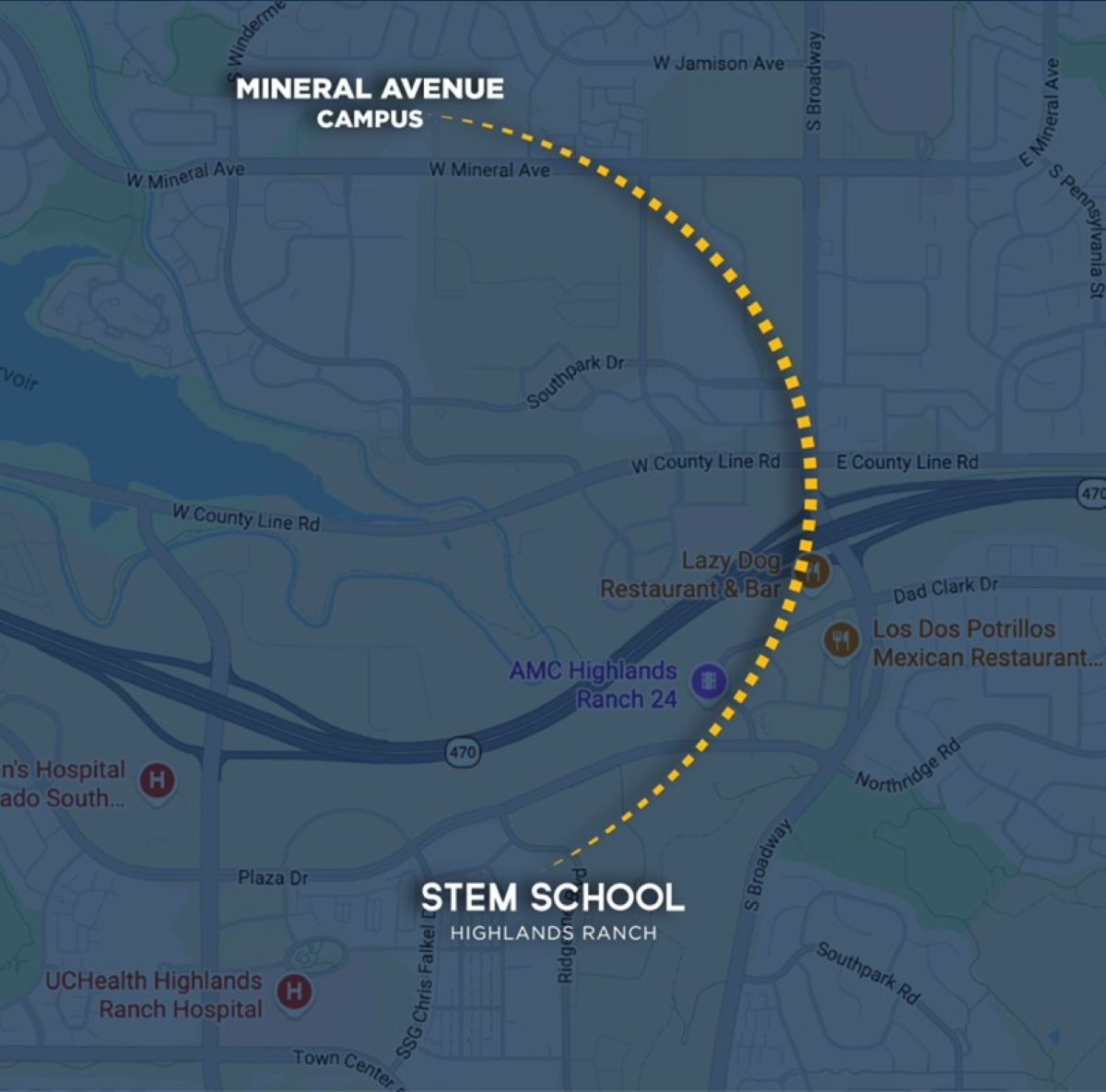
The Littleton Public Schools Board unanimously denied an application from STEM School Highlands Ranch to relocate its high school to a site on Mineral Avenue within Littleton.
The board voted 5–0 on May 28 against the proposal from STEM, a Douglas County-based K–12 charter school. Board members said their decision was driven by financial concerns, a lack of demonstrated community demand and limited benefit for existing LPS students.
“The fundamental requirement of any charter school application is that it must demonstrate it is in the best interest of students,” board member Joan Anderson said. “The feedback was consistent and clear, families in our district do not believe this charter school serves that best interest.”
In a statement following the decision, STEM CEO Matt Cartier highlighted the school’s financial stability and track record, saying that independent experts have consistently rated STEM among the top-tier charter schools nationwide in financial health.
“That does not mean every future project is without risk — no major facility project is — but it does mean STEM approaches growth, debt, and long-term planning from a position of financial discipline and organizational strength,” he said. “This financial foundation helps ensure that we can continue investing in opportunities, facilities, and resources that benefit students while maintaining long-term sustainability.”
Cartier had presented the proposal to the board on May 14, citing space constraints at the school’s current campus as the primary reason for the request.
“The reason we want to relocate is not to shove ourselves into Littleton Public Schools and be a thorn in your side,” Cartier said. “We are out of space.”
District officials emphasized the potential financial impact of approving the application. LPS already shares more funding with its charter schools than required under Colorado law, they said. Board members said adding a relocated high school could further strain district resources.
Board President Chérie Garcia-Kuper said the proposal would place a financial burden on LPS without significantly benefiting district residents. She pointed to STEM’s projected facility costs, including an estimated $1 million annual deficit tied to the move and a net loss of about $200,000 in the first year under LPS’ mill levy funding structure.
“STEM’s own application shows they do not expect to serve more LPS residents, they aren’t changing their operations, and their board is structured so that DCSD (Douglas County School District) residents maintain control,” Garcia-Kuper said.
Board members also cited LPS policy requirements for charter schools, which include expanding learning opportunities for district students and providing additional educational choices within the public system. Several members said the application did not sufficiently meet those standards.
“This application is different,” Garcia-Kuper said. “It is proposing to relocate a Douglas County high school into Littleton.”
According to district data, about 76% of STEM students currently reside in Douglas County, reinforcing worries that the relocation would not significantly serve LPS families.
Board member Lindley McCrary noted that roughly 54% of LPS revenue comes from local taxpayers and said the board has a responsibility to protect those resources.
“Public schools are in a very challenging time financially,” McCrary said. “That gives us a responsibility to be fiscally responsible with every single dollar.”
Board member Andrew Graham echoed those concerns, citing district debt and resource allocation.
“I don’t think LPS voters want our resources diluted anymore,” Graham said.
Despite the denial, board members acknowledged the quality of STEM’s academic program and leadership.
“This has nothing to do with the quality of education being provided at STEM,” McCrary said.
In his statement following the decision, Cartier while the decision was “not the outcome we hoped for, it was also not an outcome for which we were unprepared.”
“It is also important to recognize that everything the Littleton Board shared about STEM was positive. Their comments reflected clear respect for our students, our teachers, our academic outcomes, and the strength of our overall school operations,” he said. “While we are disappointed in the outcome, we should also be encouraged that the Board’s discussion affirmed the quality of our school community and the important work happening every day at STEM.”
STEM leadership also signaled it is considering next steps, including a possible appeal to the Colorado Department of Education.
“We want to be very clear: this decision does not change who we are, the strength of our school, or the work we are doing for students every day,” Cartier said.


Parenting from prison: Inmates hope to be present in their children’s lives, while physically absent
Marianne Goodland
marianne.goodland@coloradopolitics.com
Updated 6 hours ago
The room was decorated with balloons, the tables sparking bright with colors as the smell of pizza and cake wafted through the air. As did music. This was, after all, a father-daughter dance. Except this was not a typical father-daughter...

Colorado schools are losing students as births, migration slow
Nico Brambila
nico.brambila@denvergazette.com
Updated 1 week ago
Colorado public schools went from adding roughly 3,500 students a year before the COVID-19 pandemic in 2020 to losing nearly 4,000 students a year afterward. As more than 870,000 Colorado students return to the classroom for another school year, they...

Aurora student journalist cleared of disciplinary charges after ignoring ‘gag order’
Kyla Pearce
kyla.pearce@gazette.com
Updated 1 week ago
A Community College of Aurora student who accused the college of putting an “unconstitutional gag order” on his student-run publication was cleared of disciplinary charges against him. CCA student Andrew Green tried to register his independent student publication, called “FoxTalk,”...
DPS meets Marrero’s academic goals, but most students remain below state standards
Nico Brambila
nico.brambila@denvergazette.com
Updated 1 week ago
The majority of Denver Public Schools students do not meet state standards — and the academic goals set by Superintendent Alex Marrero’s administration do not expect them to. Marrero’s first strategic road map in 2021 set a goal of 10%...

Douglas County School District, Castle Rock clash over school land and fee use
Nicholas Fogleman
nicholas.fogleman@denvergazette.com
Updated 1 week ago
The Town of Castle Rock and the Douglas County School District are at odds over a proposed ordinance change that would give the town greater discretion over how land and cash dedicated for school facilities can be used. Under Castle...

Federal science agency gives CU Boulder $37.5M to supercharge its quantum studies
Bernadette Berdychowski
bernadette.berdychowski@denvergazette.com
Updated 2 weeks ago
The University of Colorado Boulder was awarded $37.5 million from a federal research agency to propel its quantum research, the U.S. National Science Foundation announced Tuesday. The school was one of eight academic institutions to receive a total of $290...

Denver Public Schools welcomes 89,000 students back to the classroom
Elizabeth Pond
elizabeth.pond@denvergazette.com
Updated 2 weeks ago
A swarm of students — some happily greeting teachers and reuniting with friends, others nervously clinging to their parents’ legs and rubbing bleary eyes — kicked off the first day of the new school year on Monday at Newlon Elementary...

Colorado schools reopen with measles vaccination rates below protective threshold
Nico Brambila
nico.brambila@denvergazette.com
Updated 2 weeks ago
Colorado is entering the new school year without active measles transmission, but health officials remain concerned as kindergarten MMR coverage sits at just 87.8% and most counties fall below the 95% threshold considered protective against outbreaks. “These declining vaccination rates,...
Jeffco Public Schools board votes to put $133M mill levy override before voters
Matt Kyle
matt.kyle@denvergazette.com
Updated 2 weeks ago
Voters in Jefferson County will decide this November whether or not to approve a $133 million mill-levy override that Jeffco Public Schools officials say is needed to cover funding shortfalls in the district. The Jeffco Public Schools Board of Education...
District 49 dissolves longtime provider of special services
Eric Young
eric.young@gazette.com
Updated 3 weeks ago
A longtime education service provider that has been subject to recent public and government scrutiny is shutting down. School District 49’s Board of Education approved the dissolution of the Education ReEnvisioned Board of Cooperative Education Services (ERBOCES) during a special...
PREV
PREVIOUS
Denver approves $4.5M purchase of old state building to make way for affordable housing
The Denver City Council approved the purchase of a former office building once home to the Colorado Department of Labor and Employment in Capitol Hill for $4.5 million on Monday — marking the first project to use Vibrant Denver Bond money for affordable housing. The former CDLE office at 251 E. 12th Ave. has been […]
Judge blocks federal retaliation against Boulder climate agency
A federal judge in Colorado has blocked the Trump administration’s effort to transfer control of a climate research supercomputer, ruling the move likely violated federal law and may have been motivated by political retaliation. U.S. Senior District Judge R. Brooke Jackson on Monday granted a preliminary injunction halting plans by the federal government to shift […]