

10th Circuit weighs whether Constitution protects bystander recordings of police
Although several federal appeals courts across the country have held that the First Amendment protects a person’s right to record police officers performing their duties in public, that right has yet to be recognized in Colorado.
That may change, however, as a panel of three judges on the U.S. Court of Appeals for the 10th Circuit heard oral arguments on Wednesday about the right to record. In an unusual move that signified the importance of the issue, the U.S. Department of Justice participated in the arguments even though it was not a party to the case.
Natasha N. Babazadeh, with the Justice Department’s Civil Rights Division, told the panel that in the past year, there have been eight court cases within the six-state region of the 10th Circuit that have implicated the right to record.
“Addressing this issue is timely and it would provide much-needed clarity to district courts. It is also uncontroversial,” she said.
The case of Abade Irizarry marks the second time in recent history that the 10th Circuit will have the opportunity to recognize a constitutionally-protected right for bystanders to document the actions of police officers. The appeal also comes nearly two years after a video of George Floyd’s murder at the hands of Minneapolis police officers sparked international racial justice protests and the enactment of policing reforms in Colorado.
Irizarry, who describes himself as a YouTube journalist and blogger, sued Lakewood police agent Ahmed Yehia for interfering with and retaliating against him as he recorded an early-morning traffic stop in May 2019. According to his lawsuit, Irizarry and three other amateur journalists were using their cameras and cell phones to record police who were attending to a suspected drunk driver.
When Yehia arrived, he reportedly stood in front of Irizarry’s camera, then shined his flashlight in a way that saturated the camera’s sensor. Yehia also allegedly returned to his cruiser and “drove right at” Irizarry, swerving around him and honking his horn. Other officers, Irizarry wrote, told Yehia to then leave the scene.
Yehia’s response to the lawsuit was to assert qualified immunity, which shields government employees from civil liability unless they violate a clearly-established legal right. Although qualified immunity is intended to protect officers who act reasonably, courts typically view rights as clearly-established only when a prior appellate decision under very similar circumstances has labeled them as such.
In June of last year, U.S. Magistrate Judge Nina Y. Wang granted Yehia’s motion to dismiss, finding that at the time Yehia allegedly violated Irizarry’s rights, the First Amendment right to record was not clearly established in the 10th Circuit. However, she also concluded that the right does exist now.
Irizarry, who initially represented himself in court, appealed to the 10th Circuit with the assistance of the prominent law firm Arnold & Porter.
As Irizarry was appealing his case, the U.S. Supreme Court declined to review another right-to-record appeal out of the 10th Circuit. In Frasier v. Evans, decided in March 2021, the 10th Circuit not only refused to decide whether the First Amendment guarantees a right to record police, but also held that officers are entitled to qualified immunity even if they learned in their training that bystanders have a right to record.
Civil liberties advocates at the time decried the decision as an abuse of the qualified immunity doctrine. Even though the 10th Circuit’s ruling was out of step with the six other multistate circuit courts that have weighed in on the right to record, the Supreme Court passed on the case in November.
As in Frasier, Irizarry’s lawsuit has attracted the attention of multiple outside groups with an interest in reforming qualified immunity or advancing First Amendment principles. Most prominently, the Justice Department argued in favor of neither party, but asked only for a recognition of the right to record. The Civil Rights Division told the appellate panel that it relies on photos and videos of police misconduct when investigating alleged violations of people’s constitutional rights.
“The United States urges this court once and for all to recognize that the First Amendment protects the right to record police officers performing their duties in public,” said Babazadeh.
Yehia did not contest that the First Amendment protected Irizarry’s right to record. Instead, he argued that no prior cases had put him on notice that the right to record was clearly established.
“There has to be a case identified where an officer, acting in similar circumstances, was held to have violated a constitutional right,” said Alex Dorotik, deputy city attorney for Lakewood, during oral arguments.
Judge Carolyn B. McHugh countered that the existence of a similar case may not be necessary.
“There are some cases where the conduct is so egregious that the Supreme Court has said we don’t need clearly-established law because everybody knows you can’t drive your car over someone trying to exercise their First Amendment right,” she said. “Isn’t that this case?”
Andrew Tutt, representing Irizarry, agreed that Yehia had not only obstructed Irizarry’s recording, but used his car as a “deadly weapon,” according to the allegations.
Acknowledging the six other appellate courts – from the sprawling Ninth Circuit along the West Coast to the conservative Fifth Circuit in the south – that have recognized a right to record, Senior Judge Paul J. Kelly Jr. wondered about the effect if the 10th Circuit followed suit.
“If we made that same decision going forward, would it help your client at all? Say starting today, it’s recognized?” asked Kelly, who was also a member of the panel that decided the Frasier case.
“Yes, absolutely. My client regularly engages in filming the police,” Tutt responded. “Going forward, officers can’t do what Officer Yehia did in this case.”
Strictly speaking, Judge Scott M. Matheson Jr. mused, the panel could still bypass the issue of a right to record because neither party contested it to the 10th Circuit.
Irizarry’s appeal attempted to forestall that outcome. Tutt claimed that the lack of a dispute between the parties as to whether the First Amendment guarantees the right to record – an agreement that also existed between the parties in the Frasier case – was evidence that the right is clearly-established after all.
Elizabeth Wang, the lawyer who represented plaintiff Levi Frasier in his lawsuit against Denver police officers, called it a “fantastic argument.”
“If the defendant doesn’t even bother to debate the issue, then the proposition is beyond debate. Seems pretty straightforward to me,” she told Colorado Politics. “It does not seem like the right outcome to allow defendants to sidestep this issue forever by simply refusing to debate it.”
The case is Irizarry v. Yehia.


Gov. Jared Polis moves to end ICE subpoena fight over Colorado workers’ personal data
Marianne Goodland
marianne.goodland@coloradopolitics.com
Updated 2 days ago
The effort by Gov. Jared Polis to comply with an administrative subpoena from U.S. Immigration and Customs Enforcement for information held by several state agencies is over. Polis, in a motion filed Feb. 20, asked for a permanent injunction and...
Ex-Colorado Sen. Sonya Jaquez Lewis avoids prison, gets probation for forged ethics letters
Marianne Goodland
marianne.goodland@coloradopolitics.com
Updated 2 days ago
Former state Sen. Sonya Jaquez Lewis, D-Longmont, was sentenced Friday to two years of supervised probation and 150 hours of community service, and a $3,000 fine, to be waived if she completes an additional 100 hours of community service. The...
Toll to sexual assault survivors rises if they feel blamed and disbelieved
Jenny Deam
jenny-deam@coloradopolitics.com
Updated 2 days ago
Natalie, a single mother, dropped off her son at daycare, went to therapy and then returned home. She swallowed a fistful of pills, washing them down with a six-pack of beer. She was ready to end her life. “I just...
Colorado rape cases rarely result in an arrest and prosecution
Jenny Deam
jenny-deam@coloradopolitics.com
Updated 2 days ago
Authorities say they are especially difficult cases. In Colorado, most go nowhere. Over the past decade, for every 10 reports of rape, there is only one arrest. Warning: This story contains descriptions of sexual violence. Kiersten May remembered a fuzziness...

10th Circuit upholds finding of no misconduct against Colorado federal judge
Michael Karlik
michael.karlik@coloradopolitics.com
Updated 3 days ago
A judicial committee for the Denver-based federal appeals court upheld the chief judge’s finding last week that a federal judge in Colorado did not engage in misconduct by handling a civil case involving other attorneys and judges in the state....
SCOTUS whisperer? Justice Carlos Samour may get second opportunity to turn state dissent into national precedent
Michael Karlik
michael.karlik@coloradopolitics.com
Updated 2 days ago
For the second time in two years, Justice Carlos A. Samour Jr. occupies an unusual position: Having his dissent in a Colorado Supreme Court case potentially forming the basis of U.S. Supreme Court precedent. Earlier this week, the nation’s highest...

10th Circuit appoints ex-Colorado solicitor general to argue issue after federal government declines
Michael Karlik
michael.karlik@coloradopolitics.com
Updated 2 days ago
The Denver-based federal appeals court took the unusual step earlier this month of appointing an attorney to independently argue a key issue in a criminal sentencing appeal after the government indicated it would not contest the defendant’s view of the...
Daniel Domenico to take over as Colorado’s chief federal judge
Michael Karlik
michael.karlik@coloradopolitics.com
Updated 45 minutes ago
Daniel D. Domenico will become the new chief judge of Colorado’s federal trial court next week, a role that encompasses the administration of the court as well as a judicial caseload. Under federal law, the chief judge of a U.S....
10th Circuit upholds violations, sanctions against Colorado Springs mental health hospital
Michael Karlik
michael.karlik@coloradopolitics.com
Updated 2 hours ago
The Denver-based federal appeals court agreed earlier this month that the government properly cited and penalized a Colorado Springs psychiatric hospital for failing to protect its staff from known risks posed by patients. The Occupational Safety and Health Administration inspected...
Appeals judges tell Boulder students about workload, ‘attack mode’ during school visit
Michael Karlik
michael.karlik@coloradopolitics.com
Updated 4 days ago
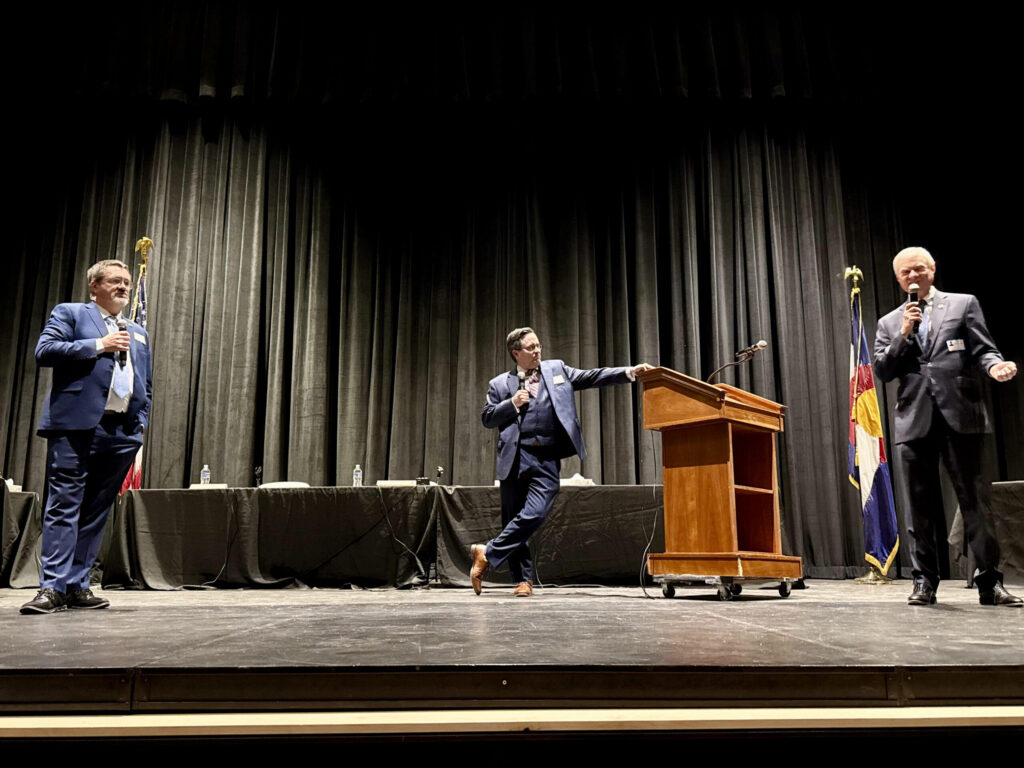
Three judges on Colorado’s second-highest court traveled to Boulder on Tuesday to hear oral arguments in real cases and field questions from students about their professional paths, their workload on the Court of Appeals, and their approach to interacting with...
PREV
PREVIOUS
Elijah McClain's mother fighting former attorney for $4 million in legal fees
The mother of Elijah McClain is contesting a request by her former lawyer for nearly $4 million in legal fees from a wrongful death action. In the complaint filed Tuesday in Denver District Court, Sheneen McClain accused Mari Newman of creating an unnecessary power struggle between her and Elijah’s father, of giving her bad legal […]

Polis signs bill to create 125 more behavioral health beds
Gov. Jared Polis signed into law Wednesday a measure that sets the stage for creating at least 125 more inpatient beds for Coloradans with severe mental illnesses. The law, passed with overwhelming support in both the House and Senate, requires the human services and health departments to “create, develop or contract” at least 125 new […]