

‘There should not be partisan politics in public safety’: Former Aurora police chief speaks out after firing

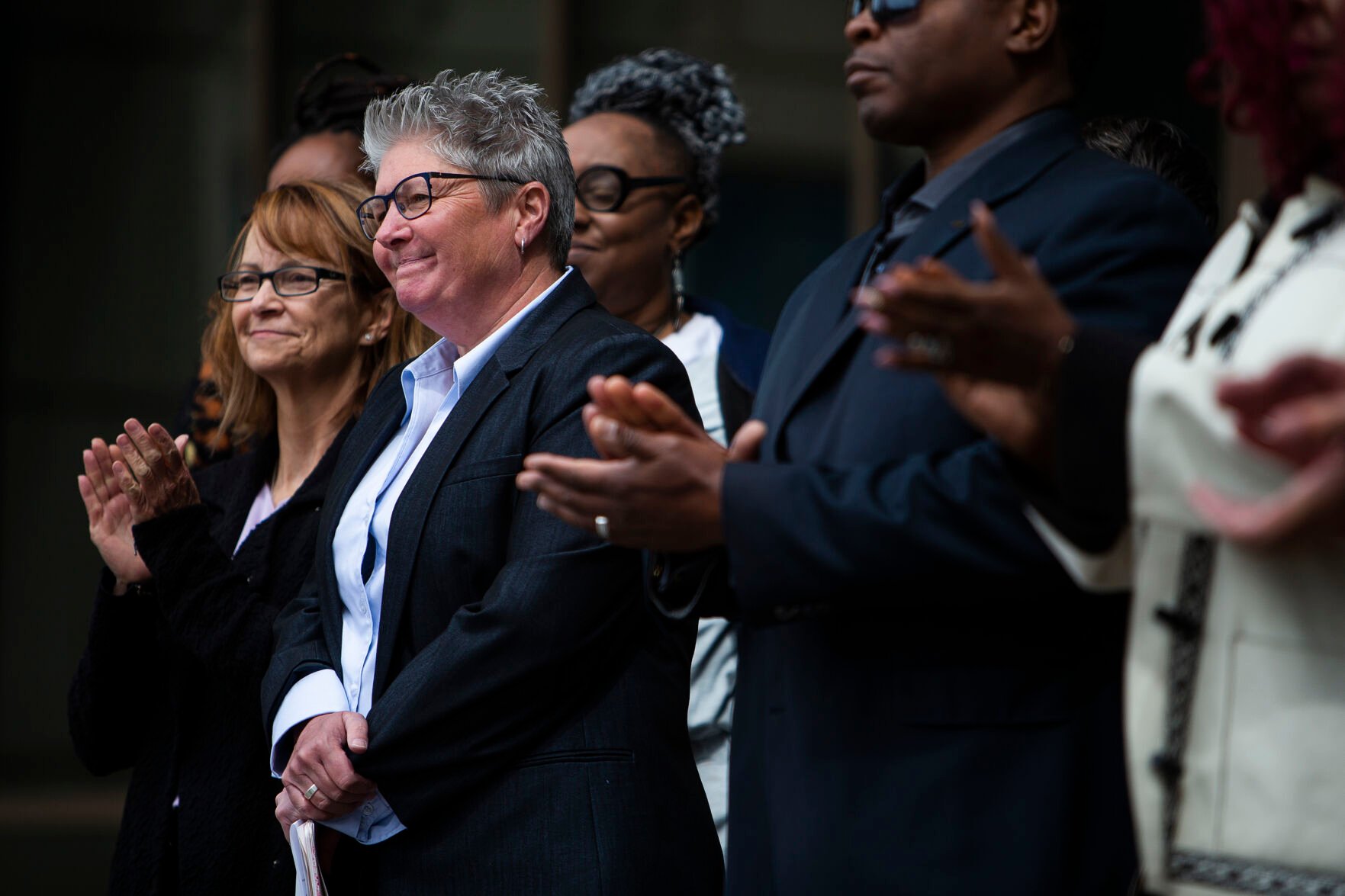
After the firing of Aurora Police Chief Vanessa Wilson last week prompted an uproar among her supporters, a group gathered Monday on the steps of City Hall to decry the decision as a politically motivated vendetta against a woman who they say focused on building trust in the community and was willing to make decisions about discipline unpopular among officers.
“It is a day of solace. I know lives have not been lost, but the flags should be hanging low,” said Maisha Fields, the daughter of state Sen. Rhonda Fields, a Democrat from Aurora.

Fields’ brother and his fiancee were fatally shot and killed. Wilson’s supporters said she struck a necessary balance between solving crime, equitable policing of marginalized people, supporting officers and holding them accountable.
Wilson was appointed interim chief in early 2020 after well over 20 years with the department, and City Council removed the interim tag in August of that year. She took the helm of a department roiling with controversy because of 23-year-old Elijah McClain’s death during a police stop in 2019 during which he was forcefully subdued and injected with ketamine by paramedics.
City Manager Jim Twombly fired Wilson last week. Wilson’s supporters have characterized the move as the culmination of a coordinated effort by a new conservative majority on City Council.
Aurora police chief Vanessa Wilson fired
Twombly did not pinpoint any single catalyst that drove his decision, instead referring generally to losing confidence in her leadership. He denied she was fired because of a report that found a backlog of thousands of crime reports awaiting processing in the Police Department’s records section, news of which broke the day before the city announced Wilson’s firing.
Twombly said Wilson prioritized community involvement, but suggested she did not effectively manage the department’s operations and engage with her officers.
Wilson did not disparage Twombly directly, calling him a “good man” who allowed her to act on what she believed were the right things to do. But she disavowed his public reasoning for firing her because he had lost confidence in her “overall leadership” and “overall management.”
“To that I say, sir, you’re very wrong,” she said.
During her tenure, Wilson made a practice of publicly announcing decisions to discipline officers, especially in cases of excessive force. A few months after she took on the role of interim chief, she fired three officers for participating in a photo appearing to mock McClain’s death.
Five officers and Aurora Fire Rescue workers have since been criminally charged in connection with his death.
Wilson also held a news conference, anticipating public outcry, about an incident last summer in which an officer pistol-whipped and choked an unarmed Black man who was stopped for trespassing. The officer resigned before the internal investigation of the incident was finished, but the department continued the investigation.
Aurora police Sgt. Paul Poole on Monday decried Wilson’s firing, saying he wouldn’t be surprised if he faces retaliation for doing so. He also read a statement from an anonymous officer of color, who worries that ousting Wilson will mean the Police Department returns to a system that protects unethical officers.

One of Aurora’s two police unions said in a statement last week that it supports Wilson’s termination. The Aurora Police Association wrote: “We look forward to working closely with a new incoming administration, prioritizing the morale of the officers, leadership of the Administration and service to the citizens of Aurora. We are committed to working with the incoming administration, City Administration, and City Council, to rebuild our police department in order to recruit and retain officers to ensure our city and neighborhoods are a safe place to work and live.”
Wilson also took a conciliatory tone when Attorney General Phil Weiser’s office announced a state consent decree to mandate reform after an investigation found patterns of excessive force and racially biased policing in the Aurora Police Department. Wilson publicly assured officers the department was already implementing changes with an eye toward fixing issues laid out in the report with a plan titled “A New Way,” calling the decree “nothing to be afraid of.”
Aurora’s City Council adopted the consent decree. The agreement is enforceable in court.
Late last year, Wilson fired Doug Wilkinson, the president of the Aurora Police Association, for an email he sent to members disparaging the consent decree as designed to “replace as many of the department’s white males as possible with as many women and minorities.”
Former Aurora Councilwoman Debi Hunter Holen called Wilson “a woman who not only cares about the community, but a woman who also loves her staff and her officers so much that she was willing to clean house of those who broke their code of conduct to cause harm.”

Ward Four Councilman Juan Marcano called the Aurora Police Department an agency “at war with itself, undermining someone who … who stepped up at a time where our community was grieving and furious, demanding change.”
Wilson declined to say whether she will file a lawsuit challenging her firing. She also did not give specifics on her possible next career steps, saying only that she will “continue to look at ways that serve this community as well as law enforcement somewhere in the future.”
Rumors that Wilson might quit began swirling a few weeks before she was fired with reports Twombly had proposed a plan for her resignation. Wilson vehemently denied the reports at the time and said Monday that she refused to accept a resignation when she believes politics motivated her firing.
“And I have to stand up for myself,” Wilson said. “I wasn’t going to go quietly into the night. … There should not be partisan politics in public safety.”
But she asked people to focus on continuing to move the Police Department forward and creating a culture of holding officers accountable while supporting those who are committed to ethical service.
“This police department right now has men and women out there answering calls for service. They took this oath not because of me, but because of what’s in their hearts.”


10th Circuit orders new unlawful arrest trial against Colorado Springs officers
Michael Karlik
michael.karlik@coloradopolitics.com
Updated 5 minutes ago
The Denver-based federal appeals court concluded on Friday that a trial judge inappropriately allowed jurors to see several unflattering video clips of a plaintiff being belligerent toward police officers during a trial to determine whether police violated her constitutional rights....

Colorado redistricting limits measure heads to November ballot
Marissa Ventrelli
marissa.ventrelli@coloradopolitics.com
Updated 2 hours ago
A proposed constitutional amendment that would prohibit Colorado’s congressional maps from being redrawn outside of election cycles has qualified for the November ballot, according to the Secretary of State’s Office. Under Initiative No. 256, redistricting changes for the 2028 election...
Polis announces ‘Governor for a Day’ contest for Colorado students
Marissa Ventrelli
marissa.ventrelli@coloradopolitics.com
Updated 4 hours ago
Colorado seventh and eighth graders have the chance to experience a day in the life of the governor through a new contest launched by Gov. Jared Polis. The “Governor for a Day” competition will give one student the chance to...
Federal judge to await SCOTUS decision before addressing Boulder County firearm ordinances
Michael Karlik
michael.karlik@coloradopolitics.com
Updated 4 minutes ago
A federal judge agreed on Friday that she would await the U.S. Supreme Court’s decision in an upcoming Second Amendment case before she addresses the constitutionality of similar gun ordinances in multiple Boulder County jurisdictions. Rocky Mountain Gun Owners, the...
Colorado state House Democratic candidate arrested in Texas for public intoxication
Marianne Goodland
marianne.goodland@coloradopolitics.com
Updated 1 hour ago
A Democrat from Lone Tree who is running for a House seat was arrested in Texas in May on charges of public intoxication and resisting arrest. Christian Schilder, the Democrat, is challenging Rep. Brandi Bradley, the Republican incumbent, in the...
Trump says communities that don’t build data centers will be ‘backwards and poor’
Christian Datoc
christian-datoc@coloradopolitics.com
Updated 3 hours ago
President Donald Trump criticized the rising wave of anti-data center sentiment, clashing with his administration’s aggressive efforts to build out the domestic artificial intelligence sector. Trump has placed a concerted focus on making the U.S. the global leader in AI,...

What happens when robotaxis meet motorcades in DC? The mother of all traffic jams, says AI expert
Rob Crilly
rob.crilly@washingtonexaminer.com
Updated 1 hour ago
Waymo has Washington, D.C. on its list of targets for self-driving taxis. Just two problems: Can they cope with motorcades? And how would lawmakers feel if every time the vehicles grind to a halt in front of the flashing lights...
Trump promises retaliation for Iran attacks: ‘We’re going to hit them hard’
Rena Rowe
rena.rowe@washingtonexaminer.com
Updated 5 hours ago
President Donald Trump on Monday vowed to retaliate against Iran following the latest attack on a U.S. base in Jordan, marking a return to military action after weeks of relative calm. “We’re going to hit them hard. There will be...

State Supreme Court names next chief justice, 10th Circuit releases full-court decision | COURT CRAWL
Michael Karlik
michael.karlik@coloradopolitics.com
Updated 6 hours ago
Welcome to Court Crawl, Colorado Politics’ roundup of news from the third branch of government. The Colorado Supreme Court has named its next chief justice, and the Denver-based federal appeals court released a decision that overwhelmingly rejected one of its...
Initiative asks Colorado voters to approve 8th-grade reading standard for ballot measures
Marissa Ventrelli
marissa.ventrelli@coloradopolitics.com
Updated 2 hours ago
A ballot initiative that would require all ballot measures to be written at no higher than an eighth-grade reading level has qualified for the November ballot, according to the Colorado Secretary of State’s Office. The measure, backed by the group...
PREV
PREVIOUS

LGBTQ references removed from Colorado social studies standards for grades K-3
When Colorado’s revised social studies framework is presented to the state Board of Education on Tuesday, it will not include a proposed revision that would have allowed discussion about LGBTQ people’s historical contributions and issues in lower-grade civics and social studies classes. The Social Studies Standards Review and Revision Committee has withdrawn its plans to […]

Sweeping Senate bill would create independent judicial discipline office in Colorado
A new office of judicial discipline – independent of the Colorado Supreme Court that currently presides over it – would be created under a sweeping Senate bill that includes a yearlong legislative inquiry into whether the process of investigating jurists has been effective or not. Citing more than two years of jarring newspaper reports about […]