

State ethics commission votes to move forward on complaint tied to Mesa County Clerk

The state’s Independent Ethics Commission voted 4-0 Tuesday to proceed on a complaint believed to be against Mesa County Clerk Tina Peters.
The complaint alleges Peters accepted plane rides and other gifts in excess of the state gift limit of $65 from MyPillow CEO Mike Lindell. Lindell said in an Aug. 23 video that he flew Peters on his private plane to a cyber symposium on election fraud.
In the video, Lindell talks to Peters, stating, “Sorry your hotel was broken into. We’ll get you to a better place and get you some protection.” Complainant Anne Landman said that infers that Lindell is paying for her housing and security.
It appears that Peters “has accepted, and is continuing to accept thousands of dollars worth of services, travel, security and favors from Mr. Lindell in violation of the Colorado Constitution,” the complaint states.
Landman told Colorado Politics in September she responded to additional questions from the commission about her complaint, which is still confidential under commission rules, although it will now become public as the commission decided it is non-frivolous.
Peters also faces a lawsuit from the Elections Division of the Secretary of State’s office over those gifts. The lawsuit, filed with the Office of Administrative Courts, alleged Peters failed to file campaign finance reports, failed to register as a candidate for re-election and accepted donations above the state’s legal limit as she continued to solicit contributions for a re-election bid.
The commission did not set a date for hearing, which is likely to take place next year.
In other business: the commission held a brief hearing on jurisdictional issues related to a complaint against Custer County Public Health Director Clifford Brown. He did not attend Tuesday’s hearing.
Based on a complaint filed by Jordan Hedburg, editor and publisher of the Wet Mountain Tribune, Brown is alleged to have breached the public trust by claiming he holds a master’s of public health degree from a university that may or may not exist. The documentation Brown submitted to the commission shows he allegedly received a master of science in public health, a different degree than an MPH, from Dartley University, which several sources claimed is not accredited to offer degrees. Other sources told Colorado Politics it never existed in the state (Delaware) where it claimed to do business.
Brown is not a medical doctor. He has a doctorate in optometry and spent much of his career in the US Public Health Services as an optometrist, not in virology or epidemiology. The Custer County Board of Health hired Brown in August, 2020.
County Attorney Clint Smith told the commission Tuesday the board of health, which is also the county commission, did not vet Brown’s academic record, transcripts or degree and relied only on his experience in the Public Health Service.
State law and rules outlined by the Colorado Department of Public Health and Environment state that a public health director can be a physician, public health nurse or other qualified public health professional. Brown has never been licensed to practice optometry in Colorado, according to the state database maintained by the Department of Regulatory Agencies.
An optometrist, according to the American Association for Pediatric Ophthalmology & Strabismus, “receives a doctor of optometry (OD) degree after completing four years of optometry school, preceded by three years or more years of college.” An optometrist, the organization said, is not a medical doctor.
According to the ethics commission investigation, Michele Shimomura, director of CDPHE’s office of public health practice, planning and local partnerships, told the investigator that the county did not appear to submit, within 30 days of hire, a required minimum qualifications review form for local public health directors.
Shimomura, who was hired in October 2020, said she could not confirm whether that form was ever submitted, citing email problems. The form showed up at CDPHE in April 2021, according to the report.
Shimomura told the investigator that she knows the degree from Dartley is “controversial.” CDPHE approved the review form, although Shimomura admitted she never validated Brown’s educational qualifications, telling the investigator that’s the county’s problem if the information was inaccurate.
Hedburg told the commission Tuesday Brown does not have a bona fide degree in public health and continues to mislead the public by claiming he has an MPH in emails, phone calls and in meetings of the board of health.
COVID-19 is raging in Custer County. Its one-week positivity rate is 30%, more than double the state average and the highest positivity rate in the entire state, according to CDPHE. A Facebook posting Tuesday from the Custer County public health department said the county “has 31 positive cases of COVID 19 reported in the last 7 days, and four community members have died of COVID 19 in the past 30 days.” The county’s total population, according to the 2020 census, is just over 5,000.
Mike McFalls, superintendent of schools for the district, ordered county schools to go to remote learning on Monday because of a high number of COVID cases and other seasonal illnesses among staff and students.
The jurisdictional issue Tuesday is tied to an allegation of second degree forgery. Smith told the commission the charge does not apply to academic documents. The other claim – use of a forged academic record – is relevant only when Brown applied for the public health director job, not after he accepted it, according to Smith.
The commission met in executive session to discuss the jurisdictional issues and will issue a written opinion in the coming days. A formal hearing on the complaint is scheduled for January.



Army veterans Jessica Killin, Joe Reagan qualify for Democratic primary ballot in Colorado’s 5th CD
Ernest Luning
ernest.luning@coloradopolitics.com
Updated 11 hours ago
Democratic congressional candidates Jessica Killin and Joe Reagan secured spots Saturday in Colorado’s June primary to decide who will run against Republican U.S. Rep. Jeff Crank in a district that’s only ever sent GOP lawmakers to Congress. The two Democrats,...

Boebert challenger Eileen Laubacher joins lawsuit aimed at blocking her from Democratic assembly
Ernest Luning
ernest.luning@coloradopolitics.com
Updated 1 day ago
A Denver District Court judge on Thursday permitted Democratic congressional candidate Eileen Laubacher to join a lawsuit filed by one of her primary opponents seeking to prevent Laubacher from participating in the party’s assembly process in a bid to qualify...

Colorado GOP chair Brita Horn says she’ll resign next month, points to ‘divide within our party’
Ernest Luning
ernest.luning@coloradopolitics.com
Updated 2 days ago
Colorado Republican Party Chair Brita Horn said Thursday that she will resign her position next month following the GOP’s state assembly, citing what she described as an “enduring divide” within the party “marked by vitriol and hostility.” Horn’s announcement came...

Senate committee moves forward with Colorado ballot measure to redirect TABOR refunds to schools
Marianne Goodland
marianne.goodland@coloradopolitics.com
Updated 1 day ago
A Senate panel on Thursday voted along party lines to move forward with a bill that would ask voters for permission to eliminate Taxpayer’s Bill of Rights refunds and redirect those dollars to K-12 public education. The 6-3 vote in...

Colorado committee recommends rejecting alcohol, marijuana tax hike to fund mental health care
Marissa Ventrelli
marissa.ventrelli@coloradopolitics.com
Updated 1 day ago
In a rare move, Colorado’s Capital Development Committee unanimously recommended that another legislative committee reject a bill asking voters to approve higher excise taxes on alcohol and marijuana to fund a new mental health hospital in Aurora. Sponsored by Rep....

Republican Jeff Crank, Democrat Jessica Killin qualify by petition for Colorado’s 5th CD primary
Ernest Luning
ernest.luning@coloradopolitics.com
Updated 3 days ago
Republican U.S. Rep. Jeff Crank and Jessica Killin, one of the Democrats challenging the first-term incumbent, have both qualified for the primary ballot in Colorado’s 5th Congressional District after turning in a sufficient number of petition signatures, state election officials...

Split vote by Colorado Title Board stops ballot push to privatize Pinnacol Assurance
Marianne Goodland
marianne.goodland@coloradopolitics.com
Updated 12 hours ago
The Colorado Title Board, a three-member panel that sets the language for ballot measures, recently reversed a prior decision and blocked a proposal to privatize Pinnacol Assurance from moving forward. The main issue decided by the title board is whether...

Colorado joins multi-state call to keep ICE away from polling locations
Jacob Mauk
jacob.mauk@denvergazette.com
Updated 5 days ago
Colorado Secretary of State Jena Griswold announced Monday that the state has formally requested written confirmation from the Department of Homeland Security that ICE agents will not be stationed at polling locations during the 2026 election cycle, according to a...

Can deliberation save democracy? | Vince Bzdek
Vince Bzdek
vince.bzdek@gazette.com
Updated 6 days ago
In September 2019, 523 Americans traveled to Dallas for an experiment called “America in One Room.” The gathering was designed to test a theory: Could representative citizens deliberate productively even in an era of intense polarization? The event focused on...
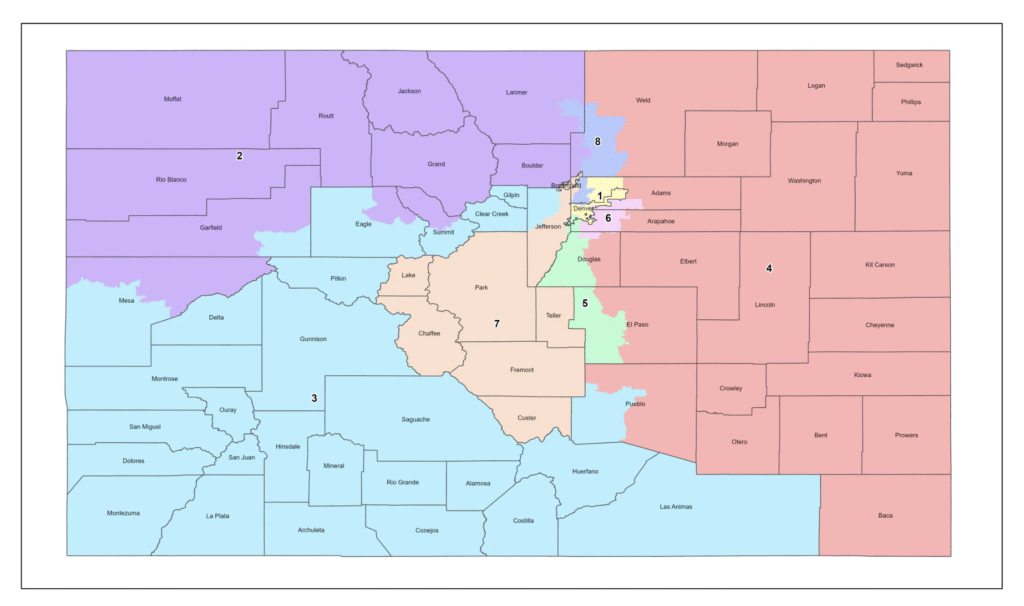
Redistricting scheme would give Colorado Democrats seven House members, split El Paso County | Bob Loevy
Bob Loevy
bob-loevy@coloradopolitics.com
Updated 1 week ago
A proposed redistricting plan, which could give Colorado seven Democratic members of the U.S. House of Representatives and only one Republican, would split El Paso County into two parts and thereby weaken the county’s influence in Congress. El Paso County,...
PREV
PREVIOUS

Denver to expand construction career program for high schoolers
Denver is set to expand its Careers in Construction program beginning next year, providing training and recourses for high school students looking to go into construction. The Denver City Council unanimously approved the establishment of a Denver Construction Careers Contribution Fund to fund the program expansion on Monday. The Careers in Construction program is currently […]
Attorney general, Aurora to announce tentative consent agreement for changes to city's police, fire departments
Aurora and the Colorado attorney general will announce a tentative consent agreement on Tuesday afternoon they have reached to address systemic issues with the city’s police and fire departments. The negotiations for a consent decree arose from a mid-September report by Attorney General Phil Weiser that the police and fire departments have patterns of violating […]