

Students quiz justices, lawyers during Supreme Court’s visit to Arvada high school
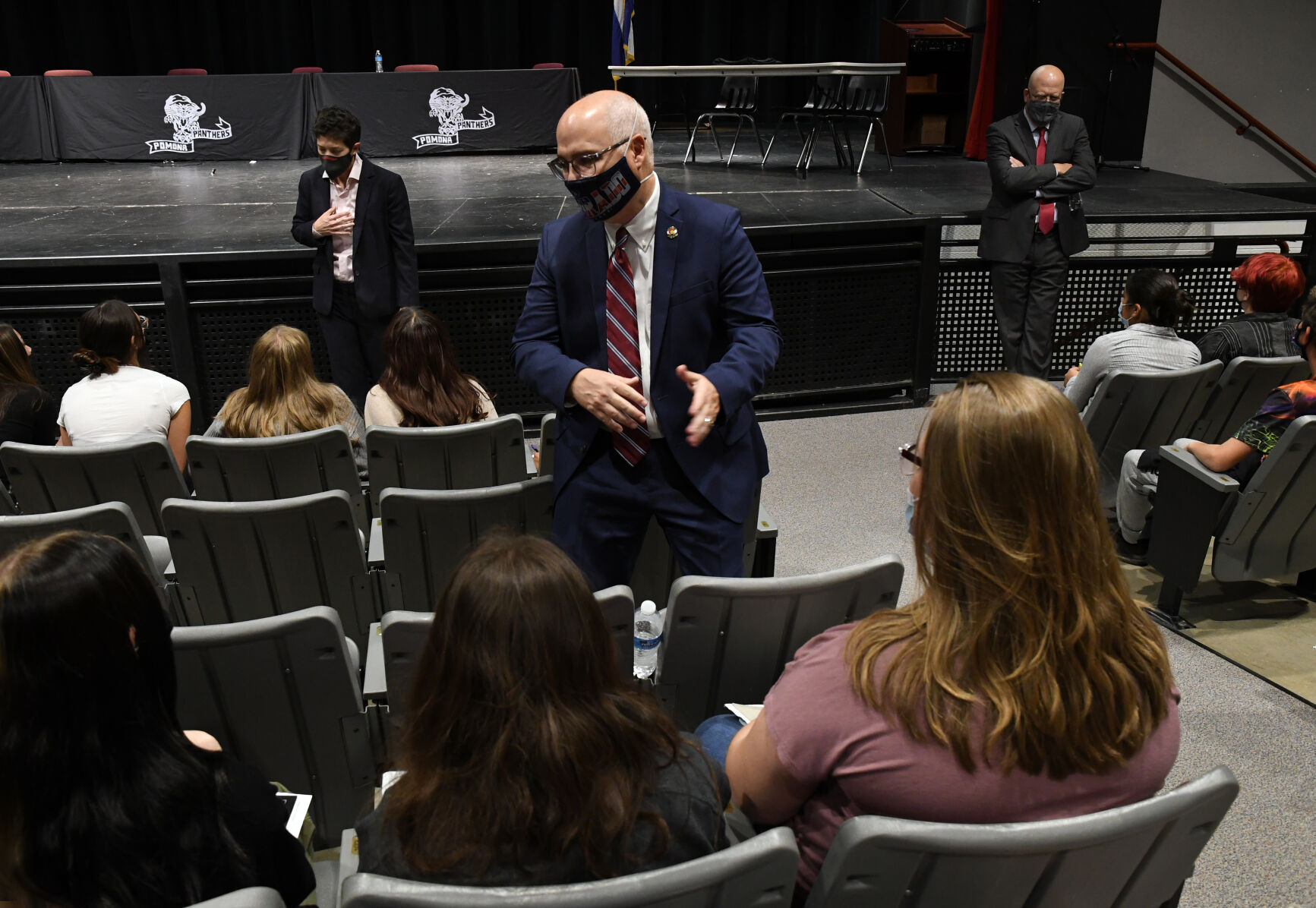
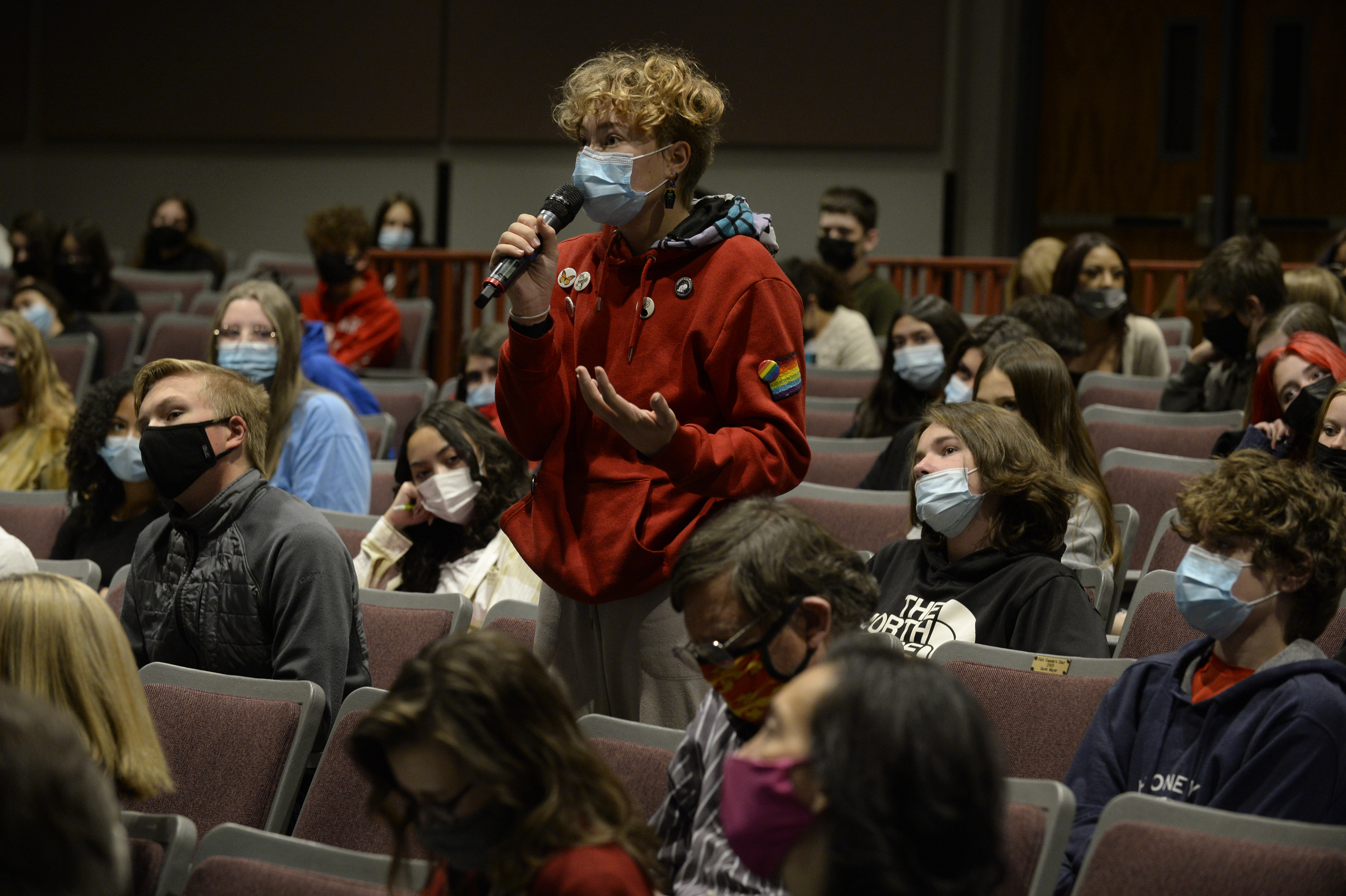
After listening for two hours to lawyers absorbing pointed questions from the state’s seven Supreme Court justices, one student asked something the attorneys would likely never hear during a typical oral argument.
“Do you think you won?”
The Colorado Supreme Court on Tuesday traveled to Pomona High School in Arvada to consider two real cases in front of an audience of students, teachers and other community members. Each set of oral arguments lasted for one hour, with the students able to ask questions of the lawyers and, at the end, of the justices themselves.
Although John T. Lee, representing the prosecution, and public defender James S. Hardy were on opposite sides of their case, they ended up agreeing that it was difficult to tell whether either man had “won” the argument.
“There are seven personalities you’re trying to read and figure out what they’re thinking and how it’s gonna go,” said Hardy. “Their minds may not be formed on the issue yet.”
The Courts in the Community program, which began in 1986, enables the Supreme Court and Court of Appeals to travel outside of the elegant judicial center in downtown Denver and conduct their business in front of a bigger – and younger – audience. This was the first time the justices ventured into the community since the COVID-19 pandemic began, and the Court of Appeals will do the same next month at Overland High School in Aurora.

Barbara Taylor, a civics teacher at Pomona High who helped organize the event, said she originally anticipated the Supreme Court would come to the school in spring 2020.
“It’s so nice for these kids to meet important people and people in power because especially with the pandemic, they feel disengaged from their school and the community,” she said.
Various representatives from the judicial branch spoke about the basic logistics of the Supreme Court’s operation: justices sit in order of seniority, and when they hold a conference after oral arguments, they share their thoughts about the case in reverse seniority. The chief justice assigns one member to write the majority opinion, which can take months to finalize.
However, as a departure from the usual practice, Tuesday’s schedule allotted 15 minutes following each case for students to quiz the lawyers. Several members of the audience eagerly took advantage of the opportunity to press them on both legal and factual issues.
“When you figure out a sidewalk needs to be repaired, why doesn’t someone go out and just put a cone out in front of the sidewalk?” one student asked Luis Toro of the Boulder City Attorney’s Office. Toro had just finished arguing why the city should be immune from lawsuit after a large, unmarked gap in the sidewalk caused a woman to fall and suffer major injuries.
“Don’t citizens provide taxes to help pay to make the community better?” observed ninth grade student Giselle Romero. Randall Paulsen, the attorney for the plaintiff, agreed with her.
“The city in my opinion should be responsible for the consequences of the failure to use those tax dollars wisely to protect the people in their community from injury,” he said.
Students were also quick to question details in the case of Jose Ornelas-Licano, in which a police investigator designed an experiment specifically for Ornelas-Licano’s trial to measure the shape of bullet holes in a windshield after firing a gun from different angles. The prosecution argued the investigator’s work experience made the experiment valid, while the defense called it “junk science.”
“Science is pretty precise,” senior Saturn Anderson said to attorneys Lee and Hardy. “Even very, very small differences can make a lot of impact on the outcome of the experiment. So I was just wondering if similar bullets, similar windshield was actually good enough to test and have an accurate, conclusive result.”
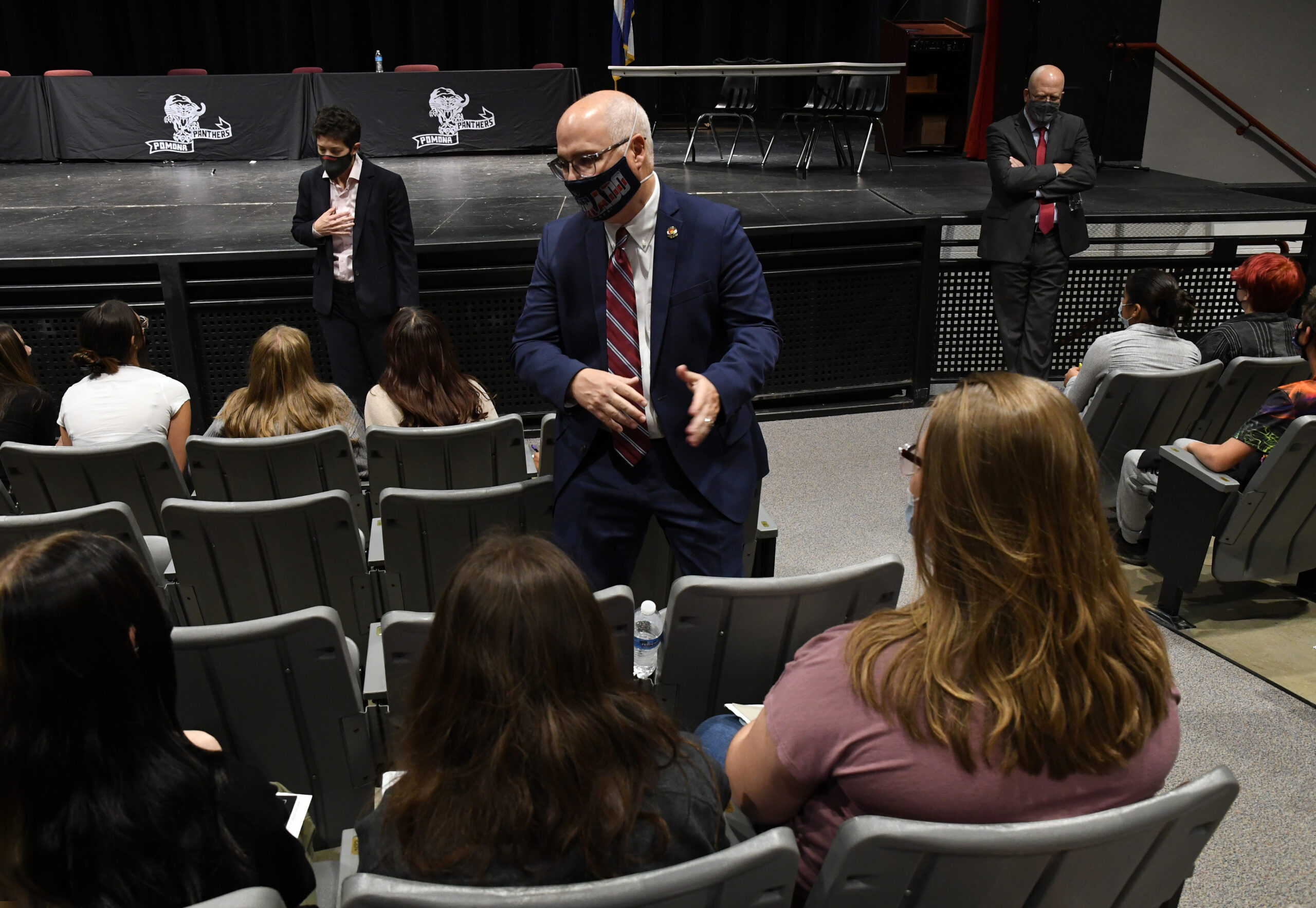
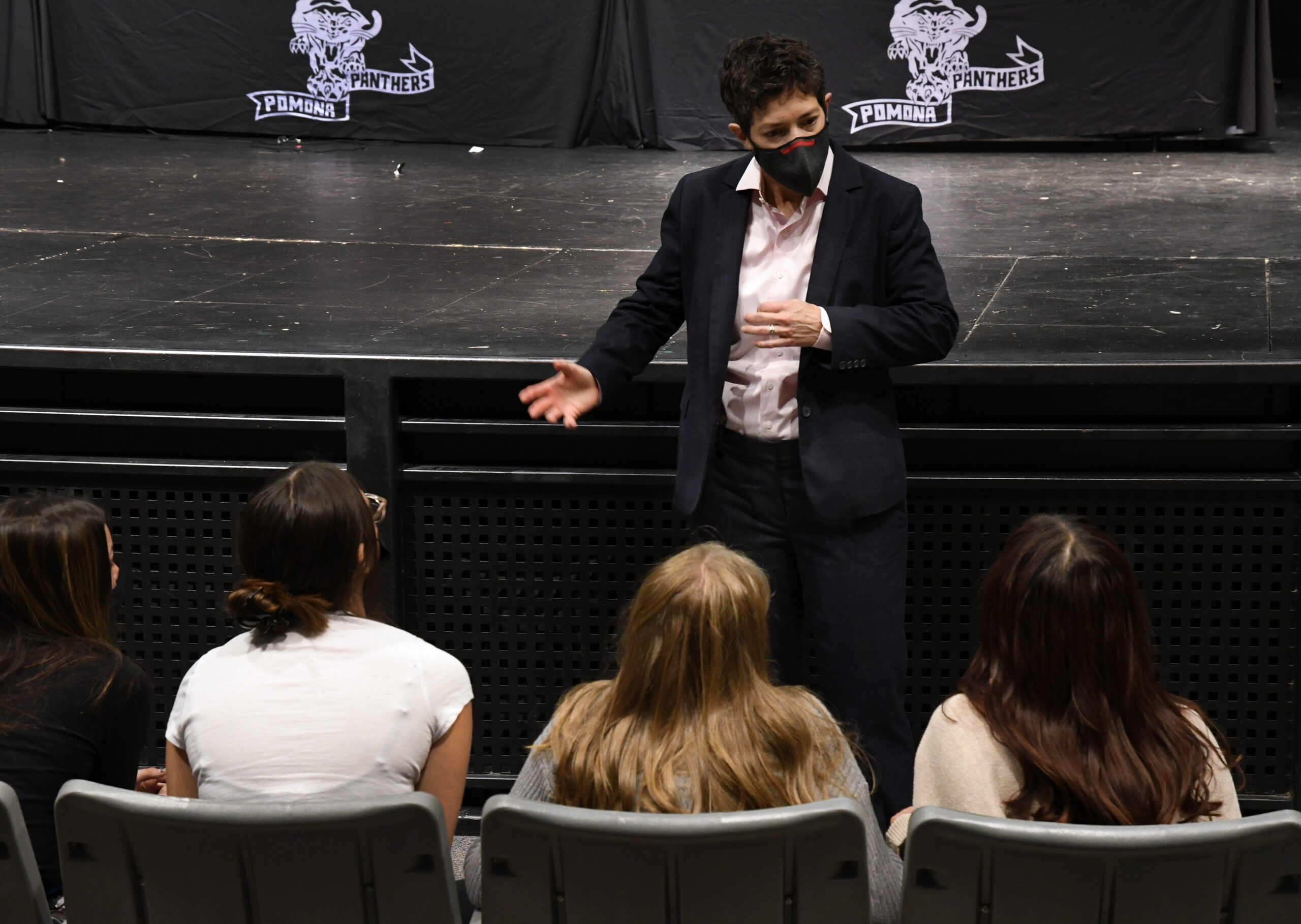
Each of the justices spoke to a small group of students afterward, sharing their experiences from the Court as well as from their prior professional lives.
Justice Carlos A. Samour, Jr. spoke of the grueling 2015 murder trial he oversaw as a district court judge of the perpetrator of the Century 16 movie theater murders in Aurora.
“Every other Friday we took off. I wanted to give the jury a break, I wanted to give the lawyers a break and I wanted to give me a break,” he recalled.
Justice Richard L. Gabriel revealed he was still upset about a capital punishment case from more than two decades ago in which he defended Norman Lee Newsted, who was convicted of murder in Oklahoma. The state executed Newsted in 1999, and Gabriel said he believed he did a good job for his client, and that Newsted believed the same.
“You can’t lie. You can’t change the facts. Your job is to make the best argument you can,” he told the students. “If you don’t believe in yourself, juries won’t believe in you either.”
Taylor, who has taught for over two decades, praised Justice Melissa Hart for coming to Pomona High previously to help students practice for the Marshall-Brennan Constitutional Literacy Project’s moot court competition. Hart and two staff attorneys also met with the school’s civics teachers for a training about Colorado’s judicial branch and the two cases heard on Tuesday.
Hart, who was a University of Colorado law professor prior to joining the Court, acknowledged to her group of students the limitations of her authority as a justice.
“It’s the legislature that gets to make the policy decisions. They say what should or shouldn’t be permitted,” she said. “In my opinion, sometimes they make really weird policy choices. But I can’t say, ‘you made a weird policy choice.'”
The justices emphasized that the roughly 120 cases they consider each year are not easy – and that is a good thing. All of the cases are significant and they contain gray areas that beg for resolution.
“It’s hard to put it away sometimes. It’s a 24/7 kind of job we have,” Gabriel said, when asked about his least favorite part of being a justice. “When we see emergencies, we have to drop everything and jump on it. It’s hard to find work-life balance.”
And, quipped Samour, “he has to put up with me.”




10th Circuit partially revives lawsuit over 2020 Denver protest injuries
Michael Karlik
michael.karlik@coloradopolitics.com
Updated 1 day ago
The Colorado-based federal appeals court revived a man’s claims against Denver on Friday after concluding a trial judge resolved the case in the city’s favor without analyzing two of the three instances of alleged excessive force and other constitutional violations....

Federal judges find Colorado immigration judge violated several orders
Michael Karlik
michael.karlik@coloradopolitics.com
Updated 4 hours ago
Multiple federal judges in Colorado have freed people from immigration custody after determining that one immigration judge violated their directives for properly conducting bond hearings. For nearly a year, Colorado’s U.S. District Court has faced a flood of habeas corpus petitions...

Misconduct complaints from ex-Colorado judicial discipline director dismissed against federal judges
Michael Karlik
michael.karlik@coloradopolitics.com
Updated 2 days ago
The administrative body for the Denver-based federal appeals court upheld a finding last week that misconduct complaints against Colorado’s chief federal trial judge and the chief appeals judge warranted dismissal and appeared to be a “litigation tactic” by the complaining...

First-ever Red Rocks naturalization ceremony draws most diverse group of new citizens
Michael Karlik
michael.karlik@coloradopolitics.com
Updated 2 hours ago
Colorado’s federal trial court held its first-ever naturalization ceremony for nearly 300 new citizens on Thursday at Red Rocks Park and Amphitheatre. “We’re doing it to commemorate the 250th anniversary of the Declaration of Independence and the United States. Red...
Jeffco taxpayers could be on the hook for a possible child sex assault settlement
Matt Kyle
matt.kyle@denvergazette.com
Updated 1 day ago
Taxpayers may end up on the hook for a child sexual assault settlement, possibly worth up to $15 million, after Jeffco Public Schools failed to notify its insurance company in a timely manner about the case. The incident stems from...
10th Circuit finds no fair housing violation by Littleton landlord for worker’s alleged rape of tenant
Michael Karlik
michael.karlik@coloradopolitics.com
Updated 4 hours ago
The Denver-based federal appeals court concluded on Monday that Littleton’s housing authority could not be held liable for a maintenance worker’s alleged rape of a tenant, as the worker’s employment did not provide any special access to the victim. A...

Jeffco Public Schools sues Trump administration to protect funding after alleged transgender policies violation
Matt Kyle
matt.kyle@denvergazette.com
Updated 2 days ago
In the wake of several threats by the Trump administration to revoke federal funding, Jeffco Public Schools filed a lawsuit against the Department of Education seeking to protect that badly needed money. Jeffco has been under investigation by the DOE’s...
Denver detox center did not violate man’s rights with 10-hour hold, 10th Circuit says
Michael Karlik
michael.karlik@coloradopolitics.com
Updated 4 days ago
The Colorado-based federal appeals court concluded on Tuesday that Denver’s detoxification facility did not violate a man’s rights by holding him against his will for 10 hours until his blood alcohol content was projected to reach zero. Unusually, Brian Garrett’s...

Federal judge clarifies ex-GOP treasurer candidate’s burden to prove defamation claims
Michael Karlik
michael.karlik@coloradopolitics.com
Updated 4 days ago
A federal judge clarified last week that businessman and former Republican statewide candidate Brian Watson will need to surmount a higher hurdle in proving his claim that a party guest’s alleged description of him as a “criminal” amounted to defamation....
Colorado board permits state to appeal injunction against arthritis drug price cap
Marissa Ventrelli
marissa.ventrelli@coloradopolitics.com
Updated 4 days ago
A Colorado board voted Friday to allow the Attorney General’s Office to fight an injunction against a price cap on a drug that treats arthritis. A U.S. district court judge had granted the company Amgen a preliminary injunction, temporarily blocking...
PREV
PREVIOUS

State health officials remain evasive on health orders as hospitalizations hit worst point of pandemic
Colorado’s hospital capacity is stressed beyond any previous point in the pandemic, state health officials said Wednesday, a metric that leaders have long said will drive any future public health orders. But those officials have remained vague about if any such orders are coming. Though hospitalizations for COVID are lower now than they were in […]

Neguse, Cheney team up to help out firefighters
Liberal Democrat Joe Neguse of Colorado and conservative Republican Lynn Cheney have a common cause they care deeply about: taking care of wildland firefighters. The political odd couple penned an op-ed Wednesday in The Hill, a Washington, D.C.-focused news outlet, about their plan to raise pay and benefits for those increasingly called on to protect […]