

TRAIL MIX | In Colorado, count on fields swelling for open US House seats
By the end of the year the outline of Colorado’s newest congressional district – the state’s 8th CD – should be finalized, and by next July the major party candidates for the seat will have been chosen in what could be barnburner primaries.
While the state’s independent redistricting commission has relatively free rein when it comes to situating the new district, so long as its members stick to a set of constitutional requirements, a draft map released in June suggests the seat will be centered around the northern suburbs in the Denver metro area, stretching north to include some of the fast-growing communities along the Interstate 25 corridor.
There’s still plenty of wrangling and jostling left to accomplish this summer and fall as the commission considers testimony at a series of hearings around the state and awaits final census numbers before setting anything in stone.
Depending where the final lines fall, both the Democratic and Republican primaries could be crowded with hopefuls eyeing that rarest of Colorado political prizes: an open congressional seat.
In a state that has imposed term limits on state and local offices since the late 1990s, the U.S. House and Senate stand apart as open-ended prospects for eager politicians.
Unlike some other states, where voters like to shuffle their D.C. contingent on a regular basis, Colorado voters tend to keep sending their senators and House members back for more terms, though the topsy-turvy political climate of the last dozen or so years has seen higher forced turnover than usual in the state’s Capitol crew.
Since the 2008 election, voters have bounced five of the state’s House members and two of its senators, each in what could be considered wave elections: Republican Reps. Marilyn Musgrave, Mike Coffman and Scott Tipton; Democratic Reps. Betsy Markey and John Salazar; Democratic Sen. Mark Udall; and Republican Sen. Cory Gardner.
While midterm elections often are wave elections – see the Republican waves in 2010 and 2014 and the Democratic wave of 2018 – no one knows for sure whether 2022 will be one, and so far the number of candidates emerging for the state’s seven existing congressional seats suggests it might not be.
Just one seat has so far attracted a crowd, though it’s a record-setting one.
In last week’s Trail Mix, we took a look at the multitude of candidates running in the Democratic primary for Colorado’s 3rd CD, held by first-term Republican Rep. Lauren Boebert, who felled Tipton in a primary last year.
Counting the three Democratic candidates who have already withdrawn from the race, 10 candidates have filed for the seat, which promises to be among the most competitive races in the state next year.
That’s more candidates than have ever filed to run in a U.S. House primary in Colorado – quite a feat, considering the droves of wanna-bes that tend to show up for open House seats, whether created by an incumbent retiring or, like is happening this year, the state gaining an additional district following a census.
Recent primaries for the U.S. Senate have been more crowded, routinely reaching into double digits in the last few cycles and topping out at 22 Democrats who ran at one time or another against Gardner ahead of last year’s election. (Former Gov. John Hickenlooper, who went on to win the nomination and defeat Gardner, nearly cleared the field when he ended his presidential campaign and entered the Senate race in September 2019.)
In House contests, however, it’s been open seats that have attracted the throngs.
Here are the Colorado House races that have featured packed primaries over the last several decades:
When incumbent Rep. Tom Tancredo announced he was retiring after five terms, the 2008 Republican primary in the deep red 6th CD drew five candidates, including then-Secretary of State Mike Coffman, then-state Sen. Ted Harvey and Wil Armstrong, a businessman and son of former U.S. Sen. Bill Armstrong.
Coffman survived a bruising primary and went on to win the general election in a walk, eventually holding the seat for five terms, including with three wins after redistricting had turned it into the state’s congressional battleground. Coffman lost in 2018 to Democrat Jason Crow but bounced back the next year to win a mayoral race in Aurora.
The heavily Republican 5th CD became open in 2006 when incumbent Rep. Joel Hefley decided to retire after 10 terms representing the Colorado Springs-based seat. Six Republicans ran for the seat, and in a stunner, all six made the primary ballot.
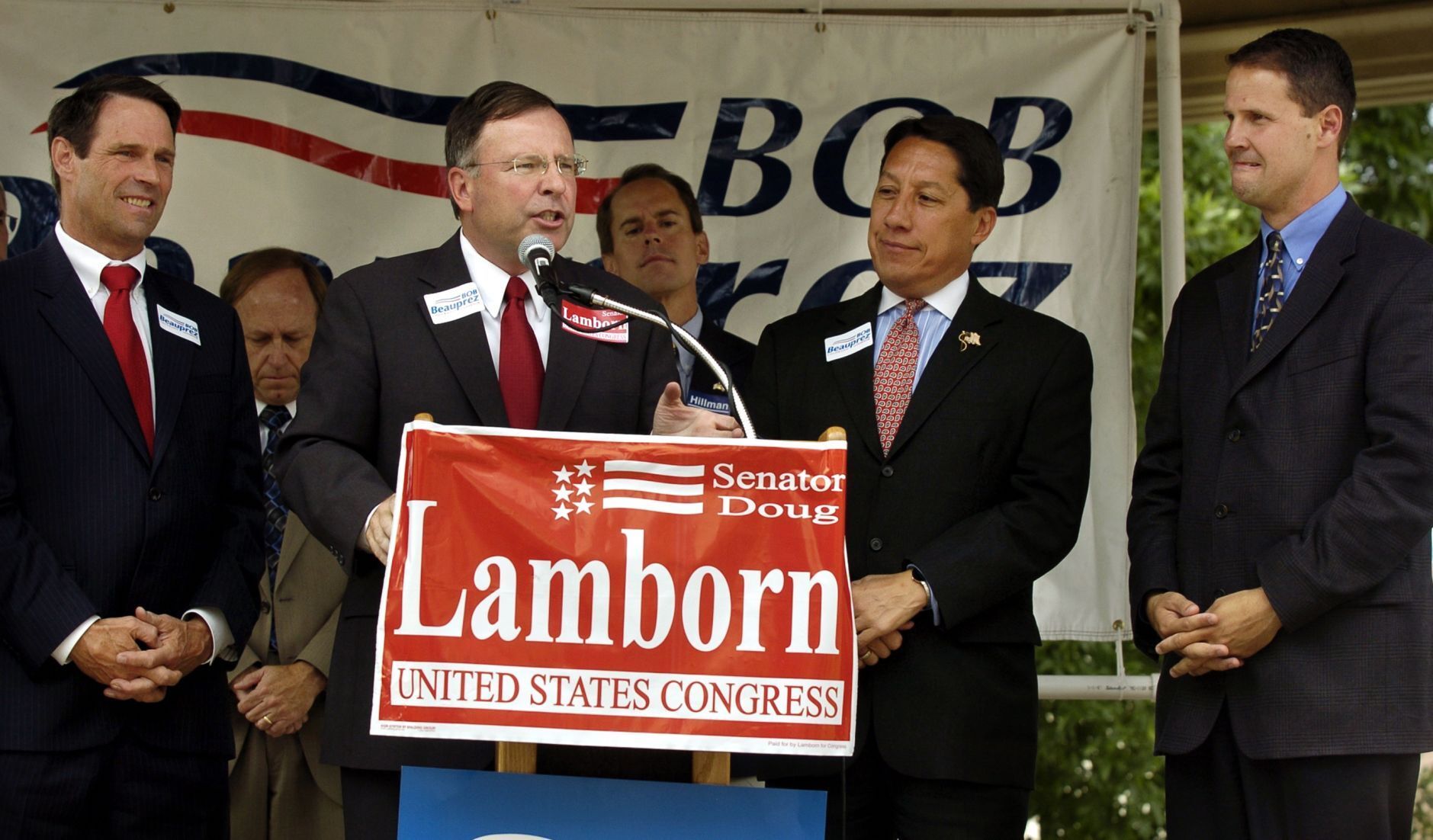
Republican Doug Lamborn, a young lawyer and state lawmaker, won what turned out to be a nasty primary by just 892 votes and has managed to hang on to the district for eight terms, despite facing primaries more often than any other current House member in Colorado.
In 2004, the last year that dawned without an incumbent seeking re-election in the 3rd CD, seven Republicans made a bid for the seat – including eventual GOP nominee Greg Walcher – but the job went to Democrat John Salazar, a state lawmaker and rancher with roots stretching back generations in the San Luis Valley.
The last time Colorado added a congressional district, in 2002 – when the 7th CD was born – seven Republicans filed to run for the suburban seat, which wrapped around the north side of the Denver metro area, encompassing parts of Jefferson, Adams and Arapahoe counties.
It turned out that some of the aspiring House Republicans were staking a claim to get a campaign started early in case the new seat included their residences, because the ranks thinned a bit once the final map was released.
The initial field featured several of the party’s once-and-future stars, including Coffman, current state Rep. Mark Baisley, former state lawmaker and ambassador Sam Zakhem, Bush administration official Rick O’Donnell and former state GOP chairman Bob Beauprez, the eventual nominee and general election winner.
Three Democrats threw their hats in that cycle, though then-state Sen. Mike Feeley won the nomination before losing the new seat by just 121 votes in what turned out to be the closest House race in the country that year.
Tancredo – at the time a former state legislator, Reagan administration official and president of the Independence Institute – was one of seven Republicans who sought the 6th CD nomination in 1998 when it opened up following eight-term Republican Rep. Dan Schaffer’s decision to retire. Other GOP candidates that year included Zakhem and then-state lawmakers Barry Arrington, Martha Kreutz, Bill Schroeder and Tom Blickensderfer.
The Denver-based 1st CD saw just four Democrats run for the open, safely Democratic seat in 1996, when pioneering House member Pat Schroeder – the first woman sent to Congress from Colorado – stepped down after 12 terms. State lawmaker and attorney Diana DeGette won the nomination over Doug Friednash, Tim Sandos and Leslie Franklin, and has easily won another dozen terms since.
If experience holds, expect a sizable crop of candidates to emerge by next spring for Colorado’s open 8th CD.

Federal judge hears arguments about Colorado’s 3-day gun purchase waiting period
Michael Karlik
michael.karlik@coloradopolitics.com
Updated 3 hours ago
A federal judge heard arguments on Monday about the constitutionality of a 2023 Colorado law that generally imposes a three-day waiting period on firearm purchases after the initiation of a background check. The test that the U.S. Supreme Court created...

U.S. Supreme Court clears way for Trump mail voting order in advance of midterms
Wire Services
wire-services@coloradopolitics.com
Updated 7 hours ago
WASHINGTON • The U.S. Supreme Court on Monday cleared the way for President Donald Trump to move ahead with an executive order that seeks to restrict the mailing of ballots to American citizens in an eligible voters list. The executive...
Colorado Supreme Court intervenes in Weld County prosecution dismissed due to Missy Woods misconduct
Michael Karlik
michael.karlik@coloradopolitics.com
Updated 6 hours ago
The Colorado Supreme Court ordered a Weld County trial judge last week to respond to the district attorney’s claim that he improperly dismissed a criminal case because of “outrageous” conduct by the Colorado Bureau of Investigation. Daniel Lee Eatinger stood...

Trump opens ‘economic D-Day’ offensive against Iran as war nears six-month mark
Christian Datoc
christian-datoc@coloradopolitics.com
Updated 11 hours ago
President Donald Trump is seeking to increase the financial pressure on Iran with new secondary sanctions on nations and foreign actors propping up the regime’s economy as the war between the United States and Tehran nears the six-month mark. Treasury...

Trump announces 50% tariffs on Canadian cars, auto parts, and steel
Naomi Lim
naomi-lim@coloradopolitics.com
Updated 11 hours ago
President Donald Trump escalated the trade war with Canada after talks collapsed last week, announcing Monday that the United States would impose 50% tariffs on cars, trucks, automotive components, and steel starting Jan. 1, 2027. “Canada has been ripping off...

Iran puts out propaganda video tracking Barron Trump’s location, offering $10 million for his assassination
Timothy Nerozzi
timothy-nerozzi@coloradopolitics.com
Updated 13 hours ago
The Islamic Revolutionary Guard Corps is putting a hit out on President Donald Trump’s son, Barron Trump, with an inflammatory video claiming to track his location. State-run television in Iran is broadcasting a propaganda video claiming to show the locations...
Nevada sues Trump administration over Colorado River cuts
Marianne Goodland
marianne.goodland@coloradopolitics.com
Updated 5 hours ago
On Monday, the state of Nevada filed a lawsuit against the Trump administration and Interior Secretary Doug Burgum, seeking to block the Colorado River management plan. On Friday, Burgum released a “record of decision” that would reduce water allocations to...

Healthcare Freefall: Longer drives, fewer options for maternity care in Colorado
Thelma Grimes
thelma.grimes@coloradopolitics.com
Updated 15 hours ago
Editor’s Note: Colorado’s healthcare system is entering a period of accelerating instability — a “tsunami,” as multiple leaders describe it — driven by collapsing hospital finances, shrinking Medicaid reimbursements, disappearing services and a political fight over who is responsible for...
Polis requests federal disaster declaration for Colorado wildfires and floods
9News
9news@coloradopolitics.com
Updated 8 hours ago
On Sunday, Gov. Jared Polis officially requested a Major Disaster Declaration from President Donald Trump and the Federal Emergency Management Agency to support recovery from two wildfires and the subsequent flooding and debris flows on both burn scars. Polis requested a declaration...
US strikes another boat in eastern Pacific, killing two, Pentagon says
The Associated Press
the-associated-press@coloradopolitics.com
Updated 15 hours ago
U.S. forces have struck another vessel in the eastern Pacific, killing two people the Pentagon says were trafficking drugs. The U.S. Southern Command announced the strike in a social media post early Monday. The death toll from the Trump administration’s...
PREV
PREVIOUS

Biden's Colorado judicial nominee advances out of Senate committee
President Joe Biden’s nominee to a seat on the federal appeals court based in Colorado will receive a vote before the full U.S. Senate after a committee on Thursday narrowly advanced her nomination. Veronica S. Rossman of Denver received a vote of 12-10 from the U.S. Senate Committee on the Judiciary, with Republican U.S. Sen. […]

RIVER TOWNS | Series examines life along Colorado's rivers
In the arid West, water means life. Turn on your tap, and you’re part of the Colorado circulatory system. The towns born along the banks of Colorado’s most iconic waterways – the Colorado, the Big Thompson and the Arkansas lead a list of 158 named rivers – live the same way yet differently along the banks. […]