

Revenue forecasts show explosive growth but inflation fears follow

The state’s quarterly revenue forecasts show Colorado’s recovery from the pandemic moving at breakneck speed, with higher-than-expected individual income tax and sales taxes now above pre-pandemic levels.
But inflation fears as well as disruptions in supply chains could limit the state’s recovery, according to economists with the General Assembly’s Legislative Council.
In a presentation to the Joint Budget Committee Friday, economic Elizabeth Ramey likened the economy’s recovery to relearning to ride a bike: a bit wobbly at first.
Unemployment remains high among low-wage workers, yet businesses are having trouble finding employees, she said. Home inventories are low but prices are skyrocketing.
These wobbles, however, are expected to be temporary as businesses adjust to consumer spending the health concerns continue to abate, she said.
The good news is that retail spending is up year over year by 18%, and that spending in the restaurant, bar and hospitality industry is now seeing strong growth that is approaching pre-pandemic levels.
In the labor market, nonfarm job growth is up 17,000, including 10,000 in leisure and hospitality from April. The unemployment rate has stayed steady the past three months, at 6.4%.
But the biggest job loser is still accommodations and food service, which lost 137,000 jobs in March and April 2020, and are still down by some 44,000, Ramey said.
And the gap between high- and low-wage earners during the pandemic is still “K-shaped,” where those at the higher end of the wage scale got through the pandemic relatively unscathed and those at the lower end are still struggling.
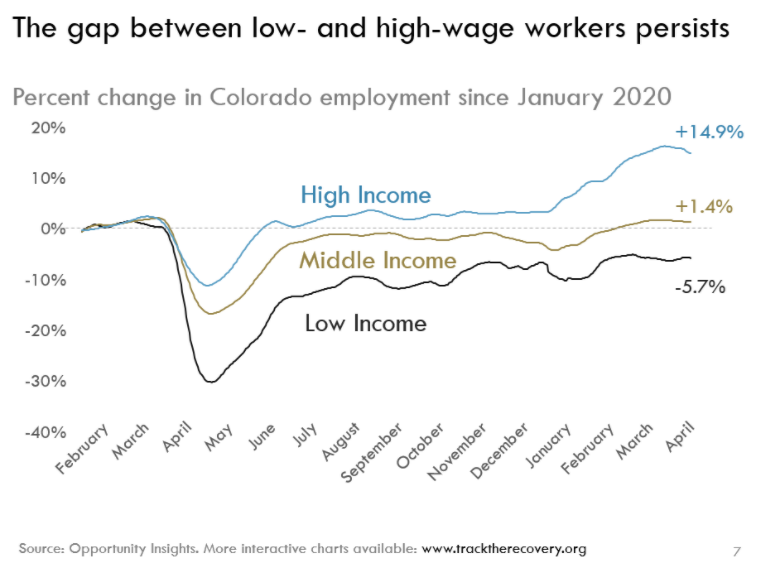
One factor that has kept the economy growing is federal stimulus payments, but the effects of those payments are starting to taper off, according to Ramey. Other sources of income are now re-awakening, she said.
Then there’s inflation. At the national level, inflation in the energy and transportation sectors (i.e. vehicles) is high; gas prices are up 27.8%; vehicle costs are up almost 20%. Ramey attributed those increases to returns to pre-pandemic levels for energy and for supply chain issues, like microchips, for vehicle prices.
Inflation, interest rate hikes and the continued problems in the supply chain could drive the forecasts lower; what could drive it up includes passage of a federal infrastructure spending package, which would result in boosts in spending, employment, incomes and tax revenues.
What all this means for the general fund, which is made up primarily of income and sales taxes: robust growth. From just a year ago, when the general fund was expected to decline precipitously, and which resulted in a $3.4 billion cut to the state budget for 2020-21, those revenues are expected to be up 13.2% in the next fiscal year.
From the March 2021 forecast, that means $1.6 billion more in general fund for the 2020-21 fiscal year, $1.1 billion for the following year and $1.14 billion for 2022-23.
That growth in revenue also means a TABOR refund for the next three years, beginning in the current fiscal year and which will be paid out in the 2021-22 fiscal year. That’s $551.4 million in Coloradan’s pockets next April; $658 million the following April and $908 million in April 2024.
How those refunds will work: the first tier goes to paying local governments for the senior and veterans homestead property tax exemption, about $165 million. The second tier is a temporary reduction in state income tax, from 4.55% to 4.5%, or $130 million. If a third tier is needed, that’s a reduction in state sales tax. In all three forecast years, all three tiers will be utilized, according to the Legislative Council forecast.
Refunds come from general fund, but cash funds can “push out” general fund dollars. Those cash funds include fees, and the General Assembly passed a lot of bills to increase fees, most notably in the $5.4 billion transportation bill signed by Gov. Jared Polis on Thursday.
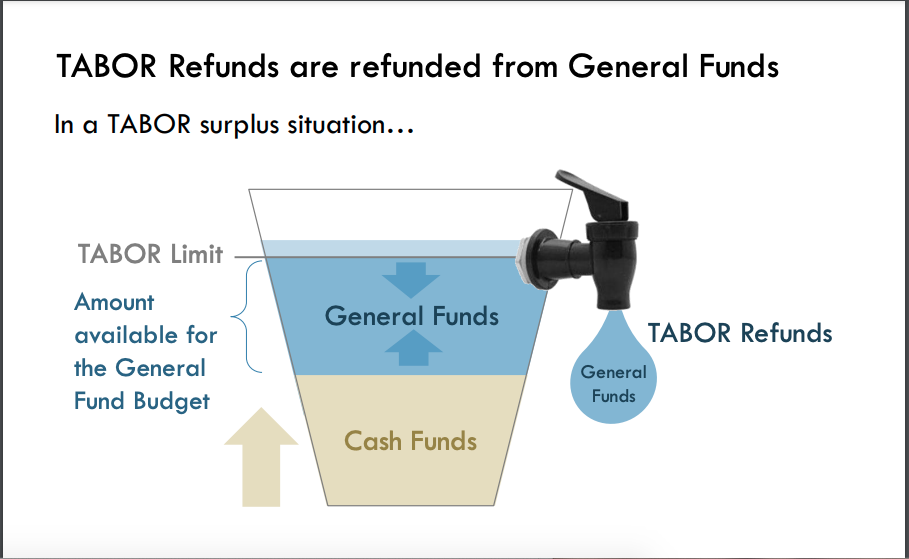
The general fund growth leaves lawmakers with $3.2 billion to spend in the 2022 session for the following fiscal year budget, but similar to this year, that’s one-time money that won’t be available in future years.
The forecast from the Governor’s office of State Planning and Budgeting is remarkably similar, according to OSPB Director Lauren Larson. A side-by-side comparison showed a less-than 1% difference between the two forecasts in revenue.
But the uncertainty in the economy remains. Larson told the committee that previous recessions are not a good guide to how the state will emerge from the recession. She cited Fed Chair Jerome Powell, who said Wednesday that “this is an extraordinary unusual time, and we really don’t have a template of any experiences of a situation like this.”
She said no one expected the state to be above the TABOR cap, which triggers the TABOR refund, so quickly.
Similar to the Legislative Council forecast, her office is still concerned about unemployment, with disparities remaining, particularly for people of color. Unemployment remains above the percentage of population for both Black and Hispanic Coloradans, she noted. The state, however, is above the national average on returning to work, the forecast said.
Larson had more specific numbers on inflation, noting that airline fares and prices for used cars and trucks are driving up inflation in transportation on a national basis.
As to the general fund revenue, OSPB forecasts robust growth (and the trigger for the TABOR refund), with $697 million estimated for refunds next year, $1 billion for refunds in 2023 and $1.14 billion in the following year.
Among the most volatile of revenues in both forecasts: severance taxes, the revenue generated by energy extraction. Those taxes are expected to be above estimates in the coming year, which also will drive up TABOR refunds, according to the forecasts.
Larson also recommended that lawmakers take a multi-year approach to its budget outlooks. While more budget funds are available, the uncertainty of new funds (particularly one-time only money) should be looked at carefully over a multi-year period.
In a statement issued Friday, Polis said the “economic results so far this year are well above expectations. As long as this year finishes out strong, there is some terrific news on the horizon: Not only will Coloradans get another income tax cut next year, but every Colorado taxpayer will also get a tax refund. … I look forward to formally announcing the expected tax cut and tax refunds this Fall.”


Denver to mull $6.9M East Colfax BRT extension, police union deal
Deborah Grigsby
deborah.smith@denvergazette.com
Updated 22 hours ago
Denver’s councilmembers will consider several items during Monday’s regular meeting, but the most notable is a resolution to overhaul contract review rules, requiring draft agreements to be shared with the Council before being heard at committee meetings. Council Resolution 26-0329...

Colorado justices confirm lawyers may ‘borrow’ allegations from elsewhere
Michael Karlik
michael.karlik@coloradopolitics.com
Updated 11 hours ago
The Colorado Supreme Court ruled on Monday that plaintiffs’ lawyers can use allegations made elsewhere to bolster their own clients’ claims, so long as the attorney first performs some degree of investigation into the “borrowed” assertions. Under Colorado’s rules for...
Colorado legislators propose $46.8 billion budget, driven by Medicaid costs
Marianne Goodland
marianne.goodland@coloradopolitics.com
Updated 14 hours ago
The six-member panel of legislators in charge of crafting the state budget has now turned over its plan to the Colorado legislature, proposing to spend $1.5 billion more for the Medicaid program. The increase is driven by Medicaid costs, which...

Governor signs bill expanding who can petition for weapons restrictions
Marissa Ventrelli
marissa.ventrelli@coloradopolitics.com
Updated 14 hours ago
Gov. Jared Polis on Monday signed a bill into law expanding who can ask a judge to temporarily restrict a person’s access to firearms. Established in 2019, 0Colorado’s extreme risk protection law (ERPO) initially allowed a family member or law...

Colorado justices restore RTD subcontractor’s award, reject ‘drastic’ view of public works law
Michael Karlik
michael.karlik@coloradopolitics.com
Updated 16 hours ago
The Colorado Supreme Court on Monday restored a $5.7 million award to a company that helped build a commuter rail line and, in doing so, rejected a view of state law that would nullify a subcontractor’s entitlement to any compensation...
As Colorado passes 6 million residents, housing initiatives take center stage
Marianne Goodland
marianne.goodland@coloradopolitics.com
Updated 15 hours ago
New Census data confirming Colorado’s population has topped six million is fueling renewed debate over Gov. Jared Polis’ housing agenda, as he tied the population increases to home construction. The governor said the counties experiencing the largest increases in new...

Congress urged to open antitrust investigation into Apple and OpenAI over ‘left-leaning bias’
Kaelan Deese, Washington Examiner
kaelan.deese.washington.examiner@gazetteedit.wpenginepowered.com
Updated 17 hours ago
A conservative legal group founded by senior White House adviser Stephen Miller is urging Congress to investigate a partnership between Apple and OpenAI, arguing the companies have effectively locked millions of people into a single, politically biased artificial intelligence system....

Trump threatens jail time over downed US fighter jet ‘leak’
Christian Datoc and Mabinty Quarshie, Washington Examiner
christian.datoc.and.mabinty.quarshie.washington.examiner@gazetteedit.wpenginepowered.com
Updated 17 hours ago
President Donald Trump threatened jail time Monday for the journalist who first reported that an airman was still missing after a fighter jet went down in Iran last week. The high-risk and eventually successful attempt to rescue the weapons officer...

Bill to accelerate police access to online data clears Colorado committee
Marissa Ventrelli
marissa.ventrelli@coloradopolitics.com
Updated 13 hours ago
A proposal to speed up law enforcement’s access to social media data is advancing in the Colorado Legislature, drawing testimony from the residents of Evergreen, where a school shooting took place, and questions from opponents worried about privacy and constitutional...
El Paso County defendant’s speedy trial rights violated, Colorado justices find in overturning convictions
Michael Karlik
michael.karlik@coloradopolitics.com
Updated 11 hours ago
The Colorado Supreme Court concluded on Monday that an El Paso County prosecutor made an unjustified decision to file a mid-case appeal, pushing the trial beyond the legal deadline and requiring that the defendant’s convictions be overturned. In Colorado, the...
PREV
PREVIOUS

Frontier-themed Western Conservative Summit lineup features Lauren Boebert, Rick Santorum, Andy Ngo
The Western Conservatives Summit is back. Sort of. After going virtual during the COVID-19 pandemic last year, like most large public gatherings, the 12th annual confab, scheduled for Friday and Saturday at a downtown Denver hotel, will be a smaller affair than in previous years, when it filled cavernous exhibit halls at the Colorado Convention Center. […]

A Colorado county's vaccination rate is below 50%. Now its COVID-19 hospitalizations are spiking.
As much of Colorado looks toward a normal summer, Mesa County is in the throes of its worst COVID-19 spike since the fall, with hospitals packed with patients, including some suffering from a newly-identified variant of the virus that’s plagued the state for 15 months. Mesa is one of nearly half of Colorado’s counties to […]