

House holds one last late-night debate on bill to unionize farmworkers

In what could be the last late-night debate of the 2021 legislative session, the House held its final vote Monday night on Senate Bill 87, a bill to grant farmworkers the right to join unions and engage in collective bargaining.
Under SB 87, workers have the right to seek action in the courts for retaliation or other complaints, require that they be paid minimum wage and overtime pay, and that employers provide workers with transportation and access to “key service providers,” including health care providers, clergy and lawyers. They also would be entitled to rest and meal breaks during the day, and a ban on short-handled hoes, cited as a tool that causes injury because the worker must bend over for hours to use it.
Republicans have warned that the bill will devastate the ag industry, and that it is further proof of Democrats’ war on rural Colorado and on agriculture in particular. That’s a claim tied to Gov. Jared Polis, who has in the past excluded Eastern Plains residents from boards and commissions important to rural Colorado, appointed an animal rights activist to the state vet board who stated that dairy farmers sexually abuse their cows, and advocated for the Department of Agriculture to promote vegan alternatives to beef, Colorado’s number one agricultural export.
Rep. Rod Pelton, R-Cheyenne Wells, a farmer and rancher, said he was sent to the Capitol to tell urban legislators about the story of ag. Senate Bill 87 “is the Front Range and urban folks telling farmers and ranchers how they should operate their businesses … They don’t have a clue about what it takes to make a living and how to survive in this industry,” he said. “We’re about to cripple ag in a significant way … it will take the little producers out of the game as they cannot meet the requirements in this bill.”
Choking back tears, Rep. Janice Rich, R-Grand Junction, said she grew up knowing that farmers were held in high esteem. “That’s not the case today. This tears at the very fabric of this country … The rural-urban divide continues.”
The future of Colorado agriculture is going to change, said Rep. Richard Holtorf, R-Akron, a farmer and rancher. He recounted conversations in which people have told him they want to move to an ag-friendly state that doesn’t undermine what they’re trying to do.
SB 87 sponsor Rep. Monica Duran, D-Wheat Ridge, said what’s been lost in the conversation is the voice of the workers the bill is intended to help.
“I listened to both sides. The only thing that I agree with is that this is the end of an era, an era where the voices of our agricultural workers will be heard, not ignored, where they will have better working conditions, breaks, and treated like human beings,” she said, adding that she could not believe that the conversation on how this would end an era, and it would be bad for farmers or ranchers. “We have yet to talk about our ag workers who are day in and day out suffering.”
House Majority Leader Daneya Esgar of Pueblo told the House that when the bill was introduced, she was torn. It’s no secret that she fights for workers rights, she said. But she also comes from an area where she appreciates agriculture and the struggles of her local farmers.
“It’s not a joke that I’m a champion of Pueblo chiles, because I know what it means for my area, what that product means to the area,” Esgar said.
The bill isn’t exactly what the advocates wanted, nor what the opponents wanted, she said. Not every farm has an issue with how they treat their workers. But there are some where the issues brought forward in this bill are happening. “We have to right that,” he said.
Rep. Marc Catlin, R-Montrose, the ranking member on the ag committee as well as its vice-chair, told the House that “there may be operators who treat people less than, and I would like to root them out. That kind of activity in this day and age is unacceptable.”
But the system is not built for the producers and the laborers, Catlin said. Americans pay less for food now than they did in the 1950s and 1960s. The system is built so that when the ag crop leaves the farm, it makes more money for the people down the supply chain than it does for the farmer who produced it.
“It’s an honorable profession…and we have taken very good care of the people who help us,” including helping them become American citizens.
The bill’s other co-sponsor, Rep. Karen McCormick, D-Longmont, told the House she decided to carry the bill, not as an attack on ag, but as a hope for integrity and pride in the ag industry. This bill will delegate to the Department of Labor and Employment guidelines and to listen to all the voices, and how to come up with overtime rules, she said. “It’s important to take into account the uniqueness of this industry.”
Much was given up in the spirit of compromise, she said, such as sending provisions to rulemaking rather than putting them into the bill. “This is to help those who have been asking for help for decades,” McCormick said.
The bill passed on a party-line 40-24 vote with Rep. Don Valdez, D-La Jara, voting with the Republicans. It now goes back to the Senate for concurrence on amendments.


Colorado Sen. Mike Weissman calls for cold water on heated hate speech
Marianne Goodland
marianne.goodland@coloradopolitics.com
Updated 1 hour ago
Likening the recent record-setting warm temperatures to hot political rhetoric, Colorado Sen. Mike Weissman, D-Aurora, pleaded for an end to death threats and other hate speech directed at lawmakers of both parties. “The increasingly tragic reality of our politics, however, like...

Ethics panel dismisses complaint against Colorado agency chief Dan Gibbs
Marianne Goodland
marianne.goodland@coloradopolitics.com
Updated 2 hours ago
A state ethics panel has dismissed a complaint against Dan Gibbs, executive director of the Colorado Department of Natural Resources. The complaint, filed in December 2021 by the Republican-affiliated group Defend Colorado, alleged Gibbs awarded the think tank Keystone Policy...

Denver airport hasn’t had notice ICE agents will assist TSA yet. Wait times are short, though
Bernadette Berdychowski
bernadette.berdychowski@denvergazette.com
Updated 1 hour ago
As President Donald Trump deployed immigration agents to help U.S. airports manage hours‑long security lines during the partial government shutdown, Denver International Airport remained relatively calm on Monday. At the nation’s third‑busiest airport, TSA PreCheck lanes remained open to start...
Appeals court recognizes longer window to sue insurers for withholding policy details
Michael Karlik
michael.karlik@coloradopolitics.com
Updated 4 hours ago
Colorado’s second-highest court split with its own prior decision earlier this month and concluded injured motorists have two years, not one, to sue insurance companies for withholding relevant information about an at-fault driver’s policy. In 2019, Colorado lawmakers enacted a measure to...

Trump open to $5 billion ICE funding cut if SAVE Act package passes
Zach LaChance, Washington Examiner
zach.lachance.washington.examiner@gazetteedit.wpenginepowered.com
Updated 5 hours ago
President Donald Trump signaled he is open to a $5 billion funding cut for U.S. Immigration and Customs Enforcement if the Senate passes the Save America Act, along with other amendments. “I don’t think we should make any deal with...

Appeals court decides free speech cases, error-prone judge reversed again | COURT CRAWL
Michael Karlik
michael.karlik@coloradopolitics.com
Updated 5 hours ago
Welcome to Court Crawl, Colorado Politics’ roundup of news from the third branch of government. The state’s Court of Appeals decided multiple cases implicating free speech rights, plus Colorado’s most error-prone judge was reversed on appeal yet again. Heard on...
It’s time to let unaffiliated voters caucus | Vince Bzdek
Vince Bzdek
vince.bzdek@gazette.com
Updated 6 hours ago
There’s no getting around it: Colorado’s 3,000 county caucuses, which just wrapped up recently, left half the electorate out in the cold. Since unaffiliated voters now make up 51% of all Colorado voters, a majority of Colorado electors are barred...

With new medical school set to open, Feinstein will step down as UNC president
Hap Fry, Special to The Gazette
hap-fry@gazette.com
Updated 1 day ago
GREELEY • Dr. Andrew “Andy” Feinstein, the charismatic president of the University of Northern Colorado, has announced that he will step down from his leadership role just on the cusp of what is perhaps his signature accomplishment being realized. He’ll...
Governor warns energy development both a boon and a risk to Colorado | A LOOK BACK
Rachael Wright, Special to Colorado Politics
rachael.wright@coloradopolitics.com
Updated 5 days ago
Forty-Five Years Ago This Week: “The real opportunity and the dangers before us are both real,” said Gov. Dick Lamm in his January state of the state address before the Colorado General Assembly. Lamm argued that energy development would continue...
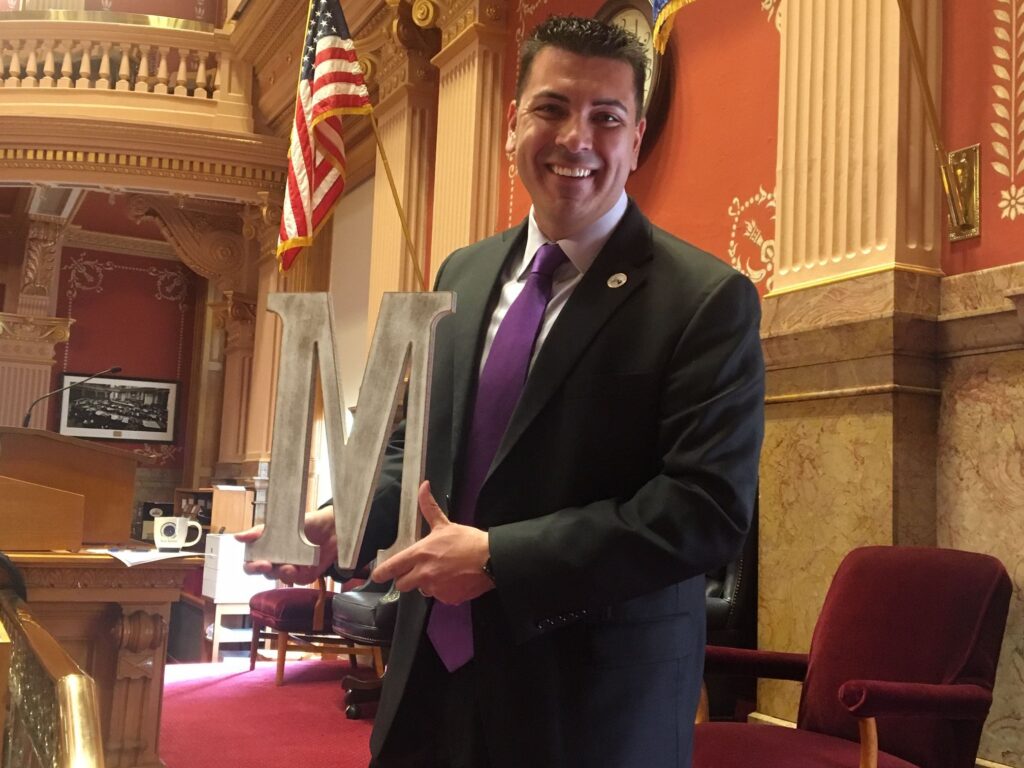
A Mile High, again: Capitol M | Week of March 21, 2026
Marianne Goodland
marianne.goodland@coloradopolitics.com
Updated 5 days ago
The lighter side of the Capitol, usually…. Local Journalism Day, except they forgot their very own local journalists. The state Senate on Thursday, March 19, passed a resolution recognizing Local Journalism Day. Everyone voted for it, which is good, because...
PREV
PREVIOUS

Aurora City Council to interview 6 candidates to fill Ward 2 vacancy
The Aurora City Council will interview six candidates later this month to determine who will fill the temporary council vacancy to represent Ward Two after Councilwoman Nicole Johnston resigns. The council set the guidelines for the interviews Monday during its regular study session. The council opted to interview all six candidates who applied for the […]

BARTELS | In three decades since ‘The Walk,’ legacy of Wellington Webb stands tall
Thirty years ago this month, Wellington Webb – once described as the “pit bull of underdogs” – won his first election as Denver mayor by beating the favored candidate in every part of the city, kicking off a 12-year stretch of defining the Mile High City for decades to come. Webb’s legacy now looms so […]