

SLOAN | It’s Biden’s turn to take on China

Last Monday, Colorado’s unique Counterterrorism Education Learning Lab, based in Denver, held a virtual event featuring two of the sharpest political strategists of this century, Karl Rove and Paul Begala, titled “Engaging the Political Pendulum and it’s Impact on National Security.” It was a fascinating, and at times, as one might expect, somewhat heated, discussion, but unlike the vituperous pablum fed to viewers of cable news shows, it was deeply illuminating, befitting the talent of the participants, and that of the equally talented moderator, Bret Stephens. If you happened to miss it, and care a thing or two about things that happen beyond our shores, I would highly recommend going to the CELL webpage and signing up for the reshowing on Wednesday March 10th, at 6pm.
The discussion covered a lot of territory, and I am not inclined to issue spoilers, but it boiled down to foreign and national security policy might change under the new Biden administration. We have had some early indicators.
Policy toward China will be the most interesting, and possibly most important. There has been little activity from the Biden administration on that front so far, but it seems likely that that is one area in which there will not be a major departure from the Trump approach. Given the acceleration of the aggressive posture assumed by Xi Jinping and the Chinese Communist leadership toward Taiwan and other neighbors, the totality of the assimilation of Hong Kong, and the violent oppression of the Uighurs, one hopes that the reorientation adopted by the previous administration will continue to the present one.
One thing which Biden could do which would be especially profitable in helping curb Chinese economic and military tendencies is to resurrect the Trans-Pacific Partnership free trade deal, or some improved version of it. Beyond the immediate economic benefits that would be experienced by American agriculture (Colorado’s agricultural community was firmly in support of TPP back in the day), the best way to counteract Chinese expansionary impulses is to isolate them economically by engaging in a trade pact with friendly pacific nations (including Taiwan). Both parties are to blame for the failure to see that happen; As Rove pointed out (okay, one spoiler) the Obama administration failed to bring the treaty to a vote in Congress; and of course, Trump, abandoning established conservative credenda early in favour of populist aims, ditched the treaty altogether.
But it is the initial indications of where a Biden administration will take policy in the middle east that raises the most concern at this early juncture. Biden seems almost desperate to pivot entirely away from the middle east, and reorientation towards the Pacific is indeed necessary and inevitable, but geography (as Robert Kaplan points out in his masterful book “The Revenge of Geography”), economics, and history conspire to make the middle east remain a crucial focus of American strategic interest.
Iran of course, is the most pressing issue in the Middle East, and Biden’s approach so far has been mixed, and unimpressive. Yes, he responded appropriately last week in ordering an airstrike against Iranian-backed militias in eastern Syria in response to rocket attacks against American and allied troops. It was a clear message that Tehran needed to hear, and Biden deserves credit for delivering it.
But the Ayatollahs have been receiving other messages from Biden and his nascent team as well. One of the first things he did upon assuming office was signal America’s intent to come back, hat in hand, into full communion with the euphemistically named Joint Comprehensive Plan of Action (JCPOA), commonly known as the Iran Nuclear Deal, more accurately termed the Iranian Nuclear Incentivization Program. This despite Iran’s accumulating list of violations of the deeply flawed 2015 accord.
The most egregious misstep in the region, however, was the deliberate erosion of America’s relationship with Saudi Arabia. The release of the classified Khashoggi report – the inquiry into the murder of the eponymous Saudi journalist – was, for starters, an unnecessary provocation which could have been handled more quietly, and more effectively, with less public means. Even more absurd is the administrations unilateral concessions to the Houthi rebels in Yemen. In early February, the Biden administration reversed the designation, and accompanying sanctions, of the Houtis as a terrorist organization, and ordered an end to U.S. support for Saudi Arabia in their war against the Iranian-backed rebels. The Houthi’s thanked him by stepping up brutal attacks on civilians in both Yemen and Saudi Arabia.
Like them or not, the Saudis are America’s largest, strongest, and most strategically important ally in a strategically important region. Empowering and emboldening our adversaries, while insulting and weakening our allies adumbrates a return to the fecklessness which passed for foreign policy in the Obama era, and if that’s the case, we will have much to worry about in all corners of the world.


What courageous citizenship really looks like | Vince Bzdek
Vince Bzdek
vince.bzdek@gazette.com
Updated 52 minutes ago
By Vince Bzdek What exactly is courage? Ernest Hemingway famously called it grace under pressure. Mark Twain wrote that “courage is resistance to fear, mastery of fear — not absence of fear.” C.S. Lewis refined that even more: “Courage is...
The coming election and mischief in the making | SONDERMANN
Eric Sondermann
eric-sondermann@coloradopolitics.com
Updated 3 days ago
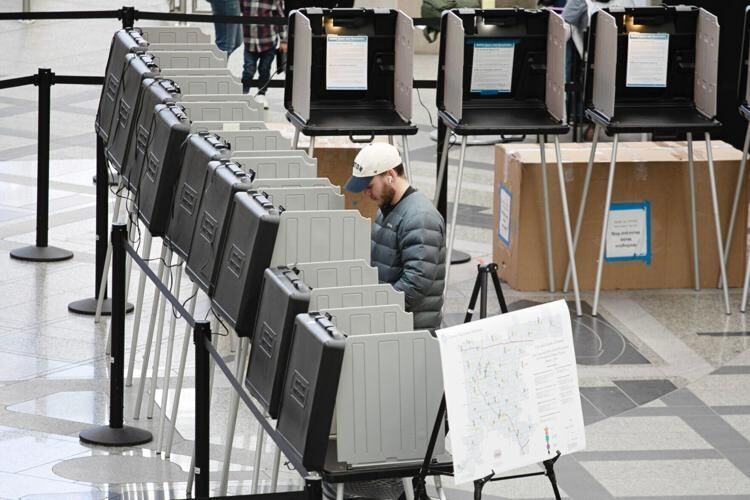
America’s tribalism is such these days that we struggle to even agree on the basic rules. Elections have always been hotly contested. As the saying goes, “Politics ain’t beanbag.” The process has long involved elements of nastiness and underhanded conduct....

Colorado’s hunting and fishing traditions rest on science, conservation and a proven heritage | IN RESPONSE
Colorado Politics
colorado-politics@coloradopolitics.com
Updated 2 days ago
By John Howard Eric Washburn’s recent column warns Coloradans the right to hunt and fish amendment is a Trojan horse designed to resurrect “cruel” practices voters have already banned and to elevate killing above every other form of wildlife management....

Why does Colorado limit who can safeguard taxpayer dollars? | GUEST COLUMN
Colorado Politics
colorado-politics@coloradopolitics.com
Updated 2 days ago
By Devin Camacho Recently, PNC Bank announced its purchase of FirstBank Colorado. Not only did Colorado lose a local banking option, but nearly 1,000 people lost jobs, with more job losses coming as the big bank now closes branches too....

Colorado’s precarious position protecting from wildfires | Paula Noonan
Paula Noonan
paula-noonan@coloradopolitics.com
Updated 2 days ago
Fourteen firefighters died in the Storm King Mountain fire west of Glenwood Springs in 1994 when 2,115 acres burned. In August 2020, the Grizzly Creek fire burned 32,631 acres along the Interstate 70 corridor east of Glenwood causing mudslides from flooding...

We must deliver on cost of living | GUEST COLUMN
Colorado Politics
colorado-politics@coloradopolitics.com
Updated 3 days ago
By Ryan Gonzalez Insurance premiums are on the rise. Property taxes are increasing. Groceries are becoming more expensive. Gas prices are reaching record levels. Housing costs are becoming unsustainable. These are the concerns I hear from people in my district....

Dan Haley on the role of oil and gas in Colorado’s energy future | The OpEdge Podcast
Tony Olivero
tony.olivero@gazette.com
Updated 3 days ago
Dan Haley, executive director of Coloradans for Responsible Energy Development, joins The OpEdge to discuss the role of oil and natural gas in Colorado’s energy future amid the state’s aggressive push toward “net zero.” Haley tells host and investigative columnist...

Rural hospitals don’t want special treatment, just a chance to care for locals | PODIUM
Colorado Politics
colorado-politics@coloradopolitics.com
Updated 2 days ago
By Kevin Stansbury As chief executive of Lincoln Health, my responsibility is simple: ensure the people of eastern Colorado have access to high-quality healthcare close to home when they need it most. That mission has never been easy. Rural hospitals...
Blue states should avoid disasters | Hal Bidlack
Hal Bidlack
hal-bidlack@coloradopolitics.com
Updated 4 days ago
Back when I was teaching political science at the U.S. Air Force Academy (and amazingly to me, a week from this column’s publication will mark 20 years since my retirement from active duty. Where the heck did that time go?)...

Right-to-hunt ballot measure’s a cruel, anti-wildlife solution to a nonexistent problem | GUEST COLUMN
Colorado Politics
colorado-politics@coloradopolitics.com
Updated 5 days ago
By Eric Washburn I love to hunt. Every year I try to hunt big game in Colorado and waterfowl in Louisiana. This year, I applied for five Colorado big game licenses — elk, deer, pronghorn, moose and bighorn sheep. I...
PREV
PREVIOUS

FEEDBACK | What the circus bill does, doesn't do
There is some misunderstanding about the proposed Traveling Animal Protection Act, SB21-135, which is aimed at ending wild animal performances in traveling circuses, county fairs and similar venues. SB21-135 only applies to a set of specifically listed species such as lions, tigers, elephants, and seals, among others. It has no impact on rodeos, stock shows, […]

NOONAN | As long as we're renaming mascots...
Paula Noonan The bill on mascots should be rewritten to put in a new set of criteria for these emblems of school pride. The bill rightly rejects mascots using American Indian images and names. It should be amended to require schools with dated mascots to freshen up. Here are some ideas for the revised bill. […]