

Denver City Council delays vote on body camera contract expansion

The Denver City Council delayed voting by a week on a resolution set to change a contract on body-worn cameras and related technology for the Denver Police and Sheriff Departments.
Councilwoman Candi CdeBaca on Monday night chose to delay by a week the full City Council’s vote on Resolution 1356, saying she wanted definitive clarification that a Denver ordinance would protect camera footage from being shared with outside entities such as Immigration and Customs Enforcement.
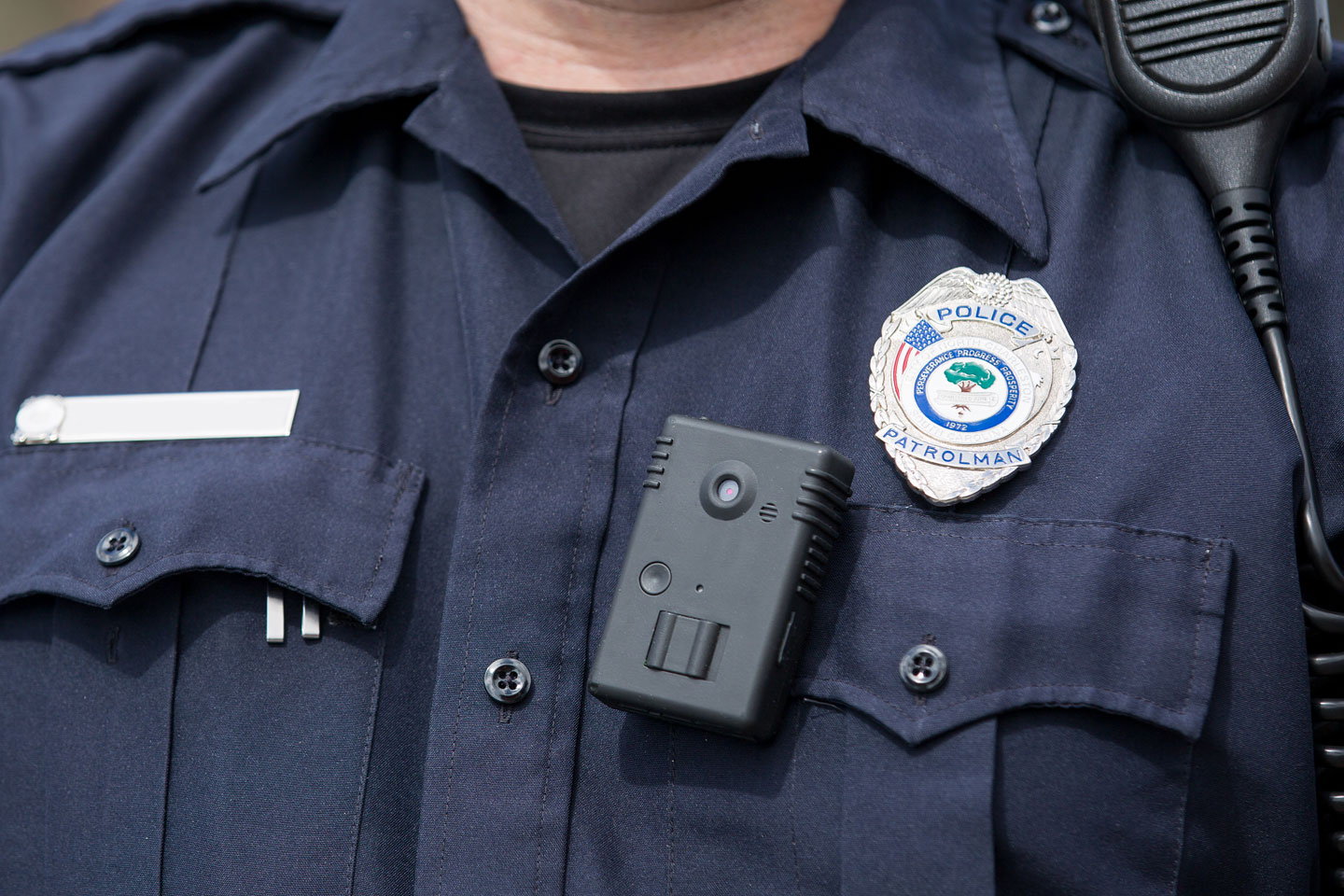
At its heart, the contract expansion with Axon Enterprise Inc., formerly known as Taser International Inc., would add more than $6 million and extend the contract into December 2025 on body-worn cameras, supporting technology, software and data storage.
What’s new
The technology automatically triggers recording if an officer draws their gun or Taser. According to a Fast Company report, Axon announced gun holster sensor technology, called Signal Sidearm, in 2017.
At a Nov. 18 meeting of City Council’s Safety, Housing, Education and Homelessness Committee, Denver Police Chief Paul Pazen said officers’ Tasers will also have sensors. He clarified that the body cameras are always on, but when recording is activated manually or automatically, a camera will capture the immediately preceding 45 seconds.
Pazen described the automatic recording technology as an important feature of new cameras for officers. In situations requiring “an immediate and necessary response, you have to grab your radio, you have to put the car in park, all of these things, sometimes hitting that button on the body cam becomes a challenge,” he said.
At Monday evening’s meeting, Pazen said data sets generated by body camera recording can be used to cross reference that use-of-force reports have been submitted in all incidents when they are required.
SB217’s effect
In June, Gov. Jared Polis signed a sweeping law enforcement reform bill that overhauls from qualified immunity to requirements for body-worn camera practices.
The new law requires officers in Colorado’s local law enforcement agencies and the state patrol to have body or dash cameras activated during interactions with the public or while responding to service calls. The mandate includes a few exceptions, such as to avoid recording information not related to a case or if an officer is working undercover.
The law’s mandate for wearing body cameras by officers who interact with the public goes into effect July 1, 2023.
Mari Newman, a partner at civil rights law firm Killmer Lane & Newman who helped write Senate Bill 217, said only capturing footage once a situation has escalated wouldn’t meet the new law’s mandate.
“The reason for that is because we can’t allow officers to decide when they do and don’t feel like recording, because that doesn’t provide the same objective evidence of what did and didn’t happen as having a recording that must take place from beginning to end of the interaction,” Newman said.
Beyond the technology
Public trust in the use of cameras by law enforcement depends on more than whether the technology works, and the integrity footage can provide in re-examining an incident can be built up or eroded by agencies’ specific policies and practices surrounding camera usage. That can include whether the officer can review the footage before they create an initial incident report or during the process.
A report that examined body-worn camera policies in police departments across the U.S. from think tank Upturn and umbrella group The Leadership Conference on Civil and Human Rights criticized the Denver Police Department’s policy allowing officers to view body-worn camera footage when documenting incidents, which has a stated purpose of ensuring accuracy.
The policy requires officers to get approval to view their own footage of use-of-force incidents and other critical situations, but the report notes the policy doesn’t mention whether officers have to file reports or statements before viewing footage in those circumstances.
Experts on body camera use from Upturn and The Leadership Conference could not be reached for interviews.
However, Senate Bill 217 includes penalties for tampering with body or dash camera footage. For example, it requires the Peace Officer Standards and Training Board to suspend an officer’s certification for at least a year if they tamper with footage or intentionally fail to activate their camera in order to hide misconduct or obstruct justice.
The new law also creates a legal inference that missing footage would have reflected misconduct by the officer.
Dr. Apryl Alexander, an associate professor at the University of Denver’s Graduate School of Professional Psychology with expertise in forensic psychology and a member of Denver’s Citizen Oversight Board, said the relative newness of body camera technology and of their widespread use by law enforcement means social-science research about aspects of body camera usage, such as whether they can influence behavior of people in law enforcement interactions, is also still developing.
“A lot of researchers are looking at two primary outcomes: [Do] body cameras increase social desirability among police officers to where they will be professional when the body cameras are on, and obey guidelines, and not engage in excessive force?” Alexander said. “And … some research [looks at] when body cameras are used, will that change the behavior of the community member interacting with law enforcement. There’s some research that suggests it does.
“But again, this is all so new that we really have to sit back and examine, is it actually changing behavior; is it actually resulting in a reduction of excessive force complaints or acts?”
Despite its points of fallibility, Newman was definitive about the value of camera footage to civil rights cases over officers’ use of force. She said cases often turn on the objective evidence it can provide of how events that led to use of force unfolded, and she added video helps even the field in cases that would otherwise have only “he said, she said” evidence and officers have the advantage of presumed credibility.
“Historically, people have been very reluctant to believe that law enforcement officials violate people’s civil rights without some compelling reason, because to do so is to have to admit that, in fact, the world is kind of lawless,” Newman said. “And so jurors have often wanted to believe that police wouldn’t engage in brutality unless the victim had done something to deserve it. Sometimes they do violate people’s civil rights for no reason whatsoever. So having the video to show that has made all the difference.”


Committee approves reworked version of previously vetoed rideshare bill
Marissa Ventrelli
marissa.ventrelli@coloradopolitics.com
Updated 1 hour ago
Members of the Colorado House Business Affairs and Labor Committee voted across party lines to pass a modified version of a bill establishing regulations on rideshare companies. Last year, Reps. Jenny Willford, D-Northglenn, and Meg Froelich, D-Englewood, introduced House Bill...
Fight over credit card ‘swipe fees’ attracts nearly 200 lobbyists in Colorado
Marianne Goodland
marianne.goodland@coloradopolitics.com
Updated 49 minutes ago
One of the most expensive fights of the 2026 session got a little closer to being over on Friday, when the Colorado Senate took a second final vote on the proposal to eliminate “swipe fees” on sales taxes. It’s not...
Veto likely as union-backed bill heads to Colorado governor’s desk — again
Marissa Ventrelli
marissa.ventrelli@coloradopolitics.com
Updated 2 hours ago
For the second year in a row, a bill that would make it easier for labor organizations to impose fees on all workers, regardless of union membership, is headed for Gov. Jared Polis’ desk. The governor, who vetoed the legislation...

Aurora mental health nonprofit cuts 100-plus jobs after Colorado agency reduces reimbursement rate
Marianne Goodland
marianne.goodland@coloradopolitics.com
Updated 5 hours ago
A nonprofit that provides services through 11 mental health centers in Aurora announced Thursday that it is eliminating 111 jobs effective June 30, the result of federal and state budget reductions. Aurora Mental Health & Recovery said the positions being...
Denver law students create AI-powered tools in federal judge’s ‘design sprint’
Michael Karlik
michael.karlik@coloradopolitics.com
Updated 8 hours ago
A tenant discovered a handwritten note on his door stating he had 48 hours to move out. The landlord changed the locks without notice or court proceedings. The tenant paid rent on time and had never received any complaints about...

Colorado space startup secures $650 million for expansion
alex-edwards
alex.edwards@gazette.com
Updated 24 hours ago
The window to deliver space superiority for the U.S. is open but shrinking rapidly, according to defense startup True Anomaly. The Centennial-based company hit a milestone in its pursuit to help deliver that, announcing Tuesday that it raised $650 million...

Colorado bill prohibits credit card companies from charging ‘swipe fees’ on sales taxes
Marianne Goodland
marianne.goodland@coloradopolitics.com
Updated 23 hours ago
Colorado senators on Wednesday voted to advance a proposal to eliminate credit card “swipe fees” on sales taxes. Proponents say the move would save businesses tens of thousands of dollars annually, while critics have countered those fees are needed to...
First ever disciplinary trial of a Colorado judge scheduled under new system
Michael Karlik
michael.karlik@coloradopolitics.com
Updated 1 day ago
A disciplinary panel on Thursday scheduled a mid-August hearing to adjudicate the alleged misconduct of Montezuma County Court Judge Ian J. MacLaren. Following voters’ passage of constitutional Amendment H in November 2024, adjudication of serious judicial misconduct allegations is open to public...
Colorado eyes licensure, new oversight body for autism therapy providers
Marissa Ventrelli
marissa.ventrelli@coloradopolitics.com
Updated 21 hours ago
A panel of Colorado legislators on Wednesday approved a bill establishing a new regulatory body and licensure requirements for professionals who provide therapy for children on the autism spectrum, as well as for the facilities in which they work. House...
Appeals court recognizes weekend, holiday rule applies to judicial review deadline
Michael Karlik
michael.karlik@coloradopolitics.com
Updated 1 day ago
Colorado’s second-highest court clarified for the first time on Thursday that the rule extending deadlines in civil cases when the final day falls on a weekend or holiday also applies to litigants seeking review of governmental decisions. Nicholas A. Rigato...
PREV
PREVIOUS

Coronavirus in Colorado: The latest numbers
There are now 13,522,247 coronavirus cases in the U.S. and 267,844 deaths, according to Johns Hopkins University. The latest COVID-19 numbers in Colorado (Updated on Nov. 30): – 228,772 cases, including 36,243 in Denver County – 1,748,078 people tested – 3,003 deaths among cases, including 524 in Denver County – 1.31% fatality rate in the […]

Day one of Colorado special session wraps up with 11 bills headed for Tuesday
The first day of the General Assembly’s “extraordinary session” wrapped up Monday evening with 14 out of the 35 introduced bills still awaiting action. However, three of the bills – two in the Senate and one in the House – never made it out of committee Monday so they are, for all intents and purposes, dead for […]