

For one-of-a-kind school, the coronavirus presents new challenge to sick students

One hundred and twenty-one years ago, Denver’s “lunger” refugees at last found a sanctuary, a hospital that would take them in and treat their tuberculosis.
For that generation of patients, the tuberculosis afflicted who’d flocked to Denver for its dry air, the sanctuary was National Jewish Hospital for Consumptives, borrowing the latter part of its name from the colloquial name for TB. The hospital opened in 1899 after several years of delays caused by funding shortages brought on by the Silver Crisis. It was the first speciality hospital of its kind in the United States, where tuberculosis was a leading cause of death.
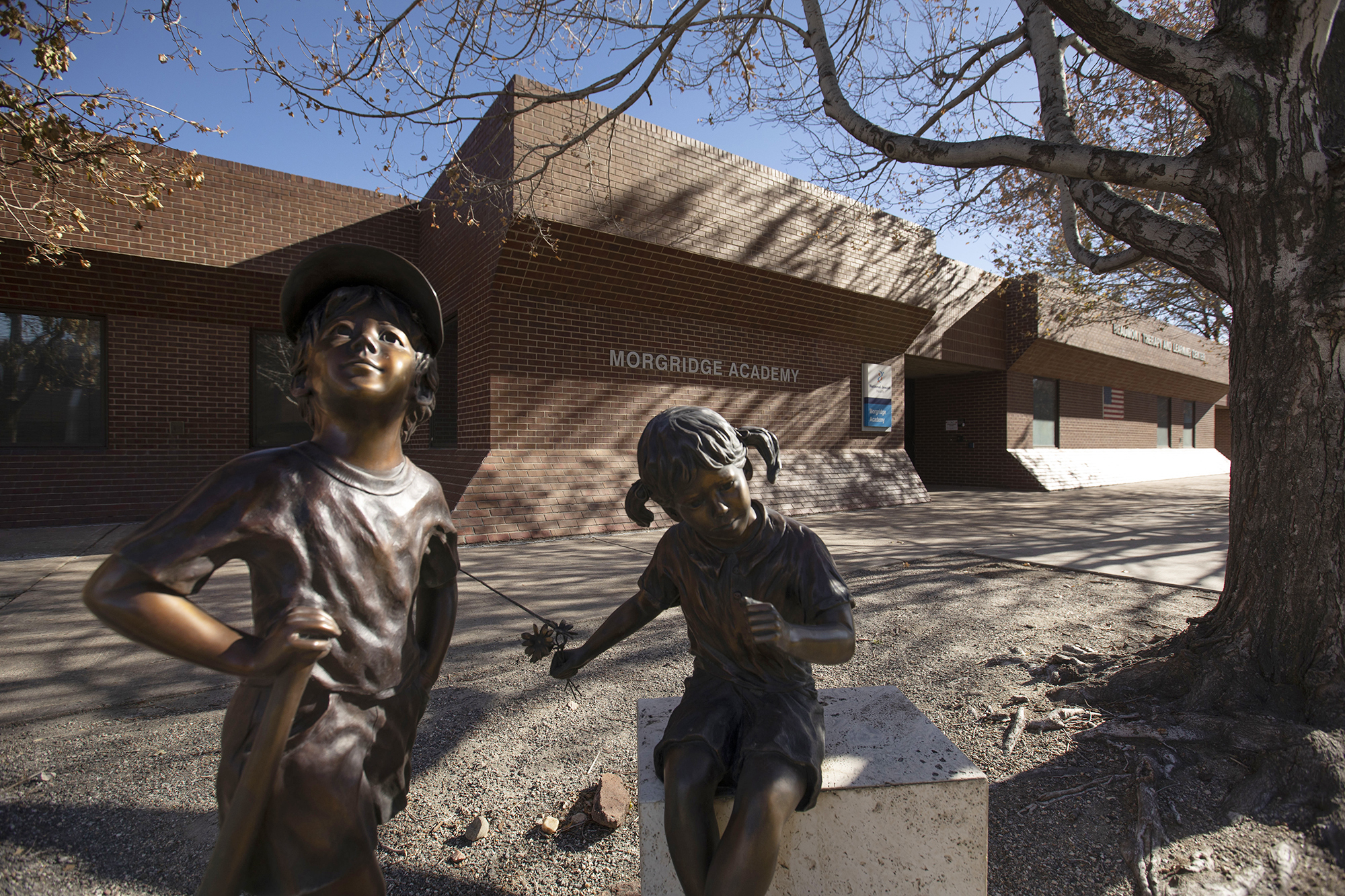
Many of those early patients were homeless before National Jewish opened, and they brought their children with them on the pilgrimage to Colorado. Those kids needed schooling, and the hospital accommodated. In the ’30s, they opened another sanctuary for another generation, a predecessor to today’s Morgridge Academy.
“They’ve had education as a goal through the whole entire existence of National Jewish,” said Jen McCullough, the principal at Morgridge.
Now, tuberculosis is largely a thing of the past. While the coronavirus has made an early bid to replace it as the respiratory killer of our time, its analogue to Morgridge is asthma. The school only accepts children with medical conditions who would struggle in a conventional classroom. Many of the few students at the school have asthma, severe enough that they weren’t making it in the school system. One kid in the school has cystic fibrosis, a serious lung disease. His brother, also a CF patient, graduated in the spring.
Morgridge maxes out at 90 students, K-8, with a ceiling of 15 kids per class. It’s got a swimming pool — a replacement for the PE tradition of running endless laps — and three full-time nurses. It’s funded partially by the state, partially by the hospital and partially by donors who let the school “be a financial black hole every year,” McCullough said. It’s not a cheap place to run. One benefactor left the school $150,000 when they died. It showed up in a plain envelope.
According to its staff, Morgridge is the only school of its kind in the United States. It caters to students who’d disappear into the larger school system and drown beneath districts’ inability to care for their needs. In the age of coronavirus, the academy’s adopted intense efforts to keep the virus out while continuing to care for kids in struggling homes. Heading into the fall, the school gave parents the option of online or in-person; it was split 50-50. But like other schools across the state, the spike statewide has led to sick teachers and sick students, and last week, Morgridge moved online again.
Morgridge initially and abruptly went virtual in March; its last day was Friday the 13th in March. Eighty-five percent of the school’s students are on free or reduced lunches. That means a family of four brings home, at most, $933 a week. Staff scrambled to get every kid a laptop. It helped set up internet for those families that didn’t have it. They, like other educators, were building the plane while it was airborne.
McCullough said she was “running around” trying to find supplies for her families because parents were “afraid to leave their homes at that point because their kids are sick and we didn’t know” what risk the virus brought to them.
What research and weeks of in-person learning has shown is that there’s little threat of transmission within schools. But with students who have damaged or sensitive lungs, or kids with compromised immune systems, the virus still presents a fear.
“They all have medical trauma,” McCullough said. “So when they see the coronavirus, they have experienced procedures it flashes them back to. It’s very scary for our kids.”
For many of its students, the school provides an education beyond geometry and geography. It’s a daily lesson in coping with and more effectively treating their disease.
“Before we went to Morgridge, my middle son was in the hospital every year for at least a week,” Katie Hastie said. Two of her sons have cystic fibrosis and type 1 diabetes. She’s referring to the older one, Kaori, who graduated from Morgridge in the spring. “Once we got there, he was able to treat his breathing and take care of his insulin. He’s only been hospitalized, after that, two to three times.”
Moving online hasn’t ended Morgridge’s ability to help kids with their symptoms; it just takes a bit more work. Nurses traveling to students’ homes to check on them, parents driving up each Monday to pick up five breakfasts and five lunches.
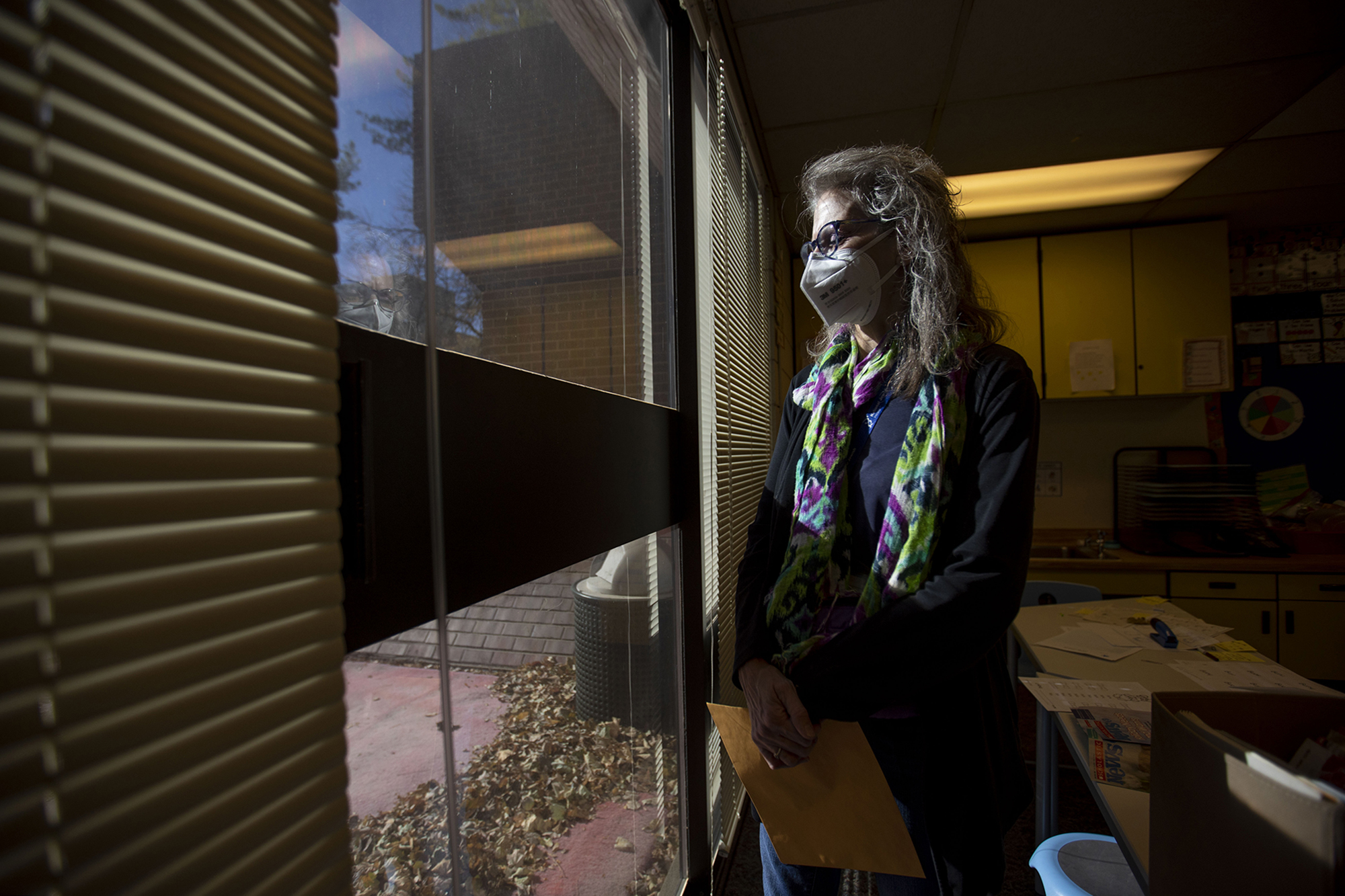
But still: The kids are taken away from the library the school’s so proud of, away from the pool and the boards that record their personal bests outside the gym, away from the teachers and social workers and nurses, all of whom have honed the type of passion that comes only from working with challenging kids.
“I feel for the kids,” said Jim Gianvito, the PE teacher, “because they definitely sense that they’re missing engagement when they’re online.”
* * *
Della is 12 years old and wants to be a mortician. She’s done the research, talked to experts, weighed options. She’s even looked at what college classes she’ll need. Her determination proceeded the pandemic, but the death brought by the disease has only hardened her resolve. You can learn from the dead, she tells her mom. They still have stories.
Della’s asthmatic. Her mom, Amber Watson, lived across a park from Della’s first school, but often she couldn’t get there in time to deal treat an asthma attack, and Della would head to the hospital. Before the family found Morgridge, they were in and out of National Jewish.
“I couldn’t even tell you how many times a week,” Amber said.
The frequent trips to the hospital hurt Della’s academics, and her school didn’t have a dedicated nurse. When she toured Morgridge four years ago, she saw the library — a small room practically overflowing with books — and that was it. She left DPS and has been at Morgridge ever since.
Now she’s a straight A student, and she wants to be mortician. Her trips to the emergency room have dwindled, just like Kaori’s had. It’s not just the on-hand nurses or the fact that the hospital’s pulmonologists were across a courtyard. The family got an education on how to treat her asthma at home.
“When we first started at Morgridge Academy, I didn’t know to do, what to say, as far as how to give her her medication at school,” Amber said. “When we go to school, every single day, every morning, they show her how to take the medication. They were so on point.”
Della used to be afraid of putting her head underwater. Now she can swim laps, which made Amber cry. Della had struggled in PE; at Morgridge, she showed up every morning to run laps around the gym to prepare for a 5K run.
McCullough said a parent once called Morgridge “the great equalizer” because every kid had something. Nobody would get bullied here because they needed a nebulizer or insulin.
“CF is so isolating, sometimes you feel like you’re the only one with it,” Kate said, using the shorthand for cystic fibrosis. “Some kids have the same thing as you, it’s OK. You’re not the oddball. In a normal school, Kaori was the oddball. He was the only one doing shots and pills, and everybody would watch.”
Debbie Suzuki, one of the school nurses, has been at Morgridge for three years after working in Adams and Douglas counties. In the latter, she covered three schools and thousands of students. She was the first dedicated school nurse the school hired, having previously leaned on National Jewish’s workforce.
It’s important for the nurses to have an active, positive relationship with the students, she said.
“It’s really important for nurses — it’s important for people to not say, ‘You’re too sick, I can’t deal with you at school,'” she said. “If you say that, all these kids will have terrible experiences and not feel wanted.”
Jim, the PE teacher, said that the teachers “kind of adopt these kids” when they walk through the door. It’s devastating each year when the eighth-graders rotate out, out of Jim’s swimming pool and often back into the ocean of the public school system.
Sixty-three year old, Jim said three times, unprompted, that he doesn’t want to retire. He couldn’t wait to get back to school this fall.
“You kidding?” he said, again unprompted. “I’ll never feel old. My job keeps me young.”
When the pandemic first started, the school helped get the family masks. The proximity to the hospital meant that Morgridge never wanted for protective gear or heavy-duty sanitizer. Doctors would keep the school staff up to date, and cleaning crews would scrub it down regularly.
Still, heading into the fall, Amber decided against sending Della back for in-person learning. The virus still “scares the crap out of me every single day,” Amber said.
“The pandemic has changed everything about the way I look on life,” she said, “especially with my daughter being an asthmatic. Every time she coughs, I’m like, “Della are you OK? Let me check your temperature.'”
It’s been socially difficult for Della. Teachers speak simultaneously to the class in front of them and the students on the computer screen. Della can see her friends laughing while she’s away. She sees one friend a few times a month, albeit outside and at a distance. That’ll dwindle further as the weather turns.
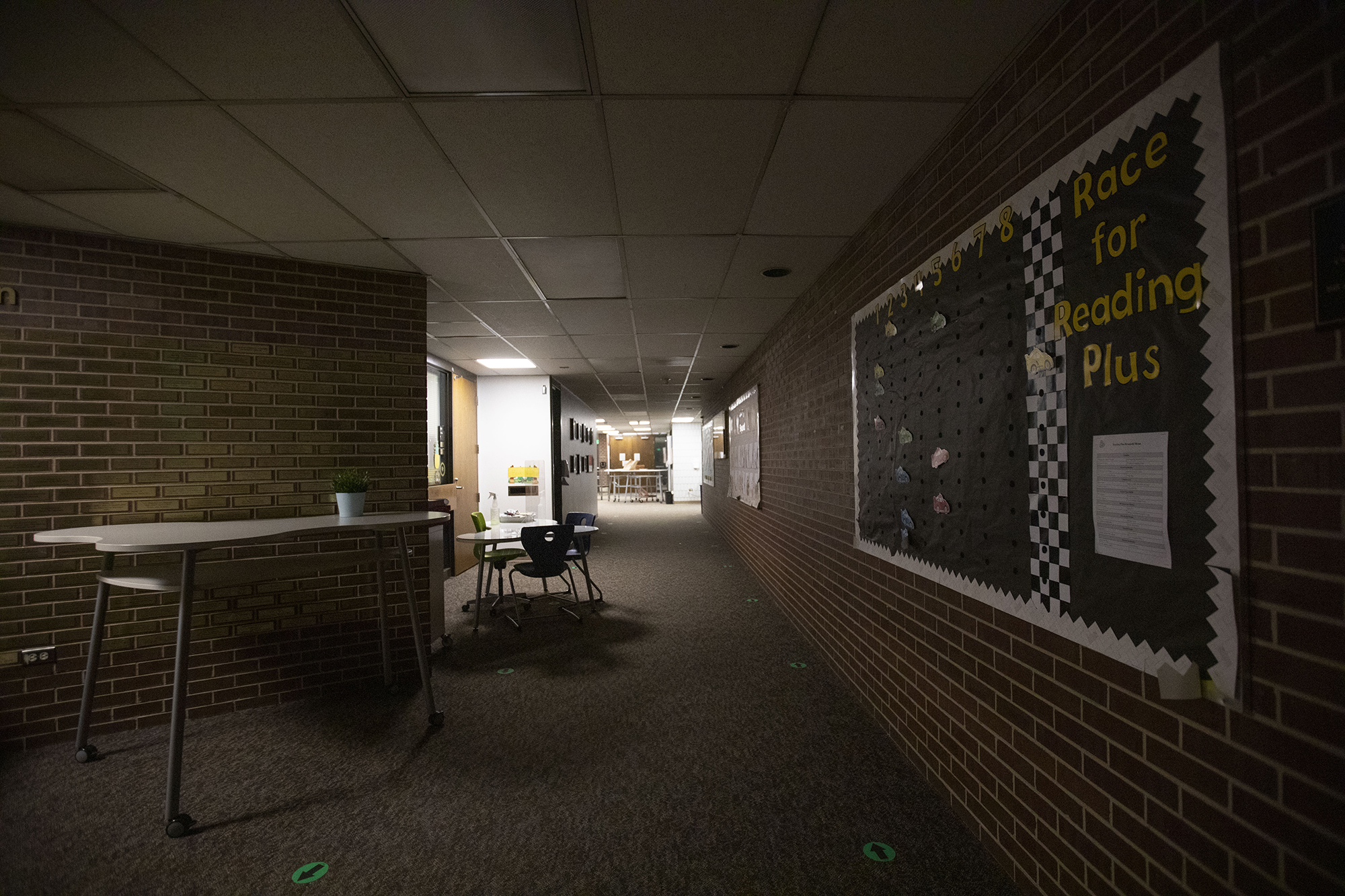
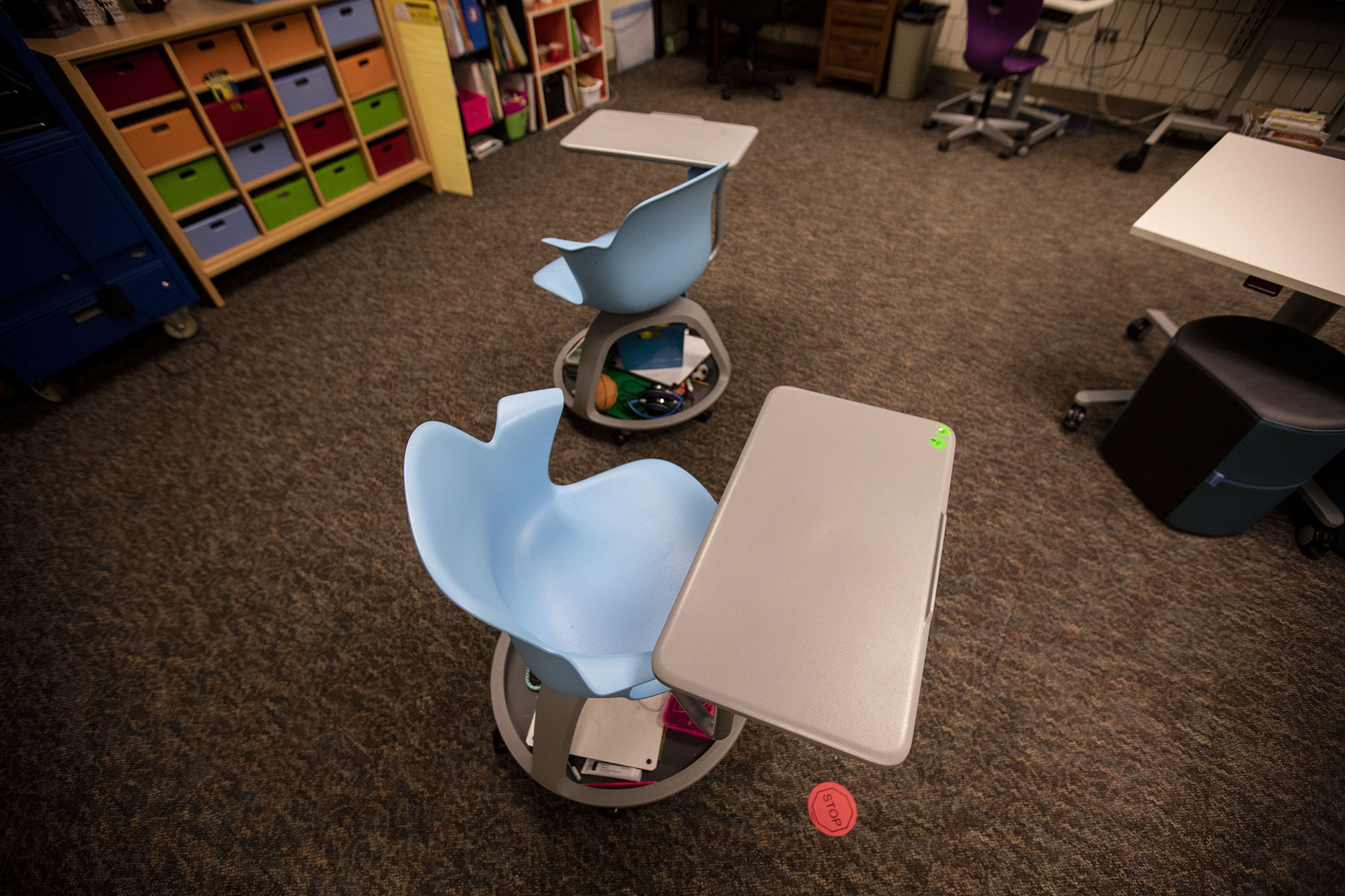
For those families who decided to stay in school — “half of the parents were like, ‘Good God take my children,” McCullough said — their kids returned to a different Morgridge. Students are screened before they walk in the door, and then they’re screened again by two nurses who sit behind a plastic barrier. Their path through the halls is guided by small green arrows on the floor, each six feet apart. They follow the stickers and march past the wall outside the library and past the pictures of main characters and villains from children’s books.
Staff are screened at the entrance to each classroom via an iPad. If it’s not their classroom and they’re just popping in, they sign in, so the school can keep track of possible exposures. The staff can get tests every two weeks. Morgridge even has a reverse air flow room; if a kid develops symptoms mid-day, “we can stick them in there,” McCullough said.
Kaori’s brother, Malik, is still at Morgridge. While Kaori is reserved, a homebody who wants to be a professional YouTuber, Malik is outgoing, a “social butterfly.” He wants to play in the NBA, but “he’s not very tall,” Katie concluded.
Both brothers were at Morgridge in the spring when it swiveled to virtual learning, and both struggled to adapt to the looser academic structure. Malik in particular missed the social part. So when the family had the choice of sending him back, Katie said yes.
“It was interesting the first day, the kids getting out of the car,” McCullough said. “There were some kids that were so excited that they were bouncing and running up to the door. Other kids, you’d look at their eyes over their little masks and they looked scared to death. When you haven’t left your house because there’s this big evil virus, there’s a lot more depression and anxiety than what we typically have.”
For some families, Morgridge has been a generational home. Beth Enderle, the first-grade teacher, said that nearly half of her current students are the children of past Morgridge students. Some grandparents are also graduates.
“We very much are surrogate caretakers for our students,” Jim said. “It’s been fantastic to be back in the building.”
* * *
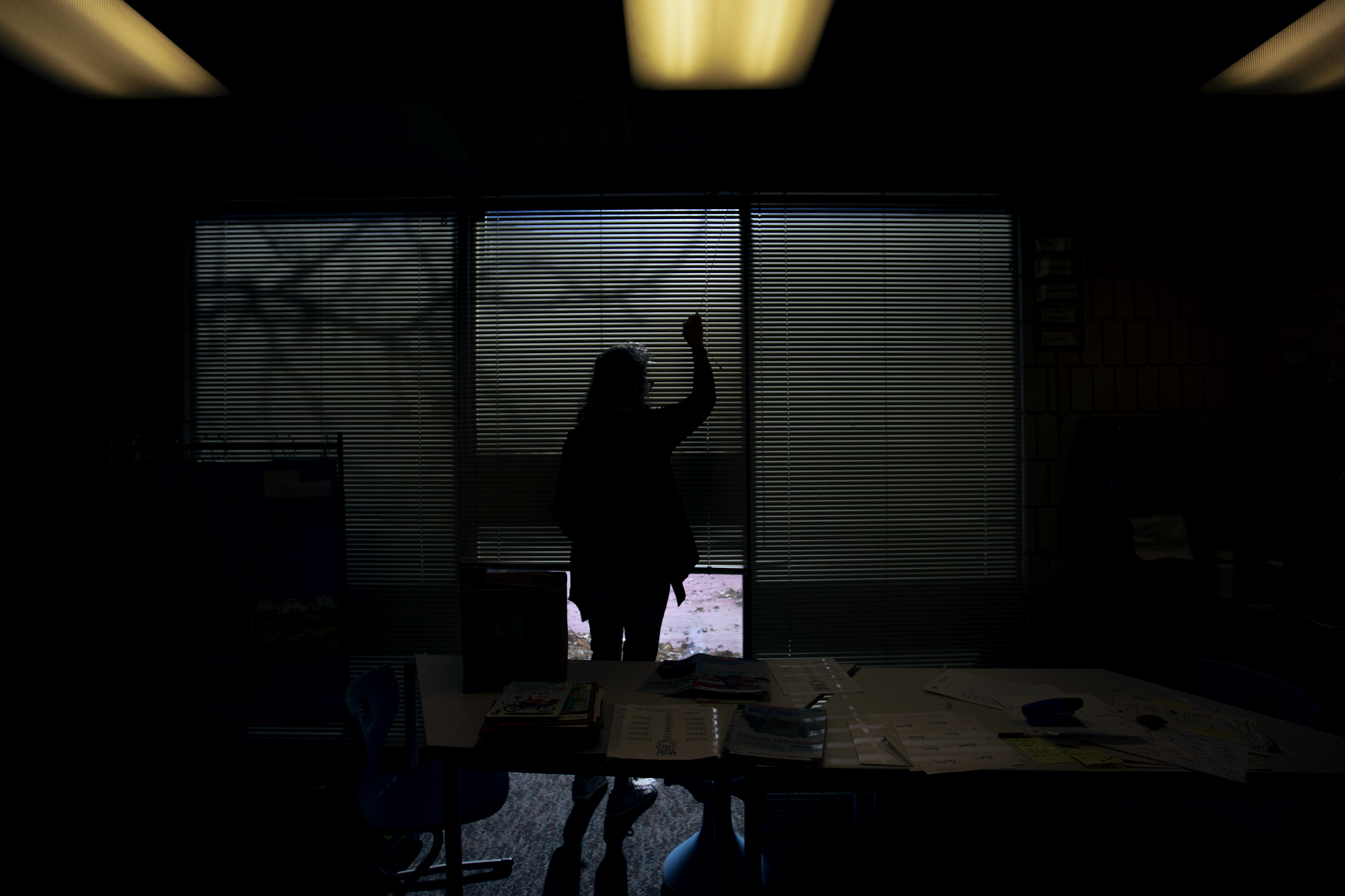
But in mid-November, the school closed again, its instruction fully online after some students and staff tested positive for the virus. Its halls are dark, its gym pitch black. The pool room is still humid, students’ names are still listed on the personal-best boards. The last date on one whiteboard is Nov. 9.
“Morgridge is definitely a safe place for kids,” Beth said. “For our kids — all of us feel like, when we go to virtual, we worry about what’s happening or not happening at home.”
Teaching via a webcam gives teachers a new view into students’ lives at home.
“When I’m teaching a first-grader,” Beth said, “and I see the oldest kid in our school is taking care of other kids, I don’t see any adults there, that’s the kind of thing our families are up against on a daily basis.”
Even if the teaching medium has changed, the mission has stayed the same. Meals still get served, and nurses are a phone call away. Teachers remind kids to pre-treat and take their meds. The school is still the safe place, the sanctuary for kids who needed one.








Colorado justices confirm leaving-the-scene prosecutions require no proof of driver’s knowledge
Michael Karlik
michael.karlik@coloradopolitics.com
Updated 1 hour ago
The Colorado Supreme Court confirmed on Tuesday that its 20-year-old decision involving drivers who leave the scene of an accident remains good law and prosecutors do not have to prove that such defendants knew they were involved in an accident....

Road-funding initiative in Colorado qualifies for November ballot
Marissa Ventrelli
marissa.ventrelli@coloradopolitics.com
Updated 42 minutes ago
A measure that would dedicate all transportation-related revenue to Colorado’s roads and bridges has officially qualified for the November ballot after it cleared the state’s signature threshold, according to election officials. Backed by the coalition Restore Our Roads, Initiative No....

Judge blocks Colorado’s proposed ban on using SNAP benefits for soda
Marissa Ventrelli
marissa.ventrelli@coloradopolitics.com
Updated 32 minutes ago
A federal judge has temporarily blocked Colorado and several other states from enforcing a proposed “Healthy Choice Waiver” that would have barred Supplemental Nutrition Assistance Program (SNAP) recipients from using their benefits to buy soda and other sugary drinks. Under...
Medicaid suspends agency behind ‘The Program,’ citing ‘credible’ fraud allegations
David Migoya
david.migoya@gazette.com
Updated 4 hours ago
The agency overseeing Colorado’s federal Medicaid program has suspended an Aurora home-health agency that’s the focus of an investigation into an enterprise that lured dozens of homeless people with promises of free housing and cash so it could siphon off...
Medicaid suspends agency behind ‘The Program,’ citing ‘credible’ fraud allegations
David Migoya
david.migoya@gazette.com
Updated 4 hours ago
The agency overseeing Colorado’s federal Medicaid program has suspended an Aurora home-health agency that is the focus of an investigation into an enterprise that lured dozens of homeless people with promises of free housing and cash and reaped tens of...
Medicaid suspends agency behind ‘The Program,’ citing ‘credible’ fraud allegations
David Migoya
david.migoya@gazette.com
Updated 4 hours ago
The agency overseeing Colorado’s federal Medicaid program has suspended an Aurora home-health agency that is the focus of an investigation into an enterprise that lured dozens of homeless people with promises of free housing and cash and reaped tens of...
Boulder police overreached in interrogating suspect, Colorado Supreme Court finds
Michael Karlik
michael.karlik@coloradopolitics.com
Updated 38 minutes ago
Two Boulder detectives violated a man’s constitutional rights by interrogating him at his home using a court order that solely authorized the collection of his DNA evidence, the Colorado Supreme Court concluded on Tuesday. The ruling curtailed the ability of...
Property owners may access evidence before eminent domain decisions, Colorado justices conclude
Michael Karlik
michael.karlik@coloradopolitics.com
Updated 36 minutes ago
The Colorado Supreme Court ruled on Tuesday that a Douglas County judge incorrectly believed he lacked the authority to allow a property owner to pursue evidence challenging a government entity’s legal right to take its property through eminent domain. In...

Missy Woods accepts plea deal, avoids trial on 102 felony counts
Jenny Deam
jenny.deam@gazette.com
Updated 2 hours ago
The former top Colorado Bureau of Investigation forensic scientist accused of altering and deleting DNA evidence in scores of criminal cases across the state for years pleaded guilty to four criminal counts Tuesday in Jefferson County. Yvonne “Missy” Woods, 65,...

ICE may deport illegal immigrants without judge approval, appeals court rules
Anna Giaritelli Washington Examiner
anna-giaritelli-washington-examiner@coloradopolitics.com
Updated 4 hours ago
A federal appeals court has ruled in favor of expanding a fast-track deportation process to let the Trump administration expeditiously remove illegal immigrants who are living inside the United States, not just at the southern border. On Tuesday, the U.S....
PREV
PREVIOUS

Governors announce small business aid alongside restrictions
In the past six weeks governors of both parties have approved hundreds of millions of dollars in aid for small businesses, nonprofits and renters struggling through the coronavirus pandemic and recession. The recent announcements are partly due to a looming deadline: If states don’t allocate federal aid they received in March by the end of […]

Pro-Trump demonstrators take the streets on Saturday to protest the election
About 70 demonstrators gathered Saturday near the Colorado State Capitol to protest what they alleged was fraud in the presidential election. Calling themselves the Colorado Election Integrity Project, the group waved “Trump 2020” banners and held up signs reading “Stop the Steal” and “Masks, Tyranny, Corruption + Vaccine = Death” and “Biden Stole America” signs. […]