

BARTELS | With fires again in sight, reminders of the destructive past
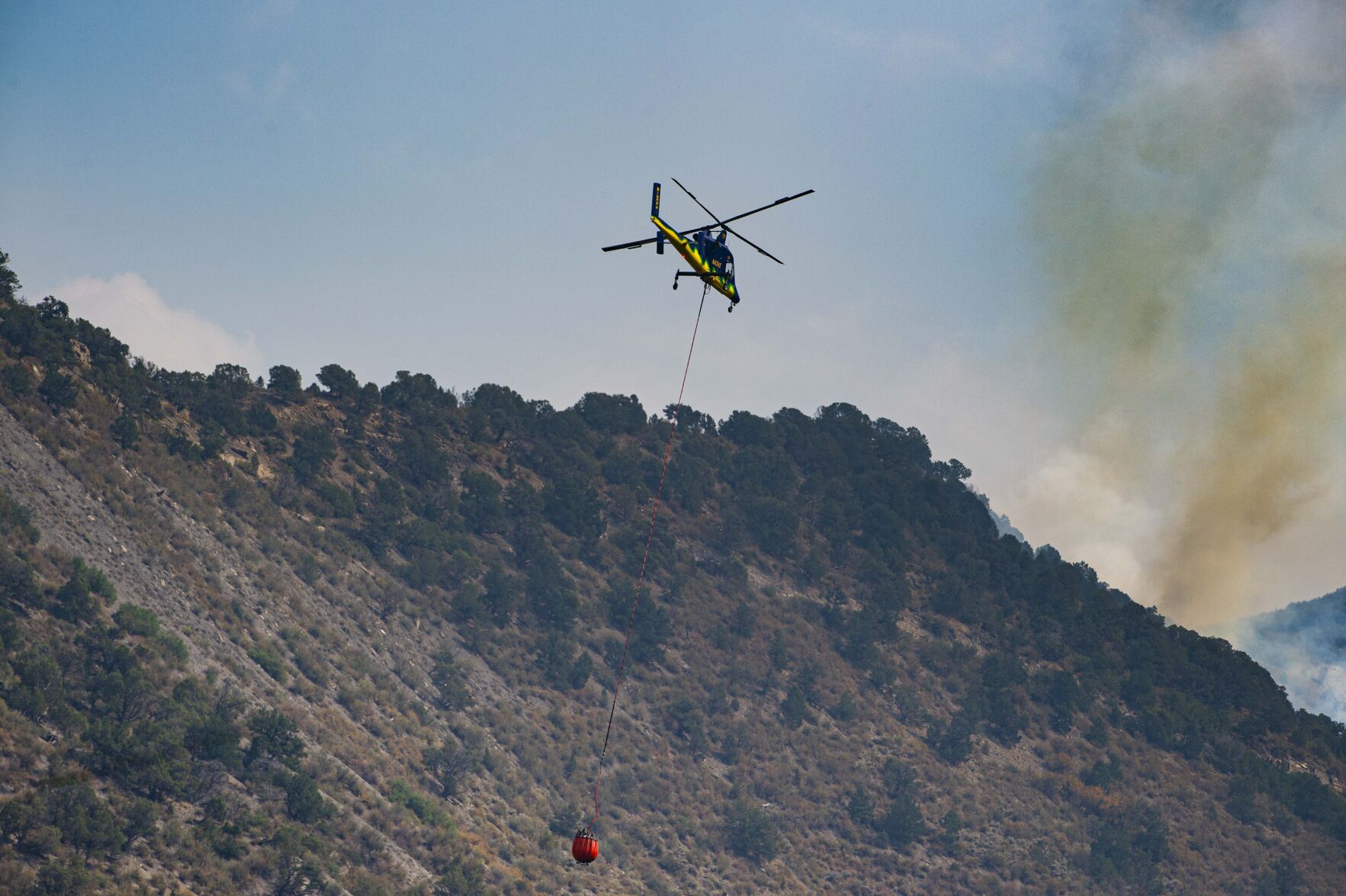
Once again, Colorado is a hot spot, with wildfires bedeviling us.
I got a look at the Pine Creek fire burning near Grand Junction when I arrived in town Aug. 8 for the start of a weeklong vacation at an old sheep camp in the mountains. Luckily, fire didn’t touch us high up. But the signs of drought were everywhere, from shrunken lakes to impossibly dusty roads.
Cell phone service was spotty but eventually I discovered that the Pine Creek fire had exploded in size, and Interstate 70 was closed due to the Grizzly Creek fire around Glenwood Springs.
So, like so many other drivers, when it was time to go home I detoured from Grand Junction to Delta to Montrose to Gunnison to Bailey and Fairplay and on into Denver. Beautiful, yes, but I felt like I was in the world’s largest slow-moving caravan of semis, campers and motorcycles.
The drive-through lines at fast-food restaurants in some towns were so long cars were idling in the streets, waiting for a chance to turn into businesses.
Water, wildfires, floods and droughts have always been the story of the West.
RELATED: Colorado Wildfires: A look at the fires burning in the state
The topics have been explored in award-winning books, including Wallace Stegner’s “Angle of Repose” and Timothy Egan’s “The Worst Hard Time.” Stegner’s description of driving wagons to Leadville on curvy mountain roads is unreal. And Egan’s look at the Dust Bowl and the Depression touches on southeastern Colorado’s history.
Those issues also are a staple for journalists, whether close to the fireline or interviewing the displaced at some high school gym, which so many of us have done over the years.
The High Park fire in Larimer County, the Buffalo Creek fire in Jefferson County, the 416 fire in La Plata County. The list goes on and on.
Whether man or Mother Nature sparks the fires, they routinely cause heartbreak and economic devastation.
Some fire stories will always stand out.
“Hell caught us” screamed the headline in the Rocky Mountain News in 1994 when 14 wildland firefighters perished on Storm King Mountain on the Western Slope. It was the nation’s worst wildfire tragedy in modern times as firefighters were trapped by 2,000-degree flames pushed by 45 mph winds.
The Waldo Canyon fire in 2012 forced the evacuation of residents in Colorado Springs, Manitou Springs, Woodland Park and elsewhere. El Paso County Clerk and Recorder Wayne Williams and his staff were counting votes the night of the primary election until fire officials evacuated county offices.
Waldo Canyon at the time was the most destructive fire in Colorado state history, as measured by the number of homes destroyed — until the Black Forest fire elsewhere in El Paso County surpassed it almost a year later.
I once told editors we needed to develop a template for reporters covering fires so all we had to do was fill in the blanks because often the stories sounded so much alike:
“(Name goes here) looked out the window and saw a plume of smoke (number of feet goes here) away. (He/she) grabbed photographs, prescription medications and (something else here) and fled the house( his/her) family had called home for (insert number here) years.
I wrote two very different fire stories just two days apart in 2000 when I covered the Hi Meadow fire in Jefferson County.
One was lighthearted:
If it’s the second Wednesday of the month, it must be “bunco” night for Dee Brown and 11 friends.
They haven’t missed an outing since they started meeting about eight years ago to play the dice game. But most of the players have been forced out of their homes and their routines by a raging wildfire.
Brown said “the girls” briefly debated holding their bunco sessions in a classroom at Conifer High School, which has been turned into a Red Cross shelter, but decided they might frighten other evacuees with their antics.
“It can get pretty exciting,” said Brown, 51, a secretary at the Colorado School of Mines. “We used to leg wrestle to break ties, although we haven’t done that in three years. We’re older, and we’ve gotten bad backs.”
The other story was heartbreaking:
Kathy Black joked and chatted as she navigated the winding mountain road Friday to where her dream home used to be. Black knew it was gone. She had known for a couple of days. Still, she had managed to maintain a cheerful outlook that amazed other evacuees.
But knowing and seeing are two different things.
Black stepped slowly from her white Chevy Blazer and stared at the charred ruins of her home in the forested Wandcrest Park subdivision.
“Oh, Mama. Oh, Mama,” the 38-year-old wailed as she collapsed in her mother’s arms. “I just thought there’d be something — anything — but it’s a pile. All the things I wrote, all the greeting cards I saved, nearly every picture I have — gone.
“Oh why, oh why, oh why.”
She stumbled to a blackened tree and threw up.
Two years later, the fire season was even worse. I got a call on a Sunday morning from an editor asking me if I could go to Glenwood Springs to cover the Coal Seam fire. I can’t, I told her. I had already committed to attending an event with Denver Mayor Wellington Webb and his wife, former state Rep. Wilma Webb, in City Park for the dedication of the new Martin Luther King Jr. statue.
As we sat in the folding chairs, ash accumulated on our clothing, our hair and the King statue. All the way from Glenwood Springs, I wondered? It turns out the ash was from the Hayman fire that was racing toward Denver from the south with frightening speed.
The blaze was one of seven burning statewide.
“All of Colorado is burning today,” Gov. Bill Owens said, to the dismay of tourism and eco devo types.
All of Colorado this year is under drought or abnormally dry conditions, for the first time in eight years. No wonder that has led to the grim news about expanding wildfires with no relief in sight.
At a recent news conference in Eagle, Gov. Jared Polis repeated the sentiments of governors before him and surely of those who will succeed him.
“It’s no question that this is a difficult time for Coloradans, especially those in the vicinity of the fires, and we appreciate our emergency first responders and public safety workers now more than ever,” he said.
“Colorado communities are struggling with the effects of severe statewide drought and have proven our resiliency time and time again, and I know this time will be no different.”


Immigration reporting measure fuels debate over Colorado’s role with ICE
Marissa Ventrelli
marissa.ventrelli@coloradopolitics.com
Updated 10 hours ago
A coalition of advocacy groups and several district attorneys rallied outside the Colorado Capitol on Thursday to oppose a ballot measure that, if approved by voters in November, would require state and local law enforcement to cooperate with federal immigration...

Colorado Politics Calendar Sept. 14-20
Rachael Wright, Special to Colorado Politics
rachael.wright@coloradopolitics.com
Updated 4 days ago
CoPo’s weekly political calendar will help you find political and public-policy events throughout Colorado. It includes candidate and issue campaign events, public policy meetings, court hearings, state and local party conventions, assemblies, debates, rallies, parades, speaking engagements, traveling dignitary appearances,...
The African roots of three Colorado leaders | SONDERMANN
Eric Sondermann
eric-sondermann@coloradopolitics.com
Updated 3 days ago
Colorado’s political transformation is measured in many ways. A once reliably red state (with asterisks) became purple and is now a rather deep blue. For better or worse, probably the latter, power is ever more consolidated along the Front Range...
Federal judge green-lights civil trial against ex-Fort Collins DUI officer
Michael Karlik
michael.karlik@coloradopolitics.com
Updated 1 day ago
A federal judge ruled on Thursday that Fort Collins’ former “DUI officer” will face a civil trial for allegedly investigating a motorist for impaired driving without any reasonable suspicion to do so. In recent years, several people arrested by Officer...

Denver police reopen 13 sex assault cases after retesting Missy Woods’ CBI work
Jenny Deam
jenny.deam@gazette.com
Updated 1 day ago
Thirteen previously closed Denver sexual assault cases have been reopened after the city’s crime lab retested DNA evidence once analyzed by former Colorado Bureau of Investigation forensic analyst Yvonne Woods. A police spokesperson told The Denver Gazette the once-closed cases...

Ballot measure aims to shift Colorado sporting goods tax revenue to land, water and wildfire projects
Marissa Ventrelli
marissa.ventrelli@coloradopolitics.com
Updated 10 hours ago
Colorado voters this November will decide whether to direct a share of sales tax revenue from sporting goods — including bicycles and skiing equipment — toward land and water conservation, wildfire prevention and expanding outdoor recreation. Supporters say the measure...

Colorado Supreme Court suspends Mesa County judge pending misconduct investigation
Michael Karlik
michael.karlik@coloradopolitics.com
Updated 12 hours ago
The Colorado Supreme Court suspended Mesa County Court Judge Michael J. Grattan on Thursday amid a misconduct investigation. The court’s Sept. 10 order gave Grattan 21 days to explain why his paid suspension should not continue through the end of...

Trump honors the fallen of the 9/11 terrorist attacks during Pentagon speech
Mabinty Quarshie
mabinty-quarshie@coloradopolitics.com
Updated 2 days ago
President Donald Trump and first lady Melania Trump honored the roughly 3,000 Americans killed during the Sept. 11, 2001, terrorist attacks during a ceremony at the Pentagon. The event marking the 25th anniversary of the deadliest attack on American soil...
Colorado Supreme Court changes course, dismisses case about special district bonds
Michael Karlik
michael.karlik@coloradopolitics.com
Updated 12 hours ago
The Colorado Supreme Court declined on Friday to decide a dispute between a large-scale Commerce City development and the various districts financing it, after initially showing interest in the ongoing case. Colorado has roughly 2,800 special districts, which are local...
Colorado leaders express outrage and pain following 9/11 attacks | A LOOK BACK
Rachael Wright, Special to Colorado Politics
rachael.wright@coloradopolitics.com
Updated 2 days ago
Twenty-Five Years Ago This Week: “Responding to the 9/11 terrorist attacks, Colorado Gov. Bill Owens told reporters in a statement, “I join all Coloradans in expressing outrage and horror at the senseless terrorist bombings in New York and Washington D.C....
PREV
PREVIOUS
Colorado Wildfires | A look at the fires burning in the state
Interstate 70 through Glenwood Canyon opened briefly Monday but closed again before re-opening Monday night as the Grizzly Creek fire flared up. Here’s a look at the size and other stats about Colorado’s wildfires, including the new Thorpe fire in Park County. Grizzly Creek fire Acres/Location: 30,719 acres/Glenwood Canyon Containment: 33% Started: Aug. 10, human […]
CU will retain scholar questioning VP nominee Harris’s citizenship
The University of Colorado will keep John C. Eastman in his position as a 2020-2021 Visiting Scholar in Conservative Thought and Policy, despite his asking whether U.S. Sen. Kamala Harris, D-Calif., who is a U.S. citizen, is eligible for the vice presidency given that she is the daughter of immigrants. “So before we so cavalierly […]