

State Supreme Court clears way for ballot initiatives on petitions, out-of-school learning

The Colorado Supreme Court has affirmed the ballot titles of two proposed initiatives that would impose far-reaching changes to the ballot initiative process itself and create an out-of-school learning opportunities agency through an unconventional funding mechanism.
Initiative 245, nicknamed the “Petition Rights Amendment,” would create the right to legislate by ballot initiative in most divisions of state and local government, and would impose a $3,000 fine on those who harass or obstruct petition circulators. Among the many modifications to the initiative process, the constitutional amendment would lower the number of signatures required to place an initiative on the ballot, remove technical affidavit errors as a reason to invalidate signatures, and give the state Supreme Court sole jurisdiction to hear protests of ballot titles.
Currently, the three-member Title Board entertains such challenges, with the high court being the appellate body of last resort. In accordance with state law, the Title Board determines if a measure pertains to a single subject and, if so, sets a title to appear before voters that is brief yet also encompasses all central features of a measure.
Initiative 245 was one of three similar versions of the amendment that received an at-times rocky reception before the Title Board. Objector Kelly Brough argued that the title omitted several important provisions.
“While concise titles are required, the scope of #245 and its revision to the lawmaking process that governs our government at all levels is undeniably enormous,” her attorney, Thomas M. Rogers III, wrote in the brief.
Designated representatives Natalie Menten and Donald L. “Chip” Creager III countered that they believed the board had already made the title too long by adding more detail than necessary.
“We face only a delay tactic about word choice,” they argued. “Stick to general topics, not details of interest only to lawyers and petition historians. The test is, ‘How does this affect Joe’s daily life, his rights, or his voting?’ Joe will never protest a petition, and has no interest in technicalities, legalese, and esoterica.”
Creager and Menten also called out one alleged inaccuracy in the language that the Title Board set and complained that the stay-at-home order during the pandemic – which they characterized as an “illegal confinement law” – abridged their constitutional petitioning rights. They asked the court to allow unlimited time for signature gathering to place measures on the November 2021 ballot.
Michael Kotlarczyk, assistant attorney general and counsel for the Title Board, defended the initiative’s title as a balance between listing all ways in which the law would change and giving voters a clear idea about what their yes or no vote would mean.
“It is notable that Petitioner thinks the Board erred on the side of too little specificity, while the Proponents believe the Board provided too much,” he observed.
Initiative 250, with designated proponents Chad Cookinham and Camille Howells, would create an out-of-school learning opportunities agency funded through donations that people could use to claim a new state income tax credit. However, to offset the loss of money to the state from the credit, the proposal would also limit the corporate net operating loss dedication, with the state setting the deduction rate as needed.
Objector Kenneth Nova through his attorney, Rogers, argued that since a limitation on a tax deduction amounts to an increase in taxes paid, the ballot title should include required tax increase language mandated by the Taxpayer Bill of Rights.
“Despite the fact that the measure will result in an annual nine-figure tax increase for Colorado corporate income tax filers, the Title Board concluded that the mandatory ‘shall [state] taxes be increased’ language of Section 3(c) of TABOR is not required for the measure,” Rogers wrote.
Benjamin J. Larson, on behalf of the proponents, responded that the interplay of the two tax provisions resulted in no net revenue gain to the state, and that Nova’s argument called for including the TABOR language “any time a single taxpayer or group of taxpayers will pay more under a proposed measure that otherwise reduces state taxes.”
Voters would not be misled into voting for a surreptitious tax increase, Larson contended, because “the Titles clearly and unambiguously describe the limit on the NOL deduction as offsetting state revenues lost from the new tax credit.”
The court affirmed both titles without elaboration.


Committee approves reworked version of previously vetoed rideshare bill
Marissa Ventrelli
marissa.ventrelli@coloradopolitics.com
Updated 2 hours ago
Members of the Colorado House Business Affairs and Labor Committee voted across party lines to pass a modified version of a bill establishing regulations on rideshare companies. Last year, Reps. Jenny Willford, D-Northglenn, and Meg Froelich, D-Englewood, introduced House Bill...
Fight over credit card ‘swipe fees’ attracts nearly 200 lobbyists in Colorado
Marianne Goodland
marianne.goodland@coloradopolitics.com
Updated 1 hour ago
One of the most expensive fights of the 2026 session got a little closer to being over on Friday, when the Colorado Senate took a second final vote on the proposal to eliminate “swipe fees” on sales taxes. It’s not...

Veto likely as union-backed bill heads to Colorado governor’s desk — again
Marissa Ventrelli
marissa.ventrelli@coloradopolitics.com
Updated 2 hours ago
For the second year in a row, a bill that would make it easier for labor organizations to impose fees on all workers, regardless of union membership, is headed for Gov. Jared Polis’ desk. The governor, who vetoed the legislation...

Aurora mental health nonprofit cuts 100-plus jobs after Colorado agency reduces reimbursement rate
Marianne Goodland
marianne.goodland@coloradopolitics.com
Updated 6 hours ago
A nonprofit that provides services through 11 mental health centers in Aurora announced Thursday that it is eliminating 111 jobs effective June 30, the result of federal and state budget reductions. Aurora Mental Health & Recovery said the positions being...
Denver law students create AI-powered tools in federal judge’s ‘design sprint’
Michael Karlik
michael.karlik@coloradopolitics.com
Updated 8 hours ago
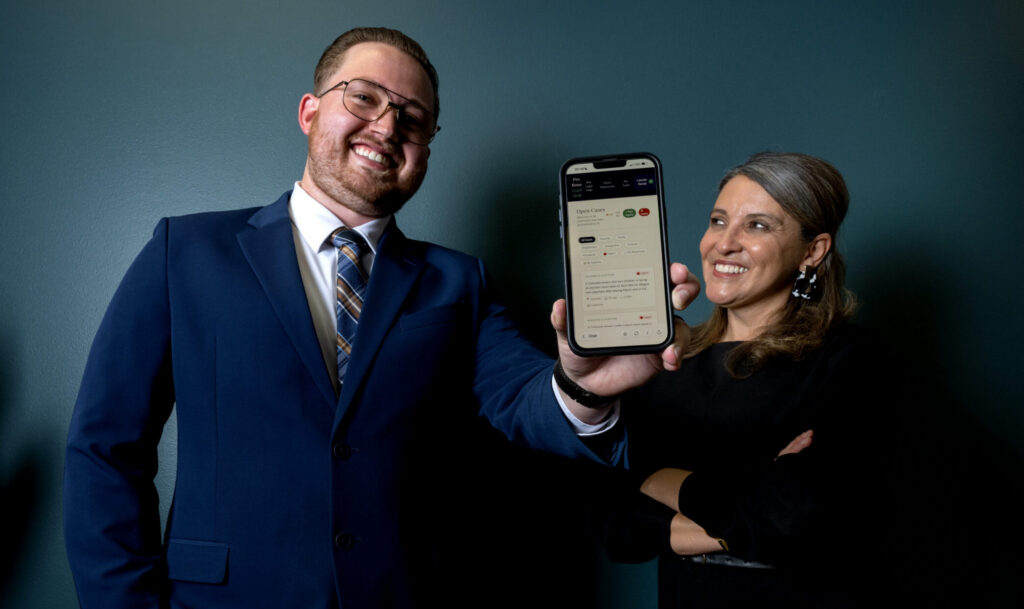
A tenant discovered a handwritten note on his door stating he had 48 hours to move out. The landlord changed the locks without notice or court proceedings. The tenant paid rent on time and had never received any complaints about...

Colorado space startup secures $650 million for expansion
alex-edwards
alex.edwards@gazette.com
Updated 1 day ago
The window to deliver space superiority for the U.S. is open but shrinking rapidly, according to defense startup True Anomaly. The Centennial-based company hit a milestone in its pursuit to help deliver that, announcing Tuesday that it raised $650 million...

Colorado bill prohibits credit card companies from charging ‘swipe fees’ on sales taxes
Marianne Goodland
marianne.goodland@coloradopolitics.com
Updated 23 hours ago
Colorado senators on Wednesday voted to advance a proposal to eliminate credit card “swipe fees” on sales taxes. Proponents say the move would save businesses tens of thousands of dollars annually, while critics have countered those fees are needed to...
First ever disciplinary trial of a Colorado judge scheduled under new system
Michael Karlik
michael.karlik@coloradopolitics.com
Updated 1 day ago
A disciplinary panel on Thursday scheduled a mid-August hearing to adjudicate the alleged misconduct of Montezuma County Court Judge Ian J. MacLaren. Following voters’ passage of constitutional Amendment H in November 2024, adjudication of serious judicial misconduct allegations is open to public...
Colorado eyes licensure, new oversight body for autism therapy providers
Marissa Ventrelli
marissa.ventrelli@coloradopolitics.com
Updated 22 hours ago
A panel of Colorado legislators on Wednesday approved a bill establishing a new regulatory body and licensure requirements for professionals who provide therapy for children on the autism spectrum, as well as for the facilities in which they work. House...
Appeals court recognizes weekend, holiday rule applies to judicial review deadline
Michael Karlik
michael.karlik@coloradopolitics.com
Updated 1 day ago
Colorado’s second-highest court clarified for the first time on Thursday that the rule extending deadlines in civil cases when the final day falls on a weekend or holiday also applies to litigants seeking review of governmental decisions. Nicholas A. Rigato...
PREV
PREVIOUS

Food workers’ union calls for expansion of mask requirement
The United Food & Commercial Workers Union Local 7, which represents approximately 22,000 workers in Colorado and Wyoming, is calling for Gov. Jared Polis to extend the public health order requiring grocery store employees to wear face coverings, and to make it apply to customers as well. “As you know, many localities and counties have […]

Denver to resume some parking meter enforcement June 1
After about two months of having just about all parking restrictions lifted in Denver as part of its response to the coronavirus pandemic, the city will begin reinforcing some of those parking restrictions as of June 1. The city’s parking fines are down nearly 18%, or about $1.2 million, year to date, according to Heather […]