

Garcia heading to federal court after Colorado Supreme Court rules she didn’t make primary ballot

Democratic U.S. Senate candidate Lorena Garcia says she’s taking her case to federal court after a Colorado Supreme Court decision Tuesday afternoon removed her from the state’s primary ballot.
In a brief, unanimous ruling the state supreme court declared that Garcia didn’t submit the required number of valid petition signatures to make the ballot. The order reversed last week’s Denver District ruling that found the candidate did well enough, considering the growing coronavirus pandemic.
The ruling leaves just two Democrats running to challenge Republican U.S Sen. Cory Gardner – former Gov. John Hickenlooper, who qualified for the primary by petition, and former state House Speaker Andrew Romanoff, the only candidate to emerge from last month’s state assembly.
Garcia’s place on the June 30 primary ballot is the latest domino to fall in a series of lawsuits involving candidates who argue they were prevented from finishing their petition drives as the COVID-19 outbreak was sweeping the state in the weeks before signatures were due.
On Monday, the supreme court kicked Democrat Michelle Ferrigno Warren off the primary ballot in response to an appeal filed by Secretary of State Jena Griswold. In a decision that served as the basis for the Garcia ruling, the high court said that the courts don’t have the authority to waive signature requirements set by the legislature, even in the face of an unprecedented public health emergency.
Garcia said late Tuesday that she decided to sue in U.S. District Court for a spot in the primary after consulting with campaign volunteers and supporters.
“My supporters across Colorado were loud and clear,” she told Colorado Politics in a statement.”It is our duty to fight this violation of our democratic process.”
Garcia said the Colorado legislature didn’t take petitioning candidates into account when lawmakers scrambled to pass emergency legislation in March to enable the political parties’ assemblies and conventions to proceed in the face of restrictions on public gatherings.
“[T]he Colorado state legislature failed in ensuring equal protection under the law when they had the chance to protect the public health of circulators and voters when COVID-19 struck Colorado. This violated the people of Colorado’s right to support their candidate,” she said.
Major party candidates can make Colorado’s ballot two ways – by receiving the votes of at least 30% of delegates at assembly or, in the case of statewide candidates, by turning in petitions containing 1,500 valid signatures from each of the state’s seven congressional districts, for a total of 10,500 signatures.
During a hurried couple of days before departing the Capitol, state lawmakers considered changing requirements for petitioning candidates but eventually only addressed the assembly route to the ballot in temporary, emergency legislation to let political parties convene remotely instead of having to nominate candidates at in-person meetings.
That could amount to violations of the First and 14th amendments – abridging freedom of speech and freedom of assembly for both voters and candidates, and interfering with the right of voters to choose candidates, in addition to violating an equal protection guarantee, according to Joy Athanasiou, Warren’s attorney, who told told Colorado Politics her client was considering pursuing the question in federal court.
A spokeswoman told Colorado Politics that Griswold is waiting to see what lands in the federal court.
“The Secretary of State’s Office recognizes the challenges posed by the coronavirus, and believes our democratic processes must ?remain accessible and fair during this trying time,” Betsy Hart, communications director for the Secretary of State’s Office, said in an email. “Once the case has been filed in Federal court, we will review and work closely with the Attorney General’s office to determine our next steps.”
Whatever the candidates do, they’ll have to do it quickly. Griswold is facing a Thursday deadline to certify the primary ballot to county clerks, who are required to send ballots to military and overseas voters by May 16.


Victor Marx says he’ll only debate Phil Weiser once in Colorado governor’s race — without a moderator
Ernest Luning
ernest.luning@coloradopolitics.com
Updated 6 hours ago
Colorado Republican gubernatorial nominee Victor Marx said on Tuesday that he will participate in only one debate with Attorney General Phil Weiser before the November election — and he challenged the Democratic nominee to hold the event without a moderator....
Independent gubernatorial candidate Greg Lopez, a former GOP congressman, qualifies for Colorado ballot
Ernest Luning
ernest.luning@coloradopolitics.com
Updated 1 day ago
Unaffiliated gubernatorial candidate Greg Lopez, a former Republican congressman from Elizabeth who left the GOP to run as an independent, has qualified for the ballot by submitting enough petition signatures, the Colorado Secretary of State’s Office said Tuesday. He’ll face...

Surprise candidate Shimon Blau cleared to face off against Melat Kiros in November
Ernest Luning
ernest.luning@coloradopolitics.com
Updated 5 days ago
Unaffiliated congressional candidate Shimon Blau, a Denver doctor, has qualified by petition for the general election in Colorado’s 1st District, where Democrat Melat Kiros defeated 15-term U.S. Rep. Diana DeGette in last month’s primary, the Colorado Secretary of State’s Office...
Victor Marx, GOP candidate for governor, faces 100-plus campaign finance complaints
Marianne Goodland
marianne.goodland@coloradopolitics.com
Updated 2 days ago
Victor Marx’s gubernatorial campaign has been hit with more than 140 campaign finance complaints, although most have been consolidated by the state’s election office because they follow similar alleged violations. Marx faces Attorney General Phil Weiser, who won the Democratic...

Jefferson County to fill commissioner vacancy after Dahlkemper tapped for lieutenant governor
Matt Kyle
matt.kyle@denvergazette.com
Updated 6 days ago
Democratic gubernatorial nominee Phil Weiser on Wednesday announced that Jefferson County Commissioner Lesley Dahlkemper would be his lieutenant governor, meaning she would be leaving her commissioner seat open should he win the race in November. However, Dahlkemper’s term was already...
Democrat Phil Weiser names Jeffco Commissioner Lesley Dahlkemper as his gubernatorial running mate
Ernest Luning
ernest.luning@coloradopolitics.com
Updated 1 week ago
Colorado Attorney General Phil Weiser, the Democratic nominee for governor, on Wednesday named Jefferson County Commissioner Lesley Dahlkemper to be his lieutenant governor running mate in the general election. Calling her “someone who can be a governing partner,” Weiser said...
Democrat John Hickenlooper hauls in $1.3 million in 2nd quarter in Colorado’s U.S. Senate race
Ernest Luning
ernest.luning@coloradopolitics.com
Updated 2 weeks ago
U.S. Sen. John Hickenlooper’s reelection campaign raised just over $1.3 million in the year’s second quarter and finished the period with $2 million in the bank, leaving the first-term Democrat with nearly 80 times as much cash on hand as...

Campaign launched to redirect $1 billion in TABOR refunds to education
Marissa Ventrelli
marissa.ventrelli@coloradopolitics.com
Updated 1 week ago
A coalition that includes the state teachers’ union on Tuesday launched a campaign for a ballot proposal that would reduce more than $1 billion in taxpayer refunds and spend the money on education. The measure is among several campaigns taking...
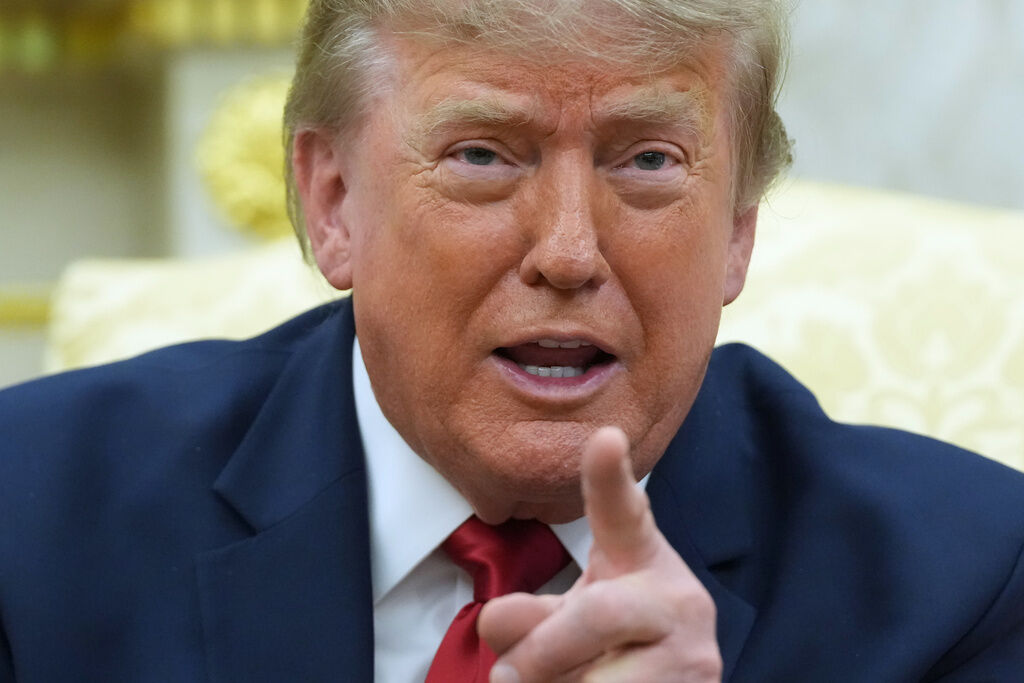
WATCH: Trump speaks on elections in primetime address
The Associated Press
the-associated-press@coloradopolitics.com
Updated 2 weeks ago
WASHINGTON (AP) — President Donald Trump will deliver a primetime address Thursday that he says will include a focus on elections. The speech comes as he’s escalated calls for Republicans to pass tighter federal voting rules for November’s midterm elections....

Signatures submitted to cap Colorado’s income tax rate
Marissa Ventrelli
marissa.ventrelli@coloradopolitics.com
Updated 2 weeks ago
The group behind a ballot measure aiming to cap the state’s income tax at the current rate has submitted signatures from voters to election officials for review, part of the tug and pull in Colorado between opposing political forces fighting...
PREV
PREVIOUS
Colorado Supreme Court declines to hear state GOP's appeal in legislative primary case
The Colorado Supreme Court on Tuesday declined to consider an appeal filed by the state Republican Party that sought to reverse a lower court ruling the GOP argued could flood the courts with political disputes. The announcement lets a lower court decision stand, leaving state Rep. Larry Liston, R-Colorado Springs, as the lone candidate on […]

COVER STORY | The plan for sports wagering to be a salvation is thrown a curve
The proposition was supposed to be simple: legalize and tax sports betting, fund the state water plan and solve a critical growth problem for Colorado. In the dealer’s choice of taxing and spending, everybody wins. There are, however, no sure bets in politics and policy. “The playbook has kind of gone out the window,” said […]