

Seven of Colorado’s Democratic US Senate candidates plan to petition onto primary ballot
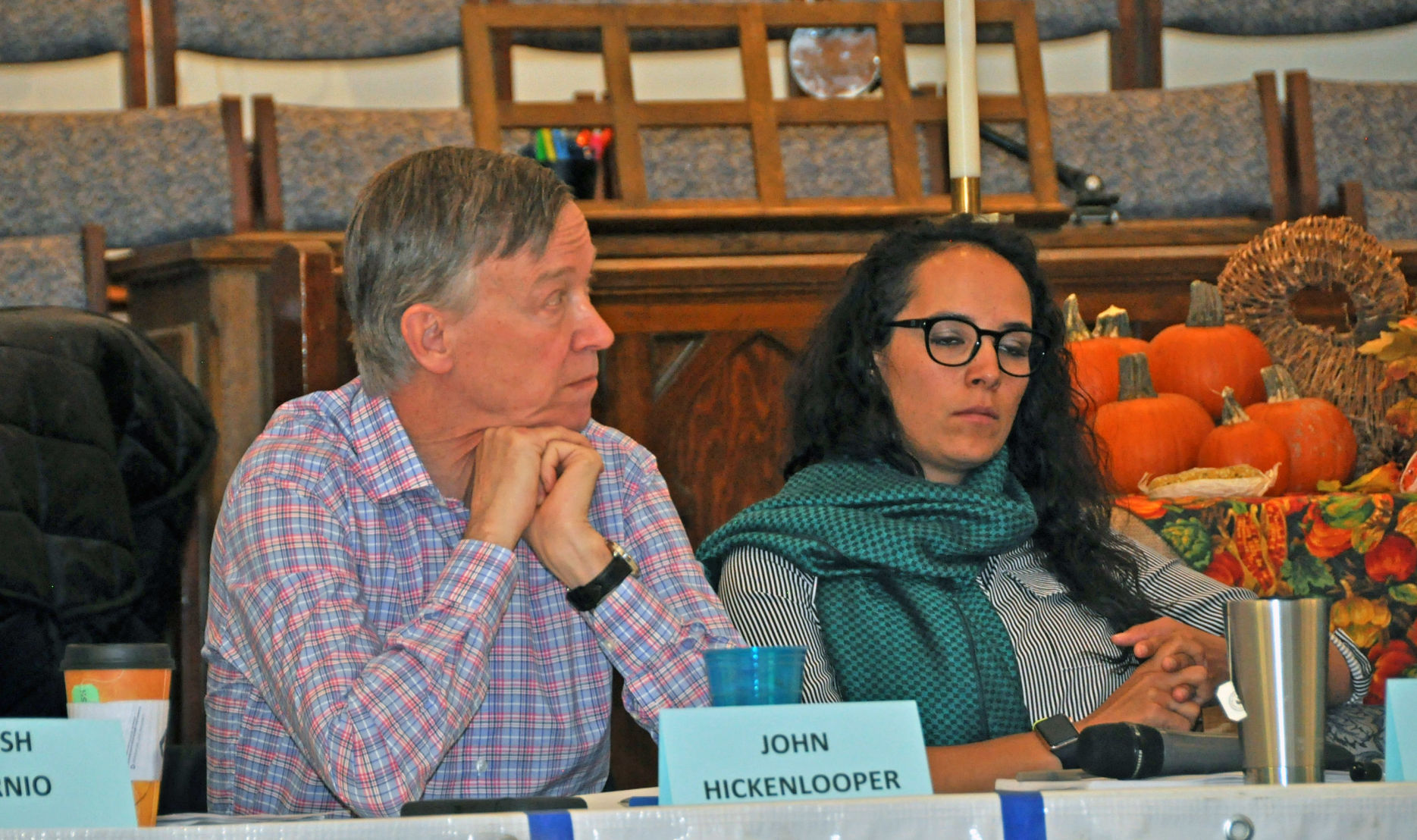
Seven of the 10 Democrats running for Colorado’s U.S. Senate seat plan to circulate petitions to land spots in the June primary — potentially setting up a crowded ballot for the chance to challenge U.S. Sen. Cory Gardner, the Republican incumbent.
Most of the candidates pursuing the nomination by petition say they’re relying on volunteers to gather the required 10,500 valid signatures — 1,500 from each of the state’s seven congressional districts — rather than planning to spend as much as the $450,000 strategists say a statewide petition drive could cost this year in Colorado.
The primary’s frontrunner, former Colorado Governor John Hickenlooper, and the newest candidate in the race, former gubernatorial candidate Erik Underwood, however, say they’re hiring petition circulators in addition to using volunteers to gather signatures.
Democrat John Hickenlooper hauls in $2.8M in 4th quarter for Colorado Senate bid
Petitions are due to the Colorado Secretary of State’s office by March 17.
The Democrats who have gotten the OK from state officials to start gathering signatures this week are Hickenlooper, nonprofit director Lorena Garcia, climate activist Diana Bray, immigration rights activist Michelle Ferrigno Warren and author Christopher “Critter” Milton, a candidate who has filed to run for the seat but hasn’t done much active campaigning in the year since the race began in earnest.
Underwood and another recent entrant to the primary, University of Denver professor David Goldfischer, haven’t yet had their petition formats approved by the secretary of state but told Colorado Politics that’s in the works.
Trump amplifies GOP attacks on Hickenlooper over spending to defend against ethics complaints
Garcia told Colorado Politics her petition drive is on track, with more than 20 trained circulators and more on the way. A campaign spokeswoman said Thursday that she’s already collected signatures in every congressional district.
Garcia said she’s “excited for the many volunteers who have committed to circulating petitions.” She added: “We are very confident that those choosing the caucus route will know that there is already a candidate on the ballot who has built a statewide grassroots coalition needed to win.”
Bray said she realizes a statewide petition is a heavy lift but is confident it’s something her campaign’s network can accomplish.
“I have an incredible team of volunteers,” she said. “I’ve been focusing for the last several months how to generate the team to do this.”
Democrat John Hickenlooper plans to circulate petitions and go through caucuses to get on US Senate primary ballot
Two of the petitioning Democrats — Hickenlooper and Underwood — say they’re also planning to go through the caucus and assembly process, which means there will be five candidates asking for support at the party’s March 7 precinct caucuses.
Candidates can qualify for the June 30 primary by winning the support of 30 percent of delegates at the Democrats’ state assembly, scheduled for April 18 this year at the Colorado Convention Center in Denver. The delegate selection process starts at caucuses.
The other candidates going through caucus are former state House Speaker Andrew Romanoff, women’s studies professor and former congressional candidate Stephany Rose Spaulding and scientist Trish Zornio.
Candidates aren’t bound to one method or the other and can switch from petitioning to the caucus route, or vice versa, as the campaign progresses.
Marianne Williamson backs Andrew Romanoff as 'progressive champion' in Colorado's Democratic U.S. Senate primary
Bray, a first-time candidate, said she decided to go the petition route because she didn’t think caucusing made sense for “people who have never been in the political arena before.”
“It is something quite novel that we’re trying to do, but that’s what my whole campaign has been about. For an underdog, long-shot candidate, petitioning with volunteers is the only pathway,” she said.
“You don’t have to be a mathematician to realize that caucusing will only work for, at most, three people, and if one candidate gets 40% at assembly, then only two can make it onto the ballot,” Bray said.
“There are 10 of us running for the Democratic primary. Caucusing is not, for me, a pathway that I see would be a winning pathway.”
Colorado Politics Must-Reads:


10th Circuit grants Boulder-Weld district’s fire chief immunity for firing union leader
Michael Karlik
michael.karlik@coloradopolitics.com
Updated 7 hours ago
The Denver-based federal appeals court decided on Monday that the chief of a fire protection district spanning Boulder and Weld counties could not be held liable for terminating a union leader through the process outlined in the collective bargaining agreement....
Michael Allen says a weakened justice system, rising crime drove him to run for attorney general
Thelma Grimes
thelma.grimes@coloradopolitics.com
Updated 6 hours ago
Michael Allen said he is running for attorney general because he believes Colorado’s criminal justice system has been weakened by recent legislation and that rising crime is directly increasing the cost of living. A Navy veteran and longtime prosecutor, Allen...

Colorado House ethics committee delays hearing to allow Rep. Lindsay to seek legal counsel
Marianne Goodland
marianne.goodland@coloradopolitics.com
Updated 10 hours ago
The Colorado House ethics committee voted Monday to pause the ethics complaint against Rep. Mandy Lindsay while she seeks legal counsel. The hearing was scheduled to begin with two days of testimony, during which Lindsay could present evidence and call...

State Supreme Court oral arguments, 10th Circuit nominee recuses from cases | COURT CRAWL
Michael Karlik
michael.karlik@coloradopolitics.com
Updated 4 hours ago
Welcome to Court Crawl, Colorado Politics’ roundup of news from the third branch of government. The state Supreme Court will hear its last set of oral arguments this week before breaking for the summer, and the nominee for a vacancy...
‘Peaking at the right time’: Barbara Kirkmeyer is confident as ballots go out
Thelma Grimes
thelma.grimes@coloradopolitics.com
Updated 6 hours ago
Calling 2026 an “interesting” year, Sen. Barbara Kirkmeyer said the race for the Republican nomination has taken her from a “bizarre debate” to a broader effort to maintain the party’s integrity, while making the case that she’s ready to lead...
Sheehy calls for Rubio to take over Iran negotiations if Vance can’t swing it
Claire Carter, Washington Examiner
claire.carter.washington.examiner@gazetteedit.wpenginepowered.com
Updated 12 hours ago
Sen. Tim Sheehy (R-MT) on Monday suggested Secretary of State Marco Rubio should be waiting in the wings to handle negotiations with Iran if Vice President JD Vance can’t get a long-term agreement with Tehran over the finish line. Vance...
Rural frustration, parental rights shape Scott Bottoms’ pitch ahead of Colorado’s gubernatorial primaries
Thelma Grimes
thelma.grimes@coloradopolitics.com
Updated 6 hours ago
With just weeks before Colorado’s June primary, Republican gubernatorial candidate state Rep. Scott Bottoms is spending nearly all his time on the road — literally crisscrossing the Western Slope and eastern plains — in a final push to connect with...

Appeals court adopts federal standard for jail deaths under Colorado law
Michael Karlik
michael.karlik@coloradopolitics.com
Updated 4 hours ago
Colorado’s second-highest court decided last month that the standard used by federal courts for assessing whether government officials may be liable for constitutional violations upon the death of a jail detainee also applies to claims made under the Colorado Constitution....

District court judges weighing Trump policies face repeated slap downs by appeals courts
Kaelan Deese, Washington Examiner
kaelan.deese.washington.examiner@gazetteedit.wpenginepowered.com
Updated 12 hours ago
Federal district court judges reviewing President Donald Trump’s immigration agenda and other contested policies are increasingly being checked by appeals courts, raising questions as to whether some members of the federal judiciary are implementing the law or seeking partisan ends....
Registered voters on the eve of the 2026 primaries | Cronin & Loevy
Tom Cronin Bob Loevy
tom-cronin-bob-loevy@coloradopolitics.com
Updated 2 days ago
The Colorado Secretary of State’s Office has published the latest voter registration figures for the state and its counties as of June. Colorado ranks among the highest states for independent, or unaffiliated, voters. Only Alaska and Massachusetts have more. New Hampshire, New Jersey, Maine and Oregon also rank highly. So here...
PREV
PREVIOUS

Adams County launches housing survey
Adams County is undertaking a housing needs assessment and is asking for residents to give feedback about their housing decisions. “Adams County receives funding from the Department of Housing and Urban Development and is conducting a study to better understand residents’ housing decisions and experiences living and working in the county and its cities,” the […]

Colorado National Guard celebrates 160th anniversary
The Colorado National Guard turns 160 years old on Thursday, dating to the territorial legislature’s establishment of two citizen-soldier military companies on Jan. 23, 1860. Within the United States, the Colorado National Guard has assisted in various natural disasters, including the 1864 flash flood of Cherry Creek in present-day Denver. Additionally, the organization once helped […]