

Colorado lawmakers carve out room for full-day kindergarten in proposed budget

The influential Joint Budget Committee gave its endorsement Tuesday to funding full-day kindergarten by next fall, but doing so could require “tightening our purse strings” and not funding other initiatives, lawmakers said.
Funding full-day kindergarten is a top legislative priority of Colorado Gov. Jared Polis, who campaigned on making it available in every district at no cost to families. Many education advocates also rallied behind the idea.
Colorado currently reimburses school districts for a little more than half the amount it pays for older students, and many districts charge parents tuition of several hundred dollars a month to make up the difference. Other districts cover the cost out of their general budgets, with federal funds for high-poverty schools, or with dedicated local taxes. Some districts only offer half-day kindergarten.
Members of the budget committee and other Democratic lawmakers repeatedly expressed concern about the broader budget impacts of paying for full-day kindergarten in one year, without a phase-in.
Nonetheless, as Joint Budget Committee members finalized their proposed state budget this week, they voted 5-1 to set aside $185 million for full-day kindergarten, with the implementation plan to be laid out in a separate bill expected to be filed this week.
That’s about 80 percent of the $227 million for kindergarten in Polis’ January budget request. The larger amount would have covered every eligible kindergartener. However, the governor has said kindergarten attendance will remain voluntary. Budget committee members decided to set aside an amount that assumes not all eligible students will enroll.
“We all understand and agree that full-day kindergarten is a great policy,” said state Rep. Daneya Esgar, a Pueblo Democrat and vice-chair of the budget committee. “We think our kids deserve that. We know that early childhood investments go a long way, and we figured it was time to figure out a way to come through and really fund this.
“But we wanted to fund this in a way that made sense for the first year.”
Right now, about 50,000 kindergarten students – roughly 80 percent – attend full-day programs and another 13,000 attend half-day programs. Eventually, education advocates and Polis hope that most children will attend full-day programs. Students who attend full-day kindergarten enter first grade more prepared and tend to have better academic outcomes.
The budget committee has not yet made a decision on $25 million for implementation costs that the governor requested or on 3,000 new preschool slots, another priority of Polis’.
Funding full-day kindergarten should free up as many as 5,000 preschool slots in the Colorado Preschool Program, funds from which are currently being used for kindergarten.
“We can’t do both,” state Sen. Rachel Zenzinger, an Arvada Democrat, said of the preschool slots.
Zenzinger has been one of the most critical voices on the kindergarten question, despite ultimately voting yes for the budget set-aside. She said kindergarten is important, but it might not deserve to “go to the front of the line” when many other needs, from special education to services for aging Coloradans, also need more money.
Immediately after agreeing to the kindergarten money, committee members approved a series of cuts to programs that they had previously agreed to fund. They face more tough decisions before finalizing the budget, which will get introduced in the Senate on Monday.
“We are tightening our purse strings,” Esgar said.
The no vote came from state Rep. Kim Ransom, a Douglas County Republican, who said she is concerned about the long-term sustainability of funding kindergarten.
The proposal will be funded by additional revenue generated by rising property values. With local school districts bringing in significantly more property tax, the state doesn’t need to backfill as much revenue. The governor’s budget director has predicted that property tax revenue will be stable at least through 2021.
And after that?
“I want to be hopeful,” Esgar said. “I want to be hopeful.”
This story was originally published by Chalkbeat, a nonprofit news organization covering public education. Sign up for their newsletters here.


Bennet, Hickenlooper to vote against Trump’s 10th Circuit nominee from Colorado
Michael Karlik
michael.karlik@coloradopolitics.com
Updated 5 hours ago
Colorado’s two Democratic senators will not vote to confirm President Donald Trump’s nominee to a vacancy on the Denver-based federal appeals court. Trump has selected U.S. District Court Chief Judge Daniel D. Domenico, who he appointed as a federal trial...
Who’s spending in Colorado to get your vote?
Marianne Goodland
marianne.goodland@coloradopolitics.com
Updated 1 hour ago
Groups that raise unlimited amounts of money have spent about $20 million in May and June to try and influence Colorado voters’ choices in the upcoming June 30 primaries. By law, these groups cannot coordinate with the candidates they support....

U.S. government declines to oppose multiple challenges to immigration detention in Colorado
Michael Karlik
michael.karlik@coloradopolitics.com
Updated 4 hours ago
Multiple federal judges in Colorado granted petitions from people challenging the lawfulness of their immigration detention this week after the government took the unusual step of declining to submit arguments in opposition. Colorado’s federal trial court is facing a flood of...

Tina Peters tells supporters to ‘stand up and fight back’ at Castle Rock event
Marissa Ventrelli
marissa.ventrelli@coloradopolitics.com
Updated 4 hours ago
Tina Peters, the former Mesa County clerk recently released from prison, warned supporters that what happened to her could happen to them, too, if they did not “stand up and fight back” at an event at the Douglas County Fairgrounds....

Iran strikes cargo ship in Strait of Hormuz, endangering Trump’s peace
Christian Datoc
christian-datoc@coloradopolitics.com
Updated 10 hours ago
Iran attacked a cargo ship traveling through the Strait of Hormuz on Thursday, possibly upending President Donald Trump‘s diplomatic end to the war with Iran. A U.S. official confirmed to the Washington Examiner that the Islamic Revolutionary Guard Corps “struck...

Senate GOP tries to mend fences with Trump after heated lunch
David Sivak
david-sivak@coloradopolitics.com
Updated 8 hours ago
Senate Republicans are trying to turn the page on a heated lunch with President Donald Trump that brought weeks of tensions to a new high-water mark. In a symbolic gesture, Senate Republicans took another vote on the Iran war Wednesday...
Colorado justices discuss solution to confusion from prior criminal ruling
Michael Karlik
michael.karlik@coloradopolitics.com
Updated 2 hours ago
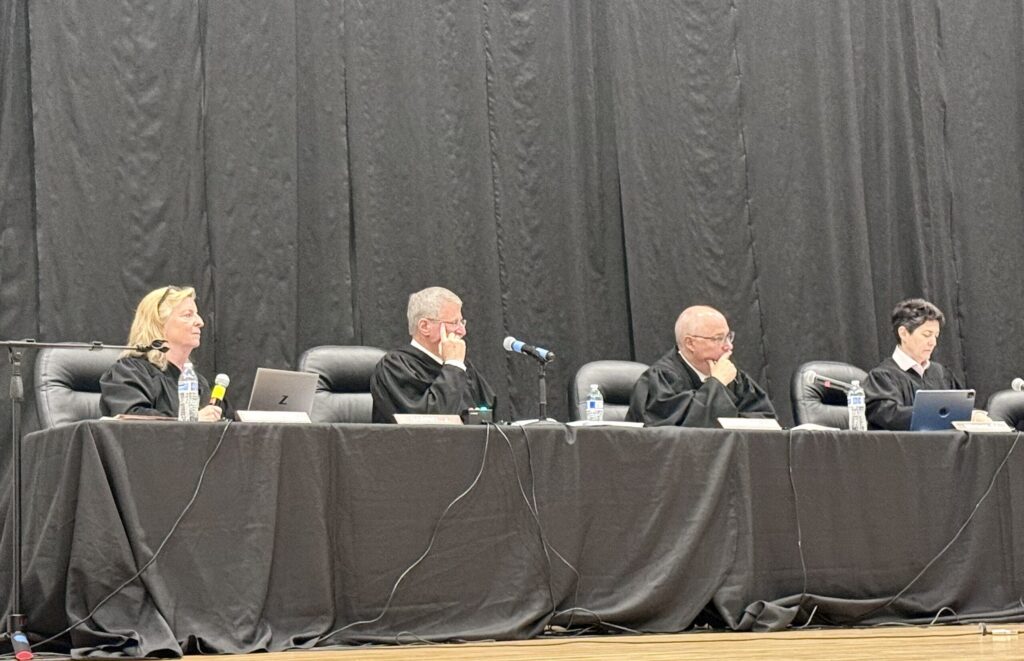
The Colorado Supreme Court pondered the fallout on Tuesday from its nearly six-year-old decision interpreting the state’s impaired driving laws, with the justices now addressing how defendants affected by the legal change must seek postconviction relief. In contrast to other...

Colorado to participate in Great American State Fair in Washington
Marissa Ventrelli
marissa.ventrelli@coloradopolitics.com
Updated 8 hours ago
Visitors to Washington, D.C. for the country’s 250th anniversary will have the opportunity to learn about Colorado’s natural beauty and culture during the Great American State Fair, a World’s Fair-style event that opened Thursday at the National Mall. While all...

RTD to reconsider service priorities as cuts, budget deficit loom
Michael Braithwaite
michael.braithwaite@gazette.com
Updated 12 hours ago
Should the Regional Transportation District aim to maximize ridership or system coverage? That question sat at the heart of the RTD Board of Directors’ first Comprehensive Operations Analysis briefing on Thursday afternoon. With the Denver transit agency facing a budget...

Mobolade, Colorado Springs leaders say election date lawsuit is attack on local voters
Brennen Kauffman
brennen.kauffman@gazette.com
Updated 11 hours ago
Mayor Yemi Mobolade and other city leaders will fight to keep Colorado Springs elections in April in the face of a new lawsuit. Mobolade, the mayor’s Chief of Staff Wayne Williams and City Councilmember Roland Rainey addressed the lawsuit in...
PREV
PREVIOUS

US official declares drought plan done for Colorado River
FLAGSTAFF, Ariz. – Seven states that rely on a major waterway in the U.S. West have finished a yearslong effort to create a plan to protect the Colorado River amid a prolonged drought, the federal government declared Tuesday. U.S. Bureau of Reclamation Commissioner Brenda Burman commended Arizona, California, Nevada, New Mexico, Utah and Wyoming for […]

Campaign finance reform group endorses Democrat Jason Crow's re-election bid
A national campaign finance reform group on Wednesday endorsed U.S. Rep. Jason Crow, the first-term Aurora Democrat who unseated a Republican incumbent last year while refusing to accept contributions from corporate political action committees. End Citizens United, a political committee devoted to reducing the role of big money in politics, included Crow and 25 other […]