

Colorado budget writers finally advance what they hope is a final proposal
State budget writers on Thursday finally got to working out differences between House and Senate versions of the annual spending plan, leaving in tact several key amendments.
Efforts to fund a survey given to students remained in the estimated $26.8 billion budget, along with using marijuana money to support housing and homeless services.
Budget writers also reconciled an issue that arose when lawmakers passed amendments that would have cut salaries for judges. The legislature had intended on eliminating a proposed 3.15 percent raise for judges, which would save about $2.2 million, but it passed too many amendments, which would have resulted in a cut. After the Joint Budget Committee’s work, those salaries would remain flat.
Budget writers also preserved an amendment that would fund implementation of Proposition 106, which allows terminally ill patients to request medication that would end their life.
And the committee allotted $750,000 to help fill nine vacant oil and gas inspector positions.
An issue that saw some of the most chatter from the JBC dealt with a proposal to reduce revenue generated by the Hospital Provider Fee by $264 million. The move would negatively impact hospitals, especially in rural parts of the state, with some hospitals saying they would close. But it is necessary to balance the budget.
The House backed an amendment that would add a footnote to the budget encouraging the state to limit Hospital Provider Fee expenditures for administrative functions in order to apply the savings to support rural hospitals. But budget writers said they had to strip the proposal.
“We clearly have some rural hospitals who are in trouble, and the attempt here is a noble attempt to put aside some money for hospitals that might otherwise close,” said Rep. Bob Rankin, R-Carbondale, a member of the JBC. “We discovered this is probably not doable … But I do want to acknowledge the intent here.”
Budget writers were unable to move forward with reconciling differences between the two versions of the budget because House Democrats had held up passage of several budget “orbital” bills that are part of the package.
Democrats in the House wanted to wait on the bills, which included the Hospital Provider Fee reduction and cutting General Fund transportation spending, as separate bills around a restructuring of the Hospital Provider Fee and transportation funding made their way through the process. Had the bills passed, lawmakers might have been able to spare the cuts to hospitals.
The transportation funding bill died, and the Hospital Provider Fee restructure is facing an uphill battle as conversations continue to see complications. The House moved the orbital bills forward this week, allowing the Joint Budget Committee to continue its work on passing a balanced budget.
The budget heads back to the legislative chambers to approve the Joint Budget Committee’s work before it can head to Gov. John Hickenlooper, a Democrat, for his signature. Conversations around the budget this year have been more drawn-out than in years past, according to Capitol observers.
Hickenlooper’s office made the marijuana money for homeless and housing a priority. The money was at first not included in the budget, but lawmakers amended it. The original proposal called for $16.3 million for housing and homeless services, but budget writers on Thursday lowered that to $15.3 million. It’s still a major win for the governor.
Democrats were also able to convince Republicans to support $40,000 to provide female prisoners with better access to tampons.
The Healthy Kids Colorado Survey, a voluntary anonymous survey that serves to collect information on youth trends, saw heated opposition from a handful of Republicans when the amendment was debated in the two chambers. But the JBC ultimately voted 4-2 to keep the money in the budget, over objections from Sen. Kevin Lundberg, R-Berthoud.
When it came to film incentives, lawmakers met in the middle. The Senate had proposed eliminating incentives meant to attract the film industry to Colorado, while the House had proposed $1.5 million. The JBC settled on $750,000.
Meanwhile, a controversial Democratic amendment that would have prohibited the attorney general from suing a local government on behalf of a private corporation, was stripped from the so-called “Long Bill.” The proposal took aim at Republican Attorney General Cynthia Coffman, who filed a lawsuit against Boulder County over its oil and gas drilling moratorium.
Despite the troubled budget, the proposal reflects a nearly 7 percent increase in discretionary spending over the current fiscal year. Budget writers carved out about $10.6 billion for the General Fund, which represents discretionary spending. The total budget would reflect a more than 4 percent increase over the current fiscal year.


Elizabeth School District dismisses challenge to book-ban injunction on eve of appellate arguments
Michael Karlik
michael.karlik@coloradopolitics.com
Updated 8 hours ago
An Elbert County school district has dismissed its challenge to a judge’s injunction ordering it to return banned books to library shelves, days before the Denver-based federal appeals court was set to hear oral arguments this week. Although a three-judge...

Colorado farmers warn U.S. Sen. John Hickenlooper tariffs and research cuts endanger agriculture
Marianne Goodland
marianne.goodland@coloradopolitics.com
Updated 10 hours ago
Northern Colorado farmers told U.S. Sen. John Hickenlooper this week that tariffs and President Donald Trump’s decision to import $40 billion worth of beef from Argentina have hurt Colorado’s agricultural industry. But the administration’s cuts to scientific research are almost...
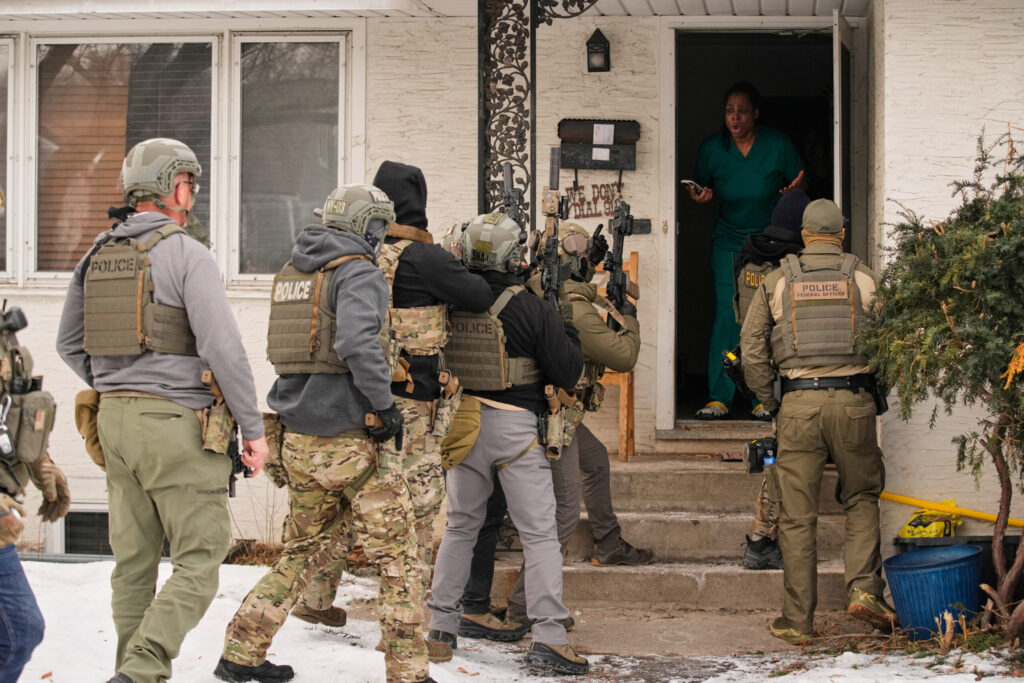
‘Doesn’t do enough’: House Democrats reject GOP deal on cutting ICE funding
Rachel Schilke, Washington Examiner
rachel.schilke.washington.examiner@gazetteedit.wpenginepowered.com
Updated 9 hours ago
House Democratic leaders are planning to oppose a bipartisan homeland security funding bill set for a vote this week, even after Republicans agreed to cut funding for Immigration and Customs Enforcement. A source familiar with House Minority Leader Hakeem Jeffries’s...

Vance heading to Minneapolis amid Trump’s ICE crackdown
Christian Datoc, Washington Examiner
christian.datoc.washington.examiner@gazetteedit.wpenginepowered.com
Updated 13 hours ago
Vice President JD Vance will deliver remarks and visit with ICE agents in Minneapolis Thursday, as President Donald Trump continues his immigration crackdown in the state. The vice president has been a critical messenger for the administration combating public opposition...

Gov. Polis, Democratic lawmakers introduce trio of housing affordability bills
Marissa Ventrelli
marissa.ventrelli@coloradopolitics.com
Updated 9 hours ago
Democratic lawmakers were joined by housing advocates and Gov. Jared Polis at the Capitol on Wednesday to announce a trio of bills they say will increase affordable housing in Colorado. “This session, Colorado Democrats are focused on lowering costs, and...

Colorado Supreme Court to hear cases on insurance coverage for COVID, witness credibility
Michael Karlik
michael.karlik@coloradopolitics.com
Updated 10 hours ago
The Colorado Supreme Court announced on Tuesday that it will decide the degree to which a virus or other hazard must affect a commercial property before it can trigger loss-or-damage coverage under an insurance policy. At least three of the...

Colorado halts wolf releases for 2026 as federal pressure mounts
Marianne Goodland
marianne.goodland@coloradopolitics.com
Updated 11 hours ago
Colorado Parks and Wildlife, facing mounting criticism from the Trump administration over its management of the wolf reintroduction program, announced Wednesday they will not bring in any new wolves to the state for the 2026 winter season. CPW was turned...

Colorado wildlife officials report first wolf death of 2026 as mortality count reaches 13
Marianne Goodland
marianne.goodland@coloradopolitics.com
Updated 11 hours ago
Colorado Parks and Wildlife announced late Monday that another British Columbia female gray wolf, known as 2504-BC, was found dead in northwest Colorado on Friday. No cause of death nor an exact location of where the wolf was found was...

Trump’s threats challenge Europe’s security and prosperity, EU chief says ahead of summit
Lorne Cook
lorne.cook@associatedpress.com
Updated 18 hours ago
BRUSSELS (AP) — U.S. President Donald Trump’s threats to annex Greenland and impose tariffs on its backers pose a challenge to Europe’s security, principles and prosperity, European Council President António Costa said on Wednesday. “All these three dimensions are being...
Federal judge says prisoner cannot sue for dog-bite injury
Michael Karlik
michael.karlik@coloradopolitics.com
Updated 19 hours ago
A federal judge concluded last week that a man cannot sue the government for injuries he sustained when a dog allegedly attacked him while he participated in a prison program. Kenneth M. Chandler, representing himself, was participating in the “FIDOS”...