

Point/counterpoint: Should the Democratic Party abandon identity politics?
The results of the 2016 election stunned Democrats who were sure they had a lock on the U.S. presidency and possibly a take-back of the Senate. Reality hit, and Democrats had decisions to make. Critics and analysts postulated that Democrats’ emphasis on minorities and identity politics were to blame.
Wikipedia defines identity politics as “a tendency for people of a particular religion, race, social background, etc., to form exclusive political alliances, moving away from traditional broad-based party politics.”
In Boston in mid-November, Sen. Bernie Sanders, I-Vt., said, “One of the struggles that you’re going to be seeing in the Democratic Party is whether we go beyond identity politics.”
Doing so is not just a matter of party survival but of survival as a democratic-based country. Republicans successfully lured Democrats into making minority issues a focus. During his campaign, President-elect Donald Trump promoted divide and conquer as a solution to American woes. Build a wall to keep out the Mexicans. Ban Muslims and set up a registry for those here. Insult women about their looks so men don’t have to compete with them. Mock the disabled to show your superiority. The underlying message was an emphasis on male white racial preservation, a topic exploited fully by the alt-right movement with a wink and a nod from Republicans.
Progressives took the bait and, in their effort to support minority rights, forgot their traditional values of inclusiveness. They allowed the more encompassing issues of income inequality, rising health care costs, stagnating wages and the impact of globalization on American jobs to fade from the political conversation, as Republicans had hoped would happen. Democrats fought the wrong enemy and ignored the economic and cultural concerns of rural America.
It may be difficult for Democrats to go beyond the traditional minority issues because helping those who can’t help themselves has been the cornerstone of the progressive policy. Job, education and health problems fall harder on minorities. There’s no need to abandon these concerns. By raising the entire ship, everyone benefits.
Broad-based solutions such as improved education would improve job opportunities for all, not just minorities. It would also encourage critical thinking, which improves decision-making about lifestyle, health care, housing, education and jobs as well as about candidates and political issues. By strongly addressing the needs of the working class and small businesses, Republicans will be less successful in convincing them that minorities are the problem. An educated populace can then recognize when laws are being made that are not in the best interests of all. Democrats can move from being the party of minorities to the party of all working families.
Voters should not take their eye off the ball, either. Conservatives would like nothing better than to watch voters argue about minority rights. Then while no one is looking, Republicans will quietly change the rules in their favor. Then the U.S. becomes an oligarchy, ruled by a select wealthy few.
Identity politics is criticized by the right and the left, but we need identity politics, even if under a different name. I suggest “civil rights.”
Conservatives use the expression “identity politics” pejoratively to describe any politics recognizing the role of race and gender in relation to power and justice. It is perceived as focusing attention on specific, narrow issues, such as Black Lives Matter or feminism, but it actually represents a broad, inclusive political framework.
Some leftists call for a political atmosphere recognizing class politics rather than so-called identity politics. They argue Democrats need to win back white working-class voters by addressing wealth and income inequity. In a sense, they are arguing for a different form of identity politics, one in which economic class is the primary identity.
Often, the policies of so-called identity politics – whether Black Lives Matters, the fight for equal pay or gay marriage rights – are economic in nature. Therefore, identity and class politics are not mutually exclusive. Democrats are capable of recognizing a plurality of issues.
Civil rights are for everyone. So-called identity politics is really the fight to ensure everyone is afforded civil rights. To bring about civil rights for everyone, we must first identify who is in danger of losing rights and who is oppressed.
Policies have disproportionate effects on specific vulnerable groups of people. We need to recognize those effects. Without identity politics, gay people would not yet have the opportunity to marry the person they love. People of color would still be consigned to separate drinking fountains or riding in the back of buses.
Women would not be allowed to vote. There would still be quotas on the number of Jewish people attending universities.
Identity politics should be distinguished from special interests because identity politics is focused on a larger theme or civil rights. Our country has not always allowed everyone the freedoms we cherish, but our country’s greatest strength is our ability to recognize injustice.
We are a singular group. We are all Americans. We need terminology that unites us.
The phrase “identity politics” fractures the populace. We should replace it with “civil rights.” Progressives should call oppression and discrimination what they are; we should use more honest terms to describe our politics. We do not need a redefinition of progressive values. Rather, we need a restatement of our values. We should remember our concerns affect people’s lives and are not mere talking points. We should strengthen our message regarding family values and history of building a strong economy.
The Democratic Party maintains an equitable outlook toward American society. The progressive vision is one that recognizes an optimal society with an emphasis on civil rights and superior socioeconomic conditions for the citizenry.
Lynne Bliss is a published author and the board president of Woodmen Hills Metropolitan District in Falcon. Summer Westerbur is president of Kairos Insurance Group and a founding member of the Colorado Springs Feminists.


Denver Mayor Peña makes unexpected announcement | A LOOK BACK
Rachael Wright
rachael.wright@coloradopolitics.com
Updated 3 days ago
Thirty-Five Years Ago This Week: Denver Mayor Federico Peña announced personal news that caught many of his supporters and Denver residents who paid close attention to politics off guard. Just two weeks prior on Nov. 16, 1990, The Colorado Statesman...

Julie Gonzales’s long but not impossible odds | SONDERMANN
Eric Sondermann
eric-sondermann@coloradopolitics.com
Updated 3 days ago
Allow me to start with a flashback. It was Thanksgiving 2024, just over 12 months back. For the first time, our son Clarke hosted the family Thanksgiving near New York City. It is a sign of our aging when the...

Performers announced for 14th Klezfest | NONPROFIT REGISTER
Thelma Grimes
thelma.grimes@coloradopolitics.com
Updated 19 hours ago
MIZEL MUSEUM JCC DENVER Denver News: Klezfest 2025, which takes place Dec. 20, will feature performances by a host of popular Jewish entertainers: Rabbi Joe Black and Steve Brodsky; Hal Aqua & The Lost Tribe; Mishmish and Gora Gora Orkestar. Rabbi Black is a pioneer of contemporary Jewish music and has...

Colorado commission makes new access-to-justice recommendations after renewed listening tour
Michael Karlik
michael.karlik@coloradopolitics.com
Updated 6 hours ago
Adding judges to handle caseloads. Expanding authority for paraprofessionals in civil cases. Allowing self-represented litigants to file electronically. Making the judiciary’s website user-friendly. Those were among the recommendations advanced by the Colorado Access to Justice Commission in a report released Friday,...

Trump targets Colorado AI law with executive order, setting stage for legal fight
Marianne Goodland
marianne.goodland@coloradopolitics.com
Updated 10 hours ago
Colorado’s 2024 effort to regulate artificial intelligence is facing a direct challenge from the Trump administration. President Donald Trump signed an executive order on Thursday to block states from enforcing their own AI laws. Trump also announced the creation of...

Colorado residents face high energy bills after regulators turn away from natural gas, experts say
Mark Samuelson Special to The Denver Gazette
mark.samuelson@denvergazette.com
Updated 12 hours ago
Colorado residents could be paying a lot more for home energy, following the state’s decision last week to turn away from natural gas as a home cooking and heating fuel, experts said. Some 1.9 million Colorado households warm their homes...
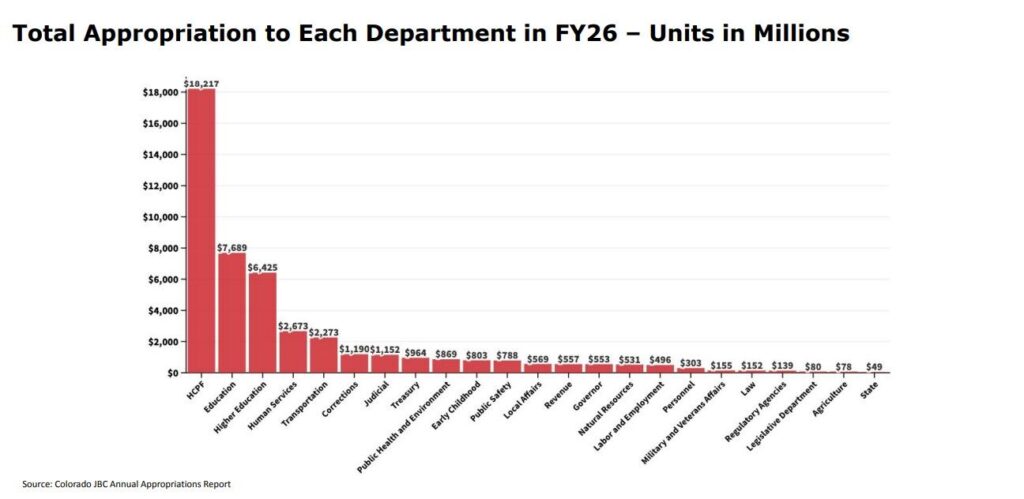
Colorado’s government spending has outpaced inflation, analysis finds
Marissa Ventrelli
marissa.ventrelli@coloradopolitics.com
Updated 18 hours ago
Colorado’s per-person spending has increased by 31% over the last two decades despite slowed population growth, according to a new analysis by the Common Sense Institute. The annual report compares state spending by department over the last 20 years, tracking...

OMB directs AI vendors seeking government contracts to measure their model’s political bias
NAOMI LIM Washington Examiner
naomi-lim-washington-examiner@coloradopolitics.com
Updated 18 hours ago
The White House Office of Management and Budget has amplified President Donald Trump‘s actions regarding artificial intelligence by directing AI vendors to measure and disclose political bias in their models when seeking contracts with the federal government. OMB Director Russell...
Abrego Garcia vows to ‘fight’ against Trump administration as judge prohibits further detention
David Zimmermann Washington Examiner
davidzimmermannwashingtonexaminer@wpstage.coloradopolitics.com
Updated 18 hours ago
Kilmar Abrego Garcia vowed to “fight” against the Trump administration on Friday, one day after a federal judge ordered Immigration and Customs Enforcement to release him from custody. The once-detained Salvadoran national appeared outside an ICE field office in Baltimore,...

House Republicans want to show voters they can get things done. Can they?
Kevin R. Kosar, Washington Examiner
kevin.r.kosar.washington.examiner@gazetteedit.wpenginepowered.com
Updated 18 hours ago
The House has spent much of the last two months of this year trying to catch up on its work. It passed 22 bills in one recent day and held 13 committee meetings and hearings the day after. All told,...