

Lawmakers aim to shed light on some judicial branch records
If the public wants to know how much the governor’s office or the Legislature spends on ink toner or Post-it notes, they can probably find that out.
But good luck obtaining information on how much money the state spends on court cases.
That’s because the state’s judicial branch is not subject to open records laws. But a bipartisan group of lawmakers is hoping to change that.
Three lawmakers held a Capitol press conference Tuesday to announce their plans to introduce a bill next year aimed at providing the public with more access to financial and personnel records of the Judicial Department.
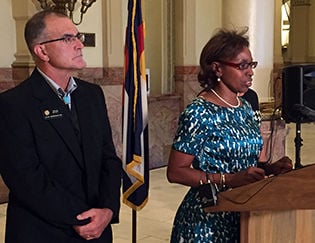
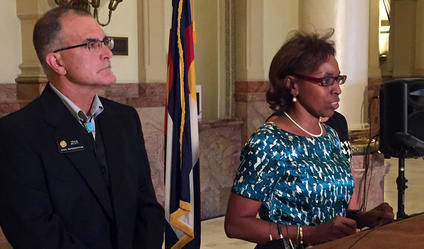
State Rep. Yeulin Willett, R-Grand Junction, listens as state Rep. Rhonda Fields, D-Aurora, speaks in support of legislation that would expand public access to records of the state judicial branch at a press conference on Sept. 22 at the State Capitol. Photo by Vic Vela/The Colorado Statesman

“This bill, plain and simple, is about transparency,” said Rep. Rhonda Fields, D-Aurora.
The proposed bill, which is still in the early drafting phase, would require the judicial branch to adhere to the Colorado Open Records Act, which makes most state records available to the public.
The executive and legislative branches of government are required to comply with CORA. But a 1999 Supreme Court decision exempts the judicial branch from open records rules. A Court of Appeals case from 2012 resulted in a similar decision.
Public information requests made to the Judicial Department are routinely denied. That has frustrated lawmakers who want to know whether state dollars are being spent wisely, including inside the state’s public defender’s office.
Fields used the recent Aurora theater shooting trial as an example. James Holmes received free legal representation from a public defender for his death penalty case. Holmes was convicted on several counts of murder and will be spending the rest of his life in prison.
“I’d like to know how much that trial cost the taxpayers,” Fields said.
Fields was asked about her personal connection to this issue. Her son was murdered in 2005 and his killer was represented by public defenders. Fields suspects the public defender’s office had more resources available at that trial than the prosecution but admits she “can’t validate that because I don’t have access to that information.”
A judicial panel is currently in the process of crafting its own set of rules regarding open records policy. But some are skeptical of that process.
“The legislative branch is tasked with crafting legislation, and it’s the duty of the judicial branch to interpret those laws, not create their own,” said Rep. Polly Lawrence, R-Roxborough Park, who plans to co-sponsor the legislation with Fields.
Many court records are protected from public view in part because of confidentiality concerns. Lawrence said her legislation would protect privileged information from being released.
“We understand the need to protect confidential and protected information and recognize the judicial branch has circumstances that may warrant greater protections,” she said. “However, these circumstances should not give the judicial branch blanket confidentiality over all of its operations, and we need to correct this imbalance in the upcoming session.”
Lawrence and Fields co-sponsored legislation last year that would have made records from the public defender’s office and the alternative defense counsel office subject to CORA. That measure died following a House Judiciary Committee hearing earlier this year.
“(Next) year, we are looking at the entire judicial branch to make sure the custodian of any personnel records has clear direction on what can and cannot be released,” Lawrence said.
It’s important for lawmakers to know how each state department spends money, Fields said. She said after the press conference that if resources are not being spent wisely by one department, they could be better spent in other areas, like education.
Rep. Yeulin Willett, R-Grand Junction, who will also help introduce the bill, said greater access to judicial records can help lawmakers determine which areas need to be addressed during the budget process.
“There is a financial tsunami, if you will, in the state,” Willett said. “There’s a number of ways to deal with that and certainly, as a fiscal conservative, a key one is to look at are areas where there’s perhaps not the most efficient spending and where we might be able to trim the budget to help with other programs. We can’t do so without more information.”
A public comment hearing on the judiciary branch’s proposed open records rules is scheduled for Oct. 1 inside Supreme Court chambers.
The Colorado Press Association, Colorado Broadcasters Association and the Colorado Freedom of Information Coalition have expressed concerns that whatever rules the judicial panel comes up with might not satisfy the public’s right to know.
“We have been monitoring the situation carefully and have serious concerns that the proposed rules do not provide the public with adequate access to information the public deserves to examine,” a CPA letter to its members reads.
— Twitter: @VicVela1

Colorado measure adding ID checks to mail-in voting qualifies for ballot
Marissa Ventrelli
marissa.ventrelli@coloradopolitics.com
Updated 6 hours ago
A ballot initiative that would require voters to include additional information on mail-in ballots has qualified for the November election, according to the Secretary of State’s Office. Backed by El Paso County Treasurer Chuck Broerman and former Deputy Secretary of...
Colorado election website error exposes personal data of confidential voters
Marissa Ventrelli
marissa.ventrelli@coloradopolitics.com
Updated 7 hours ago
A system update accidentally lifted protections on confidential records in Colorado, exposing dozens of voters’ personal information, according to the Secretary of State’s Office. The limit that normally blocks access to confidential voter profiles was inadvertently disabled during an update...
PUC adds weekly comment after killing private talks
Scott Weiser
scott.weiser@gazette.com
Updated 7 hours ago
The Colorado Public Utilities Commission will take public comment at the start of every commissioner’s weekly meeting beginning Sept. 9 as part of its new transparency mandate, the commission announced, expanding a slot previously limited to the second Wednesday of...
10th Circuit overturns framework for sentencing probation violators by 11-1
Michael Karlik
michael.karlik@coloradopolitics.com
Updated 8 hours ago
In a rare decision by all 12 of its full-time judges, the Denver-based federal appeals court ruled in a lopsided vote on Friday that one of its members created a sentencing process for probation violators that was out of step...
Federal judge dismisses excessive force lawsuit against Colorado Springs, officer
Michael Karlik
michael.karlik@coloradopolitics.com
Updated 7 hours ago
A federal judge concluded last week that a Colorado Springs police officer could not be held liable for shooting a suspect three times after the man menaced two victims with a gun and fled the scene. Al’morion Germany was involved...
DeFlock started from one man’s curiosity — now Flock cameras are a midterm issue
Claire Carter
claire.carter@washingtonexaminer.com
Updated 11 hours ago
Will Freeman wasn’t looking to start a national movement when he launched DeFlock after noticing Flock Safety’s automatic license plate readers along the side of the road. The software engineer was driving across the country in 2024 when the cameras...

Aurora student journalist cleared of disciplinary charges after ignoring ‘gag order’
Kyla Pearce
kyla.pearce@gazette.com
Updated 8 hours ago
A Community College of Aurora student who accused the college of putting an “unconstitutional gag order” on his student-run publication was cleared of disciplinary charges against him. CCA student Andrew Green tried to register his independent student publication, called “FoxTalk,”...
Colorado leaders cheer court decision to block Trump’s mail ballot order in a ruling that’s likely to be swiftly appealed
Thelma Grimes
thelma.grimes@coloradopolitics.com
Updated 9 hours ago
A federal judge on Thursday halted — at least for now — attempts to implement President Donald Trump’s executive order that seeks to restrict the mailing of ballots to American citizens on an eligible voters list. The move stalled the...

Healthcare Freefall: AI arms race hits rural healthcare as hospitals fight to keep up
Thelma Grimes
thelma.grimes@coloradopolitics.com
Updated 13 hours ago
Editor’s Note: Colorado’s healthcare system is entering a period of accelerating instability — a “tsunami,” as multiple leaders describe it — driven by collapsing hospital finances, shrinking Medicaid reimbursements, disappearing services and a political fight over who is responsible for...

House will vote to denounce socialism
Lauren Green
lauren-green@coloradopolitics.com
Updated 15 hours ago
The House of Representatives is set to vote next week when lawmakers return to condemn and denounce “socialism in all its forms,” specifically pointing to the growing Democratic Socialists of America organization. The House voted to condemn socialism last year,...
PREV
PREVIOUS

Hudson: Republican debaters seem to live in a different country
Denver Democrats assembled at the Irish Snug on East Colfax last Wednesday night to monitor round two of the Republican slugfest intended to help winnow its ample field of Presidential candidates. A handful of diehards arrived from home after viewing the four “one-percenters” who failed to qualify for the main event. Louisiana Gov. Bobby Jindal, […]
Letter: Bennet should sponsor animal antibiotics legislation
Editor: We are quickly losing the effective use of antibiotics, one of the most effective tools in our medical arsenal. This crisis has occurred because antibiotics are routinely added to the feed of animals raised for food. These antibiotics are often the same ones that humans utilize, and the bacteria that survive their journey through […]