

Hancock: Denver’s chief marketer
Making his way from a crowded Tech Center hotel ballroom, where he had just declared Denver “the most economically vibrant city in the United States today,” Mayor Michael Hancock stopped to talk with a half dozen friends and admirers, some buttonholing him for a few moments as he sped through the hallways — he’s known for staying on schedule, his days divided into strict 15-minute increments — and others pressing items in his hands. “Michael!” they cried as he rounded a corner, broad grins and high fives in abundance.
The bustling exuberance accompanied Hancock as he embraced hotel workers and stopped to pose for a couple of snapshots. Outside, slipping into the black SUV that ferries the mayor around town — last year it logged 60,000 miles — Hancock smiled and shook his head. “This is my life, one event to the next.”
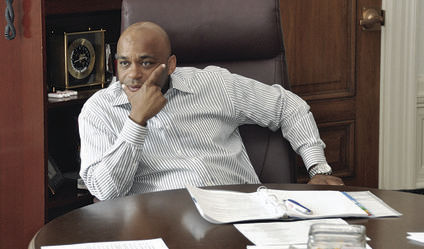
Denver Mayor Michael Hancock conducts a meeting with staff on May 29 at a side table in his office at the City and County Building.Photos by Ernest Luning/The Colorado Statesman

The Colorado Statesman spent the day with Hancock last Friday, tagging along as he delivered a commencement address in the morning, spoke to an organization that supports economic growth among minorities and women, and met with staff to consider boards and commission appointments and to finalize plans for next month’s inauguration.
Hancock’s day starts early, often before dawn, when drivers pick him up at his home — about as far as anyone can live from city hall and still be within city limits, in “farthest Green Valley Ranch,” an aide quipped — about 45 minutes before the day’s first scheduled event. Sometimes he’ll stop for a workout on the way into town, though usually he’s on the phone between stops.
Only Tuesdays and Sundays are similar week to week, he noted. On Tuesday, the day is filled with meetings with the city council president and with other council business, and Sundays are nearly always left unscheduled, allowing for “some down time, rest, recovery and church,” he said.

Denver Mayor Michael Hancock discusses board and commission appointments with aide Anthony Aragon on May 29 in his office at the City and County Building.

“There isn’t a day that’s the same, which makes this job pretty exciting. There are a lot of moving parts, anything from 20 to 25 meetings or events a day,” he said.
Back on I-25 last Friday, as the mayor neared downtown, he took a break between making phone calls to reflect on the speech he had just given and one delivered that morning at the commencement ceremonies for Emily Griffith High School and Emily Griffith Technical College at the Colorado Convention Center. Last year, his staff counted, Hancock delivered some 750 speeches, sometimes four or five a day. The man who calls himself Denver’s chief marketer said that inspiring people, explaining what the city is doing, is a key part of his job. “It’s 80 percent of what I do,” he said.
He’s got a story to tell.
Hancock, who was elected to a second term without serious opposition last month, took office four years ago, when Denver was still suffering in the throes of the Great Recession. Unemployment was flirting with double digits, the city budget out of balance by tens of millions of dollars, and city employees were facing their third or fourth round of mandatory furloughs.

“We are sitting in the most economically vibrant city in the United States of America today,” Denver Mayor Michael Hancock tells the Mountain Region Business Economic Summit luncheon in his keynote address on May 29 at the Denver Marriott Tech Center..

Last week, a Realtor.com ranking again pegged Denver as the hottest home-buying market in the country, and businesses are flocking to set up shop in the city. Even though some 100,000 people have moved to Denver in the last decade, the unemployment rate is at 3.7 percent, technically lower than what qualifies for full employment, meaning there are more jobs than there are workers.Hancock enumerated more of the economic indicators in his speeches.
“Twenty-two hundred companies moved to our city over the last four years,” he told the Mountain Region Business Economic Summit luncheon in his keynote address. “We are getting demands from as far as Beijing and Shanghai, Bombay, Johannesburg, by businesses that are intrigued by what’s happening in the Mile High City.”
Talking about the pace of real estate development — Denver leads the nation in construction jobs, he noted — Hancock laughed. “We’ve had more cranes in the air than actual birds,” he said.

Ezra Frazier hands an edition of the Original African Heritage Study Bible, King James version, to Hancock as he departs the luncheon.

Asked whether he could have imagined the kind of economic turnaround Denver has experienced four years ago, when the city council veteran was running in a crowded field of mayoral candidates, he laughed. “No,” he said, and laughed again. “We knew there was going to be some heavy lifting, some tough decisions that would be made. But the fact we kept moving forward as a city put us in the place we are today.”
Among those tough decisions, he said, was hiring a police chief from outside the city’s department and asking voters to allow the city to keep revenue over TABOR limits. DeBrucing the city enabled Denver to invest in infrastructure, restore libraries to full-time hours, and increase services for children, a particular passion for Hancock.
“All those things have been part of the ecosystem in turning the city around,” he said. “We decided we would become more aggressive in the marketplace, selling the city. We’re going to be a partner with the private sector. They’re going to be making sacrifices, they’re the ones putting people to work. We’re going to be helping them do that.”
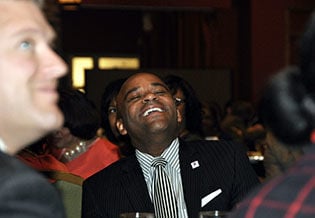
Denver Mayor Michael Hancock laughs as former Mayor Wellington Webb jokes, “When he was running for mayor, we used to tell him, ‘I know you wanted to be first, but being second is all right too,” at the Mountain Region Business Economic Summit luncheon.

It’s a piece of the puzzle Hancock described in his commencement address, delivered to some 2,000 graduates, family members and friends of Emily Griffith students.
“I consider myself the chief marketer of Denver,” he said, reeling off a similar list of cities around the world that might need a nudge to consider a move. “It’s really the hopes and dreams and efforts of the graduates who are in this room who I am banking on to stand behind my words.”
“You see, I must tell companies and investors that, when they get here, they will find the best-prepared workforce anywhere in the United States right here in Denver, Colorado. I must say that, and I must believe that.” Hancock said he trusts the faculty and staff at Emily Griffith to do just that. “Every one of you plays an integral role in making this city and this region prepared to compete on a global stage. We take your skill-sets around the world.”
Then the mayor offered some advice to the graduates: “Nobody who is going to be anybody gets to be somebody by being normal.”Sounding more and more like the Baptist deacon he is, Hancock exhorted the graduates.
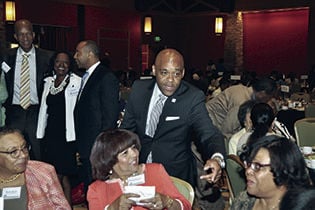
Hancock greets friends as he arrives to deliver the keynote address at the Mountain Region Business Economic Summit luncheon at the Denver Marriott Tech Center.

“You do no good shrinking, so that others can feel empowered, so that others can shine,” he said. “The reality is this — it doesn’t matter where you start. The real power is where you end up.” Casting his gaze across the crowd, he said he saw hundreds of stories facing him.
“Some of you may have come from the most challenging backgrounds. Some of you may have left high school before you had a chance to walk across that stage and get that diploma. Some of you may have had a child early. Some of you may have had to leave home just to find yourself. Doesn’t matter where you start, it really only matters where you end up. You’ve taken the bold step to not be normal,” he said.
Adapting a phrase from Dr. Martin Luther King, Hancock told the graduates, “If you’re going to be a cosmetologist, be the best cosmetologist there ever was. If you’re going to be a chef, be the one they talk about every day — people walk in the room just to see you.” Finally, circling back to his marketing pitch, he concluded, “Go forth and be the very best you have. You see, I have a selfish motive for you doing that, because, when you’re the best, I can go to London, Tokyo, Johannesberg, South Africa, and I can tell them in Denver, in Colorado, throughout the region, you’ll find the very best of the best.”
While he boasted with equal vigor about Denver’s roaring economy in his speech to the MRBES luncheon, Hancock’s point was slightly different.
“At a time when we are seeing the most unprecedented growth in this city’s history — not only population, but economically,” Hancock said, “if we let this unprecedented opportunity escape us without finding ways for communities and businesses of color to engage their piece of the pie, then shame on us.” He pointed to an executive order he signed last year that requires businesses to tell the city what they do with minority businesses before doing business with Denver. “Diversity must be a value, not a program, he added.
“The message,” he concluded, “is gird up, think outside the box. Dirt is golden. Find a way to own it and then find a way to develop it. It’s a new day in Denver. We shall not let this opportunity pass without finding ways to level the playing field. We’ll do our job; now, entrepreneurs, you’ve got to do yours.”

As his SUV heads toward the Tech Center on Interstate 25, Denver Mayor Michael Hancock makes a phone call to a nonprofit leader on May 29 in Denver.

After the speech, Hancock mused about how he went almost completely off script at the luncheon, where he was introduced by former Mayor Wellington Webb and former state Rep. Wilma Webb — the organization bestowed five WiLMAs at the summit, the acronym for its Women in Leadership and Management Award only a slight stretch — and several speakers joked about how glad they were they didn’t have to follow Hancock at the podium. (The only sure-fire way to compete with Hancock as a speaker, one said, is to end your speech by shouting, “Go Broncos!”)
While he shows up to every event with prepared remarks, Hancock said, he’ll often customize his address depending on the audience. “The script may give me a framework,” he said. His staff does research, provides background information, “But when I get there, the audience, the tone, the tenor, the levity might send me in a different direction or give me a reason to interject something once I’m there.”That’s what happened at the MRBES event, he said later.
“We’ve got a great story. One of the things we talk about in the city is the opportunity to extend it to everyone,” he said. “When you get into groups like minority and women’s organizations, they want to hear that we have an opportunity. I recognize that, I’m a person of color. It’s easy for me to say things a white mayor might not be able to say. I can say, ‘This is important, you’ve got to get outside the box, you’ve got to challenge yourself, decide I’m going to be there and be a player here.’”
Even the growing pains Denver is experiencing — some, including several new city council members, say the city is growing too fast, developing without regard to existing neighborhoods — somehow fit under Hancock’s marketer-in-chief role.
“I think people love this city and the neighborhoods they live in, and anything that might appear to disrupt that — it’s like anything, we don’t want it around us,” Hancock said. “This city is growing, people want to live here. It means we’ve turned a corner, the age and demographics of our neighborhoods are changing. With that, we’ve got to find a balance. We should not develop haphazardly, there must be thematic consistency in neighborhoods; but we’re also going to obey the law and protect property rights and use-by rights, and find that balance. We can do that as a city. This growth has come no us very quickly. I don’t know many cities that are going to be as prepared for it as they should, but we’re going to make sure we right-size and get the right balance.”
He said city officials plan to revisit the Blueprint Denver comprehensive plan and update neighborhood plans to reflect the kind of growth that’s befallen the city in recent years.
“We heard the community loud and clear: they want a say in what’s happening in neighborhoods. They also want to understand what’s happening in their neighborhoods. You cannot build borders and say you can’t come in. People chose neighborhoods for their greatness as they exist today, they’re coming. We’ve got to be able to adjust to that growth.”
And then, as the mayor’s SUV pulled into the garage on the back side of the City and County Building, Hancock pulled a cell phone from his pocket and jumped on a call before heading inside for an afternoon of meetings.


For Vance, Iran deal presents opportunity and risk
W. James Antle III Washington Examiner
wjamesantleiiiwashingtonexaminer@wpstage.coloradopolitics.com
Updated 19 minutes ago
Vice President JD Vance has a lot riding on the deal to end the war in Iran. The memorandum of understanding between the United States and Iran came together at the outset of Vance’s book tour, but that’s not the...
10th Circuit dismisses Tina Peters’ challenge to confinement as moot
Michael Karlik
michael.karlik@coloradopolitics.com
Updated 17 hours ago
The Denver-based federal appeals court granted the state’s unopposed request on Wednesday to dismiss former Mesa County clerk Tina Peters’ challenge to her confinement as moot. Although Peters received a commutation of her prison sentence last month from Gov. Jared...
Federal judge declines to recuse from death penalty case after Supermax visit
Michael Karlik
michael.karlik@coloradopolitics.com
Updated 18 hours ago
A federal judge declined to recuse herself last month from a death penalty case arising out of Colorado’s “Supermax” prison, finding that her tour of the facility earlier this year did not bias her decision-making. U.S. District Court Judge Charlotte...

Amid public pressure, Colorado candidates tackle social media regulations for minors
Bethany Johnson
bethany.johnson@denvergazette.com
Updated 58 seconds ago
Following the accidental overdose of her daughter in 2020, Patti Lujan pursued a lawsuit against Snapchat, the social media platform that, she claimed, connected her daughter with a drug dealer. In a news release announcing the lawsuit, Lujan alleged that...

Colorado state Senate: Meet the primary election candidates
Marianne Goodland
marianne.goodland@coloradopolitics.com
Updated 16 hours ago
Colorado’s June 30 primary features a slate of state Senate contests, with several incumbents stepping aside and competitive fields emerging in both parties. These are some of the races to watch as voters begin to submit ballots. Senate District 3:...

Top five hot mic moments from world leaders at G7 Summit
David Zimmermann Washington Examiner
davidzimmermannwashingtonexaminer@wpstage.coloradopolitics.com
Updated 20 hours ago
As the 52nd annual G7 Summit came to a close on Wednesday in France, world leaders not only discussed diplomacy front and center, but also engaged in lighter conversations on the sidelines. There were many hot-mic moments in which President Donald...
Appeals court clarifies offense of impersonating a peace officer
Michael Karlik
michael.karlik@coloradopolitics.com
Updated 23 hours ago
Colorado’s second-highest court clarified this month that a person commits the offense of impersonating a peace officer if they engage in “any conduct” while pretending to be law enforcement. In a case out of El Paso County, Richard James Coulier...
Hickenlooper raises $900K since April, heads into primary with almost $3 million on hand
Ernest Luning
ernest.luning@coloradopolitics.com
Updated 18 hours ago
U.S. Sen. John Hickenlooper raised just over $900,000 for his reelection bid in the 10-week pre-primary reporting period, the Colorado Democrat’s campaign said Wednesday. The campaign finished the period with almost $3 million in the bank, with more than 80%...
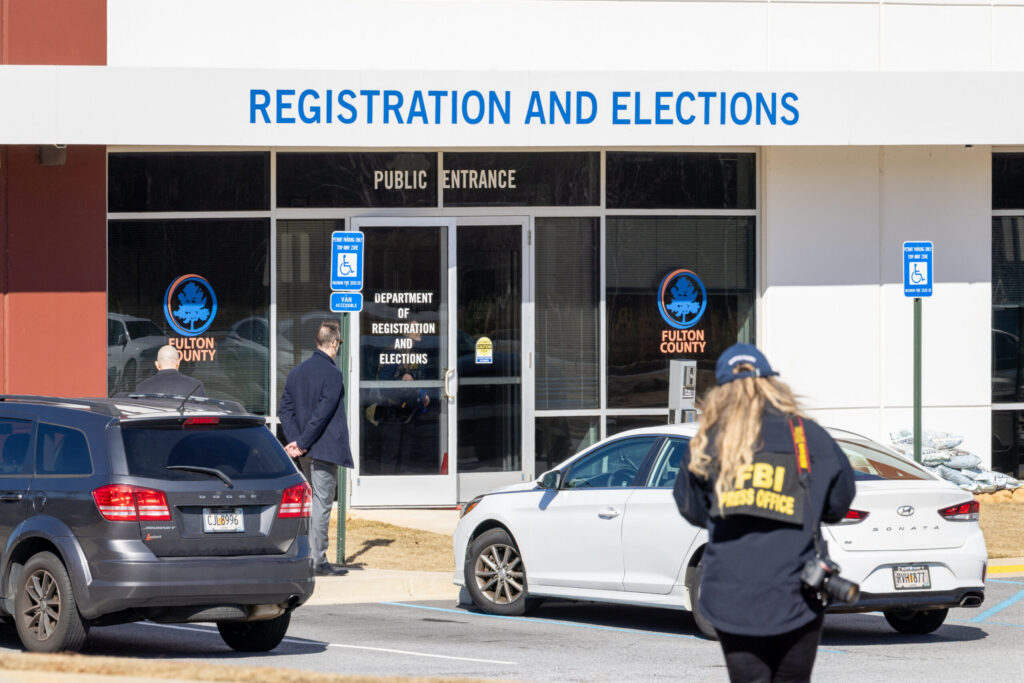
Four takeaways from Georgia, DC, Alabama, and Oklahoma primary elections
Rena Rowe, Washington Examiner
rena.rowe.washington.examiner@gazetteedit.wpenginepowered.com
Updated 22 hours ago
Voters across the country delivered a mixed verdict in a series of high-profile primary contests Tuesday, elevating political outsiders, boosting progressive candidates in deep-blue jurisdictions, and offering fresh clues about President Donald Trump’s hold on the GOP ahead of the...
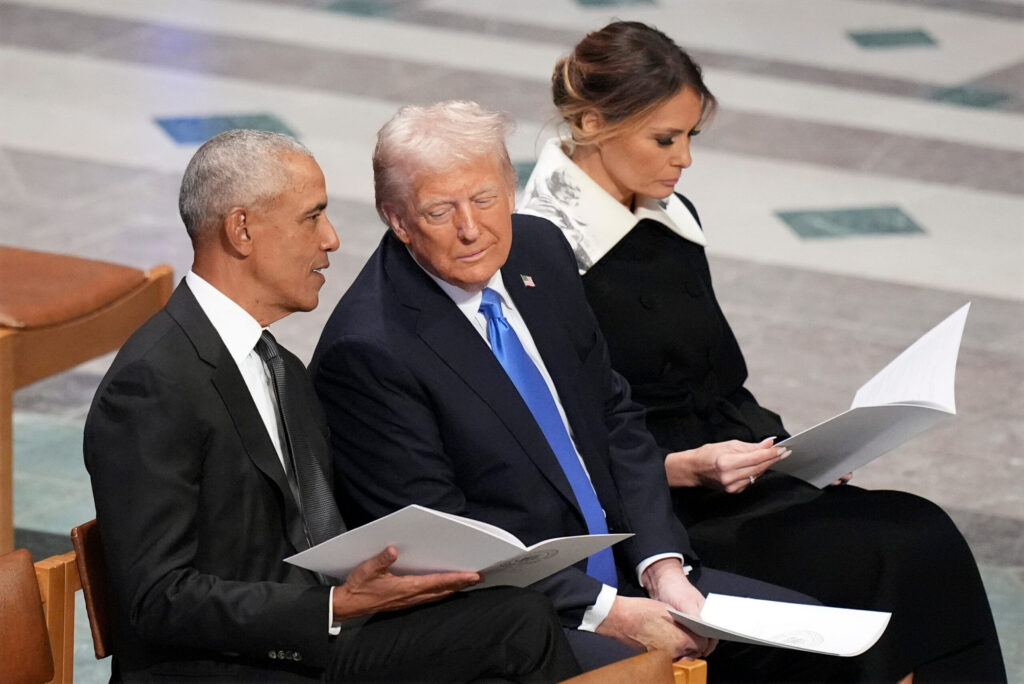
Trump and Obama lock horns as White House tries to sell new Iran deal
NAOMI LIM Washington Examiner
naomi-lim-washington-examiner@coloradopolitics.com
Updated 22 hours ago
Former President Barack Obama‘s reemergence is looming over President Donald Trump‘s peace deal with Iran as the incumbent tries to sell his deal to an increasingly skeptical public after the nearly four-month war. Obama’s return to the headlines as he...
PREV
PREVIOUS
RMGO heckles Owens on guns, DeGette dodges primary opponent
Fifteen Years Ago this week in The Colorado Statesman … Republicans should have had a routine state assembly and convention — there were no major statewide races splitting delegates, George W. Bush had sewn up the presidential nomination, and the GOP was safely in control of the congressional delegation and Legislature — but tensions were […]
Half the information doesn’t help voters
If you only knew how much your new car was going to cost, but not what kind of car or the quality of the car, would you go ahead and make the purchase? Most people would not consider that kind of transaction. That’s exactly what supporters of HB 15-1057 that would require a “fiscal note” […]