

Colorado county commissioners exchange insights at Keystone
Colorado Counties, Inc., better known as CCI, the lobbying organization that works on behalf of county interests, held its annual summer workshops at the Keystone Conference Center last week. While several sessions were so technical as to frighten away all but those who already had a handle on the issues under discussion — try “Measuring Culvert Pipe Durability Based on Environmental Conditions” for example — there were also more accessible venues where economic development, marijuana enforcement, regionally shared services and workforce development received a hearing.
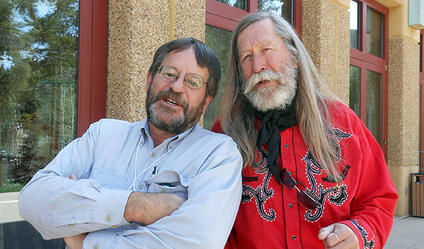
Garfield County repealed term limits shortly after they were adopted and Commissioner John Martin, who is now finishing his fifth term — a cobbler and Old West re-enactor from Glenwood Springs and chairs CCI’s Public Lands Sub-committee, kept appearing on panels because of his expertise. The respect he receives also offers up a kind of counter-argument to term limits. Tuesday morning Martin appeared in his neon red “…I’ll keep your eyes open first thing in the morning” cowboy shirt. He’s planning a sixth campaign next year.
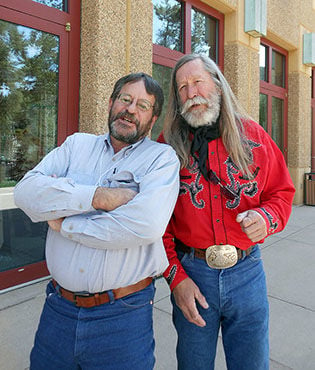
Commissioner Tom Hayden of Clear Creek County and Colorado’s senior incumbent John Martin of Garfield County, who is completing his fifth term.Photo by Miller Hudson/The Colorado Statesman

My drive up I-70 was interrupted one morning by a white, Dodge Ram pick-up traveling at least 85 miles an hour that whizzed by me with a magnetic sign on its door that proclaimed, “Mountain Corridor Constructors” and sporting New Mexico license plates. I’m pleased that the construction of the eastbound “hard shoulder” toll lane from Empire Junction to the new Veterans Tunnels in Idaho Springs is underway, but wouldn’t it be better if the vehicles flouting the law carried Colorado workers? Just asking. If you are planning any mountain excursions later this summer, be forewarned, the toll lane project has created a half dozen “pinch points” where traffic is being merged into a single lane. Sunday afternoon returns this summer are likely to prove more horrid than ever. But, of course, this inconvenience will be in the service of a better traveling experience for those who can afford the promised Lexus lane. Happier now?
My apologies, I digress. You tend to forget how much of Colorado remains rural until you see the number of cowboy hats worn in a roomful of county commissioners. Neil Westergaard, editor of the Denver Business Journal, launched the economic development discussion with a brief history lesson that commenced with voter rejection of the 1976 Winter Olympics. “We sent out a message that we were not really open for business,” Westergaard mused, “and the message was heard, loud and clear.” For nearly 20 years this ‘Not Welcome’ sign turned away both developers and businesses. And Coloradans were, for the most part, OK with the idea that, “… you can visit, but please don’t think about staying.” It was only with the more or less simultaneous decisions to build DIA, expand the Convention Center and the construction of Coors Field to attract major league baseball, largely coordinated by Roy Romer and a Republican legislature, that Colorado began to receive a second look. While most of this stimulus occurred along the Front Range, there were spillover benefits statewide. Westergaard emphasized this momentum can only be maintained with critical transportation investments, and that, while the Denver metropolitan region has benefited from FasTracks, TABOR restrictions have stymied highway improvements for pretty much everyone else. The business community recognizes this problem, but has offered few solutions.
Commissioner Mike Brazell of Park County pointed out that pressure for local economic development led his county to attract several rock festivals and special events, but that, despite record sales by local businesses, residents weren’t sure they were happy with another influx from “those kind of people.” They’ve cancelled repeat events in favor of developing accessible high speed broadband as an alternative generator of economic activity. Its success remains unproven, but one thing Commissioners learned is that many residents moved into remote mountain communities in hopes of remaining isolated and “left alone.”
The impacts from retail marijuana legalization generated an interesting response. Virtually every county reports they have had few problems with properly licensed facilities, whether grow operations or retail outlets — fewer problems than were expected. It is the “gray market” grow operations, ostensibly serving caregivers and their patients, that have proven difficult to manage. With the passage of SB14 during the past session, it is hoped this problem can be better managed. Ron Kamerzell, state enforcement director, reported that only 247 of a suspected 3,000 statewide caregivers had registered previously. Consequently, law enforcement has no way of determining whether a “grow” facility is legitimate — no matter how much its presence may annoy neighbors. It appears there will continue to be “growing pains,” but that this facet of the industry is on the road to cleaning itself up. More interesting is the gold rush for revenues. The Legislature failed to clear up local sales tax authority, but it did extend excise tax authority to counties — where CCI bragged it had skillfully outmaneuvered the Municipal League.
The session titled “How Do We Pay for That?” provided a tutorial on gimmicks that permit local governments to legally evade TABOR spending provisions. These centered primarily on Certificates of Participation, where local governments enter into lease/purchase agreements with private vendors or specially created TABOR enterprises, which actually borrow the dollars and then build facilities. There are also opportunities for issuing Special Assessment Bonds, backed by liens on property within an improvement district, but these require voter approval. However you slice it, whether it’s a water treatment plant or a jail, these “end around” devices drive up total costs.
Nonetheless, there are lawyers waiting and ready to assist in achieving such results. With Colorado’s economy improving, most Commissioners were open to considering alternatives. There was even discussion of forming inter-governmental agreements to streamline the regional provision of social services. Why have 64 different sets of rules when we could trim that number down to just 15 or 20? The sky was blue and the breeze was warm as commissioners left for home. Spirits were good even if the session on “Making the Business Case for Pavement Preservation” may have sounded like it might require more effort than it was worth. Better to arrive home and patch the potholes.
— Miller Hudson is a public affairs consultant. He can be reached at mnhwriter@msn.com.

Rep. Jeff Crank thinks Democrats are too focused on Trump, not enough on Colorado Springs
Vince Bzdek
vince.bzdek@gazette.com
Updated 56 minutes ago
By Vince Bzdek For Congressman Jeff Crank, who’s unopposed in the Republican primary for the 5th Congressional District but the main target of both candidates in the lively Democratic primary, the big question in the midterms is not who will...

Colorado Politics Calendar June 22-28
Rachael Wright, Special to Colorado Politics
rachael.wright@coloradopolitics.com
Updated 3 days ago
CoPo’s weekly political calendar will help you find political and public-policy events throughout Colorado. It includes candidate and issue campaign events, public policy meetings, court hearings, state and local party conventions, assemblies, debates, rallies, parades, speaking engagements, traveling dignitary appearances,...
Vice president attends Denver event to support energy freedom; more news from the past | A LOOK BACK
Rachael Wright, Special to Colorado Politics
rachael.wright@coloradopolitics.com
Updated 3 days ago
Forty-Five Years Ago This Week: Vice President George H.W. Bush flew to Denver to address the annual meeting of the American Association of Petroleum Landmen, where he assured the audience that the Reagan administration’s strong belief was that the private...
Does character matter anymore? | SONDERMANN
By Eric Sondermann
by-eric-sondermann@coloradopolitics.com
Updated 3 days ago
The last few weeks have been illuminating in the manner of a headlamp pointing the way to some deep, dark, murky netherworld. Graham Platner, a hero to the populist set on the Democratic side, became his party’s Senate nominee in...
A special edition of Capitol M: In remembrance of the outrageous Lynn Bartels
Marianne Goodland
marianne.goodland@coloradopolitics.com
Updated 18 hours ago
I had Lynn Bartels envy. For almost longer than I can remember. There, I said it. And it’s true. Lynn died Friday, age 69, after a short battle with glioblastoma. I was just heartsick when that news of her diagnosis...

Bernie Sanders endorses DeGette challenger Melat Kiros in Colorado’s 1st CD Democratic primary
Ernest Luning
ernest.luning@coloradopolitics.com
Updated 19 hours ago
U.S. Sen. Bernie Sanders on Friday endorsed congressional candidate Melat Kiros, one of two Democrats challenging 15-term U.S. Rep. Diana DeGette in Colorado’s June primary. Sanders, a Vermont independent who caucuses with the Democrats, called the 29-year-old Kiros “exactly the...
Trump’s 10th Circuit nominee recuses from cases against federal government without explanation
Michael Karlik
michael.karlik@coloradopolitics.com
Updated 20 hours ago
President Donald Trump’s nominee to fill a vacancy on the Denver-based federal appeals court recused himself without a clear explanation from nine cases against the executive branch while he was undergoing vetting by the White House this spring. U.S. District...

Trump’s low approval unchanged as Iran war perceptions continue to plague him
Rena Rowe, Washington Examiner
rena.rowe.washington.examiner@gazetteedit.wpenginepowered.com
Updated 19 hours ago
A new poll shows most Americans disapprove of President Donald Trump’s handling of Iran, with views on the issue closely mirroring his overall job approval rating. Just 37% of U.S. adults approve of the way Trump is handling his presidency,...

Colorado Iranians express disappointment with U.S.-Iran deal
Mark Samuelson Special to The Denver Gazette
mark.samuelson@denvergazette.com
Updated 18 hours ago
Iranians in Colorado worry agreement solidifies the Islamic regime’s power A group of Colorado Iranians expressed disappointment in the agreement reached between the U.S. and the Islamic Republic of Iran, arguing it preserves the government’s hold on power and any...
Adams County murder conviction reversed due to faulty jury instruction
Michael Karlik
michael.karlik@coloradopolitics.com
Updated 24 hours ago
Colorado’s second-highest court overturned an Adams County defendant’s murder conviction last month because the instruction provided to the jury about a trespasser’s right to use self-defense did not accurately reflect Colorado law. A person is justified in using force to...
PREV
PREVIOUS

Kindergarteners create buzz about declining bee population
Patrons at Fluid Coffee House in Denver’s Uptown neighborhood were greeted on Tuesday by smiling little faces asking them to save the bees. Kindergarteners from Downtown Denver Expeditionary School have begun a campaign to save the honeybees after spending the school year learning about insects. Teacher Jillian Williams said the kindergarten program at the charter […]
RMGO heckles Owens on guns, DeGette dodges primary opponent
Fifteen Years Ago this week in The Colorado Statesman … Republicans should have had a routine state assembly and convention — there were no major statewide races splitting delegates, George W. Bush had sewn up the presidential nomination, and the GOP was safely in control of the congressional delegation and Legislature — but tensions were […]